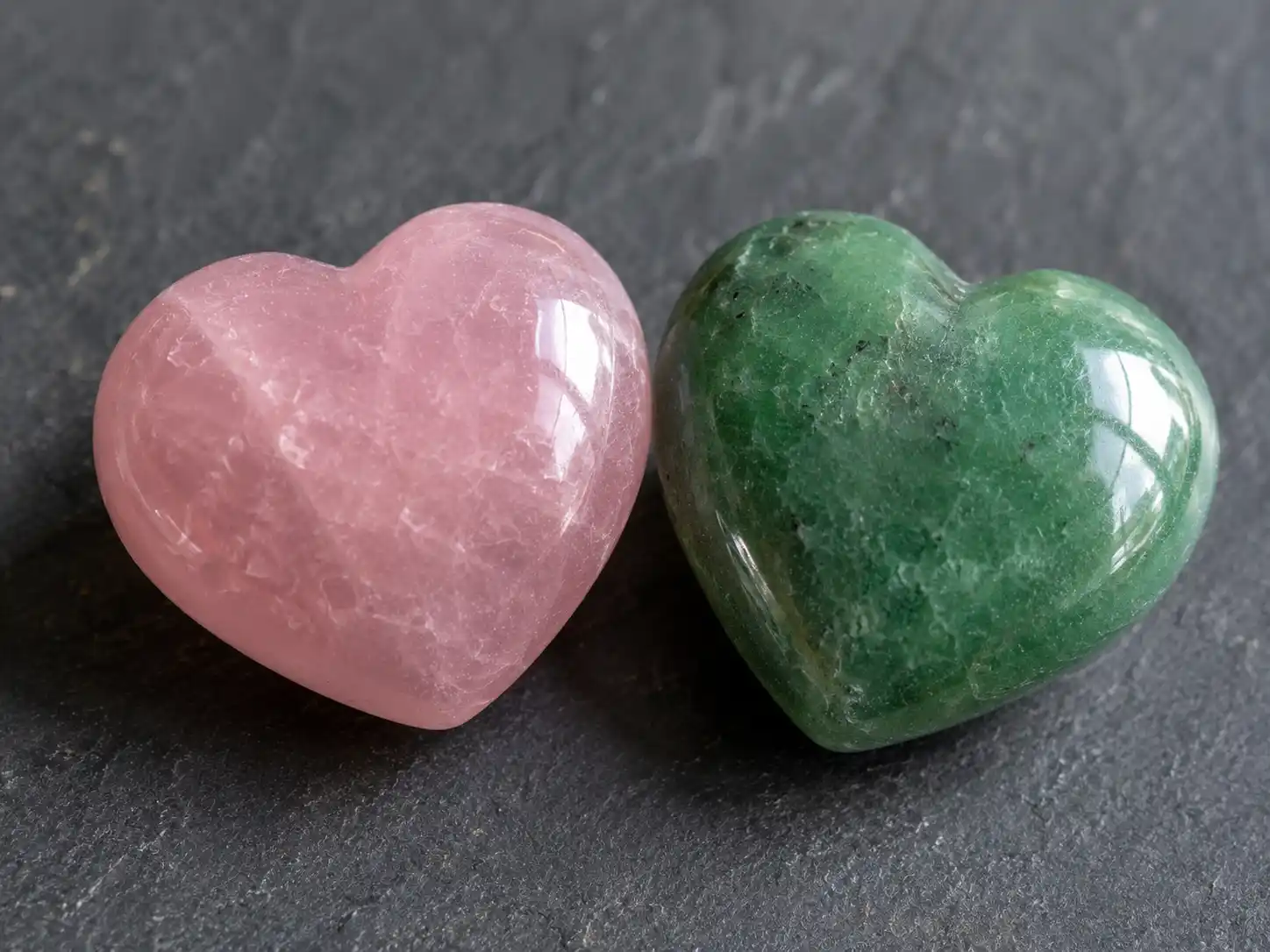
Best Crystals for Love and Romance: Top Relationship Stones
Crystals for love are traditionally associated with affection, emotional openness, trust and romantic connection. They cannot make a particular person develop feelings, guarantee compatibility or repair a relationship without mutual effort, but they may serve as meaningful reminders of the behaviors that support healthy intimacy.
Rose quartz is the most versatile love stone, while rhodonite suits accountability and repair. Rhodochrosite encourages emotional honesty, morganite symbolizes mature affection and garnet represents commitment and sustained passion.
Best Crystals for Love at a Glance
| Crystal | Traditional love association | Best suited to | Relationship practice |
|---|---|---|---|
| Rose quartz | Compassion, affection and emotional gentleness | General love and relational warmth | Express care without abandoning personal needs |
| Rhodonite | Repair, accountability and forgiveness | Conflict and rebuilding trust | Identify what can realistically be repaired |
| Rhodochrosite | Emotional honesty and tenderness | Recognizing needs and vulnerabilities | Name the feeling beneath the reaction |
| Morganite | Mature affection and emotional openness | Long-term romantic connection | Balance tenderness with clear standards |
| Kunzite | Receptivity and heartfelt expression | Allowing care to be received | Communicate appreciation directly |
| Moonstone | Emotional cycles and transition | Changing relationships | Observe patterns before making conclusions |
| Lapis lazuli | Honesty and thoughtful communication | Trust and difficult discussions | State the truth with consideration |
| Almandine garnet | Commitment, vitality and devotion | Sustaining an established bond | Follow affection with reliable action |
| Green aventurine | Openness and new possibilities | Meeting people and beginning relationships | Participate without forcing an outcome |
| Clear quartz | Intention and clarity | Defining relationship values | Choose one observable relationship intention |
What Love Crystals Can and Cannot Do
A crystal cannot override consent, create attraction or guarantee that two people will remain together. Claims that a stone can bind a person, summon a specific partner or prevent infidelity should not be treated as reliable or ethical.
A meaningful crystal can instead support personal behavior. Rose quartz may remind someone to communicate affection, while lapis lazuli can symbolize telling an uncomfortable truth. Rhodonite may accompany an apology, and clear quartz can mark a clearly defined relationship standard.
In each case, the stone supports an intention belonging to the person using it. The other person remains free to choose their own response.
Rose Quartz for Compassionate Love
Rose quartz is the best-known crystal for love. Its pale pink color and longstanding association with affection have made it a common symbol of romantic, platonic and self-directed care.
Within romance, rose quartz is most constructive when it represents compassion with boundaries. Kindness does not require agreeing to every request or overlooking behavior that repeatedly causes harm.
Use rose quartz while identifying one action that communicates care. That action may involve listening without distraction, expressing appreciation or asking what form of support would be useful.
The stone can also prompt a fairness check: is the same gentleness being extended to both people, or is one person expected to carry the complete emotional workload?
Rhodonite for Repair After Conflict
Rhodonite is traditionally associated with accountability, repair and forgiveness. It is particularly useful when a relationship has been affected by a specific mistake or repeated pattern.
Begin by stating what happened without minimizing or exaggerating it. Then identify responsibility, impact and the behavior that must change.
A sincere apology does not demand immediate forgiveness. Likewise, acceptance of an apology does not require trust to return before reliable change has been demonstrated.
The completed guide to crystals for forgiveness examines resentment and reconciliation more fully. Within romantic love, rhodonite remains focused on responsible repair between partners.
Rhodochrosite for Emotional Honesty
Rhodochrosite carries modern crystal associations with tenderness, emotional awareness and recognition of personal needs.
It may suit relationships in which indirect reactions have replaced clear communication. Anger might be covering disappointment, while withdrawal may reflect fear of rejection or conflict.
Use rhodochrosite while completing three statements:
“What I feel is…”
“What contributed to it was…”
“What I am asking for is…”
Emotional honesty does not require sharing every thought immediately. It means understanding the response well enough to communicate constructively when the time is appropriate.
Morganite for Mature Affection
Morganite is a pink-to-peach variety of beryl traditionally associated with compassion, emotional openness and enduring affection.
Its symbolism suits long-term relationships because mature love involves both tenderness and realistic knowledge of another person. It does not depend on constant idealization.
Use morganite while reflecting on how affection is expressed through ordinary reliability. Keeping agreements, sharing responsibilities and discussing difficult subjects may communicate love more clearly than occasional dramatic gestures.
Morganite jewelry is relatively durable but still requires protection from impacts and harsh chemicals. Some material may be treated to improve or stabilize color.
Kunzite for Receiving Love
Kunzite is traditionally associated with emotional openness, receptivity and heartfelt expression. Its pale pink or lilac color gives it a gentle romantic appearance.
Some people find offering support easier than receiving it. Kunzite can symbolize allowing another person to contribute without interpreting every need as weakness.
Receiving love may involve accepting a compliment, asking for help or explaining what kind of support would actually feel useful.
Kunzite can fade after extended exposure to strong light, and it has cleavage that makes impact protection important. Jewelry should be stored away from bright windows and hard objects.
Moonstone for Relationship Transitions
Moonstone is traditionally associated with cycles, intuition and emotional change. It suits relationships moving through a new phase, such as becoming exclusive, living together, managing distance or adjusting to changing responsibilities.
Use moonstone while recording what has changed, what remains stable and which expectations need to be discussed.
A change in emotional intensity does not automatically mean that love has ended. Likewise, strong feelings do not guarantee that the relationship is compatible or safe.
Moonstone encourages observation before interpretation. Practical communication should follow when a recurring pattern becomes clear.
Lapis Lazuli for Trust and Honest Communication
Lapis lazuli carries traditional associations with truth, wisdom and articulate speech. It is particularly useful when love requires a difficult but necessary conversation.
Trust depends partly on knowing that relevant information will not be withheld merely to preserve temporary peace. However, honesty should still consider timing, dignity and purpose.
Before speaking, decide what the other person needs to understand and what outcome the conversation should support. Avoid using “honesty” as justification for cruelty or unnecessary criticism.
The completed guide to crystals for communication explores these skills across a wider range of relationships and settings.
Almandine Garnet for Commitment
Almandine garnet is traditionally connected with devotion, vitality and rooted commitment. Its deep red color gives it a classic romantic appearance.
Garnet suits established relationships in which affection needs to be supported by consistent behavior. Commitment may involve protecting shared time, following through on agreements and addressing problems before they become entrenched.
The stone should not symbolize remaining in every relationship at any cost. Loyalty loses its healthy meaning when it requires tolerating abuse, coercion or continual disregard.
Almandine garnet is generally durable, although inclusions and jewelry settings still affect resistance to damage.
Green Aventurine for New Romantic Possibilities
Green aventurine is traditionally associated with opportunity, growth and favorable new experiences. It may suit someone who wants to become more open to meeting potential partners.
Pair the stone with behavior that creates realistic social opportunities. Join a recurring activity, accept an appropriate invitation or use a dating platform with clear safety boundaries.
Openness does not mean treating every interaction as a sign of destiny. Compatibility develops through communication, values, behavior and time.
Green aventurine can symbolize curiosity without pressure. A conversation may be worthwhile even when it does not become a romantic relationship.
Clear Quartz for Defining Relationship Intentions
Clear quartz is commonly used for intention-setting. It works best when the desired relationship qualities are expressed through personal behavior rather than demands placed on another person.
Useful intentions include:
“I will communicate changes in my capacity.”
“I will ask questions instead of assuming motives.”
“I will not confuse attraction with compatibility.”
“I will maintain boundaries while getting to know someone.”
A vague request to “manifest true love” provides less guidance than a clearly defined relationship standard.
Choosing a Love Crystal by Relationship Need
| Relationship need | Suggested crystals | Grounded action |
|---|---|---|
| Meet potential partners | Green aventurine and rose quartz | Enter safe settings where connection can develop |
| Communicate affection | Rose quartz and kunzite | Express appreciation specifically |
| Discuss a difficult issue | Lapis lazuli and rhodochrosite | State the feeling, event and request |
| Repair after conflict | Rhodonite and rose quartz | Take responsibility and demonstrate change |
| Strengthen commitment | Almandine garnet and morganite | Follow through on shared responsibilities |
| Navigate transition | Moonstone and clear quartz | Discuss changing expectations |
| Rebuild trust | Rhodonite and lapis lazuli | Use honesty and consistent behavior |
| Maintain boundaries | Rose quartz and black tourmaline | Pair compassion with a clear limit |
Love, Romance and Friendship
Romantic relationships and friendships share qualities such as trust, affection and communication, but they are not interchangeable.
The completed guide to crystals for friendship focuses on platonic reciprocity, companionship and repairing friendship conflicts. This article keeps romantic intimacy, attraction and partnership expectations at the center.
A strong romantic relationship may also include friendship. Nevertheless, romance should not be treated as a superior form of connection or the only source of meaningful intimacy.
Love and Self-Respect
A love practice becomes unhealthy when it focuses entirely on becoming more acceptable to another person.
Rose quartz and rhodochrosite can symbolize self-compassion, while clear quartz may define non-negotiable values. Personal needs and limits remain relevant even when a connection feels emotionally important.
Self-respect includes the willingness to notice inconsistency, coercion or repeated disregard. A relationship should not require abandoning identity, finances, friendships or physical safety.
The completed guide to crystals for setting boundaries provides a broader framework for communicating limits.
Love and Emotional Healing
Past experiences can influence how someone interprets closeness, disagreement and uncertainty. However, a new partner should not be expected to complete another person’s emotional recovery.
The completed guide to crystals for emotional healing addresses self-compassion, emotional honesty and gradual integration.
Within romance, healing may involve recognizing triggers, communicating them responsibly and seeking appropriate support without assigning complete responsibility to a partner.
Attraction Versus Compatibility
Attraction can develop quickly, while compatibility becomes clearer through repeated behavior.
Consider values, communication style, availability, goals and responses to disagreement. Strong chemistry does not remove practical incompatibility.
Green aventurine may symbolize openness, while tiger’s eye can support discernment. Use both curiosity and evidence when evaluating a developing relationship.
Avoid interpreting coincidences, intense feelings or crystal experiences as proof that someone is a destined partner.
A Three-Crystal Love Set
A balanced relationship set can include one stone for affection, one for communication and one for discernment or repair.
Rose quartz, lapis lazuli and rhodonite form a versatile combination. Rose quartz represents compassion, lapis supports honesty and rhodonite addresses accountability.
For a new relationship, green aventurine, moonstone and clear quartz may be more suitable. Their roles involve openness, observation and defined standards.
Assign each stone a separate purpose rather than expecting the set to produce love automatically.
Giving a Love Crystal as a Gift
A crystal gift should reflect the recipient’s preferences and the stage of the relationship. Rose quartz offers broad affectionate symbolism, while garnet may communicate commitment in an established partnership.
Avoid presenting a gift as a binding object or proof that the relationship must follow a particular path. The recipient should remain free to interpret or use it differently.
Consider durability, treatments and jewelry style. A beautiful but fragile stone may not suit someone seeking an everyday ring or pocket piece.
Wearing Love Crystals
Rose quartz, garnet, morganite and lapis lazuli can all appear in jewelry, although their durability and care requirements differ.
A pendant may provide a visible reminder of a relationship intention. However, the stone should not become a test of loyalty or something a partner is pressured to wear.
Remove jewelry around machinery, sports equipment or tasks where it may catch. Metal allergies and coatings also deserve attention.
Placing Love Crystals at Home
Place relationship stones where communication or reflection occurs rather than expecting one bedroom location to transform a partnership.
Rose quartz may remain beside a shared gratitude journal, while lapis lazuli can sit near a space used for important discussions. Rhodonite may accompany private reflection after conflict.
Heavy or pointed stones require secure placement. Crystals should never obstruct walkways, fall from shelves or create hazards around children and pets.
Cleansing Love Crystals
Physical care depends on the material. Kunzite is light-sensitive, lapis lazuli should not be soaked and moonstone requires protection from impact.
Sound, visualization and careful dry placement provide low-contact symbolic options. A useful reset may also involve reviewing the intention attached to the stone.
No cleansing method can remove relationship problems. Communication and action remain necessary when an issue requires attention.
When Love Is Unsafe
Crystals cannot transform abuse, coercive control, stalking or violence into a healthy relationship. Romantic feelings and spiritual beliefs do not make harmful behavior acceptable.
Seek practical support when someone controls access to money, isolates you, threatens harm, ignores consent or creates fear.
Leaving may require confidential planning and professional assistance. Do not confront a dangerous person solely because a ritual produces a feeling of courage.
Conclusion
The best crystals for love represent the qualities that healthy romance requires. Rose quartz supports compassion, rhodochrosite encourages emotional honesty and lapis lazuli strengthens truthful communication. Rhodonite suits repair, while morganite and garnet represent mature affection and commitment.
No crystal can create mutual love or guarantee a lasting relationship. Its most meaningful role is to reinforce consent, self-respect, communication and consistent behavior.
Frequently Asked Questions
1. What is the best overall crystal for love?
Rose quartz is the most versatile choice because it symbolizes affection, compassion and emotional gentleness. Rhodonite may be more suitable when repair is the main concern.
2. Can crystals make a specific person fall in love?
No. Crystals cannot control another person’s feelings, consent or choices. Practices aimed at overriding someone’s autonomy are neither reliable nor ethical.
3. Which crystal is suitable for attracting new love?
Green aventurine and rose quartz are popular symbolic choices. They should be paired with safe opportunities to meet people and realistic evaluation of compatibility.
4. Which stone supports an existing relationship?
Morganite and almandine garnet symbolize mature affection and commitment. Lapis lazuli can support honest communication.
5. Which crystal helps after a relationship conflict?
Rhodonite is traditionally associated with accountability and repair. Rose quartz may support compassion, while lapis lazuli suits a truthful conversation.
6. Are love crystals the same as self-love crystals?
The categories overlap, but romantic love focuses on mutual relationships. Self-love practices center on self-compassion, identity and personal care.
7. Can I combine several love crystals?
Yes. Two or three stones with distinct purposes are sufficient, such as rose quartz for compassion, lapis lazuli for honesty and rhodonite for repair.
8. Where should love crystals be placed?
Place them near a relationship journal, communication space or another location connected with the intended behavior. Ensure that all specimens remain physically secure.
9. Can I give rose quartz to a romantic partner?
Yes, when the recipient likes crystals and understands the symbolism as affection rather than an obligation or binding promise.
10. Can love crystals repair trust after betrayal?
No crystal can restore trust. Trust returns, when appropriate, through honesty, accountability, time and consistent changed behavior.
11. Do love crystals need to be cleansed?
There is no scientific requirement. Someone following a spiritual practice may perform a gentle symbolic reset using a method safe for the material.
12. Can crystals help an unsafe relationship become healthy?
No. Crystals cannot stop abuse, coercion or violence. Safety planning and qualified support take priority over relationship rituals.
Disclaimer: Crystals cannot create attraction, override consent, guarantee compatibility or repair a relationship without mutual effort. They should never be used to justify coercion, stalking, abuse or remaining in danger. Seek qualified support when a relationship is unsafe or severely distressing.