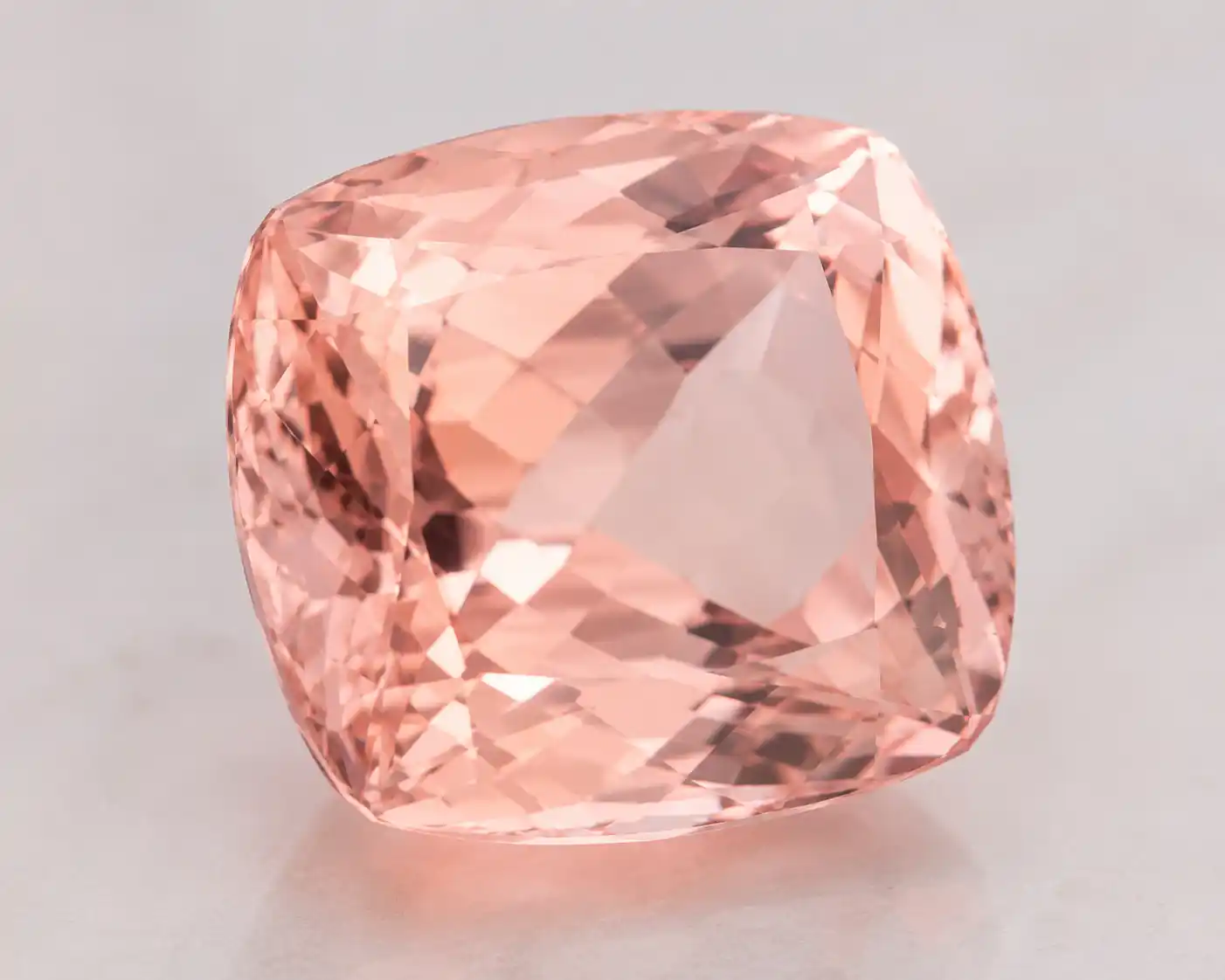
Morganite: Meaning, Healing Properties & Uses
Morganite is the pink-to-orange-pink variety of beryl, a mineral family that also includes blue Aquamarine, green Emerald, yellow Heliodor and colorless Goshenite. It commonly appears pale blush, peach, salmon, orangy pink or purplish pink, with stronger saturated color being comparatively uncommon.
Its color comes primarily from manganese within the beryl structure. Because Morganite is pleochroic, a crystal can display pale pink in one direction and a deeper bluish or purplish pink in another. Skilled cutting orientation is therefore important to preserve the best face-up color.
Modern crystal traditions associate Morganite with love, compassion, emotional recovery, trust and the heart chakra. These meanings are symbolic rather than scientifically established healing effects.
Gemologically, Morganite is valued for transparency, large available sizes and good jewelry hardness. It frequently forms in granite pegmatites, where slow crystallization and volatile-rich fluids can produce large, clean beryl crystals.
Morganite at a Glance
| Property | Morganite |
|---|---|
| Mineral family | Beryl |
| Chemical formula | Be₃Al₂Si₆O₁₈ |
| Crystal system | Hexagonal |
| Typical colors | Pink, peach, salmon, orangy pink and purplish pink |
| Main color cause | Manganese |
| Pleochroism | Pale pink to deeper bluish or purplish pink |
| Transparency | Transparent to translucent |
| Luster | Vitreous |
| Refractive index | Approximately 1.583–1.590 |
| Birefringence | Approximately 0.007–0.008 |
| Specific gravity | Approximately 2.80–2.91 |
| Mohs hardness | 7.5–8 |
| Common geological setting | Granite pegmatites |
| Common treatment | Heat to remove yellow or orange components |
| Typical uses | Faceted gems, cabochons, carvings and jewelry |
| Main care concern | Scratching, hard impact, fractures and heat during repair |
What Is Morganite?
Morganite is a color variety of Beryl.
Chemically pure beryl is colorless. Trace elements and structural effects create the family’s different colors.
Aquamarine receives blue-to-greenish-blue color primarily from iron. Emerald is colored by chromium, vanadium or both. Morganite receives its pink-to-orange-pink color mainly from manganese.
These names represent varieties within one mineral species. Morganite is not a type of Quartz, Tourmaline, Sapphire or Spodumene.
The misleading phrase pink Emerald occasionally appears in marketing. Although Morganite and Emerald share the beryl structure, they are separate varieties with different color causes, treatment patterns and market expectations.
How Morganite Forms
Morganite forms mainly in evolved granite pegmatites.
Pegmatites develop from volatile-rich residual melts left after much of a granitic magma has crystallized. Water, fluorine, boron and other components reduce viscosity and allow ions to move efficiently.
Under suitable conditions, very large crystals of Quartz, Feldspar, Mica, Beryl, Tourmaline and other minerals can grow.
Manganese must become available and enter the beryl structure for pink Morganite to form.
The same pegmatite may contain Aquamarine, colorless Beryl or Morganite in different zones. Changes in chemistry during growth can also produce color zoning within one crystal.
Large crystal size does not guarantee gem quality. Fractures, cloudiness and weak color can occur even in impressive mineral specimens.
Morganite Composition and Crystal Structure
Morganite has the beryl formula Be₃Al₂Si₆O₁₈.
Beryl’s structure contains rings of silica tetrahedra arranged around channels that run parallel to the crystal’s length. Water, alkalis and other components may occupy those channels.
Manganese substitutes within the structure and contributes to pink and orange-pink color.
Morganite crystallizes in the hexagonal system and commonly forms six-sided prisms. Compared with some Aquamarine crystals, Morganite may develop relatively flat or tabular forms.
The material has no one metaphysical component distinct from its chemistry. Its symbolism arose from color, rarity, cultural interpretation and modern crystal practice.
Why Morganite Is Pink
Manganese is the principal coloring element.
Different oxidation states and structural environments can influence whether the gem appears pale pink, peach, salmon, purplish pink or orangy pink.
Untreated material commonly contains a noticeable yellow or orange component. Heating can reduce that component and leave a purer pink.
Strong color is uncommon. Many Morganites appear pastel, especially in small stones.
Larger cut gems often show more apparent saturation because light travels through a greater volume of material.
Color should always be assessed under several lighting conditions. Warm lamps and rose-gold reflections can strengthen pink, while daylight may reveal peach, gray or yellow components.
Morganite Pleochroism
Pleochroism means a gemstone displays different colors or color strengths along different crystallographic directions.
Morganite may show pale pink in one direction and a deeper bluish or purplish pink in another.
A cutter studies the rough and chooses an orientation that retains the strongest or most attractive face-up color.
Poor orientation may leave a large gemstone washed out from above even when stronger color appears through the side.
Pleochroism can support gemological understanding but is not a simple authenticity test. Other transparent pink gems also show directional color effects.
Morganite Color Varieties
Morganite does not have a universally standardized system of named varieties.
Commercial descriptions include blush, peach, salmon, rose, champagne pink and purplish pink. These terms communicate visual style but do not represent separate mineral species or regulated grades.
Pure or stronger pink generally attracts high demand. Peach material may retain more of its original orange component and can be especially attractive in yellow or rose gold.
Purplish-pink Morganite can look cooler and may coordinate well with white metal.
A brownish or grayish modifier usually reduces brightness, although an individual stone can still be appealing.
The Pink Gemstones guide places Morganite among other pink jewelry materials.
Morganite Clarity and Inclusions
Faceted Morganite is generally expected to look clean to the unaided eye.
The gem can contain liquid inclusions, gas bubbles within liquid, crystal inclusions, tubes, veils and fractures.
Large stones may reveal internal features more readily because there is more volume to inspect.
Some included material is fashioned as cabochons or carvings rather than faceted gems. Rare cabochons may show a cat’s-eye or star effect when oriented inclusions reflect light coherently.
A small inclusion away from the girdle may have limited durability impact. Surface-reaching fractures near prongs or pointed ends deserve greater concern.
The absence of visible inclusions does not prove natural origin because laboratory-grown material and glass can also appear clean.
Morganite Hardness and Durability
Morganite ranks 7.5–8 on the Mohs scale.
This makes it durable enough for rings, earrings, necklaces and bracelets when handled appropriately.
The Gemstone Hardness Chart provides comparison with other stones.
Morganite can still be scratched by Sapphire, Ruby, Moissanite and Diamond. Hard metal edges and abrasive dust may also dull the polish over time.
The Gemstone Toughness vs Hardness guide explains why hard blows, fracture placement and setting design remain relevant.
Earrings and pendants provide safer wear than exposed rings or bracelets.
Important Morganite Sources
Brazil, particularly Minas Gerais, is a major commercial Morganite source.
Madagascar produced the early twentieth-century material that helped establish the gem’s name and reputation.
Afghanistan, Pakistan, Mozambique, Namibia and the United States have also produced Morganite, though supply may be less consistent.
California’s pegmatite districts produced historically important American material.
Source can add collector interest, but country alone does not determine quality. Fine and commercial-grade stones occur within the same region.
A seller should not assign precise origin from color alone. Reliable locality claims require provenance or suitable laboratory evidence.
The Origin of the Name Morganite
Pink beryl became known under the name Morganite in the early twentieth century.
After notable rose-colored beryl was found in Madagascar, gemologist and mineralogist George F. Kunz proposed the name in 1910 to honor financier and gem collector J. P. Morgan.
The naming reflects the relationship between early gemological scholarship, private collecting and institutional mineral collections.
Morganite is therefore a relatively modern gemstone name, even though pink beryl crystals formed geologically long before people recognized them as a separate trade variety.
The historical name should not be confused with a mine, brand or proprietary treatment.
Morganite vs Kunzite
Kunzite is the pink-to-violet variety of spodumene.
Its color can overlap with Morganite, particularly in pale pink and purplish-pink stones.
The direct Kunzite vs Morganite guide owns the full distinction.
Kunzite has strong cleavage, lower hardness and greater risk of color fading through prolonged light or heat exposure.
Morganite belongs to beryl, has different refractive properties and generally provides better practical durability for frequently worn jewelry.
Morganite vs Rose Quartz
Rose Quartz is pink Quartz, commonly translucent, cloudy or massive.
Transparent faceted Rose Quartz exists but is much less typical than transparent faceted Morganite.
The direct Morganite vs Rose Quartz guide owns identification.
Morganite generally has stronger brilliance, higher refractive index and a more transparent appearance. Rose Quartz is usually less expensive and commonly used in beads, cabochons and carvings.
Color alone cannot provide reliable separation.
Morganite vs Pink Tourmaline
Pink Tourmaline ranges from pale blush to saturated pink and red.
Tourmaline can provide stronger color in smaller stones than Morganite and may show more noticeable color zoning.
Morganite is often lighter, cleaner and available in larger sizes.
The materials also differ in crystal system, optical properties and density.
Rubellite is a saturated pink-to-red Tourmaline trade category rather than a type of Morganite.
Professional testing is appropriate when a valuable transparent pink gemstone lacks reliable documentation.
Morganite vs Pink Sapphire
Pink Sapphire is corundum with Mohs hardness 9.
It offers stronger scratch resistance and can display vivid saturation in small stones. Fine Pink Sapphire may be significantly more expensive.
Morganite offers larger pastel stones at accessible prices.
The two can be separated through refractive index, density, optical character and professional testing.
A buyer should not assume that deeper pink always means Sapphire or that pale pink always means Morganite.
Morganite vs Pink Glass and Cubic Zirconia
Pink glass can imitate Morganite’s pale color and transparency.
Gas bubbles, flow structures, lower hardness and different optical properties may reveal the imitation.
Pink Cubic Zirconia can produce greater brilliance and spectral fire than Morganite while feeling heavier for the same dimensions.
A basic visual inspection may not be enough in mounted jewelry.
The complete authentication process belongs to Real vs Fake Morganite.
Destructive scratch and flame tests should be avoided.
Morganite Treatments
Heating is the most common Morganite treatment.
It generally removes yellow or orange components and creates a purer pink. The treated color is considered stable during ordinary wear.
The process may be difficult to detect conclusively, so laboratories cannot always determine whether a particular pink Morganite has been heated.
Rare fracture filling can improve apparent clarity. Filled stones require more conservative cleaning and repair.
The dedicated Treated Morganite guide owns treatment, laboratory-grown material and disclosure.
Treatment is not automatically unacceptable. It should be represented accurately and reflected in care instructions and value.
Laboratory-Grown Morganite
Laboratory-grown pink beryl can have essentially the same composition and crystal structure as natural Morganite.
Its origin is manufactured rather than geological.
Synthetic material should be described as laboratory-grown or laboratory-created Morganite, not simply Morganite in a context that implies mined origin.
Laboratory growth can produce clean material and strong color at lower cost.
Natural and laboratory-grown stones may require professional instrumentation to separate reliably.
A report can identify origin when the purchase value justifies testing.
Morganite Quality Factors
Color is the dominant factor.
Strong attractive pink generally receives more demand than very pale, grayish or brownish material. Peach color can still be desirable when the hue is clean and the design supports it.
Clarity should normally be eye-clean in faceted gems. Cut should distribute color and brilliance without a broad window or unnecessary depth.
Size can strengthen apparent color, but large Morganite is relatively available. Carat weight alone does not create rarity.
The complete purchase process belongs to the Morganite Buying Guide, while current cost belongs to the Morganite Price Guide.
Morganite Jewelry
A Morganite bracelet requires matched stones, flexible links and a secure clasp.
Morganite earrings offer protected wear and depend on accurate pair matching.
A Morganite engagement ring needs a durable setting and realistic daily-wear planning.
Future Morganite necklaces can support large stones safely, while Morganite rings cover broader non-bridal designs.
Rose gold strengthens the warm pink appearance. White metal creates contrast, while yellow gold emphasizes peach and salmon components.
Morganite Meaning and Symbolism
Modern traditions associate Morganite with love, compassion, tenderness, emotional honesty and trust.
Its pale pink color encourages comparison with Rose Quartz, while its transparency adds symbolism involving clear communication and seeing relationships without distortion.
Morganite is sometimes described as a stone of divine love or mature affection. Such phrases express spiritual or personal interpretation rather than a measurable property of beryl.
The stone can symbolize a relationship commitment, recovery from grief or a decision to communicate more openly.
Its meaning becomes most practical when attached to a behavior rather than an expectation that the gemstone will control another person.
Morganite Healing Properties
Crystal practitioners may claim that Morganite reduces stress, heals emotional trauma, supports the heart, balances hormones or improves relationships.
These effects have not been scientifically established.
A Morganite ritual may still help a person pause, journal or practice self-compassion. Any benefit is more plausibly connected with attention, expectation and the behavior paired with the stone.
Persistent anxiety, depression, grief, trauma symptoms or physical illness requires appropriate professional support.
Morganite should not replace therapy, medication, cardiac care or reproductive treatment.
The broader Healing Crystals guide explains the distinction between symbolic ritual and medical efficacy.
Morganite and Love
Morganite is frequently included among crystals for love.
A person might use the gemstone as a reminder to express appreciation, communicate directly or maintain respectful boundaries.
The stone cannot attract a specific person, guarantee loyalty or repair an unsafe relationship.
Healthy affection depends on consent, compatibility, honesty and accountable behavior.
Morganite’s symbolism is strongest when it represents how someone intends to participate in a relationship rather than what they expect the gemstone to make another person do.
Morganite and the Heart Chakra
Pink Morganite is commonly associated with the Heart Chakra.
Within that spiritual system, the heart center represents love, empathy, grief, trust and the balance between giving and receiving.
A practical reflection can ask whether compassion is being offered without abandoning personal safety or whether a boundary needs to be stated.
Chakras are spiritual concepts rather than measurable anatomical organs.
Morganite cannot treat heart disease, blood pressure, circulation problems or chest symptoms.
Morganite for New Beginnings
Morganite may be used symbolically after a breakup, during reconciliation or when entering a new relationship stage.
The Crystals for New Beginnings guide compares this use with other transition stones.
A grounded practice identifies what was learned, which pattern should not be repeated and what action supports the new direction.
The gem cannot erase grief or guarantee that a new relationship will succeed.
It can mark a decision to approach the next stage with greater honesty or self-respect.
Cleaning and Care
Follow How to Clean Morganite Jewelry Safely.
Use lukewarm water, mild dish soap and a soft brush. Clean behind faceted stones where oil and soap film reduce brilliance.
Warm soapy water is always the safest method.
Steam and ultrasonic cleaning may be suitable for some sound stones, but they should be avoided when liquid inclusions, fractures or filling are present.
Heat exposure during repair is not recommended.
Store Morganite separately from harder gems that may scratch it.
The Crystals That Start With M and Gemstones That Start With M directories provide the wider alphabetical context.
Frequently Asked Questions
1. What is Morganite?
Morganite is the pink-to-orange-pink variety of the mineral beryl.
2. What causes Morganite’s pink color?
Manganese within the beryl structure produces pink, peach, salmon and purplish-pink colors.
3. Is Morganite the same mineral as Emerald?
They are both beryl varieties, but Emerald is green and Morganite is pink-to-orange-pink.
4. Why is Morganite usually pale?
Strong color is uncommon, and the gemstone often needs a larger size to display saturated pink effectively.
5. Is Morganite usually heat-treated?
Yes. Heating commonly removes orange or yellow components and produces a purer pink.
6. Is heated Morganite still natural?
Yes. The stone remains natural beryl, although its color has been enhanced.
7. Is Morganite suitable for everyday jewelry?
Yes, with care. Its hardness is 7.5–8, but harder gemstones and severe impacts can still damage it.
8. Where is Morganite found?
Major and notable sources include Brazil, Madagascar, Afghanistan, Pakistan, Mozambique, Namibia and the United States.
9. Is Morganite the same as Rose Quartz?
No. Morganite is beryl and is commonly transparent; Rose Quartz is quartz and is usually cloudy or translucent.
10. Can Morganite be laboratory-grown?
Yes. Laboratory-grown pink beryl exists and must be disclosed as manufactured.
11. Does Morganite have proven healing properties?
No. Love, emotional-healing and chakra claims are spiritual traditions rather than established medical effects.
12. How should Morganite be cleaned?
Use lukewarm water, mild soap and a soft brush. Avoid uncontrolled heat and use extra caution when fractures or filling are present.
Morganite’s appeal comes from a geological contrast: volatile-rich pegmatites can grow large, transparent crystals, yet manganese colors them in exceptionally soft pastel shades. Modern symbolism connects that pink with love and compassion, while gemology explains the pleochroism, treatment and cutting choices that make the color wearable.
Morganite healing, love-attraction, chakra and emotional claims are cultural or spiritual traditions rather than scientifically established effects. Do not use the gemstone to replace medical care, therapy, medication or relationship-safety decisions.