Rose Quartz Meaning, Healing Properties, Uses and Care
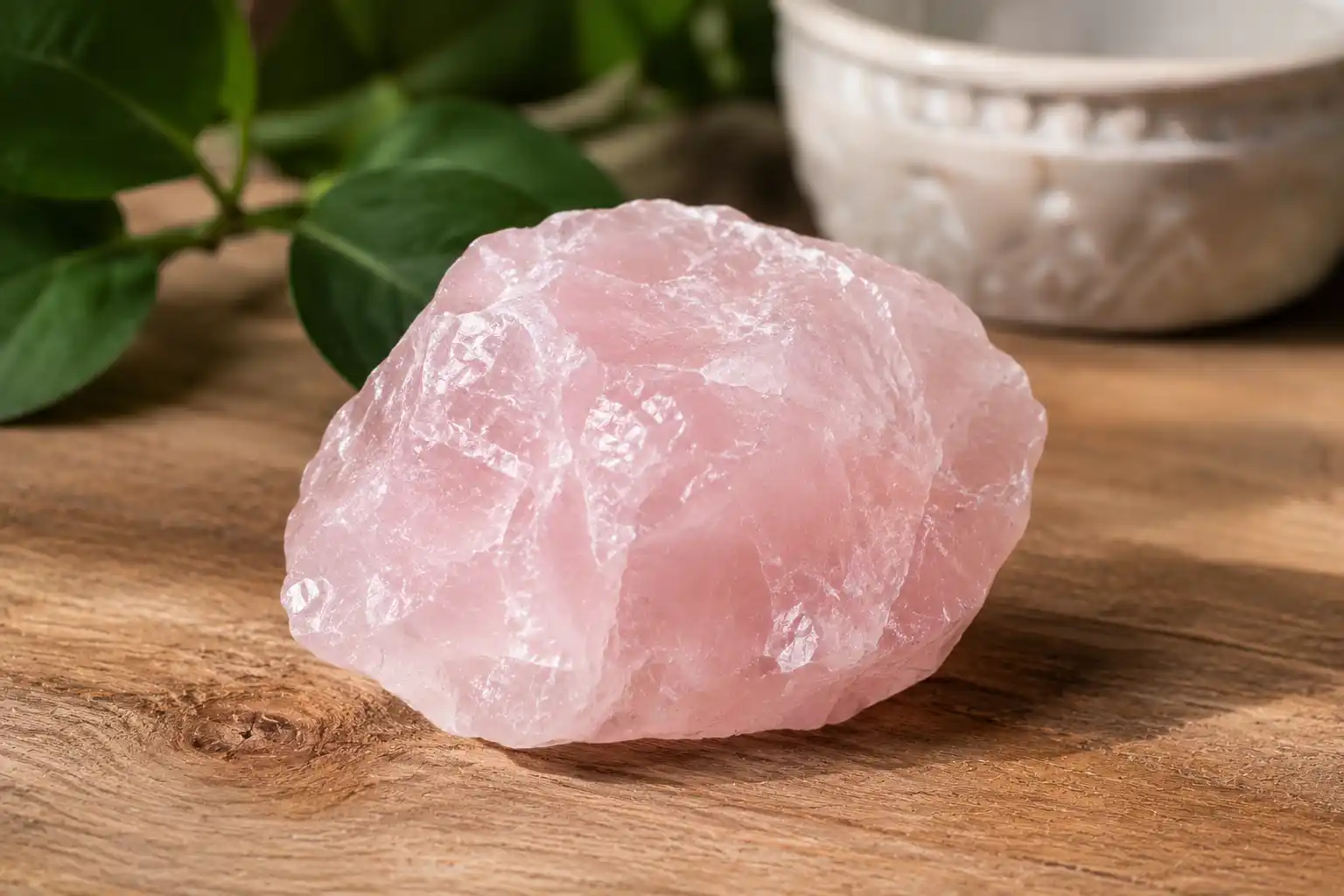
Rose quartz is the familiar pale-pink to medium-pink variety of quartz. Most material occurs as translucent massive stone with a cloudy internal appearance created by microscopic inclusions, although rare transparent crystalline pink quartz also exists.
The gemstone has become one of the most recognized symbols of affection, compassion, emotional gentleness and self-kindness in modern crystal practice. Its soft color has also supported a long history of carving, personal adornment and decorative use.
These meanings belong to cultural history, contemporary spirituality and personal ritual. Rose quartz does not treat heart disease, trauma, infertility, hormonal conditions, depression or any other medical problem. It can function as a meaningful object without being presented as healthcare.
Rose Quartz at a Glance
| Property | Rose quartz |
|---|---|
| Mineral family | Quartz |
| Composition | Silicon dioxide, SiO₂ |
| Typical colors | Nearly colorless pink, blush, pale pink, rose pink, lavender-pink and occasional stronger pink |
| Usual form | Massive, translucent quartz rather than well-formed crystals |
| Rare related form | Transparent euhedral crystalline pink quartz |
| Crystal system | Trigonal |
| Luster | Vitreous |
| Transparency | Commonly translucent; occasionally transparent or opaque |
| Mohs hardness | 7 |
| Cleavage | None |
| Fracture | Conchoidal |
| Specific gravity | Approximately 2.65 |
| Refractive index | Approximately 1.544–1.553 |
| Common optical effect | Six-rayed asterism in suitably included and oriented material |
| Common uses | Beads, cabochons, carvings, spheres, palm stones and faceted gems |
| Common treatment | Occasional irradiation; dye, coating and synthetic imitations also occur |
| Traditional themes | Affection, compassion, emotional care, forgiveness and self-kindness |
What Is Rose Quartz?
Rose quartz belongs to the wider quartz family described in Quartz: Types, Properties & Meaning.
Quartz is silicon dioxide. It forms in igneous, metamorphic and hydrothermal geological environments and is one of Earth’s most widespread mineral materials.
Unlike clear quartz or amethyst, ordinary rose quartz rarely forms transparent crystals with complete natural faces. It typically occurs in massive cores and lenses within granitic pegmatites.
These masses can be large enough to produce beads, carvings, decorative objects and substantial cabochons.
The familiar material’s pink color and cloudiness are closely connected with microscopic fibrous inclusions aligned within the quartz.
Why Is Rose Quartz Pink?
Research links the color of ordinary massive rose quartz with microscopic aligned silicate fibers.
These inclusions are similar to, though not identical with, dumortierite. Their structure and distribution interact with light to create delicate pink coloration and characteristic haze.
The color is therefore not simply a surface stain.
Natural color ranges from extremely pale to medium pink. Strong saturation is often easier to see in larger pieces because a longer light path increases the visible color.
Iron, titanium and other elements may influence selected rose or pink quartz materials, but the ordinary massive variety should not be reduced to one simplistic trace-element explanation.
Artificial irradiation can also strengthen color in some material.
Massive Rose Quartz Versus Crystalline Pink Quartz
Ordinary rose quartz is generally massive, translucent and cloudy.
Rare crystalline pink quartz forms transparent or semitransparent crystals with recognizable quartz faces.
The two materials have different color mechanisms and can show different light stability.
Crystalline pink quartz may be marketed as pink quartz, euhedral rose quartz or crystalline rose quartz.
Because transparent crystals are rare, they may attract collector interest. Synthetic hydrothermal pink quartz also exists.
A transparent terminated pink crystal should not be authenticated merely because it has quartz-like form.
The completed real-versus-fake rose quartz guide owns the complete natural, synthetic, glass and dyed-material comparison.
How Rose Quartz Forms
Rose quartz commonly develops in granitic pegmatites.
Pegmatites form from late-stage, water-rich portions of cooling magma. Their chemical environment allows unusually large crystals of quartz, feldspar, mica, beryl, tourmaline and other minerals to grow.
Rose quartz frequently occupies massive pegmatite cores rather than forming individual terminated crystals.
The microscopic fibers responsible for familiar pink color appear to have separated within the host as the quartz cooled.
Weathering later releases chunks from the pegmatite. Streams can round the material into pebbles, while mining provides larger blocks for cutting and carving.
Important Rose Quartz Sources
Brazil is a major commercial source of rose quartz.
Madagascar is known for attractive material that may show strong translucence, star effects or relatively vivid color.
Other sources include South Africa, Namibia, Mozambique, India, Sri Lanka and the United States.
Locality alone does not establish quality. Every deposit produces a range of color, transparency, fracture content and workable sizes.
A seller should not infer Madagascar or Brazilian origin from appearance alone.
Provenance records provide stronger evidence than marketing color names.
Natural Color Range
Rose quartz can appear almost white with a pink tint.
More desirable material generally shows visible pink without excessive gray, brown or yellow.
Lavender-pink and cool-pink shades occur, while some material leans peach.
Color is often uneven. Pale zones, nearly colorless quartz and cloudier areas can appear within one piece.
A uniform polished cabochon can still be natural because the cutter selected a consistent part of the rough.
The completed rose quartz buying guide owns detailed quality selection, while the rose quartz price guide retains market values.
Clarity and Cloudiness
Microscopic fibers and fractures make most rose quartz translucent.
This internal softness is part of the gemstone’s normal appearance.
Transparent material can be faceted, although the finest color is not always the clearest.
Cloudiness should be evaluated for beauty and durability rather than treated automatically as poor quality.
A dense gray or white center may reduce visible pink. Large surface-reaching cracks can weaken a carving or jewelry stone.
Small veils and fine haze that remain internal are usually less concerning.
Star Rose Quartz
Star rose quartz displays asterism.
When aligned inclusions intersect the light correctly, a six-rayed star appears across a polished cabochon or sphere.
The effect is easiest to see under a small direct light source such as sunlight or a focused lamp.
The star should move across the curved surface as the light or stone moves.
Cut orientation is essential. Material containing suitable fibers may fail to show a star when the dome is oriented incorrectly.
Some rare quartz can display more complex rays, but the six-rayed form is the familiar rose quartz phenomenon.
Rose Quartz Meaning
Rose quartz’s central meaning is compassionate affection.
It is used as a symbol of care that includes romantic love, friendship, family connection and kindness toward oneself.
The stone’s meaning is often simplified into “attracting love.” A more responsible interpretation focuses on behaviors that support healthy connection: listening, communicating, respecting consent, maintaining boundaries and accepting care.
Rose quartz cannot make a particular person fall in love or restore a relationship without mutual willingness.
Its symbolism can still provide a useful reminder of the qualities a person wants to practice.
Rose Quartz and Self-Love
Self-love in rose quartz traditions refers to treating oneself with dignity and fairness.
It does not mean believing that every decision is correct or avoiding accountability.
A practical self-compassion practice may involve recognizing a mistake without turning it into a permanent identity judgment.
Rose quartz can sit beside a journal during that reflection.
The dedicated crystals for self-love guide compares it with rhodochrosite, rhodonite and other stones used in similar practices.
A mineral cannot create self-worth automatically. It can serve as a consistent cue for habits that support it.
Rose Quartz and Romantic Love
Rose quartz is one of the most common stones in love and romance traditions.
Its pale pink color and long association with affection make it a natural gift between partners.
A healthy practice might pair the stone with an intention to communicate clearly, show appreciation or make time for connection.
It should not be used to justify obsession, surveillance, coercion or ignoring another person’s boundaries.
The broader crystals for love and romance guide owns the comparative list rather than turning this material profile into a general roundup.
Rose Quartz and Friendship
Rose quartz symbolism also extends to friendship.
It may represent gentle communication, mutual support and the willingness to repair minor misunderstandings.
A small carved stone can be exchanged as a token of appreciation.
Meaning should remain flexible. Not every rose quartz gift needs to imply romance.
A clear explanation from the giver prevents the recipient from feeling pressured by an assumed symbolic message.
Rose Quartz and Family Relationships
Within family-centered practice, rose quartz is associated with patience and care.
It can symbolize the intention to respond thoughtfully during recurring tension.
However, family connection does not remove the need for boundaries.
The stone should not be used to demand reconciliation with abusive relatives or to place responsibility for family harmony on one person.
Compassion can coexist with distance, legal protection or limited contact.
Rose Quartz and Emotional Healing
Rose quartz is often called an emotional-healing stone.
A responsible use treats it as a focus during journaling, meditation, therapy or reflective practice.
It can symbolize approaching grief, disappointment or shame with less self-criticism.
The mineral does not alter trauma memories, neurotransmitters or clinical symptoms.
Persistent distress, depression, anxiety or inability to function requires qualified mental-health care.
A spiritual ritual can complement treatment when it supports safety and realistic coping.
Rose Quartz and Forgiveness
Forgiveness is another common rose quartz theme.
Forgiveness can mean reducing the amount of attention given to an old injury. It does not require pretending that the harm did not occur.
It also does not require renewed access, trust or reconciliation.
A person may use the stone while considering what can be released and which boundary remains necessary.
The broader crystals for forgiveness and letting go guide owns the comparative intention rather than this gemstone-specific profile.
Rose Quartz and the Heart Chakra
Rose quartz is strongly associated with the heart chakra.
Modern chakra systems connect this center with love, grief, compassion, trust and emotional balance.
The pink color places rose quartz naturally within that framework.
Practitioners may hold it near the chest, place it beside them during meditation or wear it as a pendant.
The complete stone list and comparison belong in Heart Chakra Crystals.
Chakras are spiritual subtle-body concepts rather than physical organs or medical diagnostic systems.
Traditional Healing Properties
Crystal traditions attribute emotional soothing, compassion and relationship support to rose quartz.
Some sources also make physical claims involving the heart, skin, fertility, circulation or hormones.
Those physical-healing claims are not established by scientific evidence.
A gemstone should not be used to diagnose or treat chest pain, reproductive symptoms, skin conditions or cardiovascular disease.
The meaningful and safer interpretation centers on ritual, attention, emotional language and personal symbolism.
Rose Quartz for Meditation
Choose one intention connected with compassion or emotional honesty.
Hold the stone or place it where its pink color remains visible.
Notice its temperature, weight and internal haze without trying to force a sensation.
Bring attention to one situation rather than attempting to resolve every relationship at once.
Ask what a kind and boundaried response would look like.
End with one practical action, such as sending an appreciative message, scheduling support or declining something respectfully.
The completed how to program crystals guide explains how to connect a stone with a defined intention.
Rose Quartz for Journaling
Rose quartz can be used beside a journal during self-compassion work.
A useful structure separates facts, emotions, needs and possible actions.
First describe what happened without interpretation. Next identify the feelings present. Then record what support or boundary would be appropriate.
The stone serves as a visual reminder to remain fair rather than harsh.
It does not supply answers or reveal another person’s hidden motives.
Rose Quartz Affirmations
Affirmations should remain realistic.
Appropriate examples include:
“I can treat myself with fairness while continuing to learn.”
“I can offer care without abandoning my boundaries.”
“I am allowed to receive support.”
“I can communicate affection clearly and respectfully.”
“I can release responsibility for another person’s choices.”
The statement should lead toward action rather than becoming a promise that the stone will control events.
Rose Quartz in the Home
Large rose quartz pieces are often placed in bedrooms, living spaces and reflective areas.
The pale pink color creates a soft decorative effect.
A stone near a journal or seating area can mark a place intended for calm conversation.
Keep heavy carvings on stable surfaces. A fall can chip the quartz or damage furniture.
Avoid placing valuable star or transparent specimens where direct sunlight, rapid heating or repeated handling creates unnecessary risk.
The stone’s presence is symbolic. It does not generate a measurable field that forces harmony within the room.
Wearing Rose Quartz
Rose quartz is used in nearly every jewelry form.
A rose quartz bracelet remains visible during daily activity but faces frequent impact.
Rose quartz earrings provide a protected option for carved, cabochon and faceted stones.
The planned rose quartz necklace guide owns pendants, chain lengths and chest-centered symbolism.
The planned rose quartz ring guide will own ring settings and daily-wear limitations.
Jewelry meaning should remain personal rather than being marketed as guaranteed emotional treatment.
Rose Quartz Versus Morganite
Morganite is pink beryl and is commonly more transparent and brilliant.
Rose quartz has lower refractive index and density and usually shows cloudy internal texture.
Both can be pale peach-pink or blush.
The completed morganite-versus-rose-quartz guide owns the complete identification comparison.
A transparent faceted pink stone should not be identified from color or metal setting alone.
Rose Quartz Versus Rhodonite
Rhodonite is a manganese-rich silicate commonly showing black manganese-oxide veins.
Rose quartz is harder, generally cloudier and does not usually display the same bold black network.
The planned rose-quartz-versus-rhodonite guide owns the complete physical comparison.
Their symbolism also differs slightly. Rose quartz emphasizes affection and gentle self-compassion, while rhodonite commonly emphasizes compassion supported by boundaries.
Rose Quartz Versus Pink Opal
Pink opal is hydrated amorphous silica.
It is softer and often displays a waxy, porcelaneous or opaque appearance.
Rose quartz is crystalline quartz and ranks higher on the Mohs scale.
Both may show pale pink, white and cloudy areas.
Instrument testing provides the reliable separation when visual appearance overlaps.
Rose Quartz Versus Rhodochrosite
Rhodochrosite is manganese carbonate.
It commonly displays pink and white bands and is much softer than rose quartz.
Rhodochrosite also has perfect cleavage and reacts with acids.
Rose quartz lacks cleavage and is more durable for frequent jewelry wear.
Their meanings overlap around self-kindness, but rhodochrosite is often used more specifically in traditions involving emotional history and forgiveness.
Treatments
Rose quartz is occasionally irradiated to intensify color.
Pale quartz can also be dyed, coated or crackled before dyeing.
Synthetic hydrothermal pink quartz exists, particularly in transparent crystalline forms.
Treatment does not always change the underlying species. Irradiated natural rose quartz remains quartz.
Dyed glass and resin are imitations because their base materials are different.
The completed treated and synthetic rose quartz guide owns laboratory and visual detection boundaries.
Identifying Genuine Rose Quartz
Natural massive rose quartz commonly has soft pink color, cloudy translucence and fine internal veils.
Dye may concentrate in fractures and drill holes.
Glass can contain round bubbles and curved flow. Resin may show mold seams, low weight and casting swirls.
Asterism, when natural, moves across a curved surface under a focused light.
No one home test proves natural untreated origin.
The completed real-versus-fake guide owns the full inspection workflow, while how to identify crystals provides a general non-destructive sequence.
Hardness and Durability
Rose quartz has Mohs hardness 7.
It has no cleavage and generally tolerates jewelry use well.
Nevertheless, internal fractures can chip under impact. Thin carved points and exposed girdles remain vulnerable.
The gemstone hardness chart explains scratch resistance, while gemstone toughness versus hardness explains why a hard stone can still break.
Avoid deliberate scratch tests. Natural, treated and synthetic quartz all share similar hardness.
Sunlight and Stability
Ordinary massive rose quartz is generally stable in ordinary light.
Some rare crystalline pink quartz can show different light stability because its color mechanism differs.
Dyes and coatings may fade independently of the natural quartz body.
Do not place valuable specimens in intense direct sunlight for extended periods merely to test authenticity.
The completed crystals that fade in sunlight guide provides broader display precautions.
Water Safety
Stable untreated rose quartz tolerates brief cleaning with water.
That does not make prolonged soaking or direct elixir preparation advisable.
Natural fractures can retain moisture, while glue, dye, filler and metal settings may be affected.
Unknown rough may carry polishing residue or associated minerals.
Use the completed crystal water-safety guide before applying one rule to every quartz object.
Cleaning Rose Quartz
Warm water, mild soap and a soft brush or cloth are recommended.
Rinse briefly and dry thoroughly.
Avoid steam and ultrasonic cleaners.
The completed rose quartz jewelry cleaning guide owns the detailed procedure for settings, beads and treated material.
For symbolic cleansing, use how to cleanse crystals and choose a method compatible with the actual object.
Dry intention-setting, sound used at a distance and gentle wiping avoid many physical risks.
Frequently Asked Questions
1. What is rose quartz?
Rose quartz is a pale-to-medium pink variety of silicon-dioxide quartz, usually occurring as translucent massive material.
2. Why is rose quartz pink?
Ordinary massive rose quartz owes its pink appearance largely to aligned microscopic silicate fibers within the quartz.
3. What does rose quartz traditionally symbolize?
It is associated with affection, compassion, emotional gentleness, forgiveness and self-kindness.
4. Does rose quartz have scientifically proven healing properties?
No. Its healing associations belong to spiritual and cultural traditions rather than established medicine.
5. Is rose quartz connected with the heart chakra?
Yes. Modern chakra systems commonly use it for themes involving love, grief, trust and compassion.
6. Does rose quartz always look cloudy?
Most ordinary material is cloudy or translucent, but rare transparent crystalline pink quartz also exists.
7. Can rose quartz show a star?
Yes. Suitably aligned inclusions can produce six-rayed asterism in cabochons and spheres.
8. Is rose quartz ever treated?
Yes. Irradiation may intensify color, while dye, coatings and synthetic materials also occur.
9. Is rose quartz the same as morganite?
No. Rose quartz is quartz, while morganite is pink beryl with different density, refractive index and internal features.
10. Can rose quartz go in water?
Brief gentle washing is normally acceptable for stable untreated material, but prolonged soaking and direct drinking-water use are not recommended.
11. Is rose quartz durable enough for jewelry?
Yes. Its hardness of 7 and lack of cleavage support most jewelry forms, although fractures and impact still require care.
12. How should rose quartz be cleaned?
Use warm soapy water and a soft brush or cloth. Avoid ultrasonic and steam cleaning.
Rose quartz is indexed in Crystals That Start With R and Gemstones That Start With R.
Rose quartz’s reputation rests on more than a pastel color. Its microscopic fibrous inclusions create the softness that distinguishes familiar massive material, while its long decorative history helped turn that appearance into a symbol of compassionate connection. Used responsibly, the stone can support reflection and meaningful ritual without being asked to control health, relationships or another person’s choices.
Rose quartz meanings, affirmations and chakra associations are spiritual and cultural beliefs, not medical or psychological treatment. Do not ingest mineral powders or use unknown stones to prepare drinking water.