
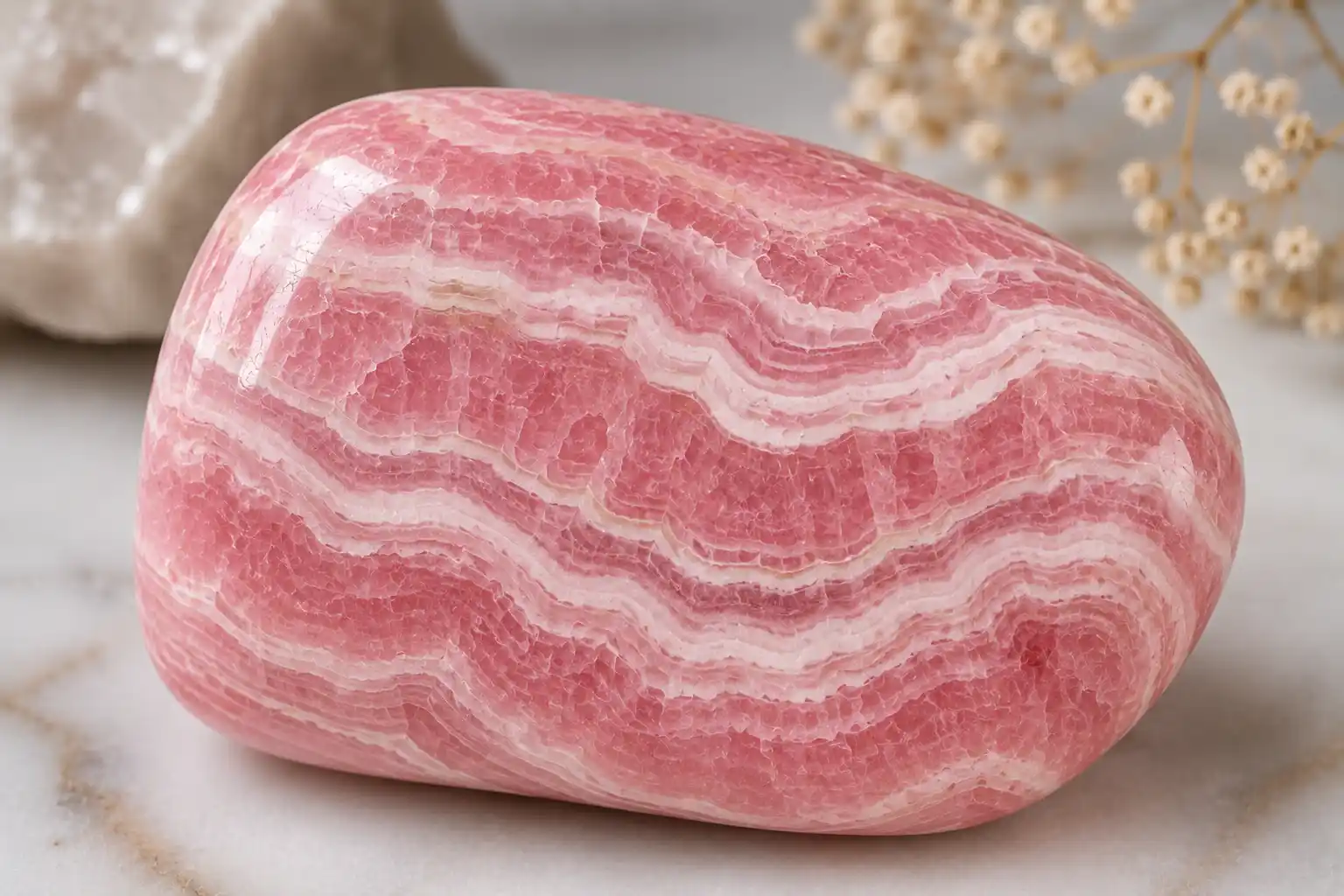

Rhodochrosite is a manganese carbonate mineral known for rose-red, pink, coral and raspberry colors. Familiar ornamental material often displays curved white, cream or pale-pink bands, while rare transparent crystals can be faceted into valuable collector gems.
In modern crystal traditions, rhodochrosite symbolizes self-compassion, emotional honesty, forgiveness and the willingness to approach painful memories without losing personal boundaries.
Its physical character offers an appropriate contrast to that symbolism. Rhodochrosite can be visually warm and luminous, yet it is soft, brittle and perfectly cleavable. It benefits from patient handling rather than force.
Metaphysical meanings are cultural and personal interpretations. Rhodochrosite does not replace mental-health care, medical diagnosis or evidence-based treatment.
Rhodochrosite at a Glance
| Property | Rhodochrosite |
|---|---|
| Mineral group | Calcite group |
| Composition | Manganese carbonate, MnCO₃ |
| Typical colors | Rose red, pink, raspberry, coral, pale pink, brownish pink and white-banded |
| Crystal system | Trigonal |
| Crystal habit | Rhombohedral or scalenohedral crystals, stalactites, botryoidal masses and banded aggregates |
| Luster | Vitreous to pearly |
| Transparency | Transparent to opaque |
| Mohs hardness | Approximately 3.5–4 |
| Cleavage | Perfect rhombohedral cleavage in three directions |
| Tenacity | Brittle |
| Specific gravity | Commonly about 3.5–3.7 |
| Refractive behavior | Strongly doubly refractive; spot readings on banded material often near 1.60 |
| Common uses | Collector crystals, cabochons, pendants, beads, carvings and display slices |
| Main care concern | Easily scratched, cleavage-sensitive and damaged by acids |
| Traditional themes | Self-compassion, emotional healing, joy, forgiveness and heart-centered courage |
What Is Rhodochrosite?
Rhodochrosite consists principally of manganese carbonate.
It belongs to the calcite group, whose members share related structures while different metals occupy the principal cation position.
Iron, calcium, magnesium and other elements can substitute for manganese. These substitutions change color, density and optical properties.
Pure manganese-rich material can be vivid red or pink. Increasing iron commonly introduces brown or muted tones. Calcium-rich areas can become paler and may grade toward related carbonate compositions.
Rhodochrosite forms as transparent crystals, granular masses, crusts, botryoidal material and stalactites.
The mineral’s name derives from Greek words referring to rose color.
How Rhodochrosite Forms
Rhodochrosite commonly develops in hydrothermal veins associated with silver, lead, copper, zinc and manganese mineralization.
Hot mineral-rich fluids move through fractures and deposit carbonate minerals as temperature, pressure and chemistry change.
Repeated pulses of fluid can create alternating pink, red, white and cream layers.
The mineral also occurs in sedimentary manganese deposits, metamorphosed manganese-rich rocks and selected pegmatitic environments.
Associated minerals may include quartz, calcite, fluorite, galena, sphalerite, pyrite, tetrahedrite, barite and manganese oxides.
The deposit environment strongly affects whether the finished material forms transparent crystals, curved bands or massive low-transparency rock.
Why Rhodochrosite Is Pink
Manganese is responsible for the characteristic pink and red colors.
Color varies with manganese concentration, iron substitution, crystal defects and associated minerals.
Fine transparent crystals may appear raspberry red, cherry red, orange-red or intense pink.
Banded material more commonly ranges from pale rose to medium pink, often alternating with white or cream carbonate layers.
Weathering can darken exposed surfaces as manganese oxides develop.
Artificial dye and coatings can also create stronger color, so vivid pink alone does not establish natural untreated material.
Banded Rhodochrosite
Banded rhodochrosite is especially associated with stalactitic material.
Mineral-rich fluid deposits successive layers around a central channel or earlier growth surface. When cut across the stalactite, those layers appear as curved, concentric, wavy or lace-like bands.
White layers commonly contain calcite-rich material or paler carbonate compositions.
The bands can be extremely fine or several millimeters wide. Their complexity and depth create much of the material’s visual appeal.
Argentina is famous for stalactitic banded rhodochrosite, particularly material associated with the Capillitas mining district.
Imitations may reproduce pink-and-white bands using pressed powder, resin or dyed carbonate. Natural pattern should be assessed with texture, density and spectroscopy rather than appearance alone.
Transparent Crystal Rhodochrosite
Transparent rhodochrosite is much rarer than banded ornamental material.
The Sweet Home Mine in Colorado produced exceptionally vivid red and pink crystals prized by mineral collectors and cutters.
Other transparent or translucent crystals occur in Peru, South Africa, Romania, Mexico, China and additional manganese-bearing districts.
Faceting rhodochrosite is difficult because of its low hardness and perfect cleavage. A cutter must orient the rough carefully and use gentle pressure.
Even a successful faceted stone is better suited to a collection or protected pendant than an exposed daily-wear ring.
Rhodochrosite Meaning
Rhodochrosite’s modern meaning centers on compassionate emotional honesty.
Its pink and red colors connect it with affection and vitality, while its curved bands suggest experiences accumulated in layers.
The stone is often used as a symbol for acknowledging earlier pain without allowing it to control every present decision.
It can also represent receiving care rather than offering support continuously while ignoring personal needs.
Forgiveness is another common theme, although responsible practice does not require reconciliation with unsafe people or denial of harm.
The symbolism works best when paired with realistic boundaries and appropriate professional support.
Rhodochrosite and Self-Compassion
Self-compassion means responding to personal difficulty with the same patience and fairness that might be offered to another person.
Rhodochrosite is used as a visual reminder to replace harsh self-judgment with honest evaluation.
That does not mean avoiding accountability. A compassionate response can still acknowledge mistakes, repair harm and change behavior.
A practitioner might hold the stone while writing about what happened, what was learned and what support is needed next.
The crystal functions as an anchor for the exercise rather than as the source of psychological change.
Rhodochrosite and Emotional Healing
Crystal traditions describe rhodochrosite as an emotional-healing stone.
In a responsible interpretation, this means it is used during reflection, journaling, meditation or therapeutic work as a symbol of emotional openness.
It is often selected when someone is processing grief, shame, rejection or old relationship patterns.
The mineral cannot remove trauma or treat a mental-health condition. A qualified therapist or healthcare professional provides assessment and evidence-based care.
The stone may complement a personally meaningful ritual when that ritual supports rather than replaces necessary treatment.
Rhodochrosite and the Heart Chakra
Rhodochrosite is frequently linked with the heart chakra.
Modern chakra systems associate this center with love, compassion, grief, trust, connection and emotional boundaries.
Pink rhodochrosite fits that color symbolism, while redder material is sometimes interpreted as connecting emotional themes with physical presence and courage.
The complete selection and balancing practices belong in Heart Chakra Crystals.
Chakra language reflects spiritual traditions rather than a structure recognized in medical anatomy.
Rhodochrosite for Relationships
Rhodochrosite is commonly associated with emotionally honest relationships.
It may symbolize the willingness to state needs clearly, accept affection, apologize sincerely and recognize recurring patterns.
Its meaning should not be used to justify remaining in abusive or manipulative situations.
Forgiveness does not require renewed access, and compassion does not eliminate boundaries.
For a relationship practice, the stone can be placed beside a journal while considering which behaviors create trust and which ones undermine it.
Rhodochrosite for Joy
Another traditional association is rediscovering joy after prolonged seriousness or stress.
The stone’s warm pink and banded appearance is interpreted as an invitation to notice pleasure without demanding that every moment become productive.
A person may choose it while returning to art, music, friendship, play or a neglected interest.
This meaning is not a claim that the mineral treats depression.
Persistent low mood, loss of interest or thoughts of self-harm require professional support rather than relying on a gemstone.
Rhodochrosite for Confidence
Rhodochrosite’s confidence symbolism differs from the assertive themes attached to ruby or red jasper.
It represents confidence built through self-acceptance and emotional clarity.
The focus is less on dominating a situation and more on speaking honestly without abandoning personal dignity.
A useful intention might be: “I can acknowledge what I feel and still choose my response.”
Pairing the stone with a specific communication plan makes the practice more practical.
Rhodochrosite for Meditation
Rhodochrosite can be used as a visual focus during quiet reflection.
Place the stone on a stable surface or hold a smooth piece gently. Notice its bands, color changes and physical weight.
Bring attention to one emotional issue rather than attempting to process an entire history at once.
Ask what feeling is present, what triggered it and what a fair response would look like.
End the meditation with one grounded action, such as scheduling support, setting a boundary or writing a message that does not need to be sent immediately.
Rhodochrosite for Journaling
The stone’s layered bands make it a natural symbol for examining experiences in sequence.
A journal practice can separate facts, interpretations, emotions and needs.
One page might describe what happened without judgment. A second can record the meaning assigned to it. A third can identify what is needed now.
This structure reduces the risk of treating every painful memory as a single overwhelming event.
The stone itself does not reveal hidden truth. It provides a consistent visual anchor while the writer reflects.
Rhodochrosite in the Home
Banded slices and polished freeforms display well in protected indoor areas.
They can symbolize emotional warmth in a reading space, bedroom or reflective corner.
Keep the material away from kitchens, bathrooms and windows where acid, moisture, heat or direct sunlight may affect the polish and associated minerals.
A display stand should support the piece securely without placing pressure on a thin edge.
Large stalactitic slices can contain natural fractures and should not be handled casually.
Rhodochrosite Jewelry
Rhodochrosite is attractive but delicate.
Pendants and earrings are safer choices because they receive less impact than rings and bracelets.
A ring should use a protective bezel or halo and be worn selectively rather than during work, exercise or household cleaning.
Beads can rub against one another, gradually dulling the surface. Knotting between beads reduces contact.
Faceted transparent stones belong in carefully protected settings or collections.
The gemstone-hardness chart explains why a hardness of 3.5–4 permits easy scratching.
Rhodochrosite Versus Rhodonite
Rhodochrosite and rhodonite overlap in pink and red colors but are different minerals.
Rhodochrosite is manganese carbonate. Rhodonite is a manganese-rich silicate.
Rhodochrosite commonly displays white, cream or pale-pink bands. Rhodonite more often shows black or brown manganese-oxide veins.
Rhodochrosite is softer and has rhombohedral cleavage. Rhodonite is harder but still has significant cleavage.
The complete side-by-side identification belongs in Rhodochrosite vs Rhodonite, while the planned rhodonite meaning guide retains rhodonite’s symbolism and uses.
Rhodochrosite Versus Rose Quartz
Rose quartz is pink quartz.
It is harder, lacks rhodochrosite’s perfect carbonate cleavage and usually has a cloudy rather than sharply banded internal appearance.
Rhodochrosite commonly has stronger pink-red color and white carbonate bands.
Rose quartz is better suited to frequent-wear jewelry, while rhodochrosite needs greater protection.
Both carry modern themes of compassion and emotional care, but their mineral identities should never be inferred from symbolism.
Rhodochrosite Versus Mangano Calcite
Mangano calcite is pink calcite colored by manganese.
Both belong to the calcite mineral group and can occur together or form compositional transitions.
Mangano calcite is commonly paler, softer-looking and more fluorescent, although visual overlap is substantial.
Rhodochrosite is generally denser and more manganese-rich.
Laboratory analysis may be necessary when a pale pink carbonate falls between simple trade categories.
The broad carbonate-family context appears in the calcite guide.
Rhodochrosite Versus Red Calcite
Red calcite can resemble coral or orange-red rhodochrosite.
Calcite is usually less dense and may show stronger double-image effects in transparent cleavage pieces.
Rhodochrosite generally has richer manganese-related pink or red and may display characteristic white banding.
Both are soft, cleavable and acid-sensitive. Destructive acid testing is therefore inappropriate for finished objects.
Raman spectroscopy or refractive measurements provide safer evidence.
Rhodochrosite Imitations
Imitations include pressed mineral powder, dyed calcite, resin, ceramic, glass and reconstructed composites.
One documented manufactured product combined pink gibbsite-rich material with white calcite powder and organic binder.
Its bands looked less complex than natural rhodochrosite, while the texture was more granular and density substantially lower.
Resin products may display bubbles, mold seams and repeated patterns.
Dyed calcite can be more difficult because it shares carbonate behavior. Color concentration in cracks, pores and drill holes provides a useful clue.
The planned Where to Buy Real Rhodochrosite owns seller checks and imitation avoidance.
Treatments
Rhodochrosite may be waxed, coated, dyed, impregnated with resin or reconstructed.
Wax improves polish and temporarily deepens color.
Polymer can strengthen porous or fractured material. Dye can intensify pale pink.
A treatment does not necessarily remove the underlying rhodochrosite identity, but it affects value and care.
The general gemstone-treatments guide explains why impregnation and reconstruction are distinct.
Cleavage and Breakage
Rhodochrosite has perfect rhombohedral cleavage.
Pressure applied in an unfavorable direction can split the stone along flat planes.
The risk is important during cutting, setting, ring wear and ultrasonic cleaning.
The completed gemstone-cleavage guide explains why a mineral can break cleanly even when the surface has not been scratched.
Rhodochrosite is also brittle. Dropping a carving onto tile can create chips or separate an existing fracture.
Water and Chemical Safety
Rhodochrosite should not be soaked.
As a carbonate, it reacts with acids. Vinegar, citrus juice and acidic cleaners can etch and dull the surface.
Water can enter fractures, weaken adhesive and affect dye, wax or polymer.
The completed crystal water-safety guide explains why brief cleaning and prolonged immersion are different questions.
Do not place rhodochrosite directly in drinking water. Natural specimens can contain associated sulfides, polishing residue and unknown treatments.
Cleaning Rhodochrosite
Dust the surface with a soft dry cloth.
When cleaning is necessary, use a barely damp cloth with a small amount of mild soap, then wipe again with clean water and dry immediately.
Avoid steam, ultrasonic vibration, acids, abrasives and household chemical cleaners.
The completed How to Cleanse and Charge Rhodochrosite provides physically gentle belief-based methods.
Store pieces individually so harder quartz, topaz and corundum cannot scratch them.
Buying Rhodochrosite
Banded material should have attractive color, well-defined natural-looking layers and a polish that does not conceal major fractures.
Transparent crystals should be evaluated for color, clarity, crystal damage and provenance.
A large transparent red crystal or faceted stone deserves stronger documentation because fine material is rare.
Ask whether the piece is natural, dyed, waxed, stabilized, reconstructed or composite.
Use the general crystal-identification guide before purchasing an unfamiliar pink stone.
Rhodochrosite appears in Pink Crystals and Pink Gemstones, as well as the red color guides when its bodycolor is strongly red.
Frequently Asked Questions
1. What is rhodochrosite made of?
It is principally manganese carbonate with the formula MnCO₃.
2. What does rhodochrosite traditionally mean?
It is associated with self-compassion, emotional honesty, forgiveness, joy and heart-centered courage.
3. Is rhodochrosite a heart-chakra stone?
Yes. Modern chakra traditions commonly connect its pink color with the heart chakra.
4. Does rhodochrosite have scientifically proven healing powers?
No. Its healing associations belong to spiritual practice and symbolism rather than established medicine.
5. Why does rhodochrosite have white bands?
Repeated carbonate deposition and changes in manganese, calcium and other components create alternating layers.
6. Is all rhodochrosite banded?
No. It also forms massive material, botryoidal growth, stalactites and transparent crystals.
7. How is rhodochrosite different from rhodonite?
Rhodochrosite is a soft manganese carbonate commonly showing white bands; rhodonite is a harder manganese silicate commonly showing black oxide veins.
8. Can rhodochrosite go in water?
Brief careful wiping is possible, but soaking is not recommended because the mineral is soft, cleavable and treatment-sensitive.
9. Can rhodochrosite be cleaned with vinegar?
No. Acids attack carbonate minerals and can etch the surface.
10. Is rhodochrosite suitable for a daily ring?
Usually not. It scratches and cleaves easily, so pendants, earrings and protected occasional-wear settings are safer.
11. Is transparent rhodochrosite valuable?
Fine transparent red crystals and faceted stones can be highly collectible because gem-quality material is rare and difficult to cut.
12. How can imitation rhodochrosite be recognized?
Look for simplified repeated bands, granular pressed texture, resin bubbles, low density and dye concentration, then confirm the material professionally.
Rhodochrosite is indexed in Crystals That Start With R and Gemstones That Start With R.
Rhodochrosite combines striking color with physical delicacy. Its manganese-rich layers record repeated mineral growth, while its modern symbolism emphasizes approaching emotional layers with equal patience. The most appropriate use respects both qualities: reflective rather than medically prescriptive, and gentle rather than physically demanding.
Rhodochrosite meanings and chakra associations are spiritual beliefs, not medical or psychological treatment. Do not ingest it, prepare direct elixirs or expose the mineral to acids.