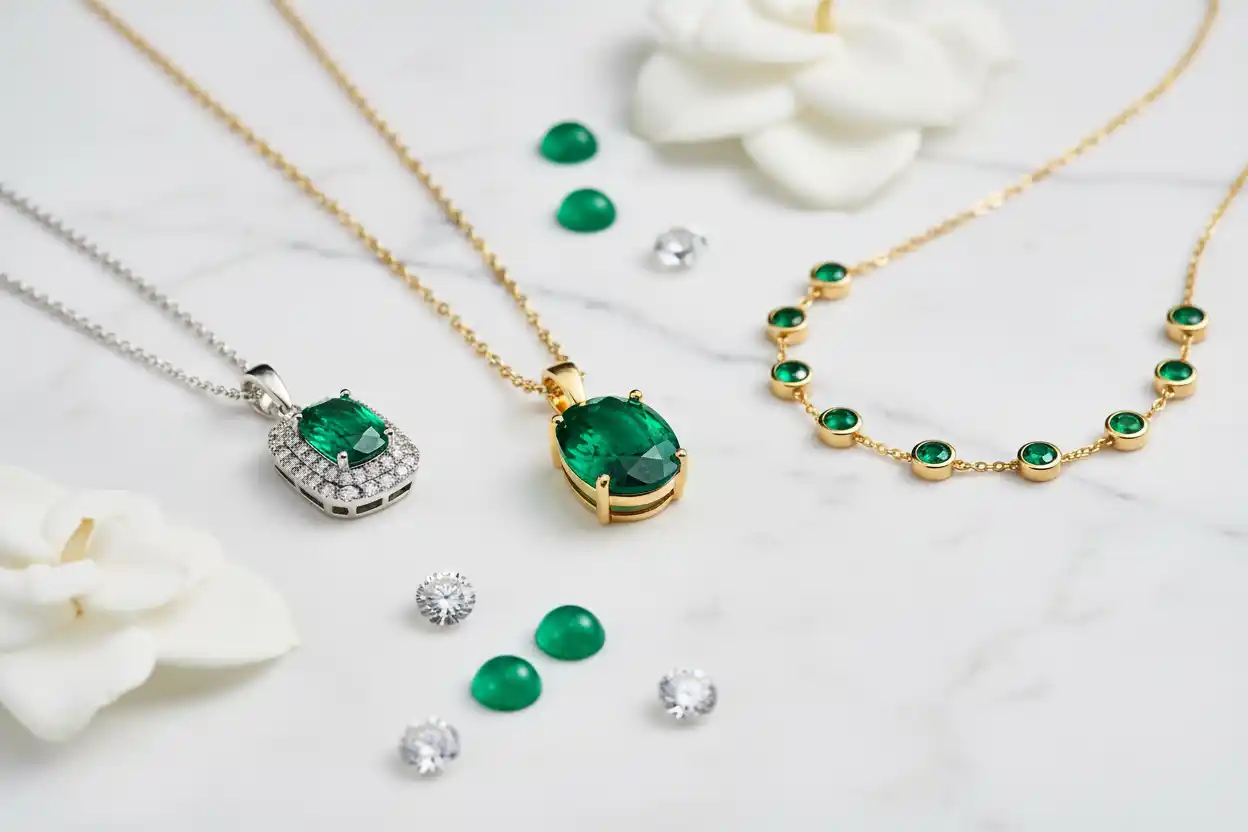
Emerald Necklaces and Pendants: Buying and Care Guide
An emerald necklace combines one of the world’s most recognizable green gemstones with a jewelry format that protects it better than most rings and bracelets. Because pendants remain away from many hard surfaces, they are especially suitable for emeralds whose natural fissures and common clarity enhancement require thoughtful wear.
The strongest necklace pairs attractive green color with secure construction. A beautiful emerald can still be lost if the bail opens, the chain breaks or a prong wears thin, so evaluate the complete piece rather than concentrating only on the gemstone.
Emerald Necklaces at a Glance
| Factor | What to look for |
|---|---|
| Gem identity | Natural or clearly disclosed laboratory-grown emerald |
| Color | Attractive green to bluish green with lively saturation |
| Transparency | Appropriate for the intended faceted or cabochon style |
| Treatment | Clear disclosure of oil, resin, dye or other enhancement |
| Cut | Balanced color with limited windowing |
| Setting | Bezel, sturdy prongs or protective halo |
| Bail | Secure, smooth and large enough for the selected chain |
| Chain | Strong enough for pendant weight and value |
| Clasp | Positive, dependable closure |
| Necklace length | Suited to pendant scale, neckline and layering |
| Main care issue | Fracture fillers, chemicals, heat and chain failure |
| Safest general cleaning | Warm mild soapy water and gentle brushing |
Why Emerald Works Well in a Necklace
Emerald has a Mohs hardness of about 7.5 to 8, but its durability depends heavily on natural fissures and treatment.
A pendant does not routinely strike desks, tools and doors the way a ring or bracelet does. Therefore, a necklace allows the owner to enjoy emerald color while reducing impact exposure.
The format also places the stone near the face, where even a modestly sized emerald can become visually prominent.
For someone who loves emerald but does not want the maintenance demands of a daily ring, a pendant can be an excellent compromise.
The drafted emerald meaning and properties guide covers the mineral’s composition, sources, history and symbolism separately.
Solitaire Emerald Pendants
A solitaire pendant centers one emerald without major surrounding stones.
This style places complete attention on color, cut and transparency. Therefore, weak saturation, excessive darkness or a large window will be easier to notice.
Emerald-cut rectangles create a refined geometric look, while ovals and cushions provide softer outlines. Round emeralds may offer more scintillation, although cutters often prioritize weight and color when working with valuable rough.
A solitaire also simplifies cleaning and maintenance compared with dense halo or cluster designs.
For frequent wear, choose a low-profile setting rather than a tall basket that catches clothing.
Bezel-Set Emerald Pendants
A bezel surrounds most or all of the emerald’s girdle with metal.
This is one of the safest pendant settings because it protects the stone’s edges and minimizes exposed prongs. It also creates a smooth profile that is less likely to catch fabric.
A full bezel works especially well around oval, round and cabochon emeralds. Partial bezels can provide more visual openness while still protecting vulnerable sections.
The metal should follow the stone’s outline evenly.
A poorly fitted bezel can make the emerald appear crooked or conceal more of the stone than necessary.
Prong-Set Emerald Pendants
Prongs expose more of the gemstone and create a lighter visual appearance.
Four prongs are common around ovals, cushions and emerald cuts, although the exact configuration should suit the stone’s shape and fractures.
The emerald should not move or click when the pendant is handled gently.
Each prong should remain smooth and firmly positioned over the stone. A prong that catches knitwear or hair may be lifting away from the gem.
Do not attempt to push a loose prong back into position at home. Emerald can be damaged by careless pressure.
Diamond Halo Emerald Pendants
A diamond halo creates strong visual contrast around emerald.
The small diamonds increase brilliance and apparent size, making a moderately sized emerald look more substantial from the front.
However, the center stone should still be attractive without the halo.
Check the emerald’s color and transparency first, then examine whether the halo is symmetrical and whether every accent diamond remains secure.
The complete piece must be cleaned according to emerald requirements. Diamond’s greater durability does not make steam or ultrasonic cleaning appropriate for an emerald-centered pendant.
Emerald Cluster Necklaces
Cluster designs arrange multiple emeralds into floral, geometric or abstract patterns.
They can create a large field of green color from smaller stones, which may be easier to source than one unusually large fine emerald.
Matching does not need to be perfect when color variation is intentional. However, one very dark, pale or cloudy stone can interrupt an otherwise coherent cluster.
Dense designs contain many small settings and can trap cosmetics or skin oils.
Open-backed construction generally makes gentle cleaning easier.
Emerald Station Necklaces
A station necklace spaces emeralds along a chain rather than concentrating them in one pendant.
Bezel-set stations are particularly practical because they protect the gemstone edges and reduce snagging.
Check whether each stone remains reasonably face-up during wear.
Poorly balanced stations can flip continuously, hiding the emeralds against the skin.
The chain segments between stones must also be strong enough for the complete necklace’s value.
A very fine chain can become a disproportionate failure point.
Emerald Tennis and Rivière Necklaces
A rivière or tennis-style emerald necklace uses a continuous or nearly continuous sequence of gems.
This format demands excellent matching because stones sit directly beside one another.
Compare:
- Hue
- Tone
- Saturation
- Transparency
- Face-up dimensions
- Setting height
A graduated design can intentionally increase stone size toward the center, but the transition should look smooth.
High-value line necklaces need strong articulation and a secure clasp, preferably with an additional safety mechanism.
Emerald Bead Necklaces
Emerald beads may be transparent, translucent or opaque and are often more included than fine faceted gems.
That does not make them undesirable when sold accurately.
Inspect drill holes for fractures and rough edges. Beads with cracks around the holes may eventually break.
Color should be evaluated for natural-looking variation. Extremely uniform vivid green beads at an unusually low price deserve closer questions about dye, impregnation or material identity.
Knotting between valuable beads can limit loss if the strand breaks.
Cabochon Emerald Pendants
Cabochons have smooth rounded tops rather than conventional facet patterns.
They are particularly effective for emerald that has rich color but limited transparency.
A bezel-set cabochon can create a durable-feeling, low-profile pendant with an antique or organic appearance.
The smooth surface reduces exposed facet junctions, although the stone’s internal fissures and treatments still matter.
Cabochons may also show phenomena such as asterism or chatoyancy in rare material.
The buyer should value the actual appearance rather than assume faceted emerald is always superior.
Choosing Emerald Color
Color usually has the greatest effect on emerald beauty.
Desirable stones commonly range from green to bluish green with strong saturation. The tone should remain light enough for the gem to look lively.
A dark stone may appear impressive beneath concentrated store lighting but nearly black in ordinary rooms.
View the pendant under several conditions before purchasing.
The chain and metal also influence perception. Yellow gold adds warmth, while white metals often emphasize cooler green tones.
The completed emerald buying guide provides a detailed framework for assessing color.
Evaluating Transparency and Jardin
Natural emerald commonly contains visible inclusions.
These internal features are often collectively described as jardin, meaning garden.
A necklace does not require an eye-clean emerald. Instead, look for enough transparency for the intended style and ensure that large surface-reaching fractures do not create obvious structural concerns.
Some inclusions can make a stone visually interesting.
However, severe cloudiness may reduce brightness, while fractures reaching a setting point may deserve professional evaluation.
Emerald Treatments in Necklaces
Many natural emeralds receive clarity enhancement.
Oil, wax, resin or other substances may be introduced into surface-reaching fractures to reduce their visibility.
Treatment should be disclosed because it affects both value and care.
A necklace described as natural emerald may still contain treated stones.
The completed treated emerald guide explains treatment levels, laboratory-grown emerald and imitation boundaries.
For a high-value pendant, independent documentation may describe the detectable extent of clarity enhancement.
Natural vs Laboratory-Grown Emerald Necklaces
Laboratory-grown emerald is synthetic emerald rather than an imitation material.
It has essentially the same mineral species and fundamental characteristics as natural emerald, but it forms through controlled technological processes rather than geological growth.
Laboratory-grown material can provide stronger clarity and larger matched stones at a lower cost than comparable fine natural emerald.
The completed lab emerald buying guide covers purchasing considerations.
The necklace should identify laboratory-grown origin clearly in the description and invoice.
Choosing the Bail
The bail is the connection between pendant and chain.
A strong gemstone setting cannot prevent loss when the bail fails.
Check that the bail:
- Is large enough for the chain and end fittings
- Has smooth interior edges
- Does not show an open solder seam
- Allows natural pendant movement
- Is proportional to the pendant’s weight
Fixed bails keep orientation consistent. Articulated bails allow the pendant to move more freely.
Hidden bails create a streamlined appearance but can be harder to inspect.
Choosing the Chain
The chain should complement the emerald without becoming the weakest component.
| Chain style | Character | Practical use |
|---|---|---|
| Cable | Simple and classic | Small to medium pendants |
| Rolo | Rounded and substantial | Medium pendants |
| Wheat | Flexible and strong-looking | Valuable pendants |
| Box | Structured and smooth | Modern designs |
| Curb | Flat interlocking links | Contemporary pendants |
| Snake | Smooth surface | Minimal designs; protect from kinking |
An extremely thin chain beneath a heavy emerald pendant may look delicate but offers poor risk balance.
Ask whether the pendant can move onto a replacement chain if needed.
Choosing Necklace Length
| Approximate length | Typical placement | Good for |
|---|---|---|
| 14–16 inches | High neck or base of neck | Small pendants and chokers |
| 18 inches | Around the collarbone | Most versatile solitaire length |
| 20 inches | Upper chest | Medium statement pendants |
| 22–24 inches | Mid-upper chest | Larger pendants and layering |
| 30+ inches | Lower chest | Long station designs |
Actual placement depends on body proportions.
An extender can improve versatility but introduces another connection that should be strong enough for the pendant.
Yellow Gold, White Gold or Platinum?
Yellow gold is a classic companion to emerald and creates warm contrast with green.
White gold and platinum create a cooler appearance and are particularly effective with diamond halos.
Rose gold provides an unconventional warm frame that can work well with medium or slightly bluish-green stones.
Metal choice also affects weight, price and maintenance.
White gold may require periodic rhodium replating, while platinum develops a natural patina with wear.
The exact alloy should also be considered when the wearer has known metal sensitivities.
Emerald Necklaces with Diamonds
Diamonds and emeralds are a classic combination.
Diamond halos, accents and alternating station designs can make the green appear more saturated through contrast.
However, diamond is significantly harder than emerald.
The design should prevent exposed diamond edges from striking or rubbing against emerald surfaces.
Likewise, store the necklace so that loose diamond sections cannot scratch emeralds.
Care should always follow the emerald’s more restrictive requirements.
Origin Claims
Colombia, Zambia, Brazil, Pakistan, Afghanistan and several other countries produce emerald.
Origin may influence market interest and price, but color alone cannot establish where an emerald was mined.
A high-value pendant sold with a Colombian, Zambian or other origin premium should have appropriate documentation when locality materially affects price.
The completed types of emerald guide provides broader source context.
A beautiful stone from a less commercially prestigious locality may still offer exceptional quality.
Emerald Necklace Pricing
Price depends on:
- Natural or laboratory-grown origin
- Color
- Transparency
- Treatment
- Individual stone size
- Total carat weight
- Matching
- Geographic origin where documented
- Metal
- Craftsmanship
Large fine natural emeralds can command steep premiums.
The completed emerald price guide owns detailed value and cost intent.
Compare necklaces with similar treatment disclosure and construction rather than judging them by carat weight alone.
Buying an Emerald Necklace Online
Confirm whether photographs show the exact necklace.
Request stone dimensions, total carat weight, treatment disclosure, metal fineness, chain length and clasp details.
For a valuable natural emerald, review any independent laboratory report.
Product photographs are often magnified, so millimeter measurements provide a more realistic understanding of size.
Video can be particularly helpful because it reveals whether a pendant flips or whether station stones remain face-up.
Read the return policy before altering chain length or removing tags.
Styling an Emerald Pendant
A small solitaire pendant works easily with workwear and simple everyday clothing.
A halo or large cabochon creates a stronger statement and may need little additional jewelry.
Emerald pairs effectively with cream, navy, black, burgundy, brown and many neutral tones.
Exact color matching with clothing is unnecessary.
When wearing elaborate emerald earrings as well, consider whether the necklace should remain simpler so that the pieces do not compete visually.
Layering Emerald Necklaces
Layering works best when chain lengths differ clearly.
Keep the emerald as the principal focal point and choose simpler neighboring chains.
Avoid layering the pendant where it repeatedly collides with diamonds or abrasive gemstone beads.
Check the arrangement during wear because necklaces can migrate and tangle.
A chain separator can help but should remain strong enough for the combined jewelry weight.
How to Wear an Emerald Necklace Safely
Put the necklace on after applying perfume, sunscreen, lotion and hairspray.
Remove it before:
- Sleeping
- Swimming
- Bathing
- Exercise
- Contact sports
- Activities where a chain may catch
- Work involving machinery
Long chains present additional snagging hazards.
Likewise, large pendants may swing into hard surfaces when the wearer bends forward.
Careful use preserves both the emerald and the chain.
Cleaning Emerald Necklaces
Warm water, mild soap and gentle brushing provide the safest general cleaning approach for most emerald jewelry.
Support the pendant and chain rather than pulling on one connection during cleaning.
Avoid steam and ultrasonic cleaners because heat and vibration may affect fractures and fillers.
The completed guide to cleaning emerald jewelry safely provides detailed instructions.
Rinse briefly over a bowl rather than an open drain, then dry the complete necklace thoroughly.
Storage
Fasten the clasp and lay the necklace flat or in a dedicated padded compartment.
Do not allow emeralds to rub against diamonds, sapphires or other harder gemstones.
Keep the chain untangled and avoid sharp folds.
For travel, use a structured jewelry case rather than placing the necklace loose inside a handbag.
Store laboratory reports, appraisals and purchase documents separately from the jewelry.
When Professional Service Is Needed
Stop wearing the necklace if the emerald moves, a prong catches, the bail opens or the chain develops stretched links.
A jeweler can inspect settings, solder seams and clasp tension under magnification.
Older or heavily enhanced emerald may also require gemological evaluation before repair involving heat.
Do not allow routine soldering near emerald without making the jeweler aware of the gemstone and treatment possibilities.
Heat can worsen fractures and affect fillers.
Conclusion
Emerald necklaces and pendants provide an excellent balance between visual impact and physical protection. Solitaires emphasize one fine stone, halos add contrast and station necklaces distribute green color across a larger area.
Choose attractive color first, then evaluate transparency, treatment and cut. Just as importantly, inspect the bail, chain and clasp because the necklace is only as secure as its weakest connection.
With gentle care and suitable construction, an emerald pendant can offer regular wear with less impact exposure than most emerald rings or bracelets.
Frequently Asked Questions
1. Is emerald good for a necklace?
Yes. Necklaces are one of the safer emerald jewelry formats because they receive fewer impacts than rings and bracelets.
2. What is the best emerald pendant setting?
A bezel offers excellent protection, while sturdy low-profile prongs provide a more open appearance.
3. What color should an emerald necklace be?
Attractive green to bluish green with strong saturation and enough brightness to remain lively generally receives the strongest demand.
4. Are emerald necklace inclusions normal?
Yes. Visible inclusions are common in natural emerald and do not automatically indicate poor quality.
5. Are emerald pendants usually treated?
Many natural emeralds receive fracture filling with oil, resin or similar materials. Treatment should be disclosed.
6. Is lab-grown emerald suitable for a necklace?
Yes. Laboratory-grown emerald can create attractive jewelry, but its synthetic origin must be represented accurately.
7. Which chain is best for an emerald pendant?
Cable, rolo, wheat and well-made box chains can all work when their thickness matches the pendant’s weight.
8. What necklace length is best?
Around 18 inches is a versatile starting point for many pendants, although personal proportions and neckline preferences matter.
9. Can emerald and diamond be used together in a necklace?
Yes, but the design and storage should prevent harder diamonds from rubbing directly against emerald.
10. Can an emerald necklace be cleaned ultrasonically?
No. Ultrasonic cleaning should generally be avoided because many emeralds contain fractures and clarity fillers.
11. How should an emerald necklace be cleaned?
Use warm mild soapy water and gentle brushing, followed by brief rinsing and thorough drying.
12. Should an expensive emerald pendant have a laboratory report?
Independent documentation is advisable when natural identity, treatment extent or claimed geographic origin materially affects price.