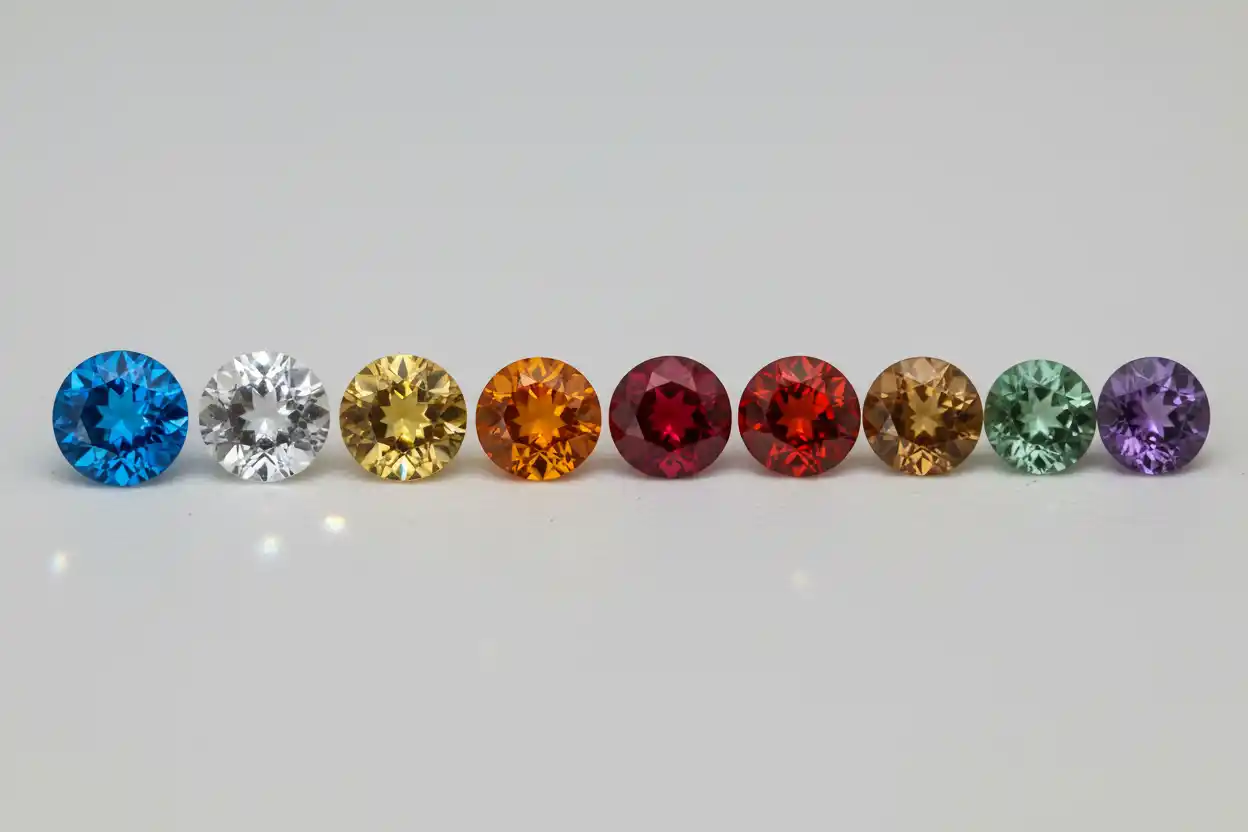
Zircon Color Meaning: Blue, White, Red, Green and More
Zircon occurs in a broad palette that includes colorless, blue, yellow, orange, red, brown, green, pink and purple. Different traditions and modern crystal practices assign symbolic meanings to these colors, although those interpretations are cultural or personal rather than scientifically proven effects.
Color also carries gemological information. Some shades occur naturally, while most vivid blue zircon and much colorless material result from heating brown rough, as explained more fully in the types of zircon guide.
Zircon Colors at a Glance
| Zircon color | Common gemological context | Traditional or modern symbolic themes |
|---|---|---|
| Blue | Usually heat-treated; may be blue to greenish blue | Calm, communication, clarity and trust |
| Colorless or white | Natural or heat-treated | Simplicity, honesty, renewal and clear intention |
| Yellow or golden | Natural or heated | Optimism, learning, prosperity and confidence |
| Orange | Natural or heated; often contains yellow or red modifiers | Creativity, enthusiasm and constructive action |
| Red or hyacinth | Rare natural color, often orangy or brownish red | Vitality, courage, commitment and protection |
| Brown | Common natural rough color | Stability, practicality, patience and connection with the earth |
| Green | Rare; sometimes associated with radiation-damaged structure | Growth, resilience, balance and long perspective |
| Pink or purple | Uncommon collector colors | Affection, imagination, individuality and reflection |
Zircon’s Mineral Identity
Zircon is natural zirconium silicate with the formula ZrSiO₄. It should not be confused with cubic zirconia, a manufactured zirconium-oxide diamond simulant.
Its high refractive index and dispersion create considerable brilliance and spectral fire. Strong double refraction can make pavilion facet edges appear doubled when viewed through the crown.
The complete mineralogy, formation, structural types and identification features belong to the zircon meaning guide and classification page rather than this symbolism-focused article.
The broader differences between natural gems and manufactured products appear in lab-grown versus natural gemstones.
Are Zircon Colors Natural?
Zircon occurs naturally in yellow, orange, red, reddish brown, brown, green, pink, purple and colorless forms. Blue natural zircon is exceptionally uncommon.
Heating brown or reddish-brown zircon under reducing conditions commonly produces blue or greenish-blue material. Heating under oxidizing conditions may create colorless, yellow or related pale colors.
Heat treatment is accepted in the zircon market, but sellers should disclose it. The process changes color and can partly repair radiation-related structural damage.
Some heated colors may partially return toward brown after prolonged exposure to strong light. Treatment and stability questions are covered more fully in gemstone treatments explained.
Blue Zircon Meaning
Blue zircon is the best-known jewelry color and the most commercially popular. Its hues range from pale icy blue to saturated greenish blue and electric turquoise-blue.
Modern symbolic traditions associate blue zircon with calm communication, honesty, mental clarity and trust. Some people wear it as a reminder to speak carefully, listen fully or approach difficult conversations without unnecessary conflict.
Lighter blue stones may symbolize openness and fresh perspective, while saturated blue-green material is often linked with confidence and purposeful expression.
These interpretations overlap with the broader themes discussed in the blue crystals guide but do not represent scientifically measurable properties.
Nearly all vivid blue zircon should be assumed heated unless a qualified laboratory concludes otherwise. Treatment does not make the stone synthetic; it remains natural zircon whose color has been modified.
White and Colorless Zircon Meaning
Colorless zircon has historically served as a diamond alternative because of its brilliance and fire.
Symbolically, white or colorless zircon is associated with honesty, simplicity, fresh beginnings and clear intention. Some wearers choose it to represent a commitment made without unnecessary display.
Its lack of body color allows spectral flashes to dominate. Consequently, modern interpretations may connect it with seeing several possibilities within one apparently simple situation.
Colorless zircon belongs visually among white crystals and clear crystals, although those broad lists include minerals with very different properties.
Natural colorless zircon exists, but heating is also used to remove brown coloration. The traditional term Matara or Matura zircon refers historically to colorless material associated with Sri Lanka.
Yellow Zircon Meaning
Yellow zircon ranges from pale lemon to canary and warm golden yellow.
Modern symbolism connects it with optimism, intellectual curiosity, confidence and the willingness to notice practical opportunities.
A pale yellow stone may represent gentle encouragement, while rich golden zircon is often associated with accomplishment, generosity and prosperity.
These themes overlap with the yellow crystals guide but should remain framed as personal or cultural interpretation.
Canary zircon is a descriptive color term rather than a formally defined mineral variety. The seller should describe the actual hue, treatment and origin instead of relying on the name alone.
Golden Zircon Meaning
Golden zircon occupies the warmer and more saturated end of the yellow range.
Its color has encouraged associations with abundance, achievement, wisdom gained through experience and gratitude for material stability.
Unlike symbolic promises of guaranteed wealth, a realistic personal interpretation might use golden zircon as a reminder to manage resources carefully or recognize progress already made.
The Persian-derived root often linked with the word zircon has associations with gold-colored appearance, which adds historical depth to golden zircon symbolism.
Orange Zircon Meaning
Orange zircon ranges from yellow-orange and amber to reddish orange.
Modern crystal traditions associate orange stones with creativity, enthusiasm, sociability and translating inspiration into practical work.
Muted amber-orange material may symbolize persistence and gradual momentum, while saturated reddish orange is often linked with courage and energetic action.
These themes relate to the broader orange crystals guide without implying that color produces a universal emotional response.
Some orange zircon is naturally colored, while heating can modify other material. Sellers should describe treatment without using a romantic trade name as a substitute for disclosure.
Red Zircon Meaning
Red zircon is rare and can range from orangy red and brick red to deep reddish brown.
Historical terms such as hyacinth or jacinth have been applied to red, orange-red and brownish-red zircon. Older texts sometimes used those words for other gems as well, so historical references are not always mineralogically precise.
Modern symbolism connects red zircon with vitality, courage, commitment and protective intention. A deep red stone may be chosen to represent endurance rather than impulsive energy.
These interpretations overlap with the broader red crystals guide.
Fine transparent red zircon is uncommon, especially in larger sizes. The combination of rarity, strong brilliance and natural color can create a collector premium.
Brown Zircon Meaning
Brown is among zircon’s most common natural colors. It ranges from pale champagne and honey brown to cinnamon, reddish brown and dark chocolate.
Modern symbolic interpretations emphasize stability, practicality, patience and connection with geological time.
Because much blue and colorless zircon begins as brown rough, brown zircon can also symbolize hidden potential or transformation without suggesting that untreated material is inferior.
The brown crystals guide explores related color associations across other minerals.
Chocolate, cognac and cinnamon zircon are descriptive marketing names. They do not establish locality, treatment or a standardized grade.
Green Zircon Meaning
Green zircon is rare in the jewelry market and particularly interesting to mineral collectors.
Many green stones have experienced natural radiation-related structural damage over geological time. Their refractive index, density, hardness and brilliance may therefore differ from ordinary high-type zircon.
Modern symbolism associates green zircon with patience, resilience, long-term growth and learning from deep history.
Some people connect its geological age and structural transformation with the idea that change can occur gradually without erasing identity.
Green zircon belongs visually in the green crystals guide, but color alone cannot establish whether a stone is high, intermediate or low zircon.
Pink and Purple Zircon Meaning
Pink, lilac, violet and purple zircon are uncommon collector colors.
Pink zircon is often associated with affection, kindness and personal openness. Purple material receives modern associations with imagination, individuality, reflection and creative independence.
These symbolic themes appear across the pink crystals guide and purple crystals guide, but zircon’s actual color origin and treatment status remain gemological questions.
Some stones show transitional colors such as pinkish orange, reddish purple or plum. Trade descriptions should reflect the observed hue rather than forcing the gem into one rigid category.
Historical Zircon Color Names
Several historical and commercial terms appear in zircon literature.
Matara zircon traditionally refers to colorless zircon associated with the Matara region of Sri Lanka.
Jargoon or jargon has been applied inconsistently to pale yellow, smoky or nearly colorless zircon.
Hyacinth or jacinth commonly refers to yellowish-red, orange-red or reddish-brown zircon, although older texts also used the term for other gemstones.
Starlite is an older trade name for heat-treated blue zircon. It does not mean the gem displays a star effect.
Because these words lack consistent modern boundaries, the ordinary color description should appear alongside the historical name.
Color, Structure and Metamictization
Zircon can contain trace uranium and thorium incorporated during crystal growth. Their radioactive decay gradually damages the surrounding lattice over geological time.
High zircon retains a well-ordered structure. Intermediate and low zircon show increasing structural disruption.
Color and structural condition can be related, but one does not perfectly predict the other. Green stones are often associated with intermediate or low structure, while brown, yellow and red material can occur across several conditions.
Heating can alter color and partly restore structural order. The classification details remain with the types of zircon guide.
Zircon Color and Value in 2026
Blue receives the strongest broad consumer demand. Commercial stones commonly range from approximately $30–$150 per carat, while fine larger blue gems can reach $150–$350 per carat or more.
Colorless zircon commonly sells for roughly $20–$100 per carat, depending on brilliance, clarity and size.
Yellow, golden, orange and brown stones often range from $20–$250 per carat. Fine saturated orange-red stones may exceed that range.
Rare transparent red, green, pink or purple zircon can command approximately $100–$500 per carat, with exceptional collector stones rising higher.
Color alone never determines value. Structural condition, clarity, cutting, treatment stability and abrasion also matter.
The complete valuation framework remains with the zircon price guide.
Buying Zircon by Color
View the stone under daylight-equivalent and warm indoor lighting. A gem that appears vivid blue in a cool photograph may look more greenish or gray in person.
Ask whether the color is natural or heat-treated. Blue and colorless material are commonly heated, while disclosure remains relevant for every shade.
Check for abrasion along the facet junctions. Zircon’s brilliance can distract from worn edges that reduce value.
Rotate the stone to examine extinction, color zoning and facet doubling. A good cut should balance brightness with crisp reflections.
Rare red, green, pink or reportedly unheated stones deserve independent laboratory identification.
The complete purchase workflow appears in the zircon buying guide.
Zircon Jewelry and Color Choice
Blue zircon is often chosen for December birthstone jewelry and cool-toned designs. Zircon is one of the stones recognized in the December birthstone guide and December birthstone jewelry guide.
Colorless zircon works well when the wearer wants strong fire without a dominant hue.
Golden, orange and brown stones complement warm metal tones, while red, pink and purple zircon offer less common collector-focused alternatives.
The setting should protect the stone from impact regardless of color. Style-specific considerations appear in the guides to zircon rings, zircon necklaces, zircon earrings and zircon bracelets.
Zircon Versus Cubic Zirconia Colors
Natural zircon and cubic zirconia can both be manufactured or found in many colors, but they are different materials.
Zircon is natural zirconium silicate. Cubic zirconia is laboratory-manufactured zirconium oxide.
Synthetic cubic zirconia colors are created through controlled additives and manufacturing conditions. Their classification belongs to the types of cubic zirconia guide.
Color does not provide a reliable separation. Refractive behavior, density, facet doubling and laboratory testing are more useful.
The comparison in moissanite versus cubic zirconia also illustrates why diamond simulants should not be grouped automatically with natural zircon.
Cleaning, Sunlight and Color Stability
Clean zircon with lukewarm water, mild soap and a soft brush. Rinse carefully and dry with a lint-free cloth.
The complete procedure appears in how to clean zircon jewelry.
Avoid steam and ultrasonic cleaning. Zircon can be brittle, while fractures and treatments create additional risks.
Some heated blue or colorless stones may partially return toward brown after prolonged strong light exposure. Ordinary wear is usually not a problem, but hot display windows and intense ultraviolet exposure should be avoided.
Store zircon separately from harder gemstones so facet edges do not abrade.
Meaning and Symbolism in Context
Zircon’s symbolism has changed across cultures and historical periods. Older traditions linked the gem with protection, wisdom, sleep, travel and prosperity, although historical names were sometimes applied to other minerals.
Modern color meanings are flexible rather than universal. One person may interpret blue as calm, while another associates it with confidence or a December birthday.
A symbolic interpretation becomes most useful when it reflects the wearer’s own purpose without presenting the stone as a medical or emotional treatment.
Frequently Asked Questions
1. Which zircon color has the strongest traditional meaning?
No single color has a universal meaning. Blue is currently the most popular and is often associated with calm and communication, while historical red and golden zircon carried protective or prosperity-related symbolism.
2. What does blue zircon symbolize?
Modern traditions commonly connect blue zircon with trust, clarity, thoughtful communication and calm confidence.
3. What does white zircon symbolize?
Colorless or white zircon is associated with simplicity, honest intention, renewal and seeing several possibilities within one clear form.
4. What does golden zircon symbolize?
Golden zircon is often linked with accomplishment, gratitude, prosperity and the responsible use of resources.
5. What does red zircon symbolize?
Red zircon is commonly associated with vitality, courage, commitment and protective intention.
6. What does brown zircon symbolize?
Brown zircon symbolizes stability, patience, practicality and connection with geological time in many modern interpretations.
7. What does green zircon symbolize?
Green zircon is associated with resilience, long-term growth and learning from change, particularly because many green stones have unusual structural histories.
8. Is blue zircon’s meaning affected by heat treatment?
Treatment changes color, not the wearer’s personal symbolism. However, buyers should still know that most vivid blue zircon has been heated.
9. Is zircon color meaning scientifically proven?
No. Color symbolism is cultural, spiritual or personal rather than a scientifically demonstrated effect of the gemstone.
10. Which zircon color is the most valuable?
Blue has the strongest broad demand, while rare fine red and green stones can receive collector premiums. Quality and size matter as much as color.
11. Is colorless zircon the same as cubic zirconia?
No. Colorless zircon is a natural zirconium-silicate gemstone, while cubic zirconia is manufactured zirconium oxide.
12. Which zircon color is the December birthstone?
Blue zircon is the color most commonly associated with December, although zircon naturally occurs in many other colors.
Zircon color symbolism is most meaningful when it complements honest gemological information. A blue stone can represent calm while still being heat-treated, a brown stone can symbolize stability without being less natural, and a rare green crystal can reflect deep geological change without making universal promises about its wearer.
Zircon appears in Crystals That Start With Z and Gemstones That Start With Z.