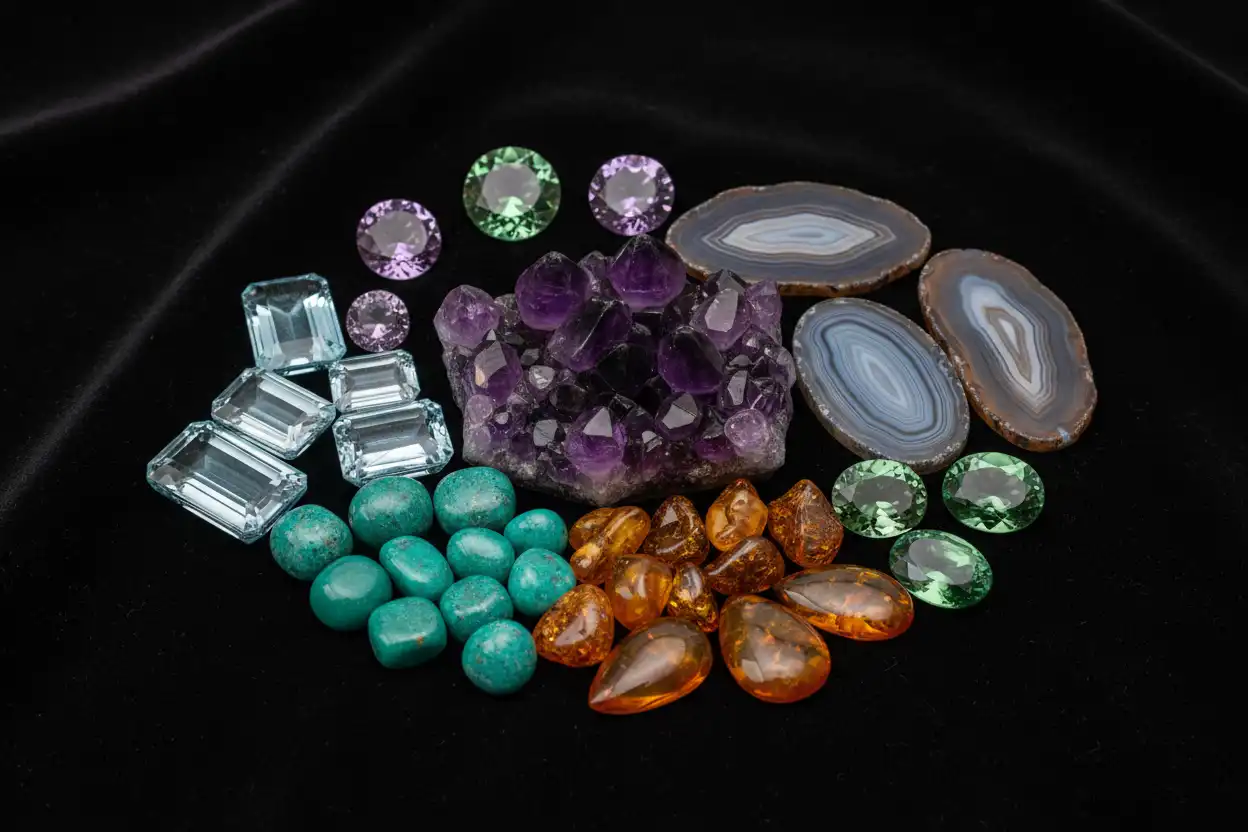
Gemstones That Start With A: A–Z Guide
Gemstones that start with A include abalone shell, agate, alexandrite, almandine garnet, amazonite, amber, amethyst, ametrine, ammolite, andalusite, angelite, apatite, aquamarine, aventurine, axinite and azurite.
These materials range from durable transparent gems and ornamental rocks to fossil resin, shell-based organic gems and soft collector stones.
This directory focuses on jewelry use, durability, identification and buying considerations. For a broader mineral list, explore Crystals That Start With A.
A Gemstones at a Glance
| Gemstone | Typical colors | Material type | Common jewelry use |
|---|---|---|---|
| Abalone Shell | Blue, green, purple and silver iridescence | Organic shell material | Inlay, earrings and pendants |
| Agate | Nearly every color, often banded | Chalcedony | Beads, rings and cabochons |
| Alexandrite | Green to red color change | Chrysoberyl | Fine rings and collector jewelry |
| Almandine Garnet | Deep red to brownish red | Garnet | Rings, beads and antique jewelry |
| Amazonite | Blue-green to green | Feldspar | Cabochons, beads and pendants |
| Amber | Yellow, orange, brown, red or green | Fossil resin | Beads, earrings and pendants |
| Amethyst | Pale lilac to deep purple | Quartz | Rings, earrings and necklaces |
| Ametrine | Purple and yellow zoning | Quartz | Faceted stones and statement jewelry |
| Ammolite | Multicolored iridescence | Fossil shell gem | Doublets, triplets and pendants |
| Andalusite | Brown, green, gold and reddish tones | Silicate mineral | Faceted collector jewelry |
| Angelite | Pale blue to blue-gray | Anhydrite | Beads, carvings and pendants |
| Apatite | Blue, green, yellow, purple or colorless | Phosphate mineral | Earrings and protected pendants |
| Aquamarine | Pale blue to blue-green | Beryl | Rings, earrings and necklaces |
| Aventurine | Green, orange, blue or brown | Quartz-rich material | Beads and cabochons |
| Axinite | Brown, violet, blue or yellow | Mineral group | Rare faceted gems |
| Azurite | Deep blue | Copper carbonate | Cabochons and collector pieces |
Abalone Shell
Abalone shell is an organic gem material valued for its blue, green, purple, pink and silver iridescence.
The color comes from microscopic layers of nacre that interact with light.
Abalone is commonly used for:
- Jewelry inlay.
- Earrings.
- Pendants.
- Decorative carvings.
- Watch and instrument details.
It is traditionally associated with adaptability, emotional calm and protection.
Abalone shell is soft and sensitive to acids, heat and dehydration. Perfume, hairspray and household cleaners can dull or damage its surface.
Pieces are often backed or assembled to improve strength, which should be disclosed when relevant.
Agate
Agate is a variety of chalcedony known for bands, eyes, plumes, dendrites and other natural patterns.
It occurs in nearly every color and is widely used for:
- Cabochons.
- Beads.
- Rings.
- Cameos.
- Carvings.
- Decorative slices.
Agate is traditionally associated with stability, balance and patience.
Its good scratch resistance makes solid material practical for everyday jewelry. However, dyes, heat treatments, coatings and fracture fillings are common in the commercial market.
Color concentrated inside cracks or unusually vivid, uniform shades may indicate enhancement.
Alexandrite
Alexandrite is a color-changing variety of chrysoberyl.
Fine examples may appear:
- Green or blue-green in daylight.
- Red, purplish red or raspberry under warmer light.
- Mixed or transitional colors under ordinary indoor lighting.
Alexandrite is traditionally associated with adaptability, confidence and good fortune.
Its hardness and toughness make it suitable for rings, although natural fine-quality material is rare and expensive.
Laboratory-grown alexandrite and color-change substitutes are common. Significant purchases should include an independent report confirming identity, natural origin and treatments.
Almandine Garnet
Almandine is an iron-rich garnet species known for deep red, wine-red and brownish-red colors.
It is one of the most historically common garnets in jewelry and may appear in:
- Antique rings.
- Beaded necklaces.
- Cabochons.
- Faceted earrings.
- Carved objects.
Almandine is traditionally associated with commitment, courage and practical strength.
Its good hardness and lack of prominent cleavage make it suitable for regular wear. Very dark stones are sometimes cut thin or hollowed beneath the setting to improve brightness.
Amazonite
Amazonite is a blue-green to green variety of microcline feldspar.
Its appearance may include:
- Pale turquoise tones.
- Bright blue-green.
- White streaks.
- Grid-like patterns.
- Cloudy or mottled areas.
Amazonite is traditionally associated with communication, confidence and balanced judgment.
It is commonly cut into cabochons, beads and carvings rather than transparent faceted stones.
Amazonite has cleavage and may contain internal fractures. Rings benefit from protective settings, while pendants and earrings are generally safer choices.
Dyed stones and similarly colored materials may be sold under its name.
Amber
Amber is fossilized tree resin rather than a mineral crystal.
Its colors include:
- Yellow.
- Honey.
- Orange.
- Cognac brown.
- Red.
- Cream.
- Rare blue or green optical varieties.
Amber is traditionally associated with warmth, protection and memory.
It is lightweight and comfortable in large earrings or necklaces, but it is soft and sensitive to heat, alcohol, perfume and household chemicals.
Pressed amber, reconstructed pieces, plastic imitations and resin containing modern insects are common. Natural-looking inclusions alone do not prove age or authenticity.
Amethyst
Amethyst is the purple variety of quartz.
Its shades range from pale lilac to deep violet, often with visible zoning.
Amethyst is traditionally associated with clarity, restraint and reflection.
Its hardness makes it suitable for rings, earrings, bracelets and pendants. Exposed points and heavily fractured stones can still chip.
Strong sunlight or heat may fade or alter some amethyst. Commercial material may also be heated to produce yellow, green or brownish colors.
Natural color zoning is common and does not necessarily reduce beauty or authenticity.
Ametrine
Ametrine is quartz containing both purple amethyst and yellow-to-orange citrine zones within one stone.
Cutters often orient the gem to display:
- A distinct purple and yellow split.
- Diagonal color zoning.
- Blended warm and cool areas.
- Geometric fantasy cuts.
Ametrine is traditionally associated with balance, decisiveness and creative thinking.
Natural commercial material is strongly associated with Bolivia, although synthetic and treated stones also exist.
Its quartz durability makes it practical for many jewelry styles. Strong heat should still be avoided because it may alter color.
Ammolite
Ammolite is an organic gemstone formed from the iridescent shell layers of fossil ammonites.
Its colors may include:
- Red.
- Orange.
- Yellow.
- Green.
- Blue.
- Violet.
- Multicolored flashes.
Ammolite is traditionally associated with transformation, prosperity and adapting to change.
The colorful layer is thin and often backed, capped or stabilized. Finished gems may be sold as:
- Natural solid pieces.
- Doublets.
- Triplets.
- Stabilized stones.
- Mosaic or assembled material.
Ammolite is delicate and should be protected from scratches, heat, acids and ultrasonic cleaning.
Andalusite
Andalusite is a pleochroic gemstone that can show several colors within one faceted stone.
Common visible colors include:
- Brown.
- Olive green.
- Golden yellow.
- Reddish brown.
- Orange.
- Pinkish tones.
Andalusite is traditionally associated with perspective, balance and independent judgment.
Its unusual color combinations make it popular with collectors who prefer natural earth tones.
Andalusite has good hardness for jewelry but can be brittle. A well-proportioned cut is important because poor orientation may produce a dark or uneven appearance.
Angelite
Angelite is the commercial name commonly used for pale blue massive anhydrite.
It may appear:
- Powder blue.
- Blue-gray.
- White-veined.
- Opaque.
- Softly polished.
Angelite is traditionally associated with calm communication, patience and reflection.
It is soft, cleavable and sensitive to prolonged water exposure. For that reason, it is better suited to beads, pendants and display pieces than everyday rings.
Brightly colored or unusually durable material may be dyed, coated or misidentified.
Apatite
Apatite occurs in blue, green, yellow, purple, pink and colorless varieties.
Transparent material may be faceted, while opaque blue-green apatite is commonly cut into cabochons.
Apatite is traditionally associated with motivation, learning and clear expression.
Its vivid neon-blue and blue-green colors can resemble tourmaline or aquamarine, but apatite is considerably softer.
It scratches easily in rings and bracelets. Earrings, pendants and occasional-wear designs provide better protection.
Heat treatment may be used to alter or intensify the color of some stones.
Aquamarine
Aquamarine is the blue to blue-green variety of beryl.
Its colors range from:
- Very pale blue.
- Greenish blue.
- Clear sky blue.
- Medium blue.
- Rare deeper tones.
Aquamarine is traditionally associated with communication, composure and safe travel.
Its hardness and generally good durability make it suitable for rings, earrings and pendants.
Many stones are heat-treated to reduce green tones and produce a purer blue. This treatment is common and stable but should be considered when evaluating natural color.
Large clean aquamarines are more available than equally sized emeralds because their typical clarity differs.
Aventurine
Aventurine is a quartz-rich material containing reflective mineral inclusions that create a sparkling effect called aventurescence.
Common colors include:
- Green.
- Orange.
- Red.
- Brown.
- Blue.
- Gray.
Aventurine is traditionally associated with opportunity, optimism and practical growth.
Green material commonly contains mica, while orange and red varieties may contain iron-rich inclusions.
It is widely used for beads, cabochons, carvings and tumbled stones.
Glass imitations with strong, evenly distributed glitter can resemble natural aventurine but usually show a more artificial sparkle.
Axinite
Axinite refers to a mineral group producing uncommon transparent or translucent gemstones.
Colors may include:
- Brown.
- Reddish brown.
- Violet.
- Blue.
- Yellow.
- Greenish tones.
Axinite is traditionally associated with adaptability, resilience and personal direction.
Crystals often have distinctive wedge-shaped forms, which influenced the mineral’s name.
Faceted axinite is primarily a collector gem. It can be brittle and is usually better suited to pendants, earrings or protected settings than exposed everyday rings.
Azurite
Azurite is a deep blue copper carbonate mineral.
It may occur as:
- Dark blue crystals.
- Rounded mineral coatings.
- Banded material.
- Azurite mixed with green malachite.
- Blue inclusions in a contrasting matrix.
Azurite is traditionally associated with insight, communication and intellectual curiosity.
It is soft and sensitive to acids, heat and prolonged moisture. Most azurite is collected as mineral specimens or cut into protected cabochons and pendants.
Powder and dust should be avoided because the mineral contains copper.
Which A Gemstones Are Best for Everyday Jewelry?
Better options for frequent wear include:
- Alexandrite.
- Almandine garnet.
- Aquamarine.
- Amethyst.
- Ametrine.
- Agate.
- Aventurine.
- Andalusite in a secure setting.
Materials that need more protection include:
- Amazonite.
- Axinite.
- Apatite.
- Angelite.
- Azurite.
- Amber.
- Ammolite.
- Abalone shell.
Hardness measures scratch resistance, but it does not fully describe impact resistance. The guide to gemstone toughness vs. hardness explains why hard stones can still chip or split.
Natural, Treated and Manufactured A Gemstones
Common buying considerations include:
- Dyed agate.
- Laboratory-grown alexandrite.
- Heated amethyst.
- Synthetic or treated ametrine.
- Stabilized and assembled ammolite.
- Heat-treated aquamarine.
- Dyed amazonite substitutes.
- Plastic or resin amber imitations.
- Reconstructed shell products.
Enhancement does not automatically make a gemstone unsuitable, but the seller should disclose treatments that affect identity, care or value.
The major processes are explained in Gemstone Treatments Explained.
Care Guide for A Gemstones
- Keep amber, abalone and ammolite away from perfume, alcohol and heat.
- Protect amazonite and axinite from sharp impacts.
- Store apatite and angelite away from harder stones.
- Keep azurite away from acids, soaking and consumable liquids.
- Limit prolonged strong light exposure for amethyst.
- Use protective settings for fractured or heavily included stones.
- Avoid steam and ultrasonic cleaning when treatments or internal fractures are uncertain.
- Clean valuable jewelry according to both the gemstone and the metal setting.
Frequently Asked Questions
What is the most valuable gemstone that starts with A?
Fine natural alexandrite can be exceptionally valuable, especially when it shows a strong color change, attractive color and good clarity.
Which blue gemstones start with A?
Aquamarine, apatite, amazonite, angelite and azurite are notable blue examples.
Which purple gemstones start with A?
Amethyst and ametrine are the most familiar purple A gemstones. Some axinite may also display violet tones.
Is amber a gemstone?
Yes. Amber is classified as an organic gemstone even though it is fossilized resin rather than a mineral.
Is abalone shell a crystal?
No. It is an organic shell material composed largely of nacre.
Is ametrine natural?
Natural ametrine exists, but synthetic and treated material is also available.
Which A gemstone is best for an engagement ring?
Alexandrite, aquamarine and almandine garnet are generally stronger choices than soft materials such as apatite, amber or angelite.
Is azurite suitable for everyday jewelry?
No. It is soft and chemically sensitive, making it better suited to protected occasional wear or mineral collecting.
Continue the Gemstone Alphabet
Continue with Gemstones That Start With B, or Crystals That Start With Z, or browse all crystal and gemstone directories in the Crystals 101 collection.