Zoisite Meaning, Properties, Varieties and Identification
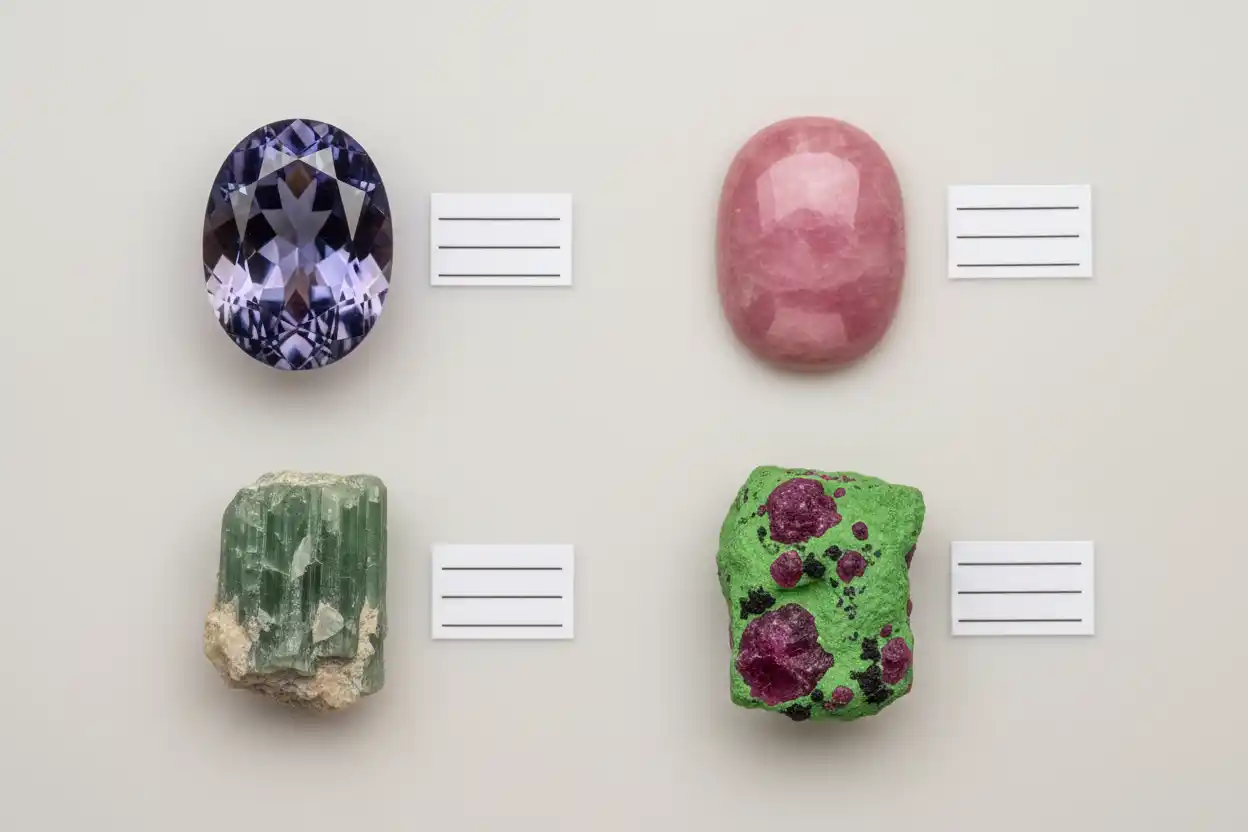
Zoisite is a calcium-aluminum sorosilicate whose varieties include blue-violet tanzanite, pink thulite and green ruby-bearing anyolite. The same mineral species can therefore appear as a transparent faceted gem, an opaque carving material or a striated collector crystal.
Its varieties have distinct market and search intent. This page explains the parent mineral, while deeper coverage remains with the dedicated guides to tanzanite, thulite and ruby in zoisite.
Zoisite at a Glance
| Property | Zoisite |
|---|---|
| Mineral class | Sorosilicate |
| Mineral group | Epidote supergroup |
| Chemical formula | Ca₂Al₃(SiO₄)(Si₂O₇)O(OH) |
| Crystal system | Orthorhombic |
| Polymorph relationship | Orthorhombic polymorph of monoclinic clinozoisite |
| Typical colors | Colorless, white, gray, green, brown, yellow, pink, red, blue and violet |
| Important gem varieties | Tanzanite, thulite and ruby in zoisite or anyolite |
| Common habit | Striated prismatic crystals, columnar masses, granular aggregates and massive rock |
| Luster | Vitreous; pearly on cleavage surfaces |
| Transparency | Transparent to opaque |
| Refractive indices | Commonly approximately 1.69–1.72 |
| Birefringence | Commonly approximately 0.006–0.018 |
| Optical character | Biaxial positive |
| Specific gravity | Approximately 3.10–3.38 |
| Mohs hardness | About 6–7 |
| Cleavage | Perfect in one direction, less distinct in another |
| Tenacity | Brittle |
| Common cuts | Faceted ovals and cushions, cabochons, beads, carvings and mineral specimens |
| Main care concern | Cleavage, brittleness, thermal shock and variety-specific treatment |
What Is Zoisite?
Zoisite contains calcium, aluminum, silicon, oxygen and hydroxyl. It belongs to the epidote supergroup but crystallizes in the orthorhombic system.
Clinozoisite has essentially the same ideal chemical composition but crystallizes in the monoclinic system. The two are polymorphs, meaning they share chemistry while arranging their atoms differently.
Trace elements create zoisite’s wide color range. Vanadium produces blue-violet tanzanite, manganese contributes pink thulite and chromium can influence some green material.
Opaque green zoisite may contain red corundum and dark amphibole, creating the decorative rock sold as ruby in zoisite or anyolite.
The broad relationship places zoisite among several materials in the types of gemstones guide, but its transparent and massive forms require different grading standards.
How Zoisite Got Its Name
Zoisite was originally called saualpite after the Saualpe Mountains in Carinthia, Austria, where the material was identified.
Abraham Gottlob Werner later named it zoisite in honor of Sigmund Zois, Baron von Edelstein, a scholar and mineral collector who recognized that the specimen represented an unknown mineral.
The word zoisite is therefore a mineral name rather than a trade description. Tanzanite, thulite and anyolite developed later as variety or commercial names.
Zoisite Colors and Forms
Green Zoisite
Ordinary zoisite commonly appears green, gray-green, yellow-green or brownish green. Iron, chromium and other trace elements may contribute to the color.
Transparent green crystals can be faceted, though they are less commercially recognized than tanzanite. Massive green material commonly becomes carvings and cabochons.
Green zoisite can resemble epidote, vesuvianite, diopside and some feldspars. Laboratory optical properties provide stronger identification than color.
Yellow and Golden Zoisite
Transparent yellow, greenish-yellow and golden zoisite is uncommon but can produce attractive collector gems.
Untreated yellow-green crystals may show noticeable pleochroism and strong internal color differences depending on orientation.
Warm stones are sometimes marketed with informal names such as golden zoisite. The term describes color rather than a formally defined variety.
Brown Zoisite
Brown and brownish-green zoisite occurs naturally and may represent the starting material for heat-treated tanzanite.
Untreated crystals can show brown, yellow-green, violet and blue pleochroic directions. Controlled heating removes much of the brown or yellow component, revealing a stronger blue-violet appearance.
Not every brown zoisite will respond successfully to treatment. Composition and crystal condition influence the result.
Blue and Violet Zoisite: Tanzanite
Tanzanite is vanadium-bearing blue-to-violet gem zoisite from the Merelani region of Tanzania.
Untreated material is commonly trichroic, showing blue, violet and brownish or yellow-green directions. Heating reduces the brown component and usually produces the familiar blue-violet dichroic appearance.
The dedicated tanzanite meaning guide owns its complete identity and symbolism. Value remains with the tanzanite price guide, while purchase-specific checks appear in the tanzanite buying guide.
Pink Zoisite: Thulite
Thulite is opaque to translucent pink or reddish zoisite colored principally by manganese.
It typically occurs as massive material rather than transparent individual crystals. Lapidaries use it for cabochons, beads, carvings and polished decorative objects.
Colors range from pale pink and rose to deep raspberry, often with white calcite, gray quartz or dark mineral inclusions.
The thulite meaning guide retains its separate formation, buying and symbolism intent.
Ruby in Zoisite or Anyolite
Ruby in zoisite is a multi-mineral rock containing red corundum crystals in green zoisite, commonly with dark amphibole.
Anyolite is a trade name derived from a Maasai word associated with green. It should not be treated as a separate mineral species.
Most red crystals in commercial material are opaque and suitable for carving rather than faceting. Some may fluoresce red under ultraviolet light because of chromium in the ruby.
The dedicated ruby-in-zoisite guide owns the complete material-specific intent.
The corundum component remains mineralogically ruby, as explained in the ruby meaning guide and types of ruby guide.
How Zoisite Forms
Zoisite forms mainly during regional and contact metamorphism of calcium-rich rocks.
It occurs in metamorphosed limestone, marble, amphibolite, eclogite and altered igneous rocks. Calcium, aluminum and silica react under appropriate pressure, temperature and fluid conditions.
The mineral may develop as prismatic crystals in veins or as granular masses distributed through the host rock.
Hydrothermal alteration can also create zoisite where hot fluids modify plagioclase feldspar and calcium-rich silicates.
Tanzanite formed under highly localized conditions involving vanadium-bearing fluids and metamorphic rocks near Merelani.
Thulite forms in manganese-bearing metamorphic environments, while ruby in zoisite develops where chromium-bearing corundum occurs within green zoisite-rich rock.
Important Zoisite Localities
Austria
The Saualpe Mountains in Carinthia are the type locality and remain historically important for ordinary zoisite.
Tanzania
The Merelani Hills produce tanzanite, the blue-violet variety found in one restricted commercial mining region.
Tanzania also produces ruby-in-zoisite material suitable for cabochons and carvings.
Norway
Norway is the classic source of thulite. Fine pink massive material has been used for carving and ornamental work.
Kenya
Kenya supplies ruby-in-zoisite or anyolite, often showing strong contrast between green matrix, red ruby and black amphibole.
Pakistan and Afghanistan
These regions have produced transparent green, yellow and brown zoisite crystals, some with strong pleochroism and facetable sections.
Additional Sources
Zoisite occurs in Switzerland, Italy, India, the United States, Canada and several other metamorphic regions.
A locality name can support geological context but should not substitute for mineral identification. Only blue-violet vanadium-bearing zoisite from the defined Tanzanian source should be sold as tanzanite.
Zoisite and Clinozoisite
Zoisite and clinozoisite have the same ideal formula but different crystal symmetry.
Zoisite is orthorhombic, while clinozoisite is monoclinic. Their colors and geological environments can overlap.
Visual identification is unreliable, particularly in massive material. Optical examination, Raman spectroscopy or X-ray diffraction can establish the structure.
Clinozoisite is also closely related to epidote. Increasing ferric iron moves compositions toward epidote within the broader group.
A green crystal should therefore not be classified as zoisite solely because it resembles a known specimen.
Inclusions and Internal Features
Transparent zoisite may contain fluid inclusions, graphite, calcite, amphibole, quartz and other mineral crystals.
Growth zoning and pleochroism can create uneven color when the cutter changes orientation.
Tanzanite commonly contains needles, crystals, fractures and liquid inclusions. The deeper treatment and authenticity questions remain with the real-versus-fake tanzanite guide.
Thulite may include calcite, quartz, manganese oxides and dark amphibole. These phases create mottled patterns and affect polishing.
Ruby-in-zoisite contains obvious red corundum grains and commonly dark amphibole. Natural boundaries are irregular rather than flat or glued.
Surface-reaching fractures can reduce the durability of transparent faceted stones. In opaque carvings, grain boundaries and mixed hardness create different wear patterns.
Identifying Zoisite
A gemologist uses refractive index, birefringence, pleochroism, specific gravity, optic character and spectroscopy.
Zoisite is biaxial positive and has refractive indices generally near 1.69–1.72. Its specific gravity commonly falls around 3.10–3.38.
Tanzanite’s strong blue-violet pleochroism is characteristic, although it can be imitated by glass, synthetic corundum and other gems.
Ordinary green zoisite can resemble epidote, vesuvianite, scapolite or green tourmaline.
Blue zoisite can resemble sapphire, iolite or kyanite.
The broader crystal identification guide explains why home scratch testing and color comparison cannot provide a conclusive answer.
Treatments and Synthetic Material
Heat treatment is the most important enhancement associated with zoisite because the vast majority of commercial tanzanite is heated.
Low-temperature heating removes brownish and yellow-green components and strengthens blue and violet. The treatment is stable under normal wear and often cannot be detected conclusively after processing.
Ordinary green, yellow and thulite material is not routinely heated on the same commercial scale.
Ruby-in-zoisite and thulite can be dyed, waxed or resin-stabilized, particularly when material is porous or fractured.
Fracture filling is rare in ordinary zoisite but may occur in transparent gems.
Laboratory-grown zoisite exists for research but has no major commercial jewelry supply. Glass, synthetic sapphire, synthetic spinel and dyed rocks are more realistic imitations.
The full terminology remains with gemstone treatments explained and lab-grown versus natural gemstones.
Cutting and Polishing
Transparent zoisite is cut into ovals, cushions, pears, rounds and emerald-style forms.
Pleochroism strongly influences orientation. A cutter must decide which blue, violet, green, yellow or brown direction will dominate the face-up stone.
Tanzanite rough is commonly oriented to favor blue or violet, sometimes sacrificing weight to improve color.
Cleavage creates a cutting risk. Pressure or heat applied along the wrong direction can split the rough.
Thulite and ruby-in-zoisite are shaped into cabochons, beads and carvings. Their mixed mineral content can undercut because ruby, zoisite, calcite and amphibole have different hardness values.
A well-polished carving should show smooth transitions rather than pits around soft inclusions or sharp raised ruby grains.
Hardness, Cleavage and Jewelry Suitability
Zoisite measures approximately 6–7 on the Mohs scale. The broader comparison appears in the gemstone hardness chart.
Its hardness is adequate for many jewelry uses, but cleavage and brittleness reduce impact resistance.
The relationship between scratching and breaking is explained in gemstone toughness versus hardness and gemstone cleavage explained.
Transparent zoisite is safest in earrings and pendants. Rings require protective settings and careful wear.
The tanzanite jewelry pages provide variety-specific guidance for rings, necklaces, earrings and bracelets.
Thulite and ruby-in-zoisite are more forgiving as thick cabochons or beads, though calcite-rich and fractured areas can still scratch or chip.
Zoisite Prices in 2026
Zoisite prices vary dramatically by variety.
Commercial green, brown or yellow massive material may sell for less than $1–$5 per carat, particularly as beads, carvings or cabochons.
Attractive transparent green or yellow faceted zoisite commonly ranges from approximately $30–$150 per carat.
Fine untreated yellow-green, mint or unusual collector stones can reach $150–$400 per carat or more when clarity, size and documentation are exceptional.
Thulite cabochons and beads commonly cost approximately $1–$10 per carat, with carving quality and Norwegian provenance affecting finished-piece prices.
Ruby-in-zoisite is generally priced by piece rather than by carat. Small cabochons may cost $5–$30, while large carvings and high-contrast designer pieces can reach several hundred dollars.
Tanzanite occupies a separate premium market and should be valued through the dedicated tanzanite price page rather than ordinary zoisite ranges.
What Determines Zoisite Value?
Variety is the first major factor. Fine tanzanite belongs to a different price tier from ordinary green massive zoisite.
Color and transparency dominate faceted-stone value. Bright yellow-green or mint material should remain lively rather than dark or gray.
Pleochroism and cutting orientation determine whether the face-up color appears balanced. Poor orientation can create large brown, gray or black zones.
Clarity matters more in transparent gems than in thulite or ruby-in-zoisite. Surface-reaching fractures reduce durability.
For opaque material, pattern and workmanship replace transparency as the main factors. Strong green-red-black contrast enhances ruby-in-zoisite, while even pink color benefits thulite.
Locality documentation can add collector interest, particularly for unusual untreated crystals.
Buying Guidance
Confirm the variety before comparing prices. Tanzanite, thulite and ruby-in-zoisite should not be valued as interchangeable colors of one commercial gem.
Assume blue-violet tanzanite has been heated unless credible evidence indicates otherwise. Treatment is accepted but should still be disclosed.
Inspect transparent stones under daylight-equivalent and warm lighting to evaluate pleochroism, extinction and color balance.
For green or yellow faceted zoisite, request a laboratory report when the stone carries a rarity premium.
Check thulite and ruby-in-zoisite for dye concentration, resin-filled cracks and uneven polish.
A seller should identify ruby-in-zoisite as a multi-mineral rock rather than implying that the entire green material is ruby.
Cleaning, Water, Heat and Sunlight
Clean sound zoisite with lukewarm water, mild soap and a soft brush or cloth.
Avoid ultrasonic and steam cleaners because heat, vibration, cleavage and fractures can damage the stone.
The complete procedure for the blue-violet variety appears in how to clean tanzanite jewelry.
Brief water contact is generally acceptable for untreated zoisite, but prolonged soaking is unnecessary. Dyed, stabilized, glued or mixed-mineral pieces require greater caution.
High heat can fracture zoisite and alter color. Keep jewelry away from torches, steam and sudden temperature changes.
Natural zoisite colors are generally stable under ordinary indoor light. Nevertheless, dyes, resin and adhesive can fade or deteriorate with prolonged heat or sunlight.
Store each piece separately from harder gems. A padded compartment also prevents ruby grains in anyolite from scratching neighboring softer materials.
Meaning and Symbolism
Modern traditions associate zoisite with development, creativity, patience and the ability to recognize change without abandoning personal identity.
Its different varieties encourage distinct interpretations. Green zoisite is linked with growth, blue-violet tanzanite with reflection and communication, pink thulite with affection and ruby-in-zoisite with the balance of vitality and steadiness.
These meanings are cultural, spiritual or personal rather than scientifically established mineral effects.
Color-based symbolism overlaps modern guides to green crystals, blue crystals, pink crystals and purple crystals.
Tanzanite is also recognized as a modern December birthstone.
Frequently Asked Questions
1. Is zoisite a mineral or a gemstone family?
Zoisite is one mineral species with several important gem and ornamental varieties, including tanzanite, thulite and ruby in zoisite.
2. Is tanzanite the same as zoisite?
Tanzanite is the blue-to-violet vanadium-bearing gem variety of zoisite from the Merelani region of Tanzania.
3. Is thulite a type of zoisite?
Yes. Thulite is pink to reddish manganese-bearing zoisite, commonly cut as cabochons, beads and carvings.
4. What is anyolite?
Anyolite is a trade name for ruby in green zoisite, commonly with dark amphibole. It is a multi-mineral rock rather than one crystal species.
5. How is zoisite different from clinozoisite?
They have essentially the same ideal chemistry but different crystal symmetry. Zoisite is orthorhombic, while clinozoisite is monoclinic.
6. What colors can zoisite be?
Zoisite can be colorless, white, gray, green, yellow, brown, pink, red, blue or violet.
7. Is all blue zoisite tanzanite?
Blue-violet gem zoisite from the defined Tanzanian source is marketed as tanzanite. Similar-looking material without that origin should be described more cautiously.
8. Is zoisite normally treated?
Most commercial tanzanite is heated to remove brownish color. Ordinary green zoisite and thulite are less routinely treated, though dye and resin can occur in opaque material.
9. Is ruby in zoisite natural?
Yes. Genuine material contains natural ruby crystals within green zoisite-rich rock, commonly with dark amphibole.
10. Is zoisite suitable for everyday rings?
Transparent zoisite can be worn in a protective ring setting, but cleavage and brittleness make earrings and pendants safer for frequent use.
11. How much is zoisite worth?
Ordinary massive material can be inexpensive, while transparent green or yellow gems may cost $30–$400 per carat. Tanzanite has a separate and generally higher-value market.
12. Does zoisite have scientifically proven healing properties?
No. Its symbolism may hold personal or cultural meaning, but scientific evidence does not establish medical, emotional or metaphysical healing effects.
Zoisite is best understood as one mineral with several dramatically different expressions. Transparent tanzanite, opaque pink thulite and green ruby-bearing anyolite share a structural identity, yet each requires its own standards for color, treatment, cutting, value and wear.
Zoisite appears in Crystals That Start With Z and Gemstones That Start With Z.