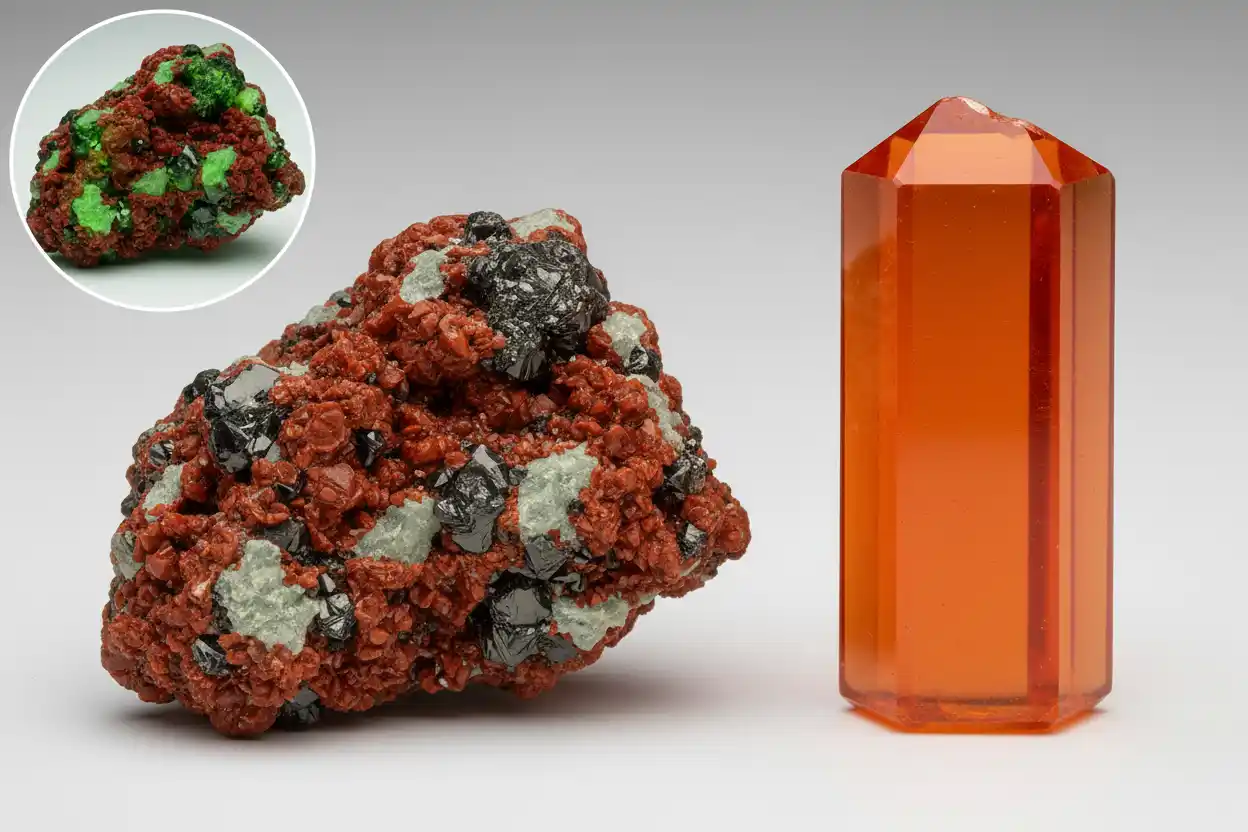
Zincite Meaning, Properties, Value and Identification
Zincite is the natural mineral form of zinc oxide, recognized for its red, orange, yellow and brown coloration. Well-formed natural crystals are exceptionally scarce, and much of the large, sharply crystallized “zincite” sold online is synthetic or an industrial furnace product rather than material mined from a geological deposit.
The mineral is historically linked with the zinc deposits of Franklin and Sterling Hill, New Jersey, where it occurs with willemite, franklinite and calcite. Its rarity, high density and strong red-to-yellow pleochroism give it mineralogical interest, but its softness, cleavage and frequent synthetic substitution limit everyday jewelry use.
Zincite at a Glance
| Property | Zincite |
|---|---|
| Mineral class | Oxide |
| Chemical formula | ZnO |
| Crystal system | Hexagonal |
| Structure type | Wurtzite structure |
| Typical natural colors | Deep red, orange-red, orange, yellow-orange, brown and occasionally yellow |
| Pure synthetic color | Colorless; dopants and structural defects create other colors |
| Crystal habit | Rare hemimorphic crystals; more commonly granular, foliated, massive or rounded |
| Luster | Subadamantine, resinous to submetallic |
| Transparency | Transparent in rare thin crystals; usually translucent to opaque |
| Refractive indices | Approximately 2.013–2.029 |
| Birefringence | Approximately 0.016 |
| Optical character | Uniaxial positive |
| Specific gravity | Approximately 5.43–5.70 |
| Mohs hardness | About 4–4.5 |
| Cleavage | Perfect basal cleavage |
| Tenacity | Brittle |
| Common use | Mineral specimens, rare collector gems, research crystals and historic radio detectors |
| Main care concern | Softness, cleavage, synthetic confusion and contamination risks from industrial material |
What Is Zincite?
Zincite consists principally of zinc and oxygen. Its ideal formula, ZnO, is chemically simple compared with many silicates, yet natural zincite is remarkably uncommon.
Pure zinc oxide is colorless. The familiar red, orange and yellow colors of natural zincite result from manganese, iron, lattice defects and related chemical or structural factors.
Natural material from New Jersey commonly occurs as irregular grains and masses rather than freestanding crystals. Individual grains may be embedded within white calcite or associated with black franklinite and green-fluorescing willemite.
The mineral’s dense oxide composition separates it from lower-density zinc minerals such as sphalerite, which is zinc sulfide, and smithsonite, which is zinc carbonate.
Why Is Natural Zincite So Rare?
Zinc oxide forms easily in industrial furnaces, but geological environments rarely allow large quantities of crystalline zincite to remain stable.
Most natural zinc deposits contain zinc as sulfides, carbonates or silicates rather than as a simple oxide. Oxygen, sulfur, carbon dioxide, silica and circulating fluids commonly favor other zinc minerals.
Franklin and Sterling Hill developed under unusual metamorphic and chemical conditions. Their complex zinc-manganese-iron ore bodies produced mineral assemblages found almost nowhere else at comparable scale.
Natural zincite crystals remain especially rare because the mineral more often grew as granular or foliated material. Sharp, transparent natural crystals large enough for faceting are therefore far less common than the brightly colored synthetic crystals seen in modern markets.
Zincite’s Name and History
The material was initially called red oxide of zinc. Wilhelm Karl von Haidinger introduced the name zincite during the nineteenth century, referring directly to its zinc content.
Historic synonyms include spartalite and sterlingite. Those names are obsolete but may appear on old specimen labels.
Zincite also played a role in early electronics. Natural or synthetic zinc oxide crystals could function as semiconductor detectors in crystal radios, often paired with a fine wire or another mineral such as galena.
Today, zinc oxide has broad industrial and technological importance, but commercial zinc oxide powder is not equivalent to a collectible natural zincite specimen.
Zincite Colors
Red Zincite
Deep red is the color most strongly associated with natural Franklin zincite. Fine grains can appear ruby red along thin edges, although most specimens remain translucent or opaque.
Manganese-related substitutions and structural defects contribute to red coloration. The precise balance varies among individual grains.
Red material fits visually within collections of red crystals, though its identity rests on zinc-oxide chemistry rather than color symbolism.
Orange Zincite
Orange and orange-red zincite is common among both natural and synthetic material. Natural specimens often show warm burnt-orange or vermilion tones beside darker ore minerals.
Industrial furnace-grown crystals frequently display brighter, more transparent orange colors. Therefore, an intense orange crystal should not be assumed natural.
Orange specimens may also appear in modern collections of orange crystals.
Yellow Zincite
Yellow and yellow-orange material occurs naturally but is less familiar than red-orange zincite. Pure synthetic zinc oxide can also be colorless or pale, while controlled defects and dopants produce yellow crystals.
The broader cultural meanings assigned to yellow stones appear in the yellow crystals guide, but those associations do not establish mineral authenticity.
Brown and Dark Zincite
Brown, red-brown and nearly black zincite can result from deep body color, inclusions, surface alteration or intergrowth with dark minerals.
Thin edges may reveal red or yellow internal color that is hidden in ordinary reflected light.
Franklin and Sterling Hill Zincite
Franklin and Sterling Hill in New Jersey are zinc-manganese-iron deposits famous for their mineral diversity and fluorescent ores.
Zincite occurs with willemite, franklinite, calcite, tephroite and numerous rare minerals. White calcite commonly provides a contrasting matrix, while black franklinite produces dark granular areas.
Although Franklin and Sterling Hill are geographically close, collectors preserve the mine distinction when reliable labels exist. Precise locality can influence both scientific and collector value.
The mines no longer produce commercial zinc ore, so natural zincite generally comes from historic collections, old stock, mine dumps where collecting is permitted, or documented museum exchanges.
Natural material from these deposits should not be confused with imported furnace zincite merely described as “Franklin-type” because of its red-orange color.
How Zincite Forms
Natural zincite at Franklin and Sterling Hill formed during high-grade metamorphism and chemical reorganization of unusual zinc- and manganese-rich deposits.
Heat and pressure recrystallized the original sedimentary or hydrothermal material. Zinc, oxygen and associated elements formed an assemblage containing zincite, willemite and franklinite.
This geological origin differs from the weathering process that creates secondary zinc carbonates and silicates in oxidized ore zones.
For example, smithsonite commonly forms through near-surface alteration, while sphalerite is generally a primary hydrothermal or metamorphic sulfide.
Zincite can occur at a few additional localities, but natural crystals remain rare worldwide. Many reported modern specimens require close verification because furnace-grown material has entered mineral collections.
Natural Versus Synthetic Zincite
Synthetic zinc oxide crystals are grown for electronics, optics, research and industrial applications. They can also form accidentally as furnace products during zinc smelting.
Large synthetic crystals commonly show sharp hexagonal forms, vivid transparency and colors ranging from colorless and pale green to yellow, orange and dark red.
Natural Franklin zincite is more likely to be granular, rounded, foliated or embedded in a characteristic ore association. However, appearance alone cannot provide certainty.
Some furnace crystals are marketed as Polish zincite because they originated near zinc-processing facilities in Poland. They may be genuine crystalline ZnO but are anthropogenic rather than geological minerals.
That distinction is similar to the broader natural-versus-manufactured terminology explained in lab-grown versus natural gemstones.
A seller should state one of the following clearly:
- Natural geological zincite with documented locality
- Laboratory-grown synthetic zincite
- Anthropogenic furnace zincite
- Unknown-origin zinc oxide crystal
Calling every furnace product natural zincite misrepresents its origin, even when its chemistry is ZnO.
Inclusions and Internal Features
Natural zincite may contain franklinite, willemite, calcite, tephroite and other associated minerals.
Dark opaque inclusions can occur within red-orange grains. Fractures, grain boundaries and cleavage planes are also common.
Transparent synthetic crystals may show curved growth lines, color zoning, gas bubbles, metallic inclusions or furnace residue. However, a clean interior does not automatically prove laboratory growth.
Pleochroism is one of zincite’s notable optical properties. Depending on orientation, a transparent crystal may appear deep red in one direction and yellow or orange in another.
A microscope can reveal useful evidence, but chemical composition alone does not determine geological origin. Provenance, morphology and trace-element analysis may all be required.
How to Identify Zincite
Zincite’s high density and refractive index distinguish it from many red-orange minerals.
A professional gemologist may observe uniaxial optical behavior, strong red-yellow pleochroism and refractive indices slightly above 2.00.
Its specific gravity near 5.5 makes it substantially heavier than quartz, calcite or most ordinary glass.
Raman spectroscopy and X-ray diffraction can confirm zinc oxide. X-ray fluorescence or electron-microprobe analysis can detect manganese, iron and other trace elements.
Those tests may confirm ZnO without proving natural origin. A furnace crystal and a natural crystal share the same essential mineral chemistry.
The identification approach in how to identify crystals should therefore be combined with locality documentation and examination of growth features.
Common Zincite Lookalikes
Synthetic Zincite
Synthetic and furnace-grown zincite are the most important sources of confusion because they share zincite’s chemistry and physical properties.
The key distinction is origin rather than mineral identity.
Crocoite
Crocoite forms bright orange-red lead-chromate crystals. It commonly develops long, slender prisms rather than zincite’s rare hemimorphic forms and requires stricter toxic-mineral handling.
Wulfenite
Wulfenite can show yellow, orange and red colors but usually forms square tetragonal plates. It is also significantly denser and contains lead.
Vanadinite
Vanadinite forms red-orange hexagonal barrels and contains lead. Its habit may look superficially similar to hexagonal synthetic zincite, but laboratory properties differ.
Sphalerite
Sphalerite can be red, orange or yellow and has high brilliance. However, it has a different crystal structure, composition and prominent cleavage.
Its separate market and valuation are covered in the sphalerite price guide and sphalerite buying guide.
Glass and Resin
Colored glass and resin can imitate transparent furnace zincite. Bubbles, low density and lower refractive index usually reveal the difference.
Treatments and Enhancement
Natural zincite is not routinely heated, irradiated or dyed. Its rarity and mineral association create more value than a standardized gemstone color.
Coating and oiling may improve the appearance of fractured or dull material, though these practices are not considered normal trade treatments.
Synthetic crystals can be intentionally doped to produce color. Manganese, cobalt and other additives influence optical and electrical properties.
A brightly colored laboratory zincite is not treated natural material; it is a manufactured crystal whose composition and growth conditions were controlled.
General disclosure terminology appears in gemstone treatments explained.
Cutting and Polishing
Faceting natural zincite is extremely uncommon. Suitable transparent crystals are scarce, and perfect basal cleavage can split the rough during preforming or polishing.
Its hardness of about 4–4.5 also makes facet edges vulnerable to abrasion. Even successful collector gems can lose sharpness during storage or handling.
Synthetic crystals provide larger and cleaner material for experimental cutting. Their high refractive index can produce strong brilliance, although body color may become overly dark in deep stones.
Cutters must orient transparent rough to balance red-yellow pleochroism. Excessive depth can turn an orange crystal nearly black face-up.
Fine documented Franklin material should generally remain intact as a specimen. Cutting away its associated ore can destroy locality evidence and reduce collector value.
Hardness, Cleavage and Jewelry Suitability
Zincite’s hardness is similar to fluorite or apatite, depending on the specimen. Its position is shown in the gemstone hardness chart.
The mineral also has perfect cleavage in one direction. The principles in gemstone cleavage explained clarify why a stone can split even when it has not been scratched deeply.
Hardness and breakage resistance are different properties, as discussed in gemstone toughness versus hardness.
Zincite is unsuitable for everyday rings or bracelets. A small synthetic or natural collector gem can be worn in a protected pendant, but exposure to impact, grit and chemicals should remain limited.
Mineral specimens are best stored in individual boxes where they cannot rub against quartz or harder crystals.
Zincite Prices in 2026
Zincite pricing depends primarily on origin. Natural Franklin material, synthetic crystals and furnace products should not share one price category.
Small natural Franklin specimens commonly retail for approximately $20–$100, depending on association, color, documentation and condition.
Better historic specimens with distinct red-orange zincite, willemite and franklinite can range from $100–$500. Exceptional old-collection or museum-quality pieces may exceed that range.
Natural faceted zincite is exceptionally scarce. Broad commercial references place natural faceted material around $40–$65 per carat at wholesale, while specialist retail stones may command approximately $75–$250 per carat or more when natural origin is credible.
Synthetic faceted zincite commonly begins around $10–$40 per carat, although unusual sizes, colors and precision cuts can cost more.
Large furnace crystals may sell for $20–$200 per piece depending on color and aesthetics. Their size should not be used to imply natural rarity.
Practical Buying Guidance
Ask the seller to state the origin category explicitly. The words genuine zincite confirm chemistry but do not answer whether the crystal formed naturally.
For natural material, request the mine, collection history and photographs of the complete specimen. Franklin and Sterling Hill pieces should usually show a plausible ore association.
Be cautious with large transparent hexagonal crystals advertised as rare natural zincite at low prices. Natural crystals of that quality are extraordinarily uncommon.
Inspect synthetic or furnace crystals for unstable residue, metallic contamination and sharp fragile edges.
A laboratory report can confirm zinc oxide and detect trace elements. However, origin may still depend on growth features and provenance.
Never pay a natural-crystal premium based only on a bright red-orange color.
Cleaning, Water, Heat and Sunlight
Remove dust with a soft brush or hand air blower. Avoid rubbing granular Franklin material because individual grains can loosen from calcite matrix.
Brief contact with lukewarm water may be acceptable for a sound specimen, but soaking is unnecessary. Furnace crystals and attached residues may respond unpredictably.
The broader water-safe crystal guide should be adapted to the specimen’s complete mineral association.
Avoid acids, alkaline cleaners, ultrasonic equipment and steam. Cleavage, fractures and mixed matrix minerals create several damage risks.
Natural red-orange color is generally stable in ordinary indoor light. Nevertheless, coatings, adhesives and some synthetic colors may react to heat or intense exposure, so conservative display guidance from crystals that fade in sunlight remains appropriate.
Store zincite in a dry, padded compartment away from harder minerals.
Safe Handling
Zincite is zinc oxide rather than a lead- or arsenic-bearing mineral, but collector specimens should still not be ingested or used to prepare drinking water.
Industrial furnace crystals may contain metallic residues or contaminants from the production environment. Their purity cannot be assumed from appearance.
Cutting, grinding or drilling generates fine zinc-oxide and associated mineral dust. Use wet methods, local ventilation and suitable respiratory and eye protection.
Wash hands after handling dusty, damaged or industrial-origin pieces. Keep loose fragments away from children and pets.
The broader principles in the toxic crystals safety list apply without implying that intact zincite carries the same hazard level as lead minerals.
Meaning and Symbolism
Modern crystal traditions often associate zincite with motivation, creativity, confidence and converting ideas into practical action.
Its red, orange and yellow colors encourage personal symbolism connected with energy, enthusiasm and persistence.
Natural zincite’s scarcity can also represent authenticity and the importance of distinguishing a genuine origin from an attractive imitation.
These interpretations are cultural, spiritual or personal rather than scientifically demonstrated effects of zinc oxide.
Frequently Asked Questions
1. Is zincite a natural mineral?
Yes. Zincite is a recognized natural mineral with the formula ZnO, although large natural crystals are exceptionally rare.
2. Why is most zincite online synthetic?
Zinc oxide crystallizes readily in laboratories and industrial furnaces, producing larger and cleaner crystals than nature usually provides.
3. Is furnace zincite the same as synthetic zincite?
Both are human-produced. Laboratory-grown crystals are intentionally manufactured, while furnace zincite may form as an industrial by-product.
4. What causes natural zincite’s red-orange color?
Manganese, iron, lattice defects and related structural factors contribute to the color. Pure zinc oxide is colorless.
5. Where is natural zincite found?
The most important natural occurrence is at Franklin and Sterling Hill, New Jersey. Smaller occurrences exist elsewhere, but fine crystals remain rare.
6. How can natural zincite be distinguished from synthetic material?
Chemistry alone cannot separate them. Crystal habit, inclusions, trace elements, ore association and documented provenance must be evaluated together.
7. Does zincite fluoresce?
Zincite itself is often weakly fluorescent or nonfluorescent, although associated Franklin minerals may glow strongly under ultraviolet light.
8. Is zincite suitable for an everyday ring?
No. Its hardness, brittleness and perfect cleavage make it unsuitable for frequent ring wear.
9. Can zincite go in water?
Brief gentle rinsing may be acceptable for a clean stable specimen, but soaking is unnecessary and may affect matrix minerals or industrial residues.
10. Is zincite toxic?
Intact natural zincite is not handled like a lead mineral, but dust should not be inhaled or ingested. Industrial-origin crystals may contain unknown contaminants.
11. How much is natural zincite worth?
Small Franklin specimens may cost $20–$100, while fine documented pieces can reach several hundred dollars. Natural faceted material is scarce and may sell well above synthetic zincite.
12. Does zincite have scientifically proven healing properties?
No. Its symbolism may carry personal meaning, but scientific evidence does not establish medical, emotional or metaphysical healing effects.
Zincite’s market requires unusual precision because a crystal can be chemically genuine yet geologically artificial. The most meaningful natural specimens preserve not only red-orange zinc oxide but also the mineral associations and documented history of the exceptional Franklin–Sterling Hill ore district.
Zincite appears in Crystals That Start With Z and Gemstones That Start With Z.
Safety disclaimer: Do not ingest zincite or use it to prepare crystal-infused water. Avoid cutting or grinding specimens without wet dust suppression, local ventilation and appropriate protective equipment, especially when the material has an industrial furnace origin.