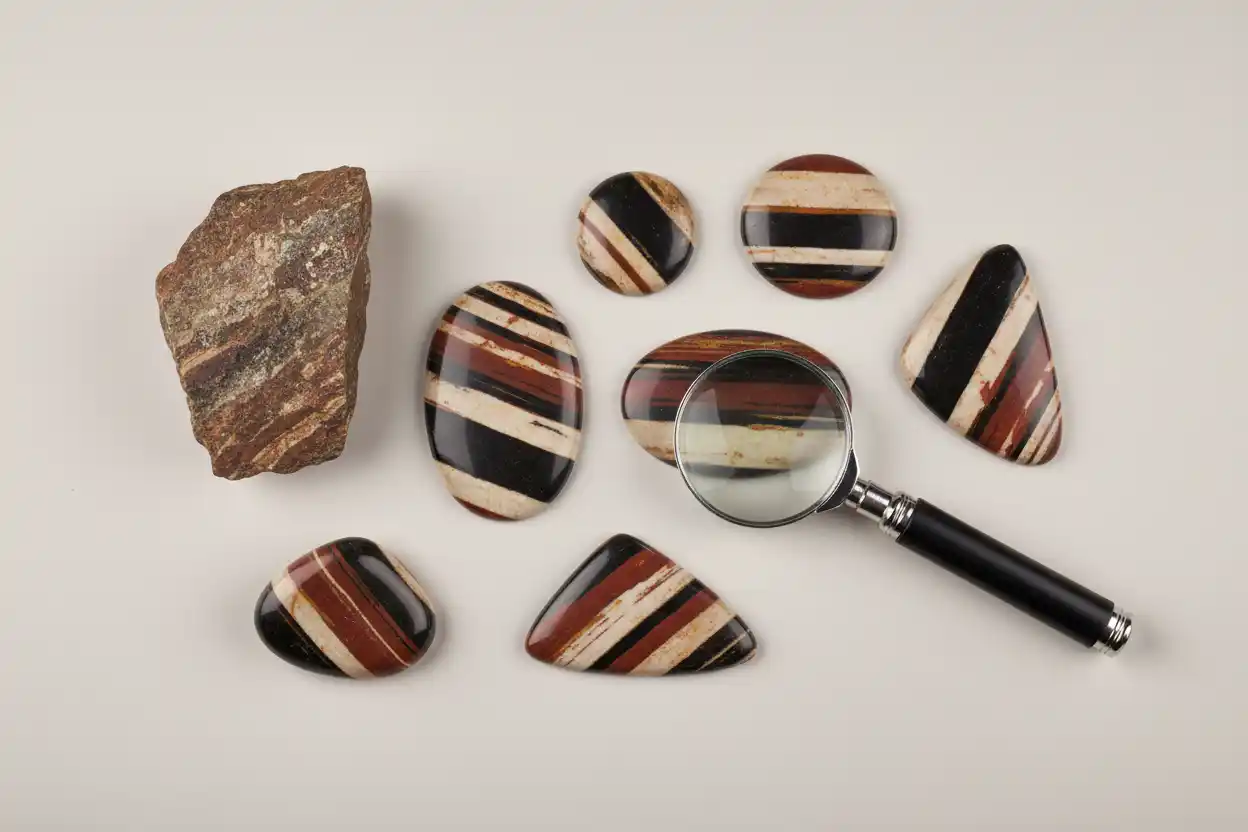
Zebra Jasper Meaning, Properties, Uses and Identification
Zebra Jasper is a commercial name for striped opaque lapidary material, usually sold as a form of jasper or chalcedony. Its alternating black, white, cream, brown, red or gray bands create the animal-like pattern behind the name.
The label is not a tightly defined mineral variety. Some market material is silica-rich jasper, while other “zebra” stones can be carbonate rock, mixed metamorphic material or another banded stone, making identification more important than the trade name.
Zebra Jasper at a Glance
| Property | Zebra Jasper |
|---|---|
| Name status | Commercial pattern name rather than a formally defined mineral species |
| Typical material | Opaque silica-rich jasper or chalcedony, though market material varies |
| Common composition | Microcrystalline quartz with iron oxides, manganese oxides, clay and other mineral impurities |
| Typical colors | Black and white, brown and cream, red and cream, gray and white, or multicolored |
| Crystal structure | Aggregate of microscopic quartz and chalcedony when genuine jasper |
| Luster | Dull to waxy when rough; vitreous to waxy after polishing |
| Transparency | Opaque, occasionally translucent at thin edges |
| Refractive index | Commonly near 1.53–1.54 for quartz-rich material |
| Specific gravity | Commonly about 2.5–2.9, but variable in mixed rocks |
| Mohs hardness | Approximately 6.5–7 when true jasper; lower in carbonate-rich mislabels |
| Cleavage | None in quartz-rich jasper |
| Tenacity | Generally tough for a brittle siliceous material |
| Common cuts | Cabochons, beads, tumbles, carvings, slabs and free-form pendants |
| Main care concern | The trade name covers materials with different hardness, porosity and chemical sensitivity |
What Is Zebra Jasper?
Jasper is a broad lapidary term for dense, opaque, silica-rich material composed largely of microcrystalline quartz or chalcedony with additional mineral impurities.
Zebra Jasper describes jasper-like material with contrasting stripes. The bands may be straight, curved, broken, wavy or irregular.
No international mineralogical rule defines the exact color combination, country of origin or chemical composition required for the name. Consequently, two Zebra Jasper products can differ significantly under a microscope or laboratory instrument.
The material should fit within the wider jasper meaning guide only when silica-rich jasper or chalcedony actually dominates. Its parent mineral relationship is explained further in the chalcedony guide.
Is Zebra Jasper a Formal Jasper Variety?
Zebra Jasper is a recognized retail name but not a formal mineral species or chemically standardized jasper variety.
The term describes pattern first. A vendor may use it for black-and-white jasper, red-banded silica rock or a striped material with only limited quartz.
This flexible usage resembles the way many names in the types of jasper guide combine pattern, locality and marketing history rather than strict mineral species.
A trustworthy seller should be able to explain what the material is, where it came from and whether its hardness and composition support the jasper label.
The page should not absorb the broader intent of the review-only Zebra Stone or Zebra Calcite entries. Those names can refer to different rocks and minerals even when their patterns look similar.
Zebra Jasper Colors and Commercial Types
Black-and-White Zebra Jasper
Black-and-white material creates the strongest zebra-like contrast. Black areas may contain manganese oxides, iron-rich minerals, carbonaceous material or other dark inclusions.
White bands may consist of pale chalcedony, quartz or a lighter host-rock component. If the pale material reacts with acid or scratches easily, the stone may not be true jasper.
Brown-and-Cream Zebra Jasper
Brown, tan and cream stones are common in beads, carvings and tumbled material. Iron oxides usually contribute warm brown, yellow or reddish colors.
The pattern can resemble picture jasper, although Zebra Jasper typically emphasizes repeated contrast rather than landscape-like scenes.
Red Zebra Jasper
Red Zebra Jasper combines red, cream, white, gray or black bands. Hematite and other iron oxides commonly produce the red areas.
Some rough sold under this name comes from Mexico and accepts a bright polish. However, “Mexican Red Zebra Jasper” is a locality-linked commercial description rather than one formal geological variety.
Its red portions may resemble red jasper, while pale bands create a different visual identity.
Yellow or Golden Zebra Jasper
Yellow, mustard and cream bands result from hydrated iron oxides, clay or related impurities. The color overlaps the broader material discussed in the yellow jasper guide.
Green Zebra Jasper
Green-striped material appears occasionally in the crystal market. Some examples contain chlorite, epidote or altered volcanic minerals rather than conventional jasper alone.
A green-and-white pattern should therefore be tested before the seller applies a jasper premium.
Pink Zebra Jasper
Pink, mauve and gray striped material is sometimes marketed as Zebra Jasper. Dyeing is more likely when the color is unusually bright, perfectly uniform or concentrated within cracks.
How Zebra Patterns Form
No single geological process creates every material sold as Zebra Jasper.
In genuine silica-rich jasper, alternating bands can form through changes in sediment composition, repeated silica deposition, iron-oxide concentration or fracture filling.
Some material begins as volcanic ash, sediment or chemically precipitated silica. Later burial, metamorphism or hydrothermal alteration compacts and silicifies the rock.
Iron-rich layers become red, brown or yellow, while manganese or carbonaceous components produce black bands. Pale layers may contain purer silica or fewer coloring impurities.
Brecciation can break an earlier rock into fragments before later silica fills the cracks. The result may appear striped, netted or angular rather than evenly layered.
Metamorphic deformation can fold and stretch pre-existing bands. Therefore, wavy zebra patterns may record geological pressure rather than simple horizontal sediment layers.
Why Locality Claims Are Difficult
Zebra-patterned lapidary material is sold from India, Africa, Mexico, Australia, the United States and other regions.
Many retail listings provide only a country or wholesale trade route rather than a mine. Material can also be exported, cut and sold from a country that was not its geological source.
Because the name lacks one type locality, pattern resemblance cannot establish origin.
A seller describing a rare mine-specific Zebra Jasper should provide acquisition history or supporting geological information. Otherwise, the material should be evaluated by composition, pattern and workmanship rather than an unsupported locality premium.
Internal Structure and Inclusions
True jasper consists of microscopic quartz and chalcedony grains mixed with other mineral phases.
Iron oxides such as hematite and goethite can produce red, orange, yellow and brown colors. Manganese oxides frequently create black dendrites, spots or bands.
Clay minerals, feldspar, calcite, magnetite and volcanic fragments may occur within the rock. Their presence explains why some areas polish differently from others.
Fine fractures can follow color boundaries. These cracks may be naturally filled with later quartz or remain open enough to absorb dye and resin.
Opaque material does not show conventional transparent-gem inclusion scenes. Identification focuses instead on grain texture, band continuity, hardness and the behavior of different mineral zones.
Zebra Jasper Versus Other Jasper Trade Names
Dalmatian Jasper usually shows black spots in a pale background rather than continuous zebra-like bands. Moreover, detailed analysis has shown that some Dalmatian material is not conventional jasper.
Picasso Jasper commonly displays dark linear markings and angular fractures through a gray, white or brown ground. Its network can resemble Zebra Jasper but tends to look more fragmented or brushlike.
Dragon Blood Jasper usually shows red patches against dark green material rather than black-and-white stripes.
Ocean Jasper and orbicular jasper are defined visually by rounded orb patterns instead of stripes.
These commercial distinctions are useful for shopping, but laboratory identification must still address the actual mineral phases.
Zebra Jasper Lookalikes and Mislabels
Zebra Calcite
Banded calcite can show black, gray, cream and honey layers. It is much softer than quartz-rich jasper and reacts with acid.
Banded Marble
Marble may create black-and-white or green-and-white patterns. Its calcite or dolomite content makes it softer and more acid-sensitive than jasper.
Zebra Stone
The term Zebra Stone is used for several Australian and international banded rocks. Some consist of clay-rich siltstone or other sedimentary material rather than jasper.
Onyx and Banded Calcite
Retail “onyx” often refers to banded calcite rather than quartz onyx. A zebra-like black-and-white product may therefore be carbonate material with a lower hardness.
Gneiss and Metamorphic Rock
Folded light and dark minerals in gneiss can create natural zebra stripes. The coarse crystalline texture distinguishes it from fine-grained jasper.
Dyed Howlite or Magnesite
White porous stones with gray veins can be dyed black, red or green. Their low hardness and concentrated dye separate them from genuine quartz-rich jasper.
How to Identify Zebra Jasper
Begin by treating Zebra Jasper as a provisional trade label rather than a confirmed mineral identity.
True silica-rich jasper should resist scratching from ordinary steel and approach hardness 6.5–7. Finished jewelry should not be subjected to destructive tests, but a lapidary offcut can be examined professionally.
A spot refractive-index reading near the quartz range supports chalcedony-rich material. Specific gravity near 2.6 is also consistent, although iron-rich inclusions may increase it.
Carbonate-rich substitutes can react with dilute acid. Acid testing should be performed only by a knowledgeable person on an inconspicuous rough sample because it permanently damages the surface.
Raman spectroscopy, X-ray diffraction and petrographic microscopy can determine whether quartz, calcite, feldspar or another mineral dominates.
The broader methods in how to identify crystals are especially important when the commercial name is visually descriptive rather than mineralogically precise.
Treatments, Stabilization and Imitations
Most dense Zebra Jasper is polished without treatment. Its natural pattern provides the main commercial appeal.
Wax or oil may deepen colors and hide a dry surface. These coatings can wear away or attract dirt.
Dye is possible in porous or fractured material. Black, red, blue and green dyes may concentrate along cracks, drill holes or pale bands.
Resin stabilization can strengthen weak or brecciated rough. The treatment is useful for lapidary work but should be disclosed.
Composite material may combine stone chips or powder with resin. Repeated patterns, rounded bubbles and a plastic-rich polish can reveal reconstruction.
There is no meaningful commercial category of synthetic Zebra Jasper. Manufacturers imitate the appearance with resin, glass, ceramic or reconstituted stone rather than growing a chemical equivalent.
The terminology follows gemstone treatments explained and lab-grown versus natural gemstones.
Cutting and Polishing
Quartz-rich Zebra Jasper is well suited to cabochons, beads, carvings, slabs and tumbled stones.
A cutter studies the band direction before sawing. A cut perpendicular to the layers produces repeated stripes, while a cut parallel to them can reveal broad blocks of color.
Curved free-form shapes often display the pattern better than small calibrated ovals. Large slabs may create dramatic bookmatched pairs when cut consecutively.
True jasper takes a bright, durable polish. Mixed rocks can undercut where softer calcite, clay or altered minerals wear faster than quartz.
The material is popular for the techniques described in rock tumbling for beginners and tumbled stones, provided all pieces in the barrel have compatible hardness.
It also suits the projects discussed in best gemstones for carving and cabochons.
Hardness, Toughness and Jewelry Suitability
True jasper commonly measures 6.5–7 on the Mohs scale, as shown in the gemstone hardness chart.
Its microscopic interlocking texture gives it reasonable practical toughness, although it remains a brittle siliceous material.
The distinction explained in gemstone toughness versus hardness matters when a stone contains fractures or contrasting soft bands.
Cabochons work well in pendants, earrings, bracelets and occasional-wear rings. A bezel protects exposed edges better than minimal prongs.
Beads are durable when the drill holes are smooth and the material is genuine jasper. Carbonate-rich substitutes may scratch or dull considerably faster.
Zebra Jasper Prices in 2026
Zebra Jasper is usually inexpensive and sold by piece, size or weight rather than by formal per-carat grading.
Small tumbled stones commonly retail for approximately $1–$6 each.
Commercial beads and small cabochons often cost $2–$15. Current free-form cabochons are commonly listed near $7, while simple imported stones may cost less.
Better patterned cabochons, matched pairs and larger designer cuts commonly range from $15–$60.
Rough material often sells for approximately $6–$20 per pound, depending on color, block size and suitability for slabbing.
Large spheres, carvings, towers and decorative objects may range from $25–$150 or more, with workmanship contributing more value than the raw stone.
A Zebra Jasper product should rarely command fine-gem prices. High premiums require exceptional artistry, unusual documented locality or laboratory-confirmed material rather than the pattern name alone.
What Determines Value?
Pattern balance is the leading factor. Clear contrasting bands generally attract more interest than muddy or poorly defined colors.
The face should display a complete visual composition. A small cabochon with well-positioned stripes may be more attractive than a larger stone with an awkward pattern.
Polish quality matters because pits and undercut bands suggest soft components, fractures or rushed finishing.
Natural untreated color is preferable to concentrated dye when the seller charges a collector premium.
Size influences decorative objects, but craftsmanship, symmetry and finish usually exceed raw material value.
Buying Guidance
Ask whether the seller has verified that the material is silica-rich jasper rather than calcite, marble or another banded rock.
Review photographs of both the front and back. Dye concentration, resin and pale unpolished interiors may become clearer at the edges.
Do not pay a major locality premium without documentation. Country names in marketplace listings frequently describe a supply chain rather than the original deposit.
Check that drill holes and thin points are free from cracks. Broad dark bands can hide fractures under weak lighting.
The seller principles in where to buy jasper apply, but Zebra Jasper requires extra attention to the ambiguity of its trade name.
Cleaning, Water, Heat and Sunlight
Confirmed untreated jasper can be cleaned with lukewarm water, mild soap and a soft brush. Rinse and dry it thoroughly.
If the composition is uncertain, avoid prolonged soaking. Carbonate-rich material, dye, resin and glued settings may respond differently from quartz.
The distinctions in crystals that can go in water should therefore be applied only after identifying the material.
Avoid ultrasonic and steam cleaning when fractures, mixed mineral bands or treatment are present.
Natural jasper colors are generally stable in ordinary light. Dyes and resin may fade or discolor under prolonged heat and sunlight, so the guidance in crystals that fade in sunlight remains relevant.
Store the stone away from diamond, sapphire and other harder gems. Dry personal practices from how to cleanse crystals avoid unnecessary chemical exposure.
Meaning and Symbolism
Modern crystal traditions associate Zebra Jasper with balance, cooperation, practicality and the integration of apparent opposites.
The contrasting bands encourage personal symbolism involving light and shadow, activity and rest, individuality and community, or structure and spontaneity.
Some people use it as a reminder that contrast can create a complete pattern rather than a conflict.
These meanings are cultural, spiritual or personal interpretations rather than scientifically established effects of jasper.
The broader jasper color meaning guide explains how different jasper colors have acquired separate symbolic associations.
Frequently Asked Questions
1. Is Zebra Jasper a real jasper variety?
It is a genuine commercial name, but it is not a formally standardized mineral variety. Some material is true jasper, while other striped rocks may be mislabeled.
2. What is Zebra Jasper made of?
When genuine, it consists mainly of microcrystalline quartz or chalcedony with iron, manganese, clay and other mineral impurities.
3. Is Zebra Jasper always black and white?
No. Brown-and-cream, red-and-white, gray, yellow and multicolored versions are also sold under the name.
4. Is Zebra Jasper the same as Zebra Stone?
Not necessarily. Zebra Stone is a broader trade name used for several banded rocks, including materials that are not jasper.
5. How can Zebra Jasper be distinguished from calcite?
True jasper is harder, does not react with dilute acid and has quartz-related optical properties. Calcite is softer and acid-reactive.
6. Is Red Zebra Jasper natural?
Natural red-and-cream silica-rich material exists. However, dye is also possible, especially when color concentrates in cracks or drill holes.
7. Where does Zebra Jasper come from?
Commercial material is sold from several countries, including Mexico, India and African sources. The name has no single universally accepted type locality.
8. Is Zebra Jasper treated?
Many pieces are untreated, but wax, dye, resin stabilization and composite construction can occur.
9. Can Zebra Jasper go in water?
Confirmed untreated quartz-rich jasper tolerates brief washing. Avoid soaking when the material’s composition or treatment is uncertain.
10. Is Zebra Jasper suitable for everyday jewelry?
True jasper is durable enough for beads, pendants and protected rings. Softer misidentified material requires more careful wear.
11. How much is Zebra Jasper worth?
Tumbled stones usually cost $1–$6, ordinary cabochons $2–$15 and larger designer pieces about $15–$60. Carving and craftsmanship can raise finished-object prices.
12. Does Zebra Jasper have scientifically proven healing properties?
No. Its symbolic associations may be personally meaningful, but scientific evidence does not establish healing effects.
Zebra Jasper is most useful as a pattern name when the underlying material is also described honestly. Buyers receive far more meaningful information from mineral composition, hardness, treatment and provenance than from an attractive striped label alone.
Zebra Jasper appears in Crystals That Start With Z and Gemstones That Start With Z.
Safety disclaimer: Cutting, grinding or polishing silica-rich Zebra Jasper can release respirable crystalline-silica dust. Use wet lapidary methods, local dust extraction and appropriate respiratory and eye protection.