Types of Labradorite: Colors and Varieties Explained
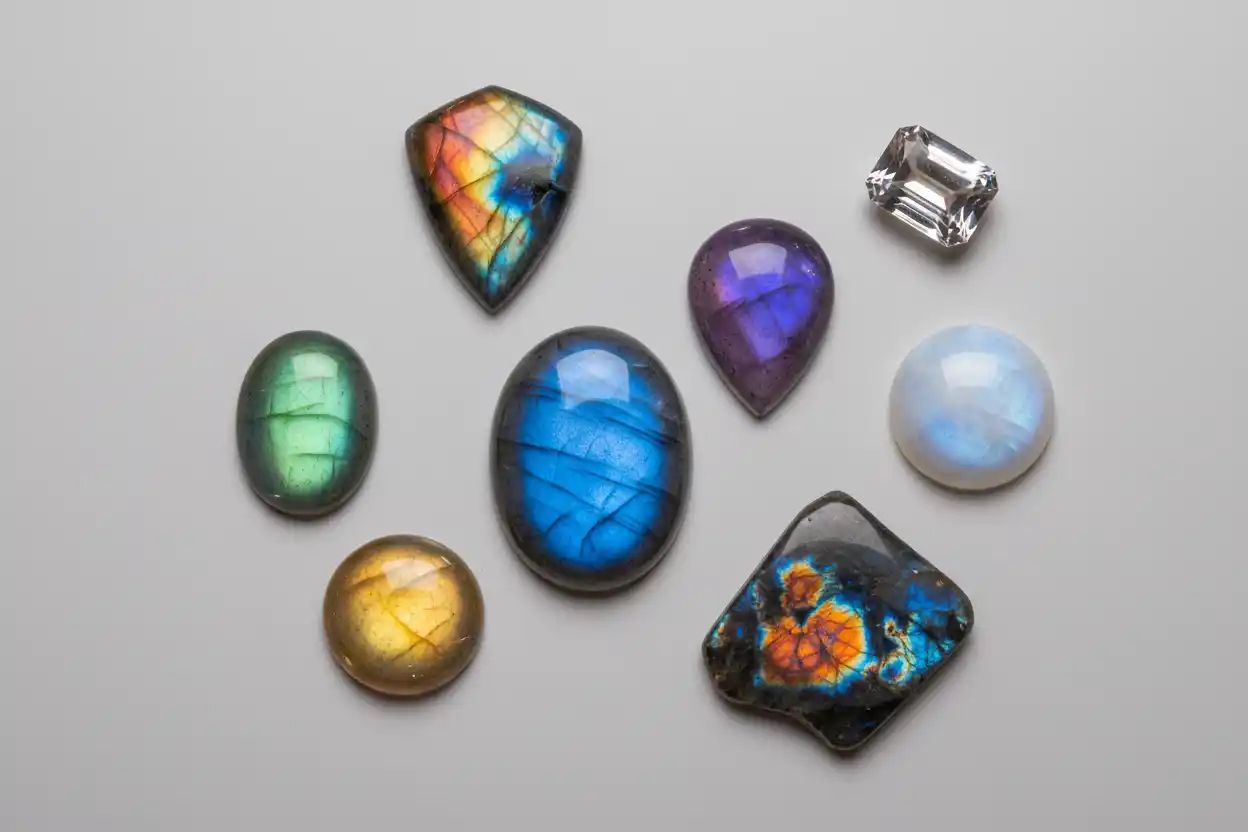
Labradorite is a calcium-rich plagioclase feldspar celebrated for labradorescence: broad flashes of blue, green, gold, orange, red, or violet that appear as the stone moves. Those colors usually come from microscopic internal layers rather than the feldspar’s body color.
The main types of labradorite are distinguished by body tone, flash color, optical coverage, transparency, mineral composition, locality, and trade name. The parent labradorite meaning and properties guide covers the material as a whole, while this article separates ordinary gray labradorite, Finnish spectrolite, rainbow moonstone, transparent yellow material, dark trade varieties, and other practical categories.
Labradorite at a Glance
| Property | Labradorite |
|---|---|
| Composition | Plagioclase feldspar between albite and anorthite, commonly approximately 50–70% anorthite component |
| Mineral group | Feldspar; plagioclase series |
| Main body colors | Gray, charcoal, blackish gray, colorless, white, cream, pale yellow, golden, greenish, brown, and transparent near-colorless |
| Optical colors | Blue, cyan, green, yellow, gold, orange, red, pink, purple, and multicolored |
| Crystal system | Triclinic |
| Typical habit | Tabular or blocky crystals; granular masses; lamellar intergrowths; cleavage fragments; massive rock-forming material |
| Luster | Vitreous to pearly |
| Transparency | Transparent to opaque |
| Mohs hardness | Approximately 6–6.5 |
| Cleavage | Two good to perfect directions meeting at close to right angles |
| Tenacity | Brittle |
| Common uses | Cabochons, beads, carvings, faceted gems, rings, pendants, earrings, bracelets, spheres, slabs, and decorative objects |
| Main care concern | Cleavage, surface scratches, fractures, incorrect cutting orientation, and damage from ultrasonic or steam cleaning |
Labradorite Within the Feldspar Family
Labradorite is part of the plagioclase feldspar series, which extends from sodium-rich albite to calcium-rich anorthite.
Its composition occupies an intermediate-to-calcium-rich range. The name therefore describes mineral chemistry, not merely a stone that shows colorful flash.
The broader feldspar family guide explains how plagioclase differs from potassium feldspar and why moonstone, sunstone, labradorite, and other trade varieties can overlap in appearance.
Not every feldspar with blue iridescence is chemically identical. Gemological and compositional testing may be needed when material sits near a boundary within the plagioclase series.
How Labradorescence Forms
Labradorescence develops from extremely fine alternating feldspar layers created as the crystal cools.
At high temperature, the material can hold a more uniform composition. During slow cooling, microscopic calcium-rich and sodium-rich lamellae separate within the feldspar.
Light enters the stone and reflects from those internal interfaces. Waves interfere with one another, strengthening certain colors and cancelling others.
Layer thickness controls which wavelengths appear. Thin, regular structures may produce vivid blue, while thicker or more complex layers generate green, yellow, orange, red, and violet.
The effect is directional. A stone can look dull gray from one angle and burst into color after a small rotation. Cutting orientation is therefore central to quality.
Gray Labradorite with Blue Flash
Gray body color with blue labradorescence is the most familiar commercial type.
The base may range from pale smoke gray to dark charcoal. Flash can appear as a narrow streak, a broad sheet, a patch, or nearly full-face color.
Fine blue-flash cabochons show strong saturation, a favorable viewing angle, and enough coverage to remain visible during normal movement. Weak stones may reveal color only at one extreme angle.
Madagascar supplies large quantities of gray labradorite for cabochons, beads, carvings, towers, and decorative pieces. Canada, Finland, Russia, Ukraine, Mexico, India, and other regions also produce blue-flashing material.
Blue-flash labradorite belongs beside other cool-colored materials in the blue gemstones guide, although its color mechanism differs from a blue body-colored sapphire or topaz.
Green-Flash Labradorite
Green labradorescence ranges from yellow-green and lime to emerald, forest, and blue-green.
Some stones show green alone, while others shift from blue at one edge to green across the center. The apparent color can change as the viewing angle moves through the interference spectrum.
Green flash does not prove chromium, nickel, or another green chromophore. The effect usually comes from layer thickness and optical interference rather than a green pigment.
A dark gray body often strengthens contrast, while a pale body can produce a softer luminous effect.
Golden and Yellow-Flash Labradorite
Golden labradorite can refer to two different appearances.
Some gray or dark stones display a gold, yellow, or bronze labradorescent flash. Others are transparent to translucent feldspar with a natural yellow or golden body color and little broad surface flash.
The first category is valued mainly for optical coverage and color intensity. The second is judged more like a faceted transparent gemstone through body color, clarity, and cut.
Commercial labels do not always distinguish these categories. Therefore, photographs should show the stone both in its neutral body position and at the angle of strongest flash.
Orange and Red-Flash Labradorite
Orange and red labradorescence requires internal structures that reinforce longer wavelengths.
Fine stones may show copper-orange, ember red, rose-red, magenta, or combinations of gold and red. These colors are less common than blue or green and often appear within multicolored material.
Red flash can be narrow and angle-sensitive. A photograph taken under one strong light may overstate how visible it remains during wear.
Stones with large full-face orange or red areas generally command premiums, especially when the underlying body remains attractive and free from major fractures.
Purple and Pink-Flash Labradorite
Purple flash ranges from lavender and violet to deep grape. Pink may appear as rose, fuchsia, or a red-violet transition.
These colors usually occur with blue, green, gold, or red rather than as one isolated sheet.
Fine purple material has become popular in designer cabochons, but some online photographs use strong contrast or editing that exaggerates the color.
Request video under a fixed neutral light source. A genuine optical flash should move across or within the stone as it rotates.
Multicolor and Rainbow Labradorite
Rainbow labradorite shows several interference colors in one stone.
Blue may grade into green, yellow, gold, orange, red, and violet across neighboring layers. The best specimens display strong separation and broad face-up coverage rather than scattered weak spots.
“Rainbow labradorite” should not automatically be confused with rainbow moonstone. Rainbow moonstone generally has a white or near-colorless transparent body, whereas rainbow labradorite commonly has a gray or dark base.
Multicolor cabochons require careful orientation. Grinding only a fraction too deep can remove a color layer or shift the best viewing angle away from the face.
Spectrolite
Spectrolite is a trade name closely associated with high-quality Finnish labradorite.
Classic material from the Ylämaa region has a dark body and may display strong blue, green, yellow, orange, red, and violet flashes. The contrast between the near-black base and saturated color creates its distinctive appearance.
Not every multicolored labradorite qualifies as Finnish spectrolite. Although the word is sometimes used generically, documented Finnish origin preserves its geographic and historical meaning.
Fine spectrolite is judged through flash saturation, coverage, color range, pattern, darkness of body, polish, and absence of distracting fractures.
Some pieces show angular color blocks or geometric patterns related to twinning and internal structure.
Rainbow Moonstone or White Labradorite
Rainbow moonstone is a transparent to translucent white or colorless plagioclase feldspar that displays blue or multicolored iridescence.
Despite the name, it is generally classified as labradorite rather than traditional orthoclase moonstone. Its optical effect may occur deeper inside the stone because the host is more transparent.
Fine material has a clean or milky body, strong blue flash, minimal distracting inclusions, and a cut that keeps the effect visible across a useful range of angles.
The market also uses “white labradorite” for similar material. However, the boundary among transparent labradorite, rainbow moonstone, and related plagioclase compositions can require gemological analysis.
The dedicated labradorite versus moonstone guide owns the complete comparison, while the parent moonstone guide covers traditional adularescent feldspar.
Transparent Yellow Labradorite
Transparent labradorite can be colorless, pale yellow, greenish yellow, champagne, or golden.
Material with a clean body may be faceted rather than cut as a cabochon. It can show subtle dispersion, birefringence, and occasional iridescent flashes, although broad labradorescence may be weak or absent.
Some commercial “golden labradorite” comes from Mexico, Oregon, or other feldspar-producing regions. Origin terms require documentation because similar yellow plagioclase occurs in several deposits.
Transparent yellow labradorite can resemble orthoclase, scapolite, heliodor, citrine, or pale topaz.
Oregon Sunstone and Copper-Bearing Labradorite
Some Oregon sunstone is mineralogically labradorite containing copper.
Copper may occur as dissolved color-producing material or as microscopic platelets that create aventurescence. Colors include pale yellow, peach, orange, red, green, teal, and bicolored combinations.
However, sunstone has its own established gem identity and market. The main sunstone guide and the dedicated Oregon sunstone guide retain that intent.
A types-of-labradorite article should position copper-bearing sunstone within the plagioclase relationship without repeating sunstone’s complete treatment, value, and buying coverage.
Dark-Body and “Black Labradorite”
“Black labradorite” is a loose trade description for labradorite with a very dark gray, charcoal, green-black, or brown-black body.
Some stones display vivid blue, green, or rainbow flash against that dark background. Others appear nearly opaque except at thin edges.
The term is not a formally defined mineral variety. It may overlap with spectrolite, dark Madagascar material, or other plagioclase.
Larvikite is also frequently sold as black labradorite. However, larvikite is a feldspar-rich igneous rock rather than a single labradorite gem. Its blue-silver reflections arise from feldspar crystals within the rock.
Body-Color Versus Flash-Color Types
A labradorite’s body color and optical color should be described separately.
A stone may have a gray body with blue flash, a blackish body with multicolor flash, or a colorless body with blue flash. Calling each one simply blue labradorite obscures an important quality distinction.
Body color affects contrast. Dark material strengthens bright flashes but can look dull when the effect disappears. Pale transparent material remains attractive without flash but may show a softer phenomenon.
Listings should ideally show the stone in both conditions rather than photographing only the strongest optical moment.
Full-Face, Partial-Flash, and Pinpoint Labradorite
Flash coverage is another practical type distinction.
Full-face material shows color across most of the cabochon from a useful viewing angle. Partial-flash stones display one strong area with a larger neutral zone.
Pinpoint or streak flash appears in small patches, lines, or isolated areas. Such stones can still be attractive when the pattern complements the shape.
A broad flash is not always superior to a balanced design. A narrow blue band can create an appealing horizon or eye-like composition when positioned deliberately.
Labradorite Crystal and Specimen Material
Most commercial labradorite is cut from massive feldspar rather than complete transparent crystals.
Natural cleavage faces may reveal flashes before cutting. However, a rough surface can conceal the best layer, and an apparently dull block may contain strong color below the surface.
Well-formed crystals are less familiar than polished cabochons but have mineralogical value. Crystal specimens may show twinning, cleavage, zoning, matrix association, and transparent yellow areas.
Large decorative slabs and spheres require stable rough because hidden cleavage or fractures can open during cutting.
Formation and Geological Context
Labradorite forms in igneous rocks as magma cools.
It is common in basalt, gabbro, anorthosite, norite, and related rocks. In some deposits, large plagioclase crystals accumulate and dominate the rock.
Slow cooling allows internal compositional separation. Microscopic sodium-rich and calcium-rich layers develop within the feldspar, creating the structures responsible for labradorescence.
Later deformation, alteration, weathering, or fracturing can weaken the material or dull its optical effect.
Anorthosite bodies are particularly associated with classic labradorite. The original type locality lies on Paul Island near Nain, Labrador, Canada.
Major Localities
Labrador, Canada, gave the mineral its name and produced historically important iridescent material.
Finland supplies spectrolite with a dark body and broad spectral flashes. Madagascar is a major modern source of gray blue-flash, green-flash, multicolored, carved, and cabochon-grade material.
India and Sri Lanka are important in the rainbow-moonstone trade. Zambia has produced transparent iridescent plagioclase with deep internal effects.
Mexico supplies transparent yellow and golden material. Oregon is known for copper-bearing sunstone within the labradorite composition range.
Russia, Ukraine, Norway, Australia, China, and the United States also produce significant plagioclase or labradorite-bearing rocks.
A color pattern alone rarely proves locality. Provenance should come from reliable mine, dealer, or collection records.
Inclusions and Internal Features
Labradorite may contain cleavage fractures, twinning planes, exsolution lamellae, needles, mineral crystals, fluid inclusions, hematite, copper, and iron oxides.
Black or dark inclusions can strengthen contrast but reduce transparency. White fractures may interrupt the flash or become more visible after polishing.
Parallel twinning lines are common in plagioclase. Under magnification, they help distinguish feldspar from lookalikes.
In transparent material, inclusions influence both clarity and structural risk. A surface-reaching fracture near a ring prong deserves more concern than a small internal crystal near the center.
How Labradorite Is Identified
Labradorite has hardness around 6–6.5 and two cleavage directions close to 90 degrees.
Its refractive index, birefringence, specific gravity, triclinic optical behavior, polysynthetic twinning, and composition distinguish it from moonstone, opal, glass, quartz, and other iridescent materials.
The gemstone hardness chart places it below quartz and above many soft carving stones. The gemstone cleavage guide explains why feldspar can chip despite moderate hardness.
Labradorescence alone does not prove identity. Coated glass, plastic, opal-like composites, shell, and other feldspars can display moving color.
The general crystal identification guide provides a safer multi-test framework.
Labradorite Lookalikes
Moonstone is the most common comparison.
Traditional moonstone usually shows a softer floating white or blue adularescence, while labradorite tends to produce broader and more saturated spectral flashes. Rainbow moonstone complicates that distinction because it is itself plagioclase labradorite.
Opal may display play-of-color in small shifting patches rather than a broad directional sheet. It also has different hardness, structure, and refractive behavior.
Larvikite shows blue-silver reflections in a multi-mineral rock. Glass may contain bubbles, flow lines, foil backing, or uniform coating.
Sunstone shows aventurescence from reflective inclusions, while labradorescence arises from microscopic exsolution layers.
Treatments, Synthetics, and Imitations
Most labradorite receives no routine color enhancement.
Wax or oil may improve polish temporarily, especially on carvings. Clear resin can stabilize fractures, while surface coatings or dark backing can increase apparent flash.
Some assembled cabochons use a thin labradorite layer attached to another material. Dye may alter pale or fractured feldspar, though it is less central to labradorite than to agate.
Laboratory-grown feldspar exists for research, but synthetic gem labradorite is not a routine retail product.
Glass, resin, coated quartz, plastic, opal simulants, and assembled stones are more common imitation concerns. The gemstone treatments guide explains why impregnation and coating should be disclosed.
Cutting Behavior
Cutting determines whether labradorite looks brilliant or lifeless.
The lapidary first studies the rough under a movable light to find the strongest flash plane. The top of the cabochon must sit nearly parallel to the internal optical layers.
Grinding too deeply can remove the best color layer. An incorrect tilt can move the flash to the edge or make it visible only from an impractical angle.
Low to medium domes often preserve broad flash. Freeforms may retain more material and follow natural color boundaries better than standard ovals.
Transparent yellow and rainbow-moonstone material may be faceted. However, cutters still account for cleavage, twinning, pleochroism, and internal iridescence.
Mixed feldspar textures can undercut during polishing. Fractures may open near thin girdles or pointed corners.
Durability and Jewelry Suitability
Labradorite’s hardness of 6–6.5 provides moderate scratch resistance, but it is softer than quartz, topaz, sapphire, and diamond.
Two cleavage directions create the greater risk. A sharp impact can remove a corner, split a cabochon, or enlarge an internal fracture.
The distinction between hardness and breakage resistance appears in gemstone toughness versus hardness.
Pendants, earrings, necklaces, and protected rings suit the material. Bracelets face more frequent knocks and should use well-rounded beads or secure settings.
A labradorite ring should have a protective bezel or halo, while a labradorite necklace usually exposes the stone to less impact.
The dedicated guides to labradorite earrings and labradorite bracelets retain their design-specific advice.
Labradorite Prices in 2026
Ordinary labradorite remains affordable because substantial quantities of commercial rough enter the market.
Small tumbled pieces and simple cabochons commonly cost $2–$15. Better blue- or green-flash cabochons often range from $15–$60 per stone.
Large pieces with broad full-face blue, orange, red, purple, or multicolored flash commonly sell for $50–$200. Exceptional designer cabochons, matched pairs, vivid spectrolite, or rare patterning may reach $200–$500 or more per stone.
Commercial faceted transparent labradorite may cost approximately $5–$30 per carat. Fine transparent rainbow-moonstone-type material, precision cuts, or strongly iridescent stones can reach $30–$100-plus per carat.
Large carvings, high-flash spheres, documented Finnish spectrolite, and artistic objects vary widely because workmanship and pattern yield dominate weight.
Detailed future pricing belongs in the labradorite price guide.
Buying Guidance
Buy the visible performance rather than the color name.
Request video showing the stone rotating under one neutral light. A still photograph may capture an angle that appears only briefly.
Check how much of the face displays color, how far the stone must tilt, whether the body remains attractive without flash, and whether editing has darkened the background.
Inspect cleavage fractures, pits, flat spots, poorly polished edges, resin-filled cavities, and dead areas. For spectrolite, request credible Finnish provenance.
Rainbow-moonstone buyers should evaluate transparency, body color, blue-flash depth, inclusions, and whether the material has been confused with traditional moonstone.
The complete transaction checklist belongs in the labradorite buying guide. General remote-shopping safeguards appear in how to buy gemstones online.
Cleaning Labradorite
Clean labradorite with lukewarm water, mild soap, and a soft brush or cloth.
Rinse briefly and dry it thoroughly. Avoid hot water, steam, bleach, acids, abrasive powders, and sudden temperature changes.
Ultrasonic vibration can enlarge cleavage fractures or loosen a filled stone. Conservative hand cleaning is therefore preferable.
The full jewelry-care process belongs in how to clean labradorite jewelry.
Storage, Water, and Sunlight
Brief contact with clean water during hand cleaning is generally manageable for sound untreated material. Prolonged soaking is unnecessary, especially when the stone contains fractures, dye, resin, glue, or an assembled backing.
Normal room light does not usually harm labradorite’s interference structure. However, strong prolonged sunlight can overheat dark stones, adhesives, or treated surfaces.
Store each piece separately from harder gemstones. A padded compartment prevents scratches and protects cleavage edges.
Spiritual cleansing methods should avoid salt, heat, prolonged water, and hard impacts. Non-contact options are covered in how to cleanse and charge labradorite.
Meaning and Symbolism
Modern crystal traditions commonly associate labradorite with adaptability, imagination, reflection, boundaries, and finding possibility within changing circumstances.
Blue flash is often linked with communication and insight, green with renewal, gold with confidence, purple with contemplation, and multicolored spectrolite with creativity or integration.
The dedicated labradorite healing properties guide owns the broader spiritual-practice intent.
These interpretations arise from modern symbolism, personal experience, and the stone’s changing visual effect. They are not scientifically demonstrated medical or psychological effects of feldspar lamellae.
Frequently Asked Questions
1. How many types of labradorite are there?
There is no fixed number. Labradorite is classified by body color, flash color, coverage, transparency, locality, composition, and trade name.
2. What is the most common labradorite type?
Gray labradorite with blue or blue-green flash is the most familiar commercial material.
3. What is spectrolite?
Spectrolite is a trade name associated with high-quality Finnish labradorite, commonly showing vivid full-spectrum flash against a dark body.
4. Is rainbow moonstone a type of labradorite?
Yes. Rainbow moonstone is generally a transparent-to-translucent white plagioclase labradorite rather than traditional potassium-feldspar moonstone.
5. What causes labradorite’s flash?
Light interference within microscopic alternating sodium-rich and calcium-rich feldspar layers creates labradorescence.
6. Is black labradorite a formal variety?
No. It is a loose trade description for very dark gray or blackish labradorite, sometimes confused with spectrolite or larvikite.
7. Is larvikite the same as labradorite?
No. Larvikite is a feldspar-rich igneous rock containing reflective feldspar crystals, while labradorite is a plagioclase mineral.
8. Is Oregon sunstone labradorite?
Many Oregon sunstones fall within the labradorite composition range and contain copper, but sunstone has its own established gem and market identity.
9. Can labradorite be faceted?
Yes. Transparent yellow, colorless, and rainbow-moonstone-type material can be faceted, although most gray flashing material is cut as cabochons.
10. Is labradorite normally treated?
Most material is untreated. Waxing, oiling, resin stabilization, backing, coatings, and assembled construction may occur and should be disclosed.
11. Is labradorite suitable for everyday rings?
It can be used in a protected ring, but cleavage and moderate hardness make pendants and earrings safer for frequent wear.
12. What makes one labradorite more valuable than another?
Strong saturation, broad flash coverage, useful viewing angle, unusual colors, attractive body tone, good polish, structural soundness, locality, and artistic cutting drive value.
Labradorite’s varieties are expressions of internal structure rather than a simple body-color chart. A Canadian blue-flash slab, Finnish spectrolite cabochon, white rainbow moonstone, Mexican golden faceted stone, and copper-bearing Oregon sunstone all belong within the wider plagioclase story, yet each reflects a different composition, optical layer, and market tradition. Related L materials appear in the crystals that start with L directory and the gemstones that start with L guide.
Safety disclaimer: Cutting, grinding, drilling, or polishing labradorite and other feldspars can release respirable silica-bearing dust. Use wet lapidary methods, effective local extraction, eye protection, and correctly rated respiratory protection; never dry-grind the material in an unventilated area.