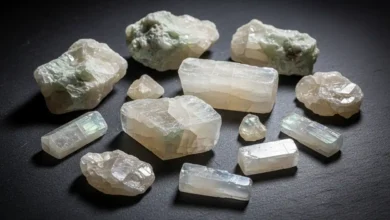

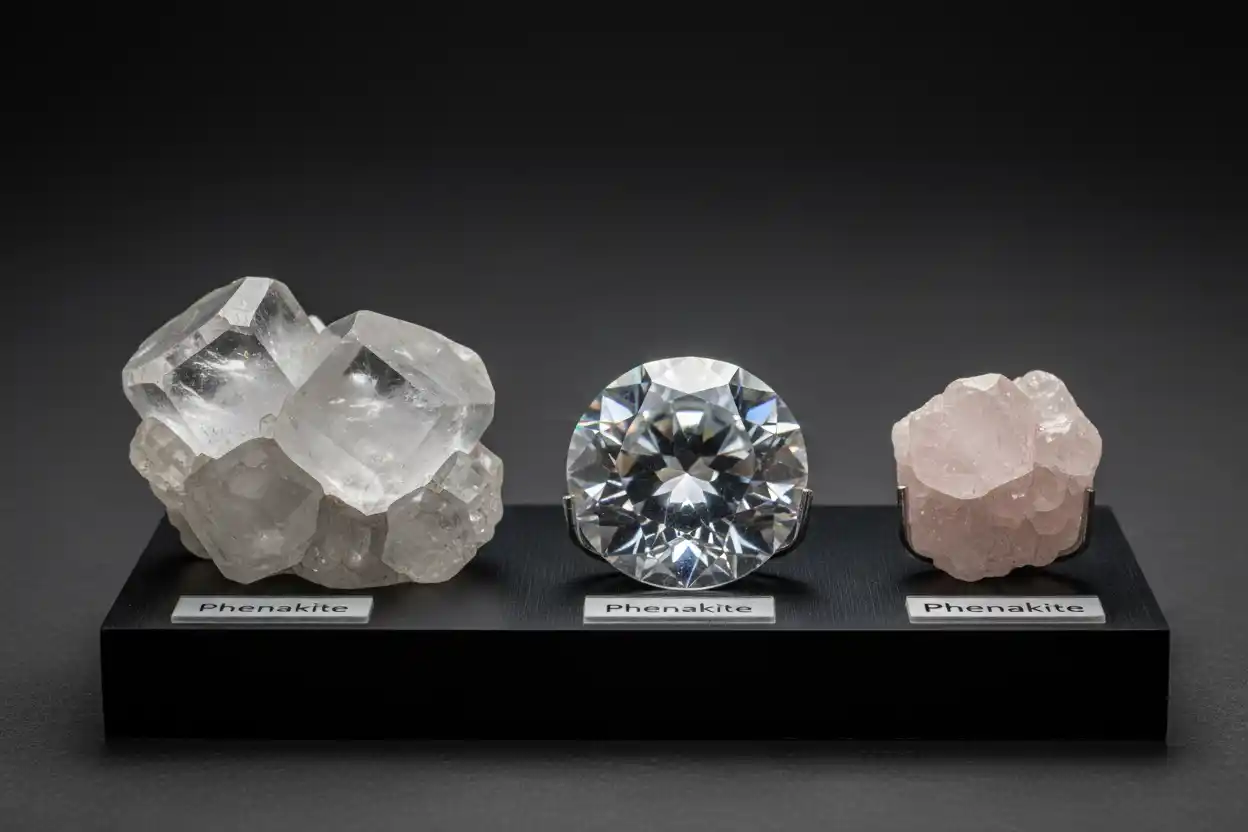

Phenakite, also spelled phenacite, is a rare beryllium silicate mineral with the formula Be₂SiO₄. Transparent crystals are usually colorless or faintly yellow, pink, or brown and can produce lively collector gems with more brilliance and optical doubling than quartz.
Its name comes from a Greek word meaning deceiver because early specimens were mistaken for quartz. Laboratory measurements readily separate the two, but visual identification remains unreliable for a loose colorless stone.
Phenakite at a Glance
| Property | Phenakite |
|---|---|
| Material type | Beryllium orthosilicate mineral and rare collector gemstone |
| Composition | Be₂SiO₄ |
| Mineral classification | Nesosilicate |
| Alternative spelling | Phenacite |
| Common colors | Colorless, white, pale yellow, wine yellow, pale pink, brown, gray, and rarely greenish |
| Crystal system | Trigonal, commonly described in the hexagonal setting |
| Typical habit | Rhombohedral, tabular, short to long prismatic, acicular, granular, columnar, and spherulitic |
| Luster | Vitreous |
| Transparency | Transparent to translucent |
| Mohs hardness | Approximately 7.5–8 |
| Cleavage | Distinct in one direction and imperfect in another, although it may appear poor in gem material |
| Tenacity | Brittle |
| Fracture | Conchoidal |
| Specific gravity | Approximately 2.93–3.00 |
| Optical character | Uniaxial positive with refractive indices around 1.650–1.670 |
| Common uses | Faceted collector gems, rare cat’s-eye cabochons, mineral specimens, scientific collections, and bespoke jewelry |
| Main care concern | Chipping, cleavage or fracture damage, misidentification, loss of provenance, and hazardous beryllium-bearing dust during cutting |
A Distinct Beryllium Mineral
Phenakite contains two beryllium atoms for every silicon-oxygen tetrahedral unit in its ideal formula.
It is not a variety of Beryl, even though both minerals contain beryllium and often form in granitic pegmatites.
Beryl has a ring-silicate structure and the formula Be₃Al₂Si₆O₁₈. Phenakite is an orthosilicate without aluminum in its ideal composition.
Its structure more closely resembles willemite and related minerals in a crystallographic sense, although their chemistry and colors differ.
Phenakite is a recognized mineral species and belongs among the specialist facetable minerals discussed in types of gemstones.
The tracker places it in the rare-facetable cluster because transparent cut stones remain unusual even though mineral specimens occur at numerous localities.
Why It Is Called the Deceiver
Nils Gustaf Nordenskiöld named the mineral in 1833 after studying specimens from the Ural Mountains.
Colorless transparent crystals resembled Quartz closely enough to mislead earlier observers.
Both can occur as glassy colorless crystals in pegmatites and hydrothermal environments. Their hardness also overlaps sufficiently to make simple scratch tests unhelpful.
Phenakite is denser and has much higher refractive indices. It also displays stronger birefringence and a different crystal structure.
The deception therefore disappears under routine gemological testing, but the historic name remains appropriate for online purchases judged only from photographs.
Crystal Structure and Habit
Phenakite crystallizes in the trigonal system. Its structure is commonly described using hexagonal crystallographic axes, which explains why some references call it hexagonal.
Well-formed crystals may appear short prismatic, tabular, rhombohedral, lenticular, or elongated.
Penetration twinning can create complex external forms. Some crystals look more like rough quartz, topaz, or beryl than a simple ideal drawing.
Granular and massive phenakite also occurs, particularly in altered pegmatitic or metamorphic environments.
Large crystals can exist without providing usable faceting rough. Internal fractures, cloudy areas, inclusions, alteration, and unfavorable cleavage may leave only small transparent sections.
How Phenakite Forms
Phenakite occurs in granitic pegmatites, greisens, Alpine-type veins, hydrothermal veins, mica schists, and other beryllium-rich environments.
Pegmatites concentrate elements that do not fit easily into common early-forming minerals. Beryllium, lithium, boron, fluorine, cesium, tantalum, and related components can become enriched in the final melt and fluids.
Phenakite may crystallize with quartz, topaz, beryl, chrysoberyl, muscovite, fluorite, feldspar, bertrandite, and other beryllium-bearing minerals.
In metamorphic environments, it can occur in mica schist near emerald and chrysoberyl deposits.
Some phenakite forms when beryl breaks down or reacts with silica-poor or alkali-rich fluids. Other crystals develop directly from pegmatitic or hydrothermal solutions.
Its presence can therefore record both original pegmatite crystallization and later alteration.
Color and Transparency
Chemically pure phenakite is colorless.
Pale yellow, wine yellow, brown, pink, and gray can result from trace impurities, structural defects, inclusions, or radiation-related effects.
Most faceted material is colorless to very pale. Strongly saturated natural phenakite is uncommon and should receive careful identification.
Cloudy white crystals may contain microscopic inclusions, fractures, alteration, or dense growth structures.
Color has less market importance than transparency and brilliance for ordinary faceted phenakite. A clean colorless stone can be more desirable than a larger but dull brown example.
Rare attractive pink, yellow, or unusual phenomenal material may command a separate collector premium.
Optical Properties and Brilliance
Phenakite has refractive indices around 1.650–1.670, substantially higher than ordinary quartz.
Its birefringence is approximately 0.016–0.020. This difference between the two principal refractive directions can make rear facet edges appear doubled through a cut stone.
Brilliance is stronger than in Clear Quartz, goshenite, petalite, and many other colorless collector gems.
Dispersion remains moderate rather than diamond-like. A well-cut stone can look lively, but it should not be marketed as having diamond-level fire without qualification.
Cut orientation affects doubling, extinction, brilliance, and face-up clarity.
Deep stones may preserve weight but appear small. Shallow stones can develop a large window because light escapes through the pavilion.
Cat’s-Eye Phenakite
Phenakite can very rarely display chatoyancy.
Parallel tubes, acicular inclusions, voids, or other aligned structures reflect light as a narrow band across a properly oriented cabochon.
GIA has documented transparent cat’s-eye phenakite in which numerous minute tubes and platy fluid-filled voids created the eye.
A sharp eye requires parallel structures, accurate cutting, a smooth dome, and a concentrated light source.
The effect is not expected in ordinary faceted material. A commercial seller offering numerous identical cat’s-eye stones should provide strong laboratory evidence.
Phenomenal phenakite follows a specialist collector market with too few examples for standardized grading.
Important Phenakite Localities
The historic type area lies near the Tokovaya River in the Ural Mountains of Russia, where phenakite occurs with emerald and chrysoberyl in mica schist.
The Ilmen Mountains and other Russian pegmatite districts have also produced notable crystals.
Minas Gerais and other Brazilian pegmatite regions supply transparent crystals and rough suitable for faceting. Some unusually large cut stones came from Brazilian material.
Sri Lankan gem gravels yield stream-worn transparent pebbles. Their original host deposits may no longer be represented by an attached matrix.
Madagascar has produced colorless, yellowish, included, and rare chatoyant material.
Norway is known for crystals from Kragerø, Iveland, and related pegmatite districts.
Mount Antero and the broader Pikes Peak region of Colorado produce crystals associated with aquamarine, fluorite, topaz, and other pegmatite minerals.
Additional occurrences are known in Namibia, South Africa, Tanzania, Myanmar, France, Maine, New Hampshire, and several other regions.
Locality should be established through provenance rather than inferred from color or crystal shape.
Phenakite and Quartz
Quartz and phenakite can both be colorless, vitreous, hard, and transparent.
Phenakite is denser, has higher refractive indices, and normally shows stronger facet-edge doubling.
Quartz has a hardness of 7, while phenakite is approximately 7.5–8.
The two minerals also differ chemically: quartz is SiO₂, whereas phenakite is Be₂SiO₄.
Crystal habit helps only when rough retains clear natural faces. Water-worn pebbles and faceted gems require instruments.
A seller should not identify phenakite through a photograph, thermal-conductivity tester, or claim that it “feels stronger” than quartz.
Phenakite and Goshenite
Goshenite is colorless beryl.
It contains aluminum and has a lower refractive index and lower birefringence than phenakite.
Both may occur in the same pegmatitic environments. Consequently, locality does not separate them.
Goshenite usually has hexagonal prismatic habits, while phenakite can form rhombohedral, tabular, or less obviously six-sided crystals.
A faceted phenakite generally appears livelier. However, cut, cleanliness, and lighting can erase that visual difference.
Laboratory measurements remain decisive.
Phenakite and Danburite
Danburite is a calcium borosilicate that commonly appears colorless, pale yellow, or pink.
It can produce bright faceted gems and is often confused with topaz or quartz.
Danburite is orthorhombic, has different refractive indices, a lower density than many topazes, and different spectra from phenakite.
Both are collector stones rather than high-volume jewelry materials.
Phenakite’s beryllium chemistry should never be inferred from a pale color shared with danburite.
Phenakite and Petalite
Petalite is a lithium aluminum silicate with very low density and lower refractive indices.
A colorless petalite gem can look large for its carat weight and often has gentler brilliance.
Phenakite is denser, optically livelier, and harder.
Petalite has prominent cleavage that creates important setting risks. Phenakite’s cleavage is less visually obvious in many faceted stones, although it remains brittle.
The two may originate from evolved pegmatites, which makes analytical testing more useful than locality assumptions.
Phenakite and White Topaz
White Topaz can resemble brilliant colorless phenakite.
Topaz is substantially denser and possesses perfect basal cleavage. Its optical measurements also differ.
Both minerals rank near 8 on the Mohs scale, so hardness cannot provide a safe practical separation.
A loose topaz may feel heavier than an equally sized phenakite, but mounted stones cannot be judged reliably through weight in the hand.
Refractive-index testing and density provide a straightforward laboratory distinction.
How to Identify Phenakite
Refractive index offers one of the strongest routine clues. Phenakite’s readings fall around 1.650–1.670.
Specific gravity normally lies near 2.96–3.00.
The mineral is uniaxial positive and displays measurable birefringence. A polariscope and refractometer can establish this optical behavior.
Doubling of inclusions and rear facet edges may become visible under magnification.
Microscopy can reveal fluid inclusions, tubes, healed fractures, mineral crystals, growth zoning, and cleavage-related features.
Raman spectroscopy provides a strong species fingerprint. X-ray diffraction confirms crystal structure, while chemical methods can establish beryllium and silicon composition.
Because many handheld X-ray fluorescence instruments cannot detect light elements such as beryllium effectively, the absence of a beryllium reading does not disprove phenakite.
The proper workflow appears in how to identify crystals.
Treatments, Synthetic Material, and Substitutes
Phenakite is not normally subjected to routine heat, irradiation, diffusion, or dyeing.
Its market is too small and its natural appearance too variable for a large standardized enhancement industry.
Fracture filling, oiling, coating, or surface repair remain possible for an individual stone and should be disclosed.
Hydrothermal and other laboratory synthesis of phenakite has been achieved for scientific purposes. Phenakite can also occur as an unintended crystalline by-product inside some synthetic emerald growth systems.
Synthetic phenakite is not a significant mainstream gem-market product.
Substitution presents the greater risk. Quartz, goshenite, topaz, danburite, petalite, zircon, glass, synthetic spinel, and cubic zirconia may receive a phenakite label.
The wider treatment and laboratory-growth categories are explained in gemstone treatments.
Durability and Jewelry Use
Phenakite’s hardness of approximately 7.5–8 gives it good resistance to ordinary scratches.
The mineral’s relative position appears on the gemstone hardness chart.
Nevertheless, it remains brittle. A sharp blow can chip the girdle or facet junctions.
Distinct-to-imperfect cleavage may also influence cutting and setting, even though it is less notorious than topaz cleavage.
The difference between hardness, toughness, and cleavage appears in gemstone toughness versus hardness.
A structurally sound stone can be used in rings, earrings, pendants, brooches, and collector jewelry.
Lower-impact earrings and pendants reduce replacement risk. A protected ring remains possible when the wearer accepts the rarity and limited replacement supply.
Prongs should not press against surface-reaching fractures. Rounded shapes and adequately thick girdles provide better protection than exposed sharp corners.
Current Phenakite Asking Prices
Phenakite pricing is inconsistent because the market is small and sellers apply the name to material of widely varying quality.
| Phenakite product | Broad July 2026 retail asking range |
|---|---|
| Small rough or incomplete crystal | About $20–$100 |
| Attractive small locality specimen | About $75–$300 |
| Fine transparent or well-formed crystal | About $250–$1,500 |
| Exceptional Russian, Brazilian, or Colorado specimen | About $1,000–$10,000 or more |
| Small included faceted stone | About $75–$250 per carat |
| Clean colorless or pale gem | About $150–$600 per carat |
| Large, exceptionally clean, pink, yellow, or precision-cut gem | About $500–$2,000 per carat or more |
| Rare cat’s-eye or major documented collector gem | Individually priced |
These figures represent broad asking-price context rather than formal appraisals or guaranteed transactions.
Some specialist dealers promote substantially higher per-carat figures for large eye-clean stones. Conversely, active listings include verified-looking gems below those promotional ranges.
A laboratory-confirmed 2.37-carat stone was recently offered around $430 total, illustrating how thin-market asking prices can diverge from generalized charts.
What Gives Phenakite Value?
Identity comes first. A colorless stone cannot carry a rare-species premium without defensible gemological testing.
Transparency and clarity strongly affect value because most phenakite is included, fractured, cloudy, or specimen grade.
Cut quality controls brilliance, doubling, windowing, symmetry, apparent size, and edge durability.
Large clean gems are uncommon. Price per carat can therefore rise as size increases, although the market remains less standardized than sapphire or tourmaline.
Pale natural pink or yellow can add collector interest when the hue is attractive and independently identified.
Chatoyancy raises value when the eye is sharp, centered, and supported by a respected report.
Specimen value depends on crystal form, luster, terminations, matrix, associated minerals, locality, condition, and provenance.
Russian Ural, Brazilian, Mount Antero, Norwegian, and historic collection material can command locality premiums.
Buying Phenakite
Request an independent laboratory report for any faceted stone carrying a meaningful rare-gem price.
The report should identify natural phenakite and list measurements and weight matching the offered stone.
Verify that the laboratory—not merely the seller—has enough equipment to separate beryllium silicates from quartz, topaz, beryl, and glass.
Examine magnified videos for windowing, doubling, fractures, chips, and possible filler.
Ask whether the stone has received coating, filling, oil, or another enhancement, even though routine treatment is uncommon.
For mineral specimens, request the exact locality, crystal dimensions, repair disclosure, and photographs from every side.
Treat unsupported claims of record-breaking size, extraterrestrial origin, or guaranteed investment appreciation cautiously.
Phenakite appears in both the crystals beginning with P directory and the gemstones beginning with P directory.
Cleaning and Storage
Clean an intact phenakite gemstone with lukewarm water, mild soap, and a soft brush.
Rinse briefly and dry it with a lint-free cloth.
Avoid steam because rapid heating can create thermal stress and affect unknown filler or repairs.
Ultrasonic cleaning is unnecessary, especially when the gem contains fractures, cavities, inclusions, or possible enhancement.
Store phenakite away from diamond, sapphire, ruby, chrysoberyl, and other hard stones.
Keep the laboratory report, locality label, purchase record, weight, dimensions, and photographs with the stone.
Mineral specimens should be handled by their matrix rather than by projecting crystals.
Phenakite Meaning and Symbolism
Phenakite was identified scientifically in the nineteenth century, so elaborate claims of a specific ancient phenakite tradition are not well supported.
Modern crystal culture associates it with clarity, concentration, discernment, and recognizing when appearances are misleading.
Its historic confusion with quartz inspires symbolism involving verification and looking beyond an initial assumption.
The mineral’s strong brilliance despite an understated bodycolor can represent quiet capability rather than obvious display.
Rare cat’s-eye material may inspire themes of focus and directing attention toward one clear line.
These meanings remain personal, artistic, spiritual, or cultural interpretations. Scientific evidence does not show that phenakite activates the brain, treats illness, changes consciousness, or produces guaranteed spiritual experiences.
Frequently Asked Questions
Are phenakite and phenacite the same mineral?
Yes. Phenakite is the more common modern spelling, while phenacite remains an accepted alternative.
What is phenakite made from?
Its ideal composition is beryllium orthosilicate, Be₂SiO₄.
Why is phenakite called the deceiver?
Early colorless crystals were confused with quartz, so the name was derived from a Greek word associated with deception.
Is phenakite rarer than quartz?
Yes. Quartz is one of Earth’s most abundant minerals, while transparent facet-quality phenakite is uncommon.
Where is phenakite found?
Important sources include Russia, Brazil, Sri Lanka, Madagascar, Norway, Colorado, Namibia, South Africa, Tanzania, Myanmar, and other beryllium-rich deposits.
What colors can phenakite show?
Most gem material is colorless or faint yellow. Pale pink, brown, gray, wine-yellow, and rare unusual tones also occur.
Can phenakite show a cat’s eye?
Yes, but chatoyant phenakite is extremely rare. Parallel tubes and fluid-filled voids can create a moving eye in a correctly cut cabochon.
Is phenakite normally treated?
No routine treatment is established. Individual stones can still be filled, coated, oiled, repaired, or incorrectly identified.
Does synthetic phenakite exist?
Laboratory synthesis is scientifically documented, but synthetic phenakite is not a significant commercial jewelry material.
Is phenakite suitable for rings?
A sound gem is hard enough for regular wear, but brittleness, possible cleavage, rarity, and replacement difficulty favor protective settings.
Is phenakite safe to handle?
Finished intact stones are generally suitable for ordinary external handling. Cutting, crushing, or grinding creates hazardous beryllium-bearing mineral dust.
What makes phenakite valuable?
Confirmed identity, transparency, clarity, size, cut, natural color, optical phenomena, specimen form, locality, condition, and documentation determine value.
Phenakite’s rarity is easy to exaggerate because its market is small and opaque. Its most useful comparison is the broader rarest gemstones guide, which separates geological scarcity from high retail pricing.
Finished intact phenakite is generally suitable for normal handling, but its beryllium remains chemically bound within the mineral and must not be ingested. Cutting, grinding, drilling, or crushing can release hazardous beryllium-bearing dust; such work requires professional wet methods, enclosed extraction, strict hygiene, eye protection, and properly selected respiratory controls.