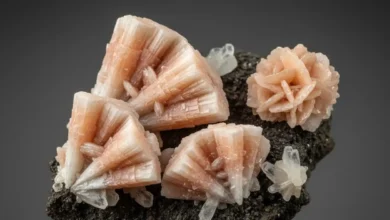

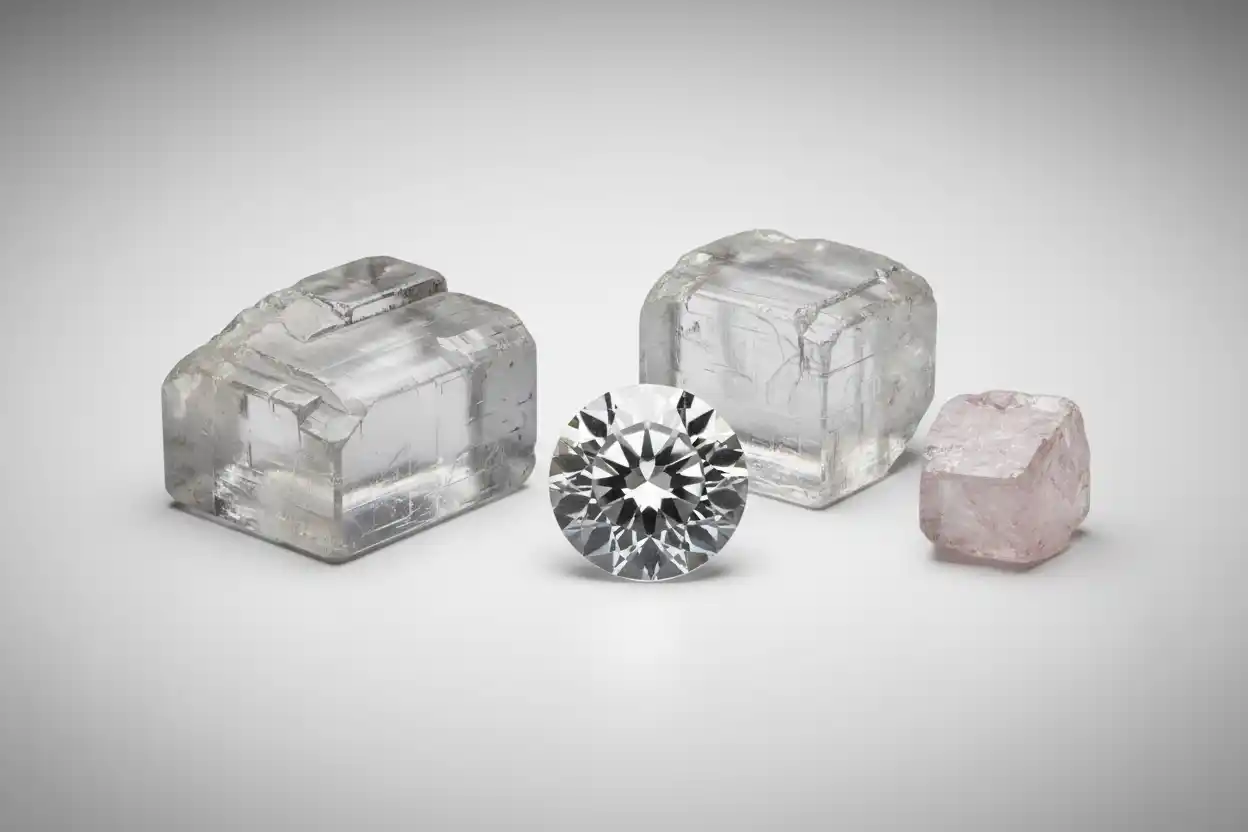

Petalite is a lithium aluminum silicate mineral with the formula LiAlSi₄O₁₀. It usually appears white, colorless, gray, or pale pink as cleavable masses and tabular crystals within lithium-rich granite pegmatites.
Transparent facetable petalite is far less common than industrial or specimen-grade material. Its low refractive index gives cut stones a clear, glassy appearance, while perfect cleavage and brittleness make them better suited to collector jewelry than exposed everyday rings.
Petalite at a Glance
| Property | Petalite |
|---|---|
| Material type | Lithium aluminum silicate mineral and occasional collector gemstone |
| Composition | LiAlSi₄O₁₀ |
| Older name | Castorite |
| Common colors | Colorless, white, gray, pale yellow, brownish, greenish white, pink, and rare color-changing tones |
| Crystal system | Monoclinic |
| Typical habit | Tabular, flattened, prismatic, columnar, cleavable, or massive |
| Luster | Vitreous; pearly on cleavage surfaces |
| Transparency | Transparent to translucent |
| Mohs hardness | Approximately 6–6.5 |
| Cleavage | Perfect in one principal direction, with another weaker direction |
| Tenacity | Brittle |
| Fracture | Subconchoidal to conchoidal outside cleavage |
| Specific gravity | Approximately 2.39–2.45 |
| Common uses | Lithium ore, glass and ceramic feedstock, mineral specimens, faceted collector gems, cabochons, and small carvings |
| Main care concern | Perfect cleavage, edge chipping, low brilliance, incorrect identification, industrial-grade impurities, and lithium-bearing cutting dust |
Petalite Is a Distinct Mineral Species
Petalite is not a variety of quartz, feldspar, spodumene, or lepidolite.
Its structure contains linked silicon-oxygen, aluminum-oxygen, and lithium-oxygen tetrahedra arranged in a low-density framework with strongly developed cleavage.
Mineral references sometimes discuss it alongside sheet silicates because its structure contains prominent sheet-like Si₄O₁₀ units. Other structural interpretations emphasize the additional tetrahedral connections that make its framework more complex than an ordinary mica sheet.
For a gem buyer, the essential facts remain stable: petalite has a defined LiAlSi₄O₁₀ composition, monoclinic symmetry, very low density, perfect cleavage, and characteristic optical measurements.
The name comes from the Greek word petalon, meaning leaf, referring to the flat, leaf-like fragments produced by its cleavage.
Castorite is an older name still encountered in historic mineral collections and specialist gem references. Petalite remains the accepted modern name.
Discovery and the Identification of Lithium
José Bonifácio de Andrada e Silva described petalite from the Utö mines in Sweden around 1800.
The pale cleavable mineral attracted scientific interest because its chemistry did not fit familiar feldspar or quartz compositions.
In 1817, Johan August Arfwedson analyzed material associated with petalite and identified a previously unknown alkali element.
The element was named lithium from a Greek word meaning stone because, unlike sodium and potassium compounds historically known from plant ash, the new element had been identified in mineral material.
Petalite therefore holds an important place in chemical history even though transparent gems remain unfamiliar to most jewelry buyers.
The Utö mines remain the type locality and a significant historical source for petalite, spodumene, lepidolite, tourmaline, and other pegmatite minerals.
How Petalite Forms
Petalite forms mainly in lithium-rich granite pegmatites.
Pegmatites represent the late stages of granitic magma crystallization. Water, boron, fluorine, lithium, cesium, tantalum, and other incompatible elements become concentrated in the remaining melt and fluid.
Under suitable pressure, temperature, and chemical conditions, petalite crystallizes with quartz, albite, potassium feldspar, spodumene, lepidolite, tourmaline, pollucite, amblygonite-group minerals, and other rare pegmatite phases.
Crystal size can become substantial because the fluid-rich environment promotes rapid ion movement and coarse growth.
However, large size does not guarantee gem quality. Many petalite masses are milky, fractured, altered, intergrown, or crossed by cleavage.
Petalite’s stability also provides information about pegmatite formation pressure. Under different conditions, petalite can react to form spodumene and quartz.
Geologists therefore examine petalite, spodumene, and quartz relationships when reconstructing the temperature-pressure history of lithium pegmatites.
Petalite and Spodumene
Petalite and spodumene are separate lithium aluminum silicates.
Petalite has the formula LiAlSi₄O₁₀, while spodumene has the formula LiAlSi₂O₆.
Spodumene is denser, has higher refractive indices, and belongs to the pyroxene group. Its gem varieties include pink-to-purple kunzite and green hiddenite.
Kunzite can resemble pale pink petalite, but it commonly shows stronger pleochroism, different cleavage behavior, higher density, and distinct optical measurements.
Petalite generally appears lighter and less brilliant because of its unusually low density and refractive index.
In some pegmatites, petalite breaks down into spodumene plus quartz through geological reactions. Accordingly, specimens may preserve complicated intergrowths rather than one pure phase.
Petalite and Lepidolite
Lepidolite is a lithium-bearing mica-group mineral, commonly purple, lilac, pink, gray, or white.
Its platy mica cleavage, low hardness, flexible flakes, and pearly sparkle distinguish it from glassy petalite.
Both minerals occur in evolved lithium-rich pegmatites and may appear in the same specimen.
A mixed commercial piece should identify each phase rather than calling the entire rock pink petalite.
Lepidolite is much softer and more suitable for mineral specimens or protected carvings than faceted jewelry.
Petalite, while harder, still requires caution because its cleavage can split a gem after impact.
Color and Optical Appearance
Pure petalite is colorless. White and gray material commonly owes its appearance to fractures, inclusions, grain boundaries, alteration, or light scattering.
Pale pink may result from trace manganese or fine mineral inclusions, although the precise color mechanism can vary by deposit.
Yellow, brownish, and greenish tones also occur. Strongly saturated colors are unusual and require careful identification.
Transparent petalite has low refractive indices around 1.50–1.52. Consequently, it lacks the sharp brilliance of zircon, sapphire, topaz, or chrysoberyl.
Its birefringence is moderate enough to produce measurable double refraction, although the effect is not as visually obvious as it is in peridot or zircon.
Petalite has little or no useful pleochroism in most stones.
Well-cut colorless material can appear clean and bright, but a shallow or poorly proportioned pavilion creates obvious windowing because the refractive index is low.
Phenomenal Petalite
Some included petalite can display weak chatoyancy when parallel needles, tubes, or reflective structures align beneath a cabochon.
The eye is generally softer than the sharp line seen in fine chrysoberyl. Its visibility depends strongly on cutting orientation and lighting.
Rare Myanmar petalite has shown a color-change effect, with yellow-green or greenish tones in daylight and warmer golden-brown colors under incandescent illumination.
These stones occupy an extremely thin collector market. A color-change claim should be demonstrated through standardized lighting rather than two digitally altered photographs.
Phenomenal appearance does not replace mineral identification. Scapolite, diaspore, glass, and other stones can display color change or chatoyancy.
Important Petalite Localities
The Utö mines in Sweden supplied the type material and remain historically important.
Bikita in Zimbabwe contains a major lithium pegmatite deposit where petalite has been mined as an industrial lithium source.
The Rubicon and related pegmatites near Karibib, Namibia, have produced white, colorless, pinkish, and transparent petalite, including large masses suitable for carving or occasional faceting.
Minas Gerais, Brazil, supplies clean colorless material, large crystals, massive petalite, and lapidary rough.
Londonderry in Western Australia is known for facetable material, while other Australian lithium districts contain substantial industrial petalite resources.
Afghanistan, Myanmar, Russia, Italy’s Elba Island, Canada, and several United States pegmatite districts have also produced specimens or gem material.
A country label alone does not establish quality. Much commercial rough changes hands through international cutting centers far from its geological source.
Petalite as a Lithium Ore
Petalite’s economic value often comes from lithium rather than gemstone production.
Industrial processors concentrate the mineral and extract lithium compounds used in battery materials, chemicals, glass, ceramics, and other applications.
Petalite can also enter glass and ceramic formulations directly. Its lithium and aluminum content helps lower thermal expansion and improve resistance to rapid temperature change.
These properties made petalite important in heat-resistant glass-ceramic and cookware formulations.
Industrial suitability depends on lithium content, iron contamination, mineral liberation, deposit size, processing cost, and the requirements of the final product.
A white industrial petalite concentrate should not be marketed as rare gem rough merely because the same mineral can produce transparent collector stones.
Likewise, a polished petalite crystal is not a medically useful source of lithium. The element remains chemically bound inside the mineral structure.
Is Petalite a Gemstone?
Transparent petalite can be faceted into ovals, cushions, pears, step cuts, rounds, and custom collector shapes.
Most stones are colorless or only faintly tinted. Their appeal lies in rarity, clarity, unusual identity, and large possible crystal size rather than intense color.
Massive pink material can be cut into cabochons and small carvings. However, cleavage and natural fractures complicate both cutting and daily wear.
Petalite belongs within the rare-facetable category rather than the mainstream precious-gem market.
The general classification in types of gemstones explains why a mineral can qualify as gem material even when most of its production goes to industry.
How to Identify Petalite
Low density provides a useful clue. A petalite gem feels lighter than topaz, zircon, garnet, or many similarly sized transparent stones.
Its refractive indices around 1.503–1.523 overlap some glasses, feldspars, scapolite, and quartz-related materials.
The stone is biaxial positive and commonly has birefringence around 0.012–0.014.
Perfect cleavage can appear as straight internal planes, step-like chips, or reflective surfaces. A buyer should not strike or scratch the stone to expose it.
Under magnification, petalite may contain fluid inclusions, mineral grains, healed fractures, cleavage features, growth structures, and fine tubes.
Raman spectroscopy provides a strong mineral fingerprint, while X-ray diffraction confirms its monoclinic structure.
Chemical analysis can detect lithium, aluminum, and silicon, although some routine handheld instruments cannot measure lithium effectively.
The multi-method approach in how to identify crystals is particularly important because colorless gems frequently overlap visually.
Petalite Lookalikes
Danburite can be colorless, pale yellow, or pink and has a similarly clean collector-gem appearance. It is harder, denser, and has higher refractive indices.
Goshenite is colorless beryl. It has hexagonal crystal habits, greater hardness, and different optical properties.
Clear Quartz is more common, slightly harder, and lacks petalite’s perfect basal cleavage.
Phenakite is a rare beryllium silicate that can resemble colorless petalite after cutting. It is harder and has substantially higher refractive indices.
White Topaz is denser, harder, and more brilliant but also possesses perfect cleavage.
Glass can imitate colorless petalite inexpensively. Round bubbles, flow lines, and singly refractive behavior may reveal it, although clean glass can require instrument testing.
The broader warning signs of misleading certificates, glass, and renamed common gems appear in how to spot fake crystals.
Durability and Jewelry Suitability
Petalite’s hardness of approximately 6–6.5 provides moderate resistance to scratching.
Its position on the gemstone hardness chart places it below quartz and well below topaz, corundum, and diamond.
Perfect cleavage creates the principal durability concern. A sharp blow can split a stone even when its surface remains relatively unabraded.
The difference between scratching and cleavage failure is explained in gemstone toughness versus hardness.
Earrings, pendants, brooches, and carefully protected collector jewelry suit petalite best.
An occasional-wear ring should have a low bezel or protective halo. Prongs must not press directly over a cleavage-reaching fracture.
Sharp corners and thin girdles are vulnerable during setting. Cushion, oval, and rounded custom cuts may survive better than exposed marquises or pointed pears.
Treatments and Synthetic Material
No routine treatment defines the petalite gem market.
Colorless and pale material normally receives ordinary cutting and polishing. Pink or phenomenal stones are also generally valued for natural appearance.
Fracture filling, coating, dyeing, oiling, and assembly remain possible, particularly in low-cost material sold through unverified channels.
A clear filler may reduce the visibility of cleavage cracks. A surface coating could add color or iridescence that does not belong to the underlying mineral.
Scientists have synthesized petalite for research and industrial purposes, but synthetic petalite is not a normal commercial jewelry product.
Misidentification with glass, quartz, feldspar, scapolite, or another colorless gem is a more realistic buying risk.
The wider distinctions among filling, coating, heat, dye, and laboratory growth appear in gemstone treatments explained.
Current Petalite Asking Prices
Petalite occupies several separate markets: inexpensive rough, industrial mineral, collector specimens, beads, carvings, and rare faceted gems.
| Petalite product | Broad July 2026 retail asking range |
|---|---|
| Small rough fragment or tumbled stone | About $3–$20 |
| Basic mineral specimen | About $15–$75 |
| Large or attractive locality specimen | About $75–$500 or more |
| Small pink cabochon or bead strand | About $15–$100 |
| Simple silver pendant or earrings | About $40–$250 |
| Commercial faceted colorless petalite | About $10–$50 per carat |
| Fine clean or pale-pink faceted petalite | About $40–$150 per carat |
| Large, phenomenal, precision-cut, or exceptional collector gem | About $150–$500 per carat or more, with few reliable comparables |
These figures represent broad asking prices rather than appraisals or guaranteed resale outcomes.
Online listings vary sharply because sellers often use rare loosely. A common white industrial fragment does not become a high-value gem merely because petalite is uncommon in jewelry.
What Gives Petalite Value?
Transparency is the strongest factor for faceted material. Most petalite is cloudy, massive, fractured, or industrial grade.
Clarity matters because low refractive index does not hide inclusions effectively. Clean material produces a brighter, more attractive finished stone.
Color can add interest. Even pale pink, yellow, or greenish tones may command a premium when natural and evenly distributed.
Phenomena such as chatoyancy or genuine color change create specialist demand when the effect is well centered and documented.
Cut quality controls windowing, brightness, symmetry, face-up size, and protection of cleavage-prone edges.
Large stones are unusual but not impossible because pegmatites can produce substantial clean zones. Price per carat should still depend on beauty and scarcity rather than size alone.
Mineral specimens gain value through crystal form, transparency, associated minerals, locality, condition, and provenance.
Laboratory documentation becomes useful when the stone is unusually valuable, phenomenal, or easily confused with another rare colorless gem.
Buying Petalite
Determine whether the product is industrial rough, a mineral specimen, massive pink lapidary material, or transparent faceted petalite.
Ask how the identification was established. A seller should not rely solely on pale color, low weight, or an informal mine label.
Request magnified photographs of cleavage, fractures, girdle edges, and drill holes.
For a faceted stone, compare dimensions with weight. Petalite’s low density means it can appear large for its carat weight.
Check for windowing. A large face-up outline may still look empty through the center when the pavilion is too shallow.
Ask about filler, coating, dye, glue, assembly, and any claimed color-change effect.
A laboratory report is appropriate for a high-priced phenomenal stone or a gem sold through an unfamiliar source.
Petalite appears in the crystals beginning with P directory and the gemstones beginning with P directory.
Cleaning and Storage
Clean petalite with lukewarm water, mild soap, and a soft brush. Rinse briefly and dry it with a lint-free cloth.
Avoid steam and ultrasonic cleaning. Cleavage, fractures, fillings, glue, and rapid temperature changes create unnecessary risk.
Remove petalite rings before housework, exercise, gardening, swimming, and activities involving hard impact.
Store the stone separately from quartz, topaz, sapphire, ruby, and diamond.
A padded compartment protects polished surfaces and keeps a neighboring object from striking a cleavage-sensitive edge.
Do not heat, torch, or attempt to transform petalite at home. Industrial phase reactions require controlled geological or manufacturing conditions and do not provide a safe treatment method.
Petalite Meaning and Symbolism
Modern crystal traditions commonly associate petalite with clarity, perspective, calm decision-making, and reducing distraction.
Its pale, glassy appearance supports symbolism involving simplicity and separating essential information from visual noise.
The mineral’s role in the discovery of lithium encourages associations with scientific curiosity, careful observation, and the value of examining an ordinary-looking material more closely.
Perfect cleavage can provide another metaphor: a material may look solid while still possessing specific directions of vulnerability.
Pink petalite is often connected with affection, self-respect, and gentle communication, while colorless material receives associations with openness and reflection.
These meanings remain spiritual, personal, artistic, or cultural interpretations. Scientific evidence does not show that petalite treats mental-health conditions, delivers medicinal lithium, changes sleep, or produces guaranteed emotional effects.
Frequently Asked Questions
Is petalite a real mineral species?
Yes. Petalite is a recognized lithium aluminum silicate mineral with monoclinic symmetry.
What is petalite’s chemical formula?
Its accepted formula is LiAlSi₄O₁₀.
Why is it called petalite?
The name comes from the Greek word for leaf and refers to the thin, leaf-like fragments produced by its perfect cleavage.
Where is petalite found?
Important sources include Sweden, Zimbabwe, Namibia, Brazil, Western Australia, Afghanistan, Myanmar, Italy, Canada, and several United States pegmatite districts.
What does petalite have to do with the discovery of lithium?
Johan August Arfwedson identified lithium in 1817 while analyzing mineral material associated with petalite from Sweden.
Is petalite the same as kunzite or spodumene?
No. Petalite and spodumene are separate lithium aluminum silicates. Kunzite is a pink-to-purple gem variety of spodumene.
What colors can petalite show?
Colorless, white, gray, pale yellow, brownish, greenish white, and pink are known. Rare stones can show chatoyancy or color change.
Can petalite display a cat’s eye or color change?
Yes, but both effects are rare. Included cabochons may show weak chatoyancy, while some Myanmar material has shown a daylight-to-incandescent color change.
Is petalite suitable for a ring?
Only with protection and careful wear. Its perfect cleavage makes earrings and pendants safer choices.
Is petalite normally treated or synthetic?
Routine treatment is not established, and synthetic petalite is not common in jewelry. Filling, coating, dye, and substitution remain possible.
Can petalite go in water?
Brief washing with lukewarm soapy water is generally suitable for intact untreated material. Avoid soaking fractured, filled, glued, or matrix-bearing pieces.
What makes petalite valuable?
Transparency, clarity, natural color, phenomena, size, cut, condition, crystal form, locality, treatment status, and reliable identification determine value.
Petalite occupies an unusual position between industrial lithium mineral and transparent collector gem. Its scarcity as clean facetable material becomes clearer when compared with other specialist stones in the world’s rarest gemstone guide.
Lithium remains chemically bound within intact petalite and should not be treated as a medicinal source. Cutting, grinding, or crushing can generate fine lithium-aluminum-silicate dust; use wet methods, effective local extraction, eye protection, and suitable respiratory protection.