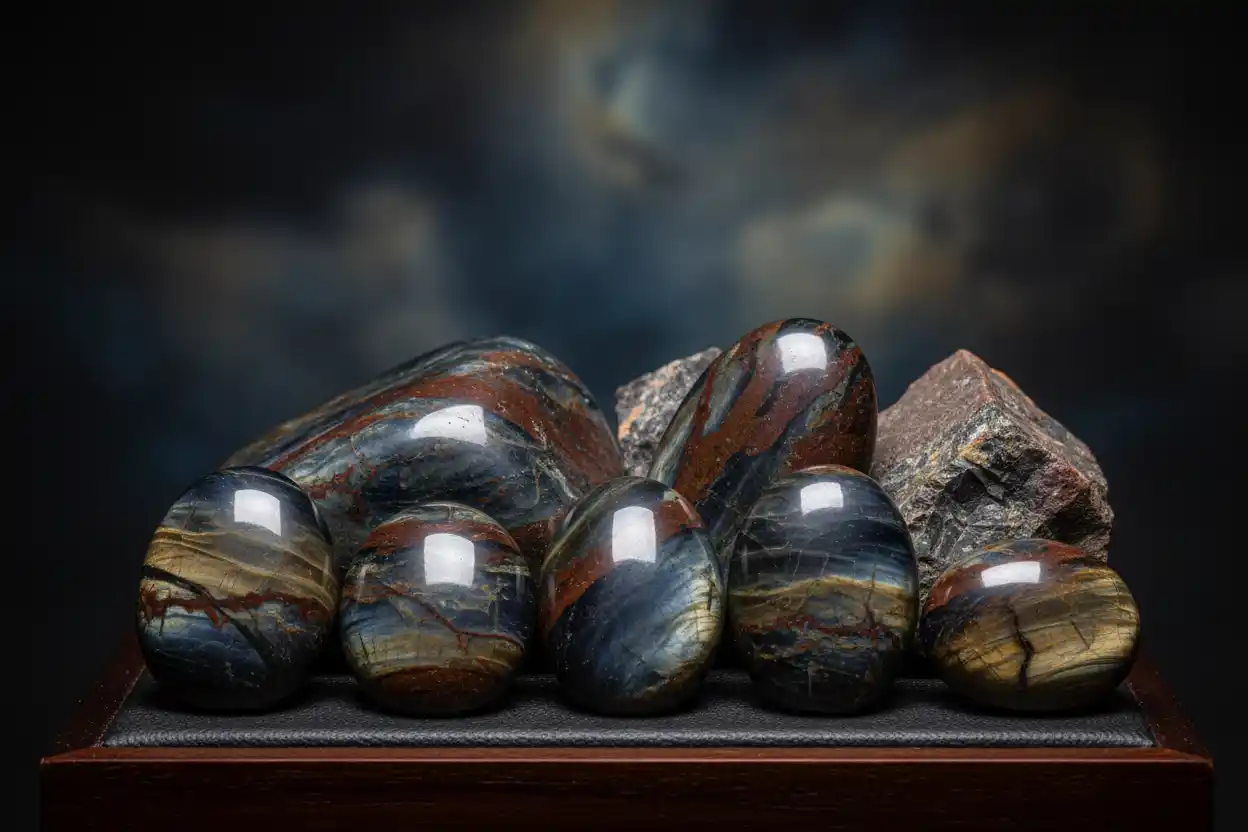
Pietersite: Meaning, Properties & Symbolism
Pietersite is a chatoyant, brecciated chalcedony containing fibrous amphibole-related inclusions and iron-rich alteration products. Its polished surfaces can display swirling flashes of electric blue, gold, bronze, rust red, brown, gray, and black that shift as the stone moves.
It is often described as brecciated Tiger’s Eye, but that phrase is incomplete. Modern microstructural research indicates that Pietersite’s chalcedony host, chaotic fiber arrangement, and formation history differ substantially from the parallel structure of conventional Tiger’s Eye.
Pietersite at a Glance
| Property | Pietersite |
|---|---|
| Material type | Brecciated, chatoyant chalcedony-based ornamental material |
| Main composition | Chalcedony and microcrystalline quartz with fibrous amphibole-related inclusions and iron oxides or hydroxides |
| Common colors | Blue, navy, gray-blue, gold, bronze, yellow, rust, red-brown, brown, black, and multicolored |
| Crystal system | No single external crystal system applies to the aggregate; quartz components are trigonal |
| Typical texture | Brecciated, fibrous, swirled, fragmented, veined, chaotic, and chatoyant |
| Luster | Vitreous to silky after polishing |
| Transparency | Opaque to locally translucent |
| Mohs hardness | Commonly about 6.5–7 |
| Cleavage | None for the chalcedony aggregate |
| Tenacity | Brittle |
| Fracture | Conchoidal to uneven |
| Specific gravity | Commonly around 2.6, with variation from inclusions |
| Common uses | Cabochons, pendants, rings, beads, bracelets, spheres, carvings, and collector slabs |
| Main care concern | Fractures, weak breccia boundaries, resin, false locality claims, poor optical orientation, and amphibole-bearing cutting dust |
Pietersite Is a Chalcedony Aggregate
Pietersite belongs within the broad Chalcedony family because its silica host is composed of microscopic quartz-related material.
The parent Quartz guide explains the wider silica family, but Pietersite’s appeal depends on fibrous inclusions and brecciated structure rather than transparent crystal form.
The stone is not one single crystal. It consists of fragments, fibers, iron-rich areas, and chalcedony cement arranged in a complex rock-like aggregate.
Therefore, assigning the whole material one simple formula such as SiO₂ omits the amphibole and iron phases responsible for its colors and optical effect.
Pietersite is a commercial lapidary name rather than an approved mineral species.
The Relationship with Tiger’s Eye
Tiger’s Eye is a chatoyant quartz-rich material containing aligned altered amphibole fibers.
Conventional Tiger’s Eye generally shows relatively parallel bands. When cut with the correct orientation, those fibers produce a smooth moving line of light.
Pietersite contains related fibrous components, but brecciation and later mineralization disrupted, rotated, bent, and reassembled them.
The result is turbulent chatoyancy rather than one regular eye. Flashes can appear as waves, flames, patches, streaks, whirlpools, or scattered moving fragments.
Current research also indicates that Pietersite’s chalcedony host and solution-breccia development differ from the columnar quartz texture associated with South African Tiger’s Eye.
For this reason, “brecciated Tiger’s Eye” is useful as a visual introduction but not a complete geological definition.
Detailed side-by-side identification belongs on Tiger’s Eye versus Pietersite.
How Pietersite Forms
Pietersite developed through several stages rather than one simple replacement process.
Silica-rich fluids deposited chalcedony and interacted with iron-bearing and sodium-rich components within fractures and cavities.
Fibrous amphibole-related minerals developed within parts of the material. Their orientation produced the potential for chatoyancy.
Fracturing then broke earlier fibrous and silica-rich zones into fragments. Fluid movement continued through the broken material.
Later chalcedony cemented the fragments while preserving their different directions.
Iron oxidation altered portions of the fibers into yellow, gold, orange, red, and brown oxide or hydroxide phases.
Because fragments point in several directions, each area reflects light independently. This produces the storm-like appearance associated with high-quality Pietersite.
The exact sequence differs between localities, and aspects of the formation model remain subjects of mineralogical interpretation.
Chatoyancy and the “Storm” Effect
Chatoyancy appears when parallel or partly aligned fibers reflect light as the stone moves.
In a classic cat’s-eye gem, the fibers run in one dominant direction and create a narrow continuous band.
Pietersite contains numerous fibrous fragments with different orientations. One patch may flash blue while an adjacent fragment reflects gold.
A single cabochon can therefore contain several independently moving lights.
High domes can display multiple fiber directions, but excessive curvature may distort the color pattern.
Flat slabs show broad textures yet may produce weaker movement.
Cutters study the rough while wet and under a concentrated light before choosing the face. A cut only a few degrees away from the strongest orientation can reduce chatoyancy dramatically.
Blue Pietersite
Blue Pietersite contains gray-blue, navy, steel-blue, or electric-blue fibrous areas.
The color is associated with less-altered blue amphibole-related material. In many descriptions, crocidolite or riebeckite-related fibers are identified as the key component.
The blue may appear as broad moving flames, fine needles, storm clouds, or scattered flashes against dark chalcedony.
Strong saturated blue is highly sought after, particularly when it appears alongside gold or rust-red areas.
Blue Tiger’s Eye can resemble more orderly blue Pietersite, but it normally retains parallel banding rather than chaotic breccia.
A seller should not apply blue Pietersite to every dark-blue chatoyant quartz product.
Gold, Red, and Brown Pietersite
Golden and brown colors develop as iron-rich amphibole fibers alter to iron oxides and hydroxides.
Fine particles create yellow, bronze, copper, orange, and reddish-brown appearances.
A single fragment may retain blue at one edge and grade into gold or rust where oxidation progressed farther.
Red Tiger’s Eye often shows more regular red-brown parallel bands. Some commercial red Tiger’s Eye is heat treated, whereas red areas in natural Pietersite can be part of its complex alteration pattern.
Strong red and blue combinations are less common than ordinary brown-gold material and can attract collector premiums.
However, color should remain visibly internal. Surface coatings and dye can imitate saturated red, blue, or gold.
Namibian Pietersite
Namibia is the original and most famous commercial source.
The name is generally credited to Sid Pieters, who recognized the material in Namibia during the twentieth century.
Namibian Pietersite is commonly associated with the Outjo region. It can display blue, gold, red, brown, black, and multicolored fibrous fragments.
Fine pieces are known for strong contrast, broad swirling chatoyancy, and dramatic combinations of blue and gold.
The deposit is not represented by one uniform grade. Much rough contains weak pattern, fractures, dull zones, or minimal blue.
Older mine stories and scarcity claims are frequently repeated without current documentation. The stone should be evaluated by appearance, condition, and defensible provenance rather than by a dramatic supply narrative alone.
Chinese Pietersite
China is the other principal recognized source.
Chinese Pietersite can show golden brown, reddish brown, blue, gray, black, and multicolored patterns.
Research has found measurable microstructural and compositional differences between studied Chinese and Namibian specimens, although both belong within the same commercial material category.
Some Chinese pieces contain abundant red-gold fibers, while others show strong blue or mixed appearances.
Visual identification of country is unreliable because the color ranges overlap. Laboratory analysis and traceable rough remain more useful than retailer assumptions.
A seller should not claim Namibia solely because blue stones command a premium.
Types and Commercial Color Names
The market uses names such as blue Pietersite, golden Pietersite, red Pietersite, tempest stone, storm stone, and multicolor Pietersite.
These terms describe appearance rather than approved mineral varieties.
The wider comparison among fibrous quartz materials belongs on types of Tiger’s Eye, although Pietersite should remain separate from ordinary color varieties.
A stone’s value depends on actual chatoyancy, color, stability, and cutting rather than the number of dramatic names attached to it.
How to Identify Pietersite
Rotate the stone under one concentrated light.
Authentic chatoyancy should move through internal fibrous fragments. Several patches may flash at different moments because their orientations differ.
Magnification can reveal fibrous bundles, chalcedony areas, iron-rich fragments, breccia boundaries, fractures, resin, and polishing marks.
The host commonly has quartz-like hardness and no cleavage. Nevertheless, destructive scratch testing is inappropriate for a finished cabochon.
A natural pattern should continue into the sides and reverse. Surface-only color or metallic paint indicates alteration or imitation.
Laboratory methods can include refractive-index testing, specific gravity, microscopy, Raman spectroscopy, X-ray diffraction, and elemental analysis.
The workflow in how to identify crystals explains why optical movement, structure, and composition must support one another.
Pietersite versus Fiber-Optic Glass
Fiber-optic glass can create a strong moving cat’s-eye effect at very low cost.
Its fibers are often extremely regular, evenly spaced, and consistent across the cabochon.
Natural Pietersite is more chaotic. It contains irregular breccia fragments, variable colors, mineral boundaries, and several directions of reflection.
Glass may show round bubbles, mold-related features, or a perfectly uniform base.
However, visually convincing products exist. Gemological testing may be necessary when a highly regular “Pietersite” stone has no natural-looking matrix or inclusion variation.
Other Lookalikes
Tiger’s Eye is the closest natural comparison but usually has straighter parallel banding.
Hawk’s Eye is a traditional name for blue Tiger’s Eye and can resemble blue-dominant Pietersite.
Chatoyant hypersthene, bronzite, arfvedsonite-bearing rock, larvikite, and certain feldspars can show moving metallic or blue reflections.
Dyed jasper, glass, resin, and ceramic may reproduce Pietersite’s color without its fiber structure.
An imitation does not need to match every property if the buyer relies only on one saturated product image.
The broader signs of fabricated stones and artificial optical effects appear in how to spot fake crystals.
Treatments and Stabilization
Most fine Pietersite is valued after ordinary cutting and polishing.
Resin stabilization may strengthen fractured or brecciated rough. Clear resin can enter cracks and improve polish.
Fracture filling may appear as glossy material along fragment boundaries or as bubbles inside repaired areas.
Dye can intensify blue, red, black, or gold. Pigment often accumulates within fractures and drill holes.
Coatings can add metallic or iridescent color but may scratch at exposed edges.
Backing can reinforce a thin cabochon or intensify dark areas.
Heat treatment is not considered the defining process for Pietersite, although heat could alter iron phases or affect fillers.
Enhancement categories are explained in gemstone treatments.
Lapidary Cutting
Pietersite is cut almost exclusively as cabochons, beads, slabs, spheres, freeforms, and carvings.
The cutter first searches for the direction in which fibers produce maximum movement.
A low dome may emphasize a wide blue or gold patch. A higher dome can display several directions but risks exposing fractures or weak boundaries.
Freeform cutting preserves the strongest fiber arrangement more effectively than standardized calibrated shapes.
Transparent resin may be used before or during cutting if the breccia would otherwise separate.
Undercutting can occur where softer altered fibers meet hard chalcedony. A skilled polish must remain even across both.
Pietersite’s optical orientation makes it especially relevant to gemstones for carving and cabochons.
Durability and Jewelry Suitability
Chalcedony-rich Pietersite commonly reaches about 6.5–7 on the Mohs scale.
Its surface durability is placed in context by the gemstone hardness chart.
Breccia boundaries and natural fractures create the greater practical concern. A hard surface does not prevent the rock from splitting along an internal weakness.
The distinction appears in gemstone toughness versus hardness.
Pendants, earrings, brooches, cufflinks, bolo ties, and protected rings suit stable material.
A bezel supports the edge better than widely spaced prongs. Ring stones should remain low and avoid open cracks near the girdle.
Bead holes require inspection because drilling through differently oriented fragments can create radial fractures.
Current Pietersite Asking Prices
Pietersite prices vary sharply according to blue content, chatoyancy, size, cutting, provenance, and seller positioning.
| Pietersite product | Broad July 2026 retail asking range |
|---|---|
| Small tumbled stone | About $5–$20 |
| Commercial cabochon | About $15–$60 |
| Strongly chatoyant blue-gold cabochon | About $50–$250 |
| Large premium multicolor cabochon | About $150–$600 |
| Exceptional collector or artist-cut cabochon | About $500–$2,000 or more |
| Bead strand | About $25–$150 |
| Small sphere or freeform | About $40–$250 |
| Large sphere, carving, or display piece | About $200–$1,500 or more |
| Sterling-silver jewelry | About $75–$500 |
| Gold or designer jewelry | Determined mainly by metal, craftsmanship, and stone quality |
These are broad asking ranges rather than appraisals or guaranteed transaction values.
Specialist sellers currently ask several hundred to several thousand dollars for exceptional cabochons, while ordinary marketplace stones can sell below $50.
What Gives Pietersite Value?
Strong mobile chatoyancy is the principal factor.
Blue generally commands a premium, particularly when it remains saturated and moves clearly across the face.
Balanced blue, gold, red, and dark areas create greater visual complexity than one muddy brown tone.
Cutting orientation controls whether the fibers flash face-up. An expensive piece of rough can become dull when cut on the wrong plane.
Contrast and pattern matter alongside color. Swirls, flames, and several independently moving fragments usually attract more interest than static cloudy inclusions.
Structural stability remains essential. Open cracks, resin-dependent fragments, chips, and poorly supported breccia lower durability.
Namibian provenance can add interest when documented, although fine Chinese material can also be highly attractive.
Polish, symmetry, thickness, treatment disclosure, and craftsmanship complete the valuation.
Buying Pietersite
Request a video under a moving concentrated light rather than relying on one front-facing photograph.
The chatoyancy should move within irregular fragments rather than appearing as fixed glitter.
Inspect the sides and back for resin, open cracks, backing, dye, and pattern continuity.
Ask whether the seller knows the source and how the Namibia or China claim was established.
Do not assume that more blue automatically means better quality. The blue must remain visible, mobile, well oriented, and structurally sound.
Compare the stone with the separate Tiger’s Eye buying guide when a seller appears to be relabeling ordinary fibrous quartz.
Pietersite appears in the crystals beginning with P directory and the gemstones beginning with P directory.
Cleaning and Storage
Clean stable Pietersite with lukewarm water, mild soap, and a soft cloth or brush.
Rinse briefly and dry it thoroughly.
Avoid prolonged soaking when the piece contains fractures, resin, dye, glue, or backing.
Steam and ultrasonic cleaning are unsuitable for heavily brecciated, filled, or repaired stones.
Do not use bleach, abrasive powder, or strong household acids.
Store Pietersite separately from sapphire, topaz, diamond, and other harder gemstones.
Setting-specific principles overlap with the advice in how to clean Tiger’s Eye jewelry, although filled Pietersite may require even more conservative handling.
Pietersite Meaning and Symbolism
Modern crystal traditions commonly associate Pietersite with decisive change, courage, adaptability, and remaining focused during disruptive circumstances.
Its turbulent blue and gold fibers inspire the popular storm-stone symbolism.
The brecciated structure can represent experiences that were broken, shifted, and reorganized without losing their original material.
Moving flashes also support themes of perspective: different aspects become visible as the stone or viewer changes position.
Because Pietersite entered the gem trade during the twentieth century, elaborate claims of an ancient worldwide Pietersite tradition are historically implausible.
These meanings remain personal, artistic, spiritual, or cultural interpretations. Scientific evidence does not show that Pietersite treats illness, controls weather, removes fear, or guarantees transformation.
Frequently Asked Questions
Is Pietersite a mineral?
No. It is a brecciated chatoyant chalcedony-based ornamental material containing several mineral components.
Is Pietersite the same as Tiger’s Eye?
No. They contain related fibrous components, but Pietersite has a chaotic brecciated structure and a chalcedony host that differs from conventional parallel-banded Tiger’s Eye.
What causes Pietersite’s moving light?
Aligned amphibole-related fibers reflect light. Different fragments point in different directions, producing several moving flashes.
What creates the blue color?
Less-altered blue amphibole-related fibers contribute blue, navy, and gray-blue areas.
What creates the gold and red colors?
Oxidation and alteration of iron-bearing fibers produce yellow, gold, bronze, rust, red-brown, and brown phases.
Where is Pietersite found?
Namibia and China are the two principal recognized sources.
Is Namibian Pietersite always better?
No. Namibian origin carries market prestige, but color, chatoyancy, cutting, condition, and treatment determine visible quality.
How can Pietersite be distinguished from Tiger’s Eye?
Pietersite usually shows broken, swirling, multidirectional chatoyant fragments, while Tiger’s Eye generally displays straighter parallel bands.
Is Pietersite suitable for rings?
Stable material can be worn in a low protective bezel. Open fractures and weak breccia boundaries make pendants safer.
Is Pietersite normally treated?
Many pieces are only polished, but resin stabilization, fracture filling, dye, coating, and backing can occur.
Can Pietersite go in water?
Brief washing is normally suitable for intact untreated material. Avoid soaking filled, dyed, backed, glued, or fractured stones.
What makes Pietersite valuable?
Strong chatoyancy, blue content, contrasting multicolor pattern, cutting orientation, structural stability, provenance, polish, size, and treatment disclosure determine value.
Pietersite’s strongest identification feature is not blue color alone but the way several fibrous fragments flash in different directions. That distinction is examined more closely in the dedicated Tiger’s Eye comparison rather than reducing both materials to one trade category.
Finished polished Pietersite is generally suitable for normal external use. Cutting, grinding, drilling, or crushing can release respirable silica and amphibole-bearing dust; use professional wet methods, enclosed extraction, eye protection, and appropriately selected respiratory controls.