

Tiger’s Eye Meaning: Properties, Healing Traditions, Uses & Care

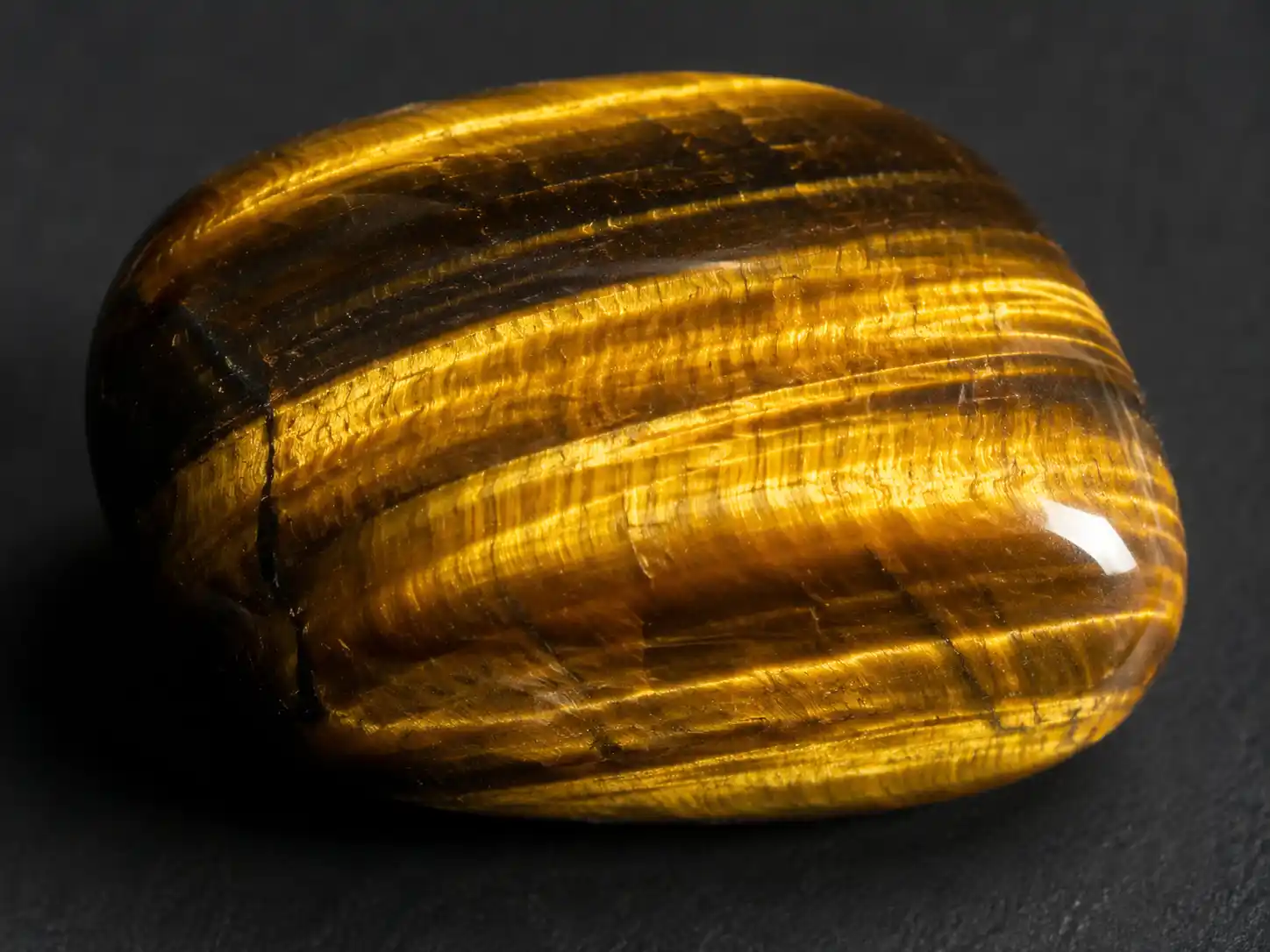
Tiger’s eye is a chatoyant quartz-rich gemstone recognized by the moving golden, bronze or brown band that seems to glide across a polished surface. Its eye-like optical effect comes from aligned fibrous inclusions within a quartz host, while iron-rich alteration produces the familiar warm colors. Tiger’s eye meaning developed around that changing band of light, with observation, grounded confidence, practical judgment, focus, courage and protective symbolism becoming its strongest modern themes.
The physical stone and tiger’s eye meaning answer different questions. Mineralogy explains the quartz-rich structure, chatoyancy, color, hardness, treatments and cutting orientation. Cultural and contemporary crystal traditions explain why the gemstone became associated with alertness, boundaries, decision-making and self-confidence. Tiger’s eye meaning can be personally useful as a reflective framework, but it is not a scientifically established healing effect.
That distinction is especially important because tiger’s eye meaning is sometimes presented as though the stone can guarantee protection, money, success or emotional control. It cannot. A polished stone can instead serve as a practical reminder to examine a situation from more than one angle, assess risk before acting and follow through on a decision once the evidence supports it.
Tiger’s Eye at a Glance
| Property | Tiger’s Eye |
|---|---|
| Material type | Chatoyant quartz-rich ornamental gemstone |
| Main composition | Predominantly silicon dioxide, SiO₂ |
| Internal feature | Aligned altered amphibole-related fibers and iron-rich products |
| Common colors | Golden yellow, bronze, brown, blue-gray and reddish brown |
| Optical effect | Chatoyancy |
| Luster | Silky to vitreous when polished |
| Transparency | Opaque to locally translucent |
| Mohs hardness | About 7 |
| Cleavage | None |
| Fracture | Uneven to conchoidal through quartz-rich areas |
| Common cuts | Cabochons, beads, tablets and carvings |
| Blue variety | Blue tiger’s eye or hawk’s eye |
| Red variety | Red tiger’s eye, commonly heat treated |
| Main treatments | Heat, dye, bleaching, resin impregnation and coatings |
| Main care concerns | Impact, treatments, glue, elastic and silica dust during cutting |
| Common symbolic themes | Focus, observation, confidence, courage, boundaries and practical judgment |
What Is Tiger’s Eye?
Tiger’s eye is a quartz-rich polycrystalline material containing aligned fibrous inclusions that produce its distinctive silky light. It belongs within the wider quartz family, although its internal texture differs greatly from transparent rock crystal, amethyst or citrine.
The stone is not one transparent quartz crystal with a stripe painted through it. Instead, its aligned structure controls how light is reflected. When a cutter positions those fibers correctly beneath a curved cabochon, a bright band appears to move as the light source, viewer or stone changes position.
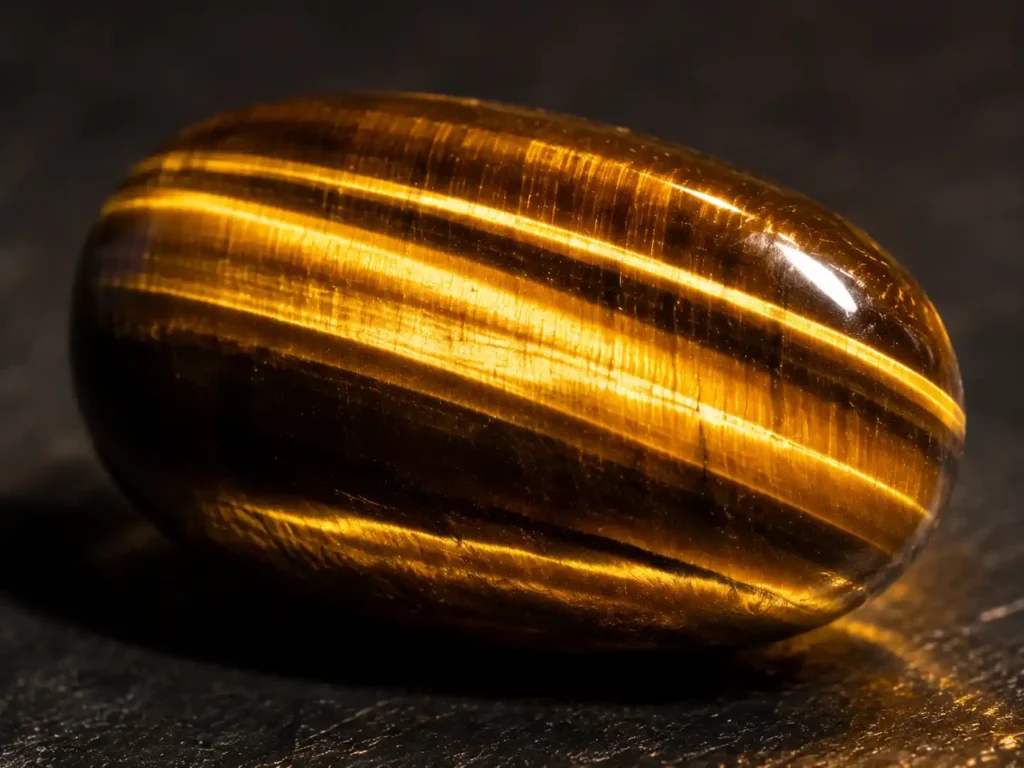
This genuine optical behavior is central to tiger’s eye meaning. The bright band can seem fixed on one point and then shift instantly when perspective changes, making the stone a natural visual metaphor for observation and reconsidering an assumption.
Tiger’s eye meaning does not come from a measurable force produced by the band. The optical effect is real; the symbolic interpretation is cultural and personal.

What Causes the Cat’s-Eye Effect?
The moving line is called chatoyancy, a term derived from the visual resemblance to a cat’s eye.
In tiger’s eye, the effect comes from aligned fibrous structures within the quartz-rich material. A polished dome concentrates reflected light into a bright line positioned roughly perpendicular to the fiber direction.
Cutting orientation matters enormously. If the fibers are positioned poorly, the band can appear weak, off-center or nearly stationary. A well-oriented cabochon produces a clean moving stripe under ordinary directional light.
Understanding this mechanism adds useful context to tiger’s eye meaning. The stone rewards a change in viewing angle, so its symbolism around perspective has a direct visual basis. It still does not mean tiger’s eye can reveal hidden truths, read another person’s motives or predict future events.
How Tiger’s Eye Forms
Older descriptions often simplified tiger’s eye as quartz replacing crocidolite while preserving its original fibrous form. Modern microstructural research supports a more complicated history involving quartz growth, fibrous amphibole-related material and repeated crack-sealing or alteration processes.
As iron-bearing components alter, iron oxides and hydroxides contribute the yellow, golden and brown colors of classic material. Less-altered blue-gray areas create hawk’s eye.
South Africa is the best-known commercial source, while important material also occurs in Western Australia and other locations. Tiger’s eye can occur alongside iron-rich rocks, jasper and related silica materials.
The geological process helps explain the stone’s physical identity, while tiger’s eye meaning remains separate. Repeated mineral growth can be used metaphorically to represent persistence, but the formation process does not create psychological resilience in the person wearing it.
Golden Tiger’s Eye Meaning
Classic golden-brown material defines the appearance most people associate with tiger’s eye meaning. Its honey, bronze, brown and dark chocolate bands combine earthy color with a bright moving reflection.
Modern traditions connect golden tiger’s eye meaning with confidence that remains attentive to consequences. This is different from impulsive boldness. A grounded interpretation asks whether there is enough information to act and whether the likely benefits justify the risks.
A useful practice is to define a decision in one sentence, list the realistic options and identify the assumption most likely to fail. The stone can sit nearby as a visual reminder to keep checking the angle rather than becoming attached to the first interpretation.
This is why tiger’s eye also appears naturally in discussions of crystals for clarity. The symbolism works best when clarity means structured thinking rather than supernatural certainty.
Blue Tiger’s Eye Meaning
Blue tiger’s eye, also called hawk’s eye, represents a less-altered blue-gray stage of the material. Colors can include slate, steel blue, blue-green, gray and nearly black, often with a silver or pale blue chatoyant band.
Blue tiger’s eye meaning is commonly associated with observation, patience and communication before action. Compared with golden tiger’s eye meaning, the symbolism tends to feel more watchful and restrained.
A practical interpretation is to pause long enough to understand a situation before responding. In a difficult conversation, that may mean identifying what was actually said, separating it from what was assumed and deciding whether a reply is needed immediately.
Blue tiger’s eye meaning remains symbolic. The stone cannot read body language perfectly, expose deception automatically or treat anxiety.
Red Tiger’s Eye Meaning
Red tiger’s eye ranges from rust and copper-brown to mahogany and burgundy. Naturally reddish areas occur, but much commercial red material is produced by heating golden-brown tiger’s eye.
Red tiger’s eye meaning emphasizes determination, focus, motivation and controlled action. The warmer color shifts the symbolism away from observation alone and toward taking the next defined step.
That does not make treated material fake. A heat-treated stone can still be natural tiger’s eye whose color has been altered. Treatment should simply be disclosed accurately.
A useful red tiger’s eye meaning practice is to narrow attention to one objective rather than starting several tasks at once. The stone does not create motivation biologically; it can serve as a cue to begin the action that has already been chosen.
Tiger’s Eye Meaning for Confidence
Confidence is one of the strongest themes in tiger’s eye meaning, but confidence is most useful when it includes reality testing.
The stone’s moving band provides a good metaphor: confidence should remain able to shift when better information appears.
Someone using tiger’s eye meaning before a presentation, negotiation or difficult conversation might ask: What am I prepared to say? Which evidence supports it? What would I do if the situation changes?
That approach creates a more useful form of confidence than simply trying to feel fearless.
Tiger’s eye cannot guarantee persuasive speech, promotions, favorable negotiations or social approval. Confidence still depends on preparation, competence and willingness to adapt.
Tiger’s Eye Meaning for Courage
Courage within tiger’s eye meaning is often described as steady rather than dramatic.
Practical courage may involve applying for an opportunity despite uncertainty, reporting a problem, setting a boundary or admitting that a previous plan is no longer working.
The goal is not to eliminate fear. It is to identify whether action remains appropriate even while discomfort exists.
This interpretation of tiger’s eye meaning preserves the traditional association with bravery without claiming that quartz alters fear pathways or automatically makes someone bold.
Courage also includes deciding not to take an unnecessary risk. Restraint can be a courageous choice when the evidence does not support proceeding.
Tiger’s Eye Meaning for Decision-Making
Decision-making may be the most natural practical application of tiger’s eye meaning.
A simple review can ask: What is the objective? Which options are realistic? What does each option cost? Who carries the risk? Which assumptions are uncertain? Can the decision be reversed? When should the result be reviewed?
This process aligns closely with the symbolism of a moving eye. The point is not endless reconsideration. It is to look from enough angles to make a defensible choice.
Tiger’s eye meaning should never be used as a divination shortcut for investments, medical treatment, legal decisions or relationship choices. The stone cannot calculate probability or reveal which option will succeed.
Tiger’s Eye Meaning for Focus
Focus in tiger’s eye meaning is less about forcing concentration and more about limiting unnecessary switching.
A tiger’s-eye object can be used as a visible cue that one task has priority for a defined period. When attention drifts, return to the chosen task instead of opening another commitment.
This approach can work especially well with a simple question: What is the next useful action?
Tiger’s eye meaning does not establish that the gemstone improves attention disorders or cognitive performance. Persistent concentration problems that impair daily life deserve appropriate professional assessment.
Tiger’s Eye Meaning for Protection and Boundaries
Eye-like gemstones have long attracted protective symbolism, and protection remains an important part of tiger’s eye meaning.
A grounded interpretation treats protection as observation, preparation and boundaries rather than an invisible shield.
Before entering a difficult situation, a person might use tiger’s eye meaning as a reminder to verify information, protect passwords, keep appropriate documentation, use safety equipment or decide in advance what behavior will cause them to leave.
A boundary describes what the person will do. “If this conversation becomes insulting, I will end it” is a boundary. Expecting the stone to force another person to behave differently is not.
Tiger’s eye cannot prevent accidents, violence, fraud or illness. Real protection requires real safeguards.
Tiger’s Eye Meaning for Prosperity and Money
Golden color has also connected tiger’s eye meaning with prosperity, resources and financial confidence in modern crystal traditions.
The stone cannot attract money, guarantee business success or prevent investment losses.
A practical prosperity interpretation is much stronger. Use tiger’s eye meaning as a cue to check the numbers, understand fees, compare alternatives and separate a desirable story from verifiable evidence.
Someone running a business might associate the stone with completing revenue-producing work before low-priority tasks. Someone managing personal finances might connect it with reviewing spending or building an emergency reserve.
The symbolism supports disciplined resource decisions rather than magical wealth promises.
Tiger’s Eye Meaning in Relationships
Tiger’s eye meaning in relationships centers on observation, self-respect, direct communication and boundaries.
The stone cannot determine compatibility, prove fidelity, identify a soulmate or make an ex return.
Its symbolism can still help someone examine behavior rather than relying only on hopes or fears. Are agreements being kept? Is communication respectful? Does conflict lead to repair, or simply repeat? Can each person say no safely?
Tiger’s eye meaning can also represent slowing down before reacting during conflict. A pause is useful when it creates a more accurate response, not when it becomes silent punishment or manipulation.
Tiger’s Eye Meaning for Emotional Reflection
Modern crystal traditions sometimes describe tiger’s eye as emotionally balancing. There is no established medical evidence that the gemstone regulates mood, anxiety or stress.
A grounded tiger’s eye meaning practice can nevertheless use the stone as a prompt to separate emotion from immediate action.
Anger may signal a violated boundary. Fear may signal a possible risk. Excitement may reveal opportunity while also reducing caution. The useful question is what the emotion tells you to investigate.
Tiger’s eye meaning can therefore represent emotional awareness combined with judgment.
Persistent anxiety, depression, trauma symptoms or other significant mental-health concerns should receive appropriate professional support rather than gemstone-based treatment.
Tiger’s Eye Meaning and the Solar Plexus Chakra
Golden tiger’s eye is commonly linked with the solar plexus chakra in contemporary spiritual systems.
Within that framework, tiger’s eye meaning emphasizes agency, confidence, disciplined action and the ability to make choices without trying to control other people.
A useful solar-plexus reflection asks whether hesitation comes from a real risk that needs investigation or simply from discomfort with uncertainty.
The distinction can improve decision-making even though chakras themselves are spiritual concepts rather than scientifically established anatomical structures.
Tiger’s eye does not treat digestive disease, adrenal disorders, metabolic conditions or other health problems sometimes associated with chakra language.
Root and Sacral Chakra Associations
Brown and red varieties are also associated with the root chakra, where tiger’s eye meaning may focus on practical stability, security and routines.
Red tiger’s eye is sometimes linked with the sacral chakra, emphasizing creativity, participation and purposeful movement.
These assignments vary among traditions and often follow color symbolism.
A grounded practice can translate root symbolism into reviewing housing, finances, routines and safety, while sacral symbolism can become a prompt to complete a creative action.
The gemstone does not physically open, close or diagnose a chakra.
Meditation With Tiger’s Eye
Tiger’s eye is particularly suitable for visual meditation because chatoyancy gives attention something concrete to observe.
Place an intact polished stone under comfortable directional light. Tilt it slowly and watch the bright line travel across the surface.
Then choose one question connected with tiger’s eye meaning: What changes when I view this situation from another position? Which risk am I underestimating? Which uncertainty am I exaggerating?
The moving band can serve as a visual metaphor without becoming an oracle.
Tiger’s eye meaning is most useful when meditation ends with an observable next step rather than a prediction.
If meditation causes panic, dissociation or significant distress, stop the exercise rather than assuming the discomfort proves spiritual progress.
Tiger’s Eye and Historical Protective Symbolism
The eye-like appearance of tiger’s eye naturally fits a much broader human history of eye imagery associated with watchfulness and protection.
That context helps explain tiger’s eye meaning without requiring one universal ancient doctrine.
The stone has been used widely for cabochons, seals, beads, carvings and jewelry, especially after large commercial deposits made it more accessible.
Historical stories about warriors, luck and protection vary in quality and are often repeated without clear sourcing. They are best treated as cultural lore rather than laboratory evidence.
Tiger’s eye meaning today can preserve the idea of watchfulness in a grounded form: notice first, then act.
Tiger’s Eye vs Pietersite
Pietersite is the closest visually related material many buyers encounter.
Tiger’s eye usually shows organized parallel or gently curved chatoyant fibers. Pietersite is brecciated, with fragmented chatoyant structures arranged in swirling, storm-like patterns.
The dedicated tiger’s eye vs pietersite comparison shows why the distinction is more than color.
Both stones may receive confidence or transformation symbolism, but their structures differ.
Tiger’s eye meaning therefore should not be transferred automatically to every chaotic blue-and-gold chatoyant stone sold under a similar trade description.
Tiger’s Eye vs Fiber-Optic Glass
Fiber-optic glass can imitate tiger’s eye remarkably well.
It may produce an extremely sharp, uniform moving band. Multiple beads can show nearly identical internal lines, overly consistent color or repeated patterns.
Natural tiger’s eye usually has more irregular color transitions, curved fibers and differences from bead to bead.
Gas bubbles or molding evidence can also suggest manufactured glass, although no single visual clue proves identity in every case.
A convincing imitation can still be decorative, but it should not be sold as natural quartz-rich material.
Tiger’s eye meaning cannot authenticate a stone. Feeling warmth, tingling or calm while holding an object is not a gemological test.
Tiger’s Eye vs Cat’s-Eye Chrysoberyl
Cat’s-eye chrysoberyl is a different mineral and a much rarer fine gemstone.
In professional gem usage, the term “cat’s-eye” without a mineral qualifier traditionally refers to chrysoberyl.
Chrysoberyl is harder and usually more transparent, with a sharper eye formed by aligned inclusions within a single crystal. Tiger’s eye is opaque to locally translucent quartz-rich material with broader silky chatoyancy.
Both can symbolize alertness because of their visual resemblance to an eye, but tiger’s eye meaning does not make the two minerals equivalent.
Treatments and Unusual Colors
Heat treatment is commonly used to produce red tiger’s eye. Dye can create vivid blue, red, green, purple and other colors. Bleaching, polymer impregnation and surface coatings may also occur.
The types of tiger’s eye guide separates natural varieties from trade colors and common treatments.
Treatment does not automatically make a stone undesirable. The issue is disclosure.
A naturally attractive heated red cabochon can be a good purchase at an appropriate price. A dyed strand can also be decorative if it is sold honestly.
Tiger’s eye meaning should not be used to claim that untreated material is spiritually stronger or that treatment destroys a measurable energy. Those claims cannot be verified scientifically.
How to Recognize Real Tiger’s Eye
Real tiger’s eye should show directional chatoyancy rather than random glitter.
The band should move as the angle changes, while natural variation in color, fiber width and pattern usually remains visible.
Very uniform beads with identical eyes deserve closer inspection, particularly when the color is unusually bright.
Magnification can reveal fibrous structure, fractures, concentrated dye or surface coatings. Professional testing can help separate natural material from glass, plastic and other imitations.
Avoid destructive scratch, flame or chemical tests. They can damage genuine jewelry and still produce ambiguous results.
Tiger’s eye meaning is subjective; authenticity relies on physical evidence.
How to Judge Tiger’s Eye Quality
Quality begins with chatoyancy.
A strong stone shows a bright, mobile band that remains visible under ordinary directional light. The eye should move smoothly rather than appearing dull or fixed.
Color comes next. Golden-brown material benefits from attractive contrast between honey, bronze and darker zones. Blue material should show a clear silvery or blue eye. Red material should be evaluated with treatment disclosure in mind.
Cutting and polish matter just as much. A well-oriented cabochon can transform average rough, while poor orientation can weaken exceptional material.
Beads should have centered drill holes without radiating cracks.
Tiger’s eye meaning does not create market value. Price is determined by appearance, condition, workmanship, matching, treatment and rarity of the particular pattern.
Tiger’s Eye Jewelry
Tiger’s eye works well in jewelry because quartz provides useful everyday scratch resistance and the moving band remains visible during normal body movement.
Tiger’s eye earrings provide relatively low-impact wear and can display strong movement near the face.
A tiger’s eye bracelet shows multiple shifting bands as the wrist turns, although elastic, thread and drill-hole condition become important durability factors.
Cabochon rings, pendants, cuff links and signet-style jewelry also suit the material.
Someone may choose a piece because tiger’s eye meaning represents confidence or focus, but setting quality and lifestyle determine how well the jewelry survives.
Hardness and Everyday Durability
Tiger’s eye is approximately Mohs 7 because quartz is its main host.
The gemstone hardness chart shows that this is durable enough for frequent wear but not resistant to every scratch.
Topaz, sapphire and diamond can scratch tiger’s eye. Hard impacts can also chip fractured cabochons or break beads near drill holes.
The material has no cleavage, which is helpful, but natural fractures and fibrous boundaries can still influence breakage.
Tiger’s eye meaning may symbolize resilience; physical durability still depends on the individual piece.
How to Clean Tiger’s Eye
For ordinary care, use lukewarm water, mild soap and a soft cloth or brush. Rinse briefly and dry completely.
The full tiger’s eye jewelry cleaning guide gives treatment-aware instructions.
Avoid prolonged soaking when dye, bleaching, resin, adhesive, elastic or thread may be present. Ultrasonic cleaning is unnecessary and may stress fractures, treatments or jewelry construction.
Harsh household chemicals should also be avoided, particularly when treatment status is uncertain.
Cleaning removes dirt and skin oils. It does not change tiger’s eye meaning or remove a scientifically measurable form of negative energy.
Lapidary Safety
Finished polished tiger’s eye can be handled normally.
Cutting, drilling and grinding are different because quartz-rich material can produce respirable crystalline silica dust.
Dry grinding should not be treated as a casual home activity. Lapidary work requires appropriate wet methods, local extraction, respiratory protection selected for the process and careful cleanup.
The historic amphibole-related fibers within the material should not be confused with loose fibers in finished polished jewelry, but creating mineral dust is still unnecessary and hazardous.
Tiger’s eye meaning never justifies unsafe cutting practices or inhalation of dust.
Can Tiger’s Eye Go in Water?
Brief gentle washing is generally appropriate for sound untreated material.
That does not mean soaking is beneficial.
Dyed, bleached, resin-treated, glued or strung pieces may respond differently to prolonged water exposure. Repeated soaking can also shorten the life of elastic or thread.
There is no reason to place tiger’s eye inside drinking water to use tiger’s eye meaning symbolically. Direct crystal elixirs provide no established medical benefit and may introduce contaminants from treatments, polish compounds, settings or handling.
Keep symbolic water rituals indirect.

How to Store Tiger’s Eye
Store tiger’s eye separately from harder gemstones.
A soft pouch or divided jewelry compartment reduces scratches and protects polished surfaces from metal edges.
Bracelets should rest in a natural curve rather than remaining stretched around a display. Long bead strands should not be sharply folded at one point.
Broken pieces can develop sharp edges and should be wrapped before disposal or repair.
The material also appears in Gems Lore’s crystals that start with T and gemstones that start with T directories for readers comparing related names.
How Tiger’s Eye Meaning Fits With the Real Stone
Tiger’s eye meaning works unusually well when symbolism grows from the gemstone’s actual appearance.
Its moving band can symbolize perspective. The eye-like effect can represent observation. Golden-brown color can suggest practical resources and grounded confidence. Quartz hardness can represent persistence.
These are metaphors, not mechanisms.
At Gems Lore, tiger’s eye meaning is most useful when the stone encourages someone to observe before reacting, compare evidence before deciding and act with confidence that remains open to correction.
That approach preserves the traditional language of courage, focus, protection and prosperity without turning the gemstone into a medical treatment, financial guarantee or supernatural source of information.
Tiger’s eye meaning does not need to promise impossible outcomes to be personally significant. A bracelet can mark a commitment to focus. A cabochon can remind someone to check risk. An inherited stone may carry family significance. The physical gem remains a remarkable example of chatoyant quartz-rich material regardless of which symbolism the owner chooses.
Frequently Asked Questions
What is the main tiger’s eye meaning?
The central tiger’s eye meaning involves grounded confidence, focus, observation, practical judgment, measured courage, boundaries and protection symbolism. These themes come from cultural and contemporary spiritual traditions rather than scientifically demonstrated effects.
What is tiger’s eye made of?
Tiger’s eye is a quartz-rich polycrystalline material containing aligned altered amphibole-related fibrous inclusions. Quartz provides most of the material’s approximately Mohs 7 hardness.
What causes the moving line in tiger’s eye?
Aligned fibrous structures reflect light directionally. When the material is cut correctly as a cabochon, the reflection forms a moving band called chatoyancy.
Is tiger’s eye a type of quartz?
Yes. Quartz is the principal host material. Tiger’s eye differs from transparent quartz varieties because its aligned fibrous internal structure creates chatoyancy.
What does tiger’s eye mean spiritually?
Spiritual tiger’s eye meaning commonly emphasizes confidence, discernment, protection, focus and grounded action. These are belief-based interpretations, not scientifically measured properties.
Does tiger’s eye have healing properties?
Claims about tiger’s eye healing properties belong to spiritual traditions. The stone has not been shown to cure disease, regulate hormones, treat anxiety, improve circulation or provide other medical effects.
Can tiger’s eye help with anxiety?
There is no established evidence that tiger’s eye treats anxiety. A person may use tiger’s eye meaning as part of a grounding or reflective routine, but persistent or severe anxiety deserves appropriate professional care.
Does tiger’s eye protect you?
Protection is part of traditional tiger’s eye meaning, but the stone cannot prevent accidents, violence, fraud or illness. A grounded interpretation uses it as a reminder to notice risk and apply practical safeguards.
Does tiger’s eye attract money?
No scientific evidence shows that tiger’s eye attracts money or guarantees business success. Prosperity-focused tiger’s eye meaning can instead symbolize budgeting, disciplined work and evidence-based financial decisions.
What chakra is tiger’s eye associated with?
Golden material is commonly associated with the solar plexus chakra. Brown and red varieties are often linked with the root chakra, while red material may also appear in sacral-chakra traditions. Chakra assignments are spiritual frameworks rather than anatomical facts.
What does blue tiger’s eye mean?
Blue tiger’s eye meaning centers on observation, patience, perspective and communication before action. Blue tiger’s eye is also known as hawk’s eye.
What does red tiger’s eye mean?
Red tiger’s eye meaning emphasizes determination, motivation, focus and controlled action. Much commercial red material has been heat treated, and some is dyed.
Is red tiger’s eye natural?
Naturally reddish material exists, but heat treatment is widely used to produce or intensify red-brown colors. Known treatment should be disclosed.
Is tiger’s eye asbestos?
Finished tiger’s eye is a quartz-rich gemstone containing altered amphibole-related inclusions. It should not be treated as loose asbestos material. Cutting or grinding quartz-rich stone can nevertheless create hazardous respirable silica dust.
How can I tell real tiger’s eye from fake?
Look for directional moving chatoyancy, natural variation and realistic fibrous structure. Fiber-optic glass can produce a very uniform sharp eye, so valuable or uncertain material may require professional testing.
What is the difference between tiger’s eye and pietersite?
Tiger’s eye usually has organized parallel or gently curved chatoyant fibers. Pietersite contains brecciated, broken chatoyant fragments with a more chaotic appearance.
Is tiger’s eye durable for everyday jewelry?
Generally yes. Its hardness near 7 and lack of cleavage make it practical for many jewelry forms, although strong impact, existing fractures and harder gemstones can still cause damage.
Can tiger’s eye go in water?
Brief washing is usually acceptable for sound untreated stone, but prolonged soaking is unnecessary and can affect dyed, resin-treated, glued or strung jewelry.
How should tiger’s eye be cleaned?
Use lukewarm water, mild soap and a soft cloth or brush, then rinse briefly and dry completely. Avoid harsh chemicals and unnecessary ultrasonic cleaning, especially when treatment is uncertain.
Does tiger’s eye meaning change by color?
Yes, symbolic emphasis varies. Golden material is commonly linked with confidence and judgment, blue with observation and patience, and red with focus and decisive action. The differences are cultural interpretations rather than measurable energetic categories.
Tiger’s eye combines a real optical phenomenon with symbolism that naturally grows from what the stone does visually. Chatoyancy moves as perspective changes, while its strong quartz-rich body allows the effect to be worn and handled in many practical forms. Tiger’s eye meaning uses those characteristics as metaphors for observation, confidence, focus and measured courage.
The most grounded tiger’s eye meaning does not promise supernatural protection, financial gain or medical healing. It represents a way of approaching decisions: look carefully, check assumptions, recognize risk and then act when the evidence is sufficient. That is a meaningful role for the stone without asking it to do what only judgment, preparation and real-world action can accomplish.
Tiger’s eye meaning, chakra associations, protection beliefs, prosperity symbolism and healing traditions belong to cultural, spiritual or personal practices rather than scientifically established medical or financial effects. Tiger’s eye should not replace medical or mental-health care, guarantee protection or predict outcomes. Finished polished material can be handled normally, but cutting, drilling or grinding quartz-rich tiger’s eye requires proper controls because respirable crystalline-silica dust is hazardous.