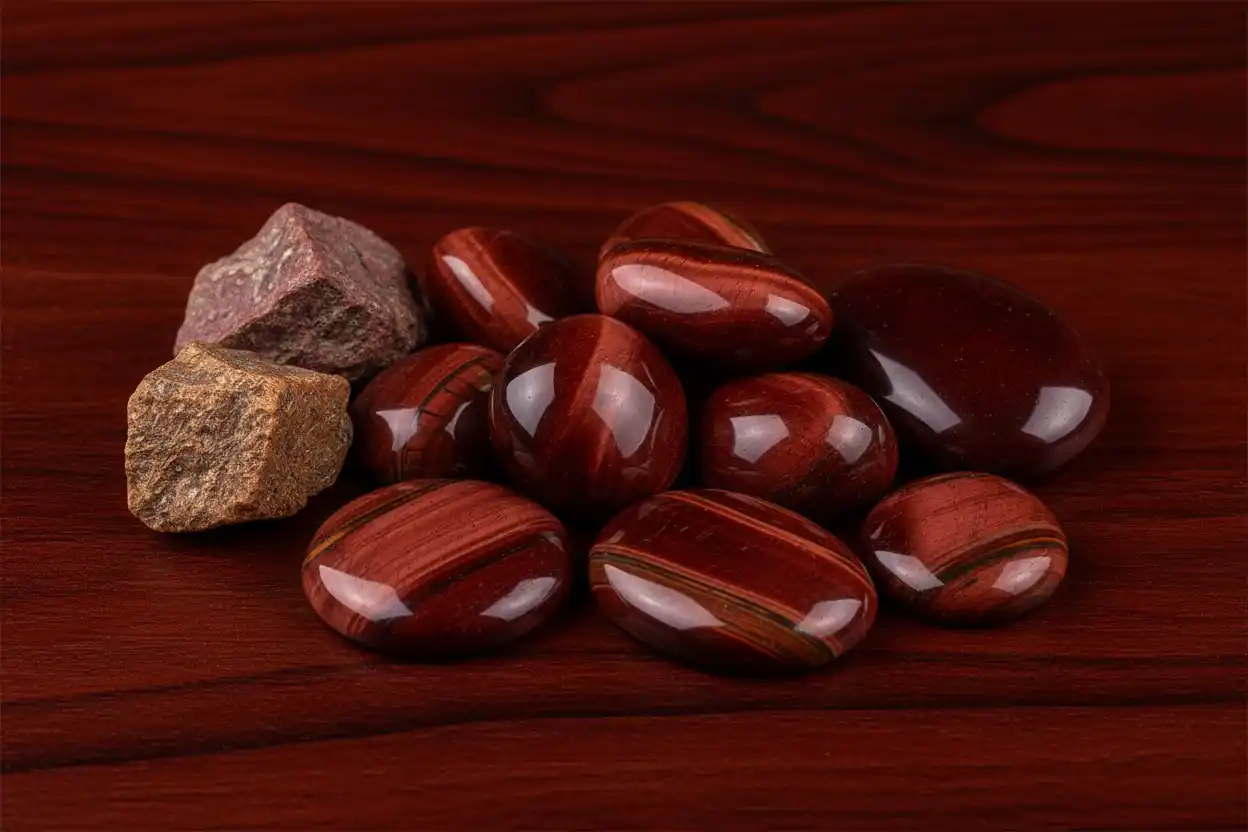
Red Tiger’s Eye Meaning, Properties, Treatment & Value
Red Tiger’s Eye is a red, brick-red, burgundy, russet, or reddish-brown chatoyant quartz material with parallel fibrous structures that create a moving band of reflected light. Much of the material sold commercially begins as golden Tiger’s Eye and receives controlled heating that converts yellow-brown iron oxyhydroxides into red hematite.
Naturally red material also occurs where geological oxidation and heating produced hematite before mining. However, natural and deliberately heated stones can look extremely similar, so buyers should assume that commercial Red Tiger’s Eye has been heated unless the seller provides reliable evidence otherwise.
Red Tiger’s Eye at a Glance
| Property | Red Tiger’s Eye |
|---|---|
| Material type | Red chatoyant quartz-rich ornamental material |
| Main composition | Columnar polycrystalline quartz, SiO₂, with altered fibrous amphibole and iron-rich phases |
| Common trade names | Red Tiger’s Eye, Bull’s Eye, Bull’s-Eye Stone, Ox Eye |
| Common colors | Brick red, burgundy, russet, mahogany red, copper red, red-brown, and nearly black red |
| Optical effect | Chatoyancy from aligned fibrous inclusions |
| Crystal system | No single external crystal system applies to the aggregate; quartz components are trigonal |
| Typical texture | Parallel fibrous, banded, silky, massive, curved, or locally brecciated |
| Luster | Silky to vitreous |
| Transparency | Opaque, with thin translucent edges in some material |
| Mohs hardness | Approximately 6.5–7 |
| Cleavage | None for the quartz-rich aggregate |
| Tenacity | Brittle |
| Fracture | Conchoidal to uneven |
| Specific gravity | Commonly approximately 2.64–2.71 |
| Common uses | Cabochons, beads, rings, bracelets, pendants, earrings, spheres, carvings, bolo ties, and decorative objects |
| Main care concern | Heat-treatment disclosure, poor chatoyancy orientation, dye, acid bleaching, fiber-optic glass, fractures, and silica-rich cutting dust |
Red Tiger’s Eye within the Tiger’s Eye Family
Red Tiger’s Eye belongs within the broader Tiger’s Eye family.
The family includes golden-brown material, blue Hawk’s Eye, red varieties, mixed blue-gold stones, and patterned forms containing hematite or jasper.
The parent page owns the shared history, general formation, jewelry use, and family-level symbolism. This guide focuses on red color, treatment, identification, lookalikes, quality, and value.
Types of Tiger’s Eye provides the wider commercial variety framework without treating every red-brown fibrous stone as an independent mineral species.
How Tiger’s Eye Forms
Older descriptions often state that quartz replaced crocidolite asbestos completely while preserving the original fibers.
Modern microscopic research supports a more complex formation model.
Quartz and riebeckite-related amphibole fibers appear to have grown together through repeated crack-seal events. Mineral-rich fluids entered narrow fractures, deposited fibrous amphibole and quartz, and then returned as the fractures opened again.
The parallel fibers created the structure needed for chatoyancy.
Subsequent oxidation altered blue iron-bearing amphibole components into yellow-brown goethite, limonite-like material, hematite, and related iron phases.
Accordingly, Tiger’s Eye is not merely a transparent quartz crystal containing one loose bundle of fibers. It is a columnar polycrystalline quartz-rich material whose internal fibrous structure developed during repeated mineral growth.
What Creates Chatoyancy?
Chatoyancy is the moving cat’s-eye-like band visible when the stone turns beneath a concentrated light.
Parallel fibrous inclusions reflect and scatter light in one dominant direction.
A cutter must orient the cabochon so the fibers run parallel to its base and across its width. The reflected line then travels across the dome as the viewing angle changes.
When the rough is cut at the wrong angle, the same material can appear dull, streaked, or almost motionless.
A narrow, bright, continuous line usually receives more demand than a broad hazy patch.
Curved fibers can create wavy or split reflections. Some buyers value this irregularity when the movement remains strong.
The phenomenon differs from the chaotic flashes in Pietersite, where brecciated fibrous fragments point in several directions.
The complete comparison appears in Tiger’s Eye versus Pietersite.
What Creates the Red Color?
Golden Tiger’s Eye commonly contains yellow-brown goethite or related hydrated iron phases.
When the material is heated in an oxidizing environment, goethite loses chemically bound water and converts toward hematite.
Hematite produces red, brick-red, russet, and burgundy tones.
The chatoyant fiber arrangement usually remains visible because the treatment changes the iron-bearing color phases rather than melting or removing the quartz-rich structure.
Temperature, heating duration, oxygen availability, starting color, fiber density, and iron content influence the finished hue.
Lower or less complete treatment can produce orange-red or coppery brown. Stronger oxidation may create deeper burgundy and dark red-brown.
Heating cannot create good chatoyancy in poorly oriented or structurally weak rough. It changes color but does not correct the fiber direction.
Natural Red Tiger’s Eye
Natural Red Tiger’s Eye can form when geological heat and oxidation convert iron-bearing phases to hematite before the material reaches the market.
Weathering, hydrothermal alteration, metamorphism, or heating associated with the deposit can contribute.
Some natural rough contains blue, gold, red, black, and gray zones representing different degrees of oxidation.
A red layer may sit beside golden Tiger’s Eye or hematite-rich ironstone within the same specimen.
However, natural and commercially heated red material can overlap closely in appearance and chemistry.
Heating reproduces an oxidation reaction that can also happen in nature. Therefore, visual inspection often cannot determine when the color change occurred.
Unless documented otherwise, a conservative description is “natural Tiger’s Eye with heat-induced red color.”
Heated Red Tiger’s Eye
Heating golden Tiger’s Eye to produce red material is an established lapidary treatment.
Historical gemological experiments demonstrated that moderate heating can turn golden material red without improving further at much higher temperatures.
Commercial procedures vary, and the exact temperature is rarely disclosed.
Properly heated stone usually retains its hardness, chatoyancy, and basic care requirements.
The treatment is stable under normal jewelry conditions. Red color does not normally wash away or fade through routine wear.
Disclosure still matters because buyers may value naturally oxidized material differently from deliberately heated stone.
Heating should not be presented as laboratory growth, dyeing, or synthetic manufacture. The underlying stone remains natural Tiger’s Eye.
The broader distinction between heat, dye, coating, filling, and bleaching appears in gemstone treatments explained.
Bull’s Eye and Other Trade Names
Bull’s Eye, Bull’s-Eye Stone, and Ox Eye are older or regional names for Red Tiger’s Eye.
These names usually refer to heated red-brown material rather than a separate mineral variety.
Some sellers use Dragon’s Eye for red Tiger’s Eye beads, but the term is inconsistent and can also refer to glass, dyed agate, ceramic, or carved products.
A product name should not replace a material description.
The clearest wording states whether the stone is natural Tiger’s Eye, whether the red color is heated or undetermined, and whether any additional dye or coating is present.
Red Tiger’s Eye versus Blue Tiger’s Eye
Blue Tiger’s Eye is the less-oxidized blue-gray, blue-green, or steel-blue material traditionally called Hawk’s Eye.
Its fibrous amphibole components retain more of their original blue appearance.
Golden Tiger’s Eye represents a more oxidized yellow-brown stage, while red material commonly reflects further conversion toward hematite.
One rough specimen can preserve all three colors.
Heating blue material does not always produce the same clear red result as heating suitable golden material. Starting chemistry and oxidation state affect the response.
Blue, gold, and red varieties share similar hardness and structural care concerns.
Red Tiger’s Eye versus Red Jasper
Red Jasper is an opaque silica-rich material colored mainly by iron oxides.
Both stones can show brick-red, rust, mahogany, and brown-red colors.
The identifying difference is chatoyancy.
Red Tiger’s Eye contains aligned fibers that create a moving silky band. Ordinary Red Jasper has a more uniform, spotted, veined, or opaque surface without one directional moving eye.
Some rocks contain Tiger’s Eye, Red Jasper, and black hematite together. This mixed material is commonly known as tiger iron.
A cabochon cut across several components should be described as a mixed rock rather than pure Red Tiger’s Eye.
Red Tiger’s Eye versus Fire Quartz
Fire Quartz is transparent to translucent Quartz containing red hematite, lepidocrocite-like phases, or other iron-rich inclusions.
It commonly displays clouds, specks, flakes, phantoms, or internal red patches.
Red Tiger’s Eye is usually opaque and distinctly fibrous.
Fire Quartz may be faceted or cut as a clear cabochon, whereas Tiger’s Eye relies on a correctly oriented dome to display chatoyancy.
Both can contain hematite, but their textures and optical effects differ.
Red Tiger’s Eye versus Fiber-Optic Glass
Manufactured fiber-optic glass is one of the most convincing Tiger’s Eye imitations.
Thousands of artificial glass fibers create an exceptionally sharp moving band.
The material is sold in natural-looking brown and red as well as bright blue, green, pink, and purple.
Its fibers are usually more uniform than those in natural Tiger’s Eye. The color can also appear unnaturally even across every bead.
Round bubbles, mold marks, chipped glass edges, and a lack of natural ironstone or quartz texture provide additional clues.
Nevertheless, high-quality fiber-optic glass can require gemological testing.
The general signs of glass and manufactured optical effects appear in how to spot fake crystals.
Dye, Bleaching, and Other Treatments
Red Tiger’s Eye can receive treatments beyond heating.
Dye may intensify weak red, produce bright crimson, or color pale bleached material.
Pigment often accumulates within fractures, surface pits, and drill holes.
Acid bleaching has historically been used to lighten dark Tiger’s Eye. The resulting material may be dyed afterward.
Resin can fill fractures, stabilize weak ironstone layers, or improve polish.
Coatings create stronger gloss or metallic color but can wear from exposed edges.
A heated stone with no other enhancement is generally more desirable than a heavily dyed or coated product.
Treatment should be evaluated through disclosure, magnification, color distribution, and seller credibility rather than price alone.
Important Sources
South Africa’s Northern Cape is the classic and most important source of commercial Tiger’s Eye.
The Prieska and surrounding regions contain fibrous quartz-rich veins within banded iron formations.
Namibia produces fibrous quartz and related Pietersite material.
Western Australia supplies tiger iron and Tiger’s Eye-rich banded rocks.
India, Brazil, China, the United States, and other countries also market chatoyant quartz products.
However, country labels often refer to cutting or wholesale distribution rather than verified geological origin.
South African origin is plausible for commercial red beads, but a seller should not claim a specific historic mine without supporting information.
How to Identify Red Tiger’s Eye
Rotate the stone beneath one concentrated light.
A genuine chatoyant band should move smoothly across the surface and remain linked with parallel internal fibers.
Magnification may reveal curved fibers, iron-rich bands, granular quartz, fractures, resin, dye, and polishing marks.
Natural material often contains small variations in fiber spacing and color. Perfectly identical beads deserve closer inspection.
Quartz-rich Tiger’s Eye approaches Mohs hardness 7 and normally resists ordinary steel.
However, destructive scratching is unnecessary for finished jewelry.
Its specific gravity commonly falls close to ordinary Quartz, with variation from iron-rich material.
Raman spectroscopy can identify quartz and associated iron or amphibole phases. Microscopy and spectroscopy can also distinguish many glass imitations.
Home testing usually cannot prove whether the red color formed naturally or through controlled heating.
Cutting and Orientation
Tiger’s Eye is cut primarily as cabochons, beads, spheres, freeforms, carvings, and flat polished slices.
Faceting is uncommon because small facets break up the continuous chatoyant band.
The cutter first examines the fiber direction on wet or polished rough.
A cabochon is then oriented with the fibers running across the stone rather than from top to bottom.
The dome’s curvature controls the apparent width and movement of the eye.
A high dome can create a narrow dramatic line but consumes more rough. A flatter cabochon preserves weight and may show a broader reflection.
Spheres reveal several moving bands because each curved surface intersects the fiber direction differently.
Durability and Jewelry Suitability
Red Tiger’s Eye commonly measures approximately 6.5–7 on the Mohs scale.
Its surface durability appears in the gemstone hardness chart.
The quartz-rich aggregate lacks mineral cleavage but remains brittle.
Natural fractures, curved fiber boundaries, ironstone layers, and thin drilled walls can chip after impact.
The distinction between hardness and resistance to breaking appears in gemstone toughness versus hardness.
Sound material performs well in rings, bracelets, earrings, pendants, necklaces, and cufflinks.
A low bezel protects a Tiger’s Eye ring from edge damage.
Bracelet beads should have smooth drill holes and enough thickness to withstand cord tension.
Current Red Tiger’s Eye Asking Prices
Red Tiger’s Eye is widely available, and heat treatment does not usually create a large rarity premium.
| Red Tiger’s Eye product | Broad July 2026 retail asking range |
|---|---|
| Small tumbled stone | About $2–$8 |
| Commercial cabochon | About $4–$20 |
| Strongly chatoyant designer cabochon | About $15–$60 |
| Bead strand | About $8–$40 |
| Stretch bracelet | About $10–$60 |
| Small sphere or palm stone | About $15–$60 |
| Large sphere or carving | About $50–$250 |
| Sterling-silver jewelry | About $30–$200 |
| Branded or designer jewelry | About $100–$600 or more |
| Documented naturally red collector rough | Individually priced, with limited standardized comparisons |
These figures represent broad asking prices rather than appraisals or guaranteed resale values.
High jewelry prices frequently reflect metal, branding, design, and retail positioning rather than unusual stone rarity.
What Gives Red Tiger’s Eye Value?
Chatoyancy is the principal factor.
The eye should remain bright, continuous, and visible during gentle movement.
Red color should be attractive and reasonably even without looking painted or artificially saturated.
Deep burgundy material can be desirable when it still returns enough light to show the moving band.
Cut orientation controls the optical effect more strongly than weight.
Surface polish should remain smooth, without flat spots, pits, scratches, or orange-peel texture.
Structural stability matters around fractures, bead holes, and mixed ironstone sections.
Natural-red documentation can add collector interest, but an unsupported untreated claim should not create a premium.
Disclosure, matching, size, and craftsmanship complete the valuation.
Buying Red Tiger’s Eye
Assume that the red color is heat induced unless reliable documentation states otherwise.
Ask whether the stone has also been dyed, bleached, filled, coated, or reconstructed.
Request a video showing the moving eye in ordinary light.
Inspect bead holes and fractures for concentrated red pigment.
Compare several products. Fiber-optic glass often appears more uniform and dramatically sharp than natural material.
Do not pay a rare-natural-red premium based only on seller language.
Detailed transaction and seller checks belong on where to buy real Red Tiger’s Eye.
Red Tiger’s Eye appears in the red-crystal directory and the red-gemstone directory.
It is also indexed in the crystals beginning with R directory and gemstones beginning with R directory.
Cleaning and Storage
Clean Red Tiger’s Eye with lukewarm water, mild soap, and a soft brush or cloth.
Rinse briefly and dry it thoroughly.
Avoid prolonged soaking when the stone contains dye, resin, glue, coatings, or fractures.
Ultrasonic cleaning may be acceptable for sound untreated material, but conservative hand cleaning is safer for beads and mixed-rock pieces.
Steam is unnecessary and can affect fillers or settings.
Avoid acids, bleach, abrasive powder, and harsh household chemicals.
Store the stone away from sapphire, ruby, topaz, and diamond.
Complete setting-specific care appears in how to clean Tiger’s Eye jewelry.
Red Tiger’s Eye Meaning and Symbolism
Modern crystal traditions associate Red Tiger’s Eye with motivation, determination, confidence, stamina, and acting on a practical decision.
Its moving optical band can symbolize attention shifting toward the part of a situation that requires action.
The conversion from gold-brown to red through oxidation and heat also inspires themes of directed change and using pressure constructively.
Red color adds contemporary associations with warmth, courage, physical presence, and persistence.
Belief-based wellness claims belong on the separate Tiger’s Eye healing-properties guide.
These interpretations remain personal, artistic, cultural, or spiritual. Scientific evidence does not show that Red Tiger’s Eye treats illness, improves circulation, increases physical strength, or guarantees confidence.
Frequently Asked Questions
Is Red Tiger’s Eye naturally red?
Natural red material exists, but much commercial Red Tiger’s Eye is heated golden Tiger’s Eye.
How does heating turn Tiger’s Eye red?
Heating converts yellow-brown hydrated iron phases such as goethite toward red hematite.
Does heat treatment damage the chatoyancy?
Proper controlled heating normally preserves the parallel fiber structure and moving eye.
Is heated Red Tiger’s Eye fake?
No. It remains natural Tiger’s Eye with a treated color.
Can natural and heated red material be distinguished visually?
Usually not with confidence. Their colors and iron chemistry can overlap closely.
Is Red Tiger’s Eye the same as Bull’s Eye?
Bull’s Eye is a traditional trade name commonly applied to red Tiger’s Eye.
How does Red Tiger’s Eye differ from Red Jasper?
Tiger’s Eye displays a directional moving band, while Red Jasper usually has a non-chatoyant opaque surface.
How does it differ from Goldstone?
Goldstone is manufactured glass containing metallic crystals, whereas Red Tiger’s Eye is natural fibrous quartz-rich material.
Is Red Tiger’s Eye suitable for rings?
Yes. Sound material has useful hardness and no cleavage, although it can still chip after impact.
Is Red Tiger’s Eye commonly dyed?
Heating is more typical, but dye, bleaching, resin, and coatings can also occur.
Can Red Tiger’s Eye go in water?
Brief washing is generally suitable for stable untreated or solely heat-treated material. Avoid soaking dyed, filled, glued, or fractured pieces.
What makes Red Tiger’s Eye valuable?
Strong chatoyancy, attractive red color, correct cutting orientation, smooth polish, stable structure, treatment disclosure, matching, and craftsmanship determine value.
Red Tiger’s Eye should be valued for the strength and orientation of its chatoyancy rather than marketed as an inherently rare red gemstone. Transparent treatment disclosure allows its heat-produced hematite color to be appreciated without confusing enhancement with imitation.
Cutting, grinding, drilling, or sanding Red Tiger’s Eye can release respirable crystalline-silica and iron-bearing dust. Its precursor fibers are mineralogically related to amphibole, so professional wet cutting, effective extraction, eye protection, protective clothing, and suitable respiratory controls are essential.