Quantum Quattro: What It Is, Meaning & Uses
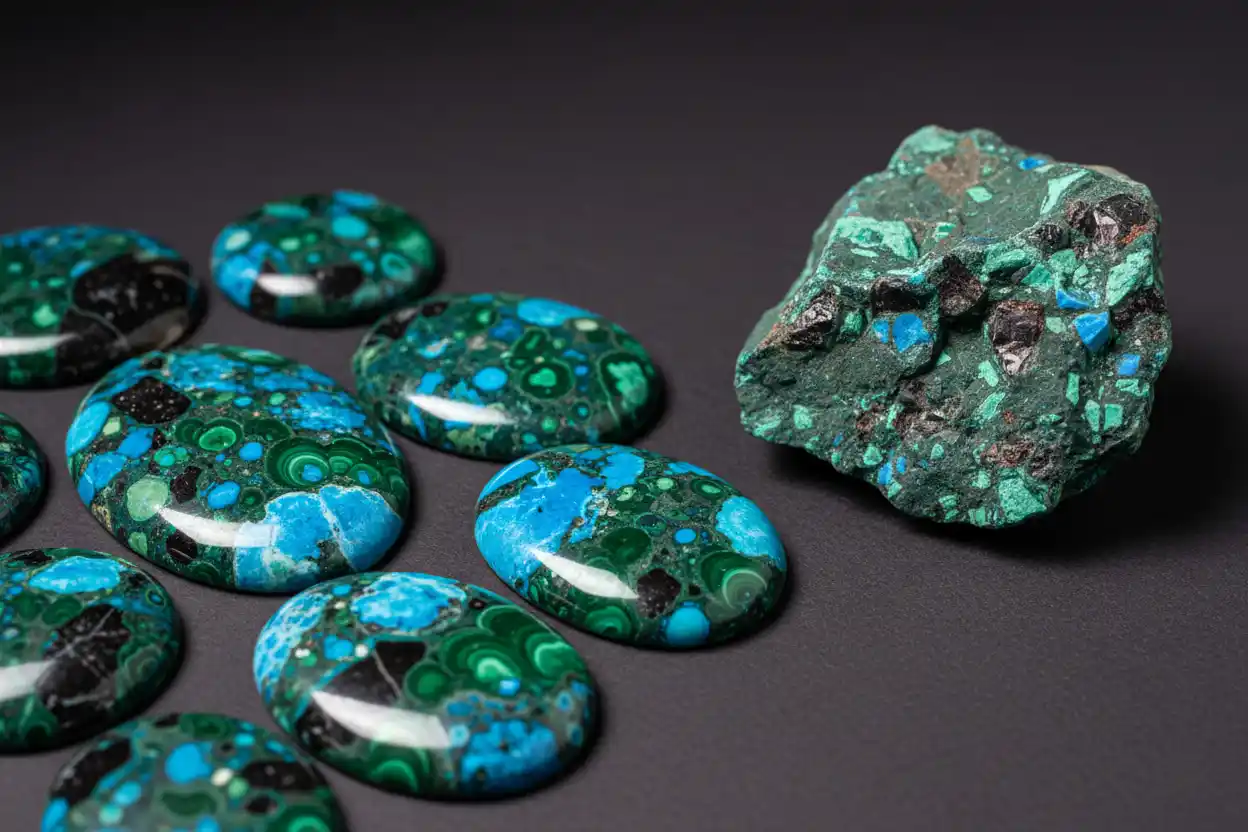
Quantum Quattro, often sold as Quantum Quattro Silica, is an unstandardized trade name for blue-green copper-mineral material commonly associated with Namibia. Commercial descriptions usually identify shattuckite, chrysocolla, malachite, dioptase, and quartz or smoky quartz, but no mineralogical rule guarantees that every stone contains all four named copper minerals.
The material is not a single mineral species, does not have one chemical formula, and cannot be authenticated by color alone. Each specimen must be evaluated as a multi-mineral rock or vein material whose hardness, density, durability, treatment, and safety depend on the phases actually present.
Quantum Quattro at a Glance
| Property | Quantum Quattro |
|---|---|
| Material type | Unstandardized trade name for blue-green copper-mineral rock or composite lapidary material |
| Commonly claimed components | Shattuckite, chrysocolla, malachite, dioptase, and quartz or smoky quartz |
| Other possible components | Azurite, cuprite, iron oxides, calcite, chalcedony, host rock, resin, and additional copper minerals |
| Common colors | Royal blue, turquoise, blue-green, emerald green, dark green, gray, black, white, brown, and red-brown |
| Crystal system | No single system applies to the whole material |
| Typical texture | Mottled, veined, brecciated, fractured, botryoidal, massive, quartz-rich, or mixed |
| Luster | Waxy, vitreous, dull, silky, or mixed according to the exposed minerals |
| Transparency | Usually opaque, with locally translucent quartz or chalcedony |
| Mohs hardness | Variable, approximately 2–7 according to the softest and hardest components |
| Cleavage | Variable by mineral phase |
| Tenacity | Brittle and commonly fractured |
| Common uses | Cabochons, pendants, beads, rings, palm stones, spheres, carvings, slabs, and mineral displays |
| Main care concern | Uncertain composition, soft copper phases, acid sensitivity, resin, dye, water entering fractures, and copper- and silica-bearing lapidary dust |
Quantum Quattro Is a Trade Name
Quantum Quattro has no formal mineral-species definition.
The name was created for the crystal and lapidary market rather than approved through mineralogical nomenclature.
Consequently, two sellers can use the same name for stones with noticeably different mineral mixtures.
Classic descriptions emphasize four copper minerals—shattuckite, chrysocolla, malachite, and dioptase—within a silica-rich or smoky-quartz matrix.
The word quattro refers to those four claimed minerals, while silica refers to the quartz-rich host or cement.
However, a blue-green rock does not become Quantum Quattro scientifically simply because a retailer repeats that list.
Some pieces may lack dioptase. Others can contain azurite, cuprite, calcite, iron oxides, chalcedony, or unidentified copper-bearing phases.
The most accurate description treats Quantum Quattro as a commercial label followed by the minerals confirmed in the specific stone.
Classic Namibian Material
Namibia is the locality most strongly associated with the Quantum Quattro name.
Commercial material is usually linked broadly with northern or northwestern Namibian copper deposits and oxidized ore zones.
These environments contain numerous secondary copper minerals formed as groundwater and oxygen altered earlier copper sulfides.
Blue shattuckite and chrysocolla can fill fractures or replace earlier material. Green malachite develops through copper-carbonate precipitation, while dioptase may form small emerald-green crystals in suitable silica-bearing conditions.
Quartz and chalcedony can cement the mixture or fill cavities and fractures.
Precise mine information is often missing from commercial products. Therefore, Namibia should be treated as a source claim requiring provenance rather than an identity that can be established visually.
Similar blue-green copper-mineral rocks are also sold from Peru and other countries under Quantum Quattro or Quantum Quattro-style names.
Because the term lacks scientific boundaries, those products cannot be rejected or accepted solely on the basis of country. Their actual mineralogy must be described.
Shattuckite
Shattuckite is a hydrated copper silicate known for rich blue, turquoise-blue, and blue-green colors.
It commonly forms fibrous, acicular, botryoidal, crust-like, or massive material in oxidized copper deposits.
Within Quantum Quattro, shattuckite is usually credited with the deepest royal-blue or navy areas.
However, azurite, chrysocolla, planchéite, ajoite, and other copper minerals can produce similar blue colors.
Visual identification is therefore provisional.
Raman spectroscopy or X-ray diffraction can separate shattuckite from closely related blue copper silicates.
Chrysocolla
Chrysocolla is a blue-to-green hydrated copper-bearing material whose exact structural and compositional description can be complex.
It often forms soft porous masses, crusts, botryoidal surfaces, and fracture fillings.
Silica-rich chrysocolla can be much harder and more durable than ordinary soft material because chalcedony or quartz supports the copper-rich color.
Within Quantum Quattro, chrysocolla is commonly associated with turquoise, cyan, and blue-green areas.
Its hardness can vary greatly, which helps explain why one cabochon polishes evenly while another develops soft pits beside hard quartz.
A seller should not assign every sky-blue area to chrysocolla without testing.
Malachite
Malachite is a green copper carbonate hydroxide with the formula Cu₂CO₃(OH)₂.
It commonly forms bands, botryoidal growth, fibrous crusts, and fracture fillings.
Malachite has a hardness around 3.5–4 and reacts with acids. Strong ammonia and aggressive household chemicals can also damage it.
Green bands in Quantum Quattro may be malachite, but dioptase, chrysocolla, copper-bearing clay, or another mineral can overlap visually.
Malachite’s softness often controls the practical durability of a polished mixed stone, even when much of the object is quartz.
Dioptase
Dioptase is a vivid emerald-green copper cyclosilicate.
It commonly forms small trigonal crystals with high luster rather than broad opaque masses.
Commercial descriptions frequently list dioptase as one of Quantum Quattro’s defining four minerals.
Nevertheless, confirming it inside a polished mottled stone can be difficult. Bright green areas are not automatically dioptase.
A laboratory may need Raman spectroscopy, microscopy, or diffraction to distinguish small dioptase grains from malachite, chrysocolla, or another copper phase.
The rarity and visual appeal of dioptase also make it a useful marketing claim, which increases the need for verification.
Quartz and Smoky Quartz Matrix
Smoky Quartz is commonly named as Quantum Quattro’s dark or gray silica matrix.
Quartz has a hardness of 7 and no cleavage, making it substantially harder than most exposed copper minerals.
Some material may contain microcrystalline chalcedony, ordinary colorless quartz, gray silica, or iron-stained quartz rather than gemologically distinct smoky quartz.
A dark appearance can also result from copper oxides, iron minerals, host rock, or shadowing around fractures.
Therefore, dark matrix should not be called smoky quartz solely from a polished photograph.
The quartz-rich component can strengthen a piece, but it does not make every exposed surface quartz hard.
Azurite and Other Possible Components
Azurite is a deep-blue copper carbonate that can occur with malachite in oxidized copper deposits.
Some products sold under the Quantum Quattro name contain azurite, cuprite, or other copper minerals even though those phases are absent from the traditional “four.”
Cuprite can contribute dark red or brown-red patches.
Calcite or dolomite may create pale veins and increase acid sensitivity.
Iron oxides produce brown, rust, red, and black areas.
Host rock may contain feldspar, clay, mica, or other silicates.
This variability reinforces why Quantum Quattro should not receive a single chemical formula or hardness value.
How the Material Forms
Quantum Quattro-type material develops in the oxidized portion of a copper deposit.
Earlier sulfide minerals react with oxygenated groundwater near Earth’s surface.
Copper dissolves and moves through fractures, pores, and cavities before precipitating as secondary carbonates, silicates, oxides, and other minerals.
Changes in pH, silica availability, carbon dioxide, temperature, water chemistry, and host-rock composition determine which phase forms.
Malachite favors carbonate-bearing conditions. Shattuckite and chrysocolla require silica-rich chemistry, while dioptase needs a narrower environment capable of producing crystalline copper silicate.
Quartz or chalcedony can arrive during a separate fluid episode and cement the earlier minerals.
Repeated fracture and filling produces the mottled, brecciated, and veined patterns valued by cutters.
One specimen may therefore record several distinct stages rather than four minerals crystallizing simultaneously.
Why the Name Is Difficult to Standardize
A formal mineral species has a defined chemical composition and crystal structure.
A formal rock classification uses measurable mineral proportions, texture, and geological context.
Quantum Quattro provides neither.
The name can be applied to natural mixed rock, stabilized material, generic chrysocolla in quartz, blue-green copper ore, or even manufactured composites.
Retail descriptions also disagree over whether the fourth mineral is dioptase, azurite, cuprite, or another component.
For that reason, the safest wording is:
“Blue-green copper-mineral material sold as Quantum Quattro, containing confirmed or visually suspected phases.”
The parent guide to identifying crystals explains why a marketing name should remain separate from laboratory mineral identification.
How to Identify Quantum Quattro
Begin by treating it as a multi-mineral material rather than testing for one species.
Magnification may reveal blue fibers, green carbonate bands, transparent quartz, botryoidal surfaces, red-brown oxides, resin, dye, and natural fractures.
Hardness varies across the same polished face. A steel point may scratch one green band while leaving quartz untouched, but destructive testing is unsuitable for finished jewelry.
Acid can attack malachite, calcite, and other carbonate phases. It should never be applied to a polished object.
Raman spectroscopy can identify individual spots when the grains are large enough.
X-ray diffraction works well on a representative powdered sample but is destructive and can miss minor phases.
Microscopy, infrared spectroscopy, and elemental mapping can clarify copper-mineral relationships.
A laboratory may conclude that a piece contains quartz, malachite, and chrysocolla without confirming every component claimed by the seller. That result does not make the stone fake; it shows that the trade name promised more precision than the material supported.
Common Mislabeling
Ordinary chrysocolla in quartz is frequently sold as Quantum Quattro.
That material can be genuine, attractive, and durable without containing shattuckite or dioptase.
Azurite-malachite, Eilat Stone-style mixtures, dyed marble, reconstituted copper-mineral powder, and blue-green resin can also receive the label.
Mass-produced beads may contain only dyed quartzite, magnesite, or glass.
Extremely uniform blue and green stripes deserve scrutiny because natural copper deposits generally produce irregular mineral boundaries.
Identical patterns repeated across several cabochons can indicate printed, reconstructed, or molded material.
The broad warning signs of resin, glass, dye, and invented rarity claims appear in how to spot fake crystals.
Treatments and Stabilization
Resin stabilization is common and often practical.
Soft chrysocolla-rich or fractured material may not survive cutting without impregnation.
Clear resin can fill pores, strengthen breccia boundaries, and create a smoother polish.
Dye may intensify blue, green, black, or turquoise colors. Pigment often collects around cracks and drill holes.
Wax and oil can deepen the appearance temporarily.
A clear coating adds gloss but may scratch, yellow, or separate from softer mineral zones.
Reconstituted products combine mineral fragments or powder with binder.
Backing may reinforce a thin cabochon or provide darker contrast beneath translucent quartz.
Treatments should be disclosed because they affect care and value. The relevant processes are explained in gemstone treatments.
Lapidary Behavior
Quantum Quattro is normally cut into cabochons, beads, palm stones, spheres, freeforms, and carvings.
Faceting is unsuitable because the material is opaque, mixed, and structurally uneven.
Hard quartz can stand above softer malachite or chrysocolla during polishing, creating undercutting.
Open cavities may collect polishing compound and require filling.
Breccia boundaries can separate as the stone is ground thinner.
The cutter must orient the best blue-green pattern while avoiding cracks and crumbly zones.
Freeform cabochons preserve attractive mineral relationships more efficiently than standardized calibrated shapes.
A dark quartz-rich area can provide contrast, while too much black or gray matrix may make the stone look dull.
Durability and Jewelry Suitability
Quantum Quattro has no single Mohs hardness.
Quartz-rich areas can approach 7, while exposed malachite is near 3.5–4 and soft chrysocolla may be lower.
The gemstone hardness chart should therefore be applied to each component rather than the trade name.
The material is brittle and commonly fractured.
The distinction between scratch resistance and structural strength appears in gemstone toughness versus hardness.
Pendants, earrings, brooches, bolo ties, and protected cabochons are safer than exposed rings.
A bezel can support a mixed-mineral edge, although setting pressure may still open a hidden fracture.
Bracelet beads receive repeated knocks and perspiration exposure. Stabilized beads should be checked for chipped holes and worn resin.
Current Quantum Quattro Asking Prices
The market is driven by appearance and trade-name appeal rather than standardized mineral grading.
| Quantum Quattro product | Broad July 2026 retail asking range |
|---|---|
| Small tumbled stone | About $5–$20 |
| Small rough specimen or slab | About $10–$50 |
| Standard cabochon | About $15–$75 |
| Strong blue-green designer cabochon | About $50–$200 |
| Large premium cabochon or matched pair | About $150–$500 |
| Bead strand | About $20–$100 |
| Palm stone or small freeform | About $20–$90 |
| Medium sphere or carving | About $40–$300 |
| Large slab, sphere, or display specimen | About $150–$1,000 or more |
| Sterling-silver jewelry | About $60–$350 |
| Gold or designer jewelry | Determined mainly by metal, craftsmanship, disclosure, and visual quality |
These are broad asking ranges rather than appraisals or resale guarantees.
Current mass-market examples include spheres around several tens of dollars, silver rings near or above $100, and large rough pieces priced according to weight and pattern.
The presence of the Quantum Quattro name does not create geological rarity by itself.
What Gives Quantum Quattro Value?
Color contrast is the first factor.
Strong natural-looking blue, turquoise, and green areas should remain visible against the quartz or host-rock matrix.
Pattern matters more than exact symmetry. Fine stones show balanced veins, clouds, and mineral boundaries rather than a muddy mixture.
Stability is essential. Open cracks, chalky areas, crumbly malachite, and extensive filler reduce durability.
A good polish should remain reasonably even despite changing hardness.
Confirmed mineral diversity may add collector interest, particularly when shattuckite, malachite, chrysocolla, and dioptase have been identified rather than assumed.
Credible Namibian provenance supports the classic trade identity but does not replace mineral analysis.
Treatment disclosure, size, cutting, metalwork, and craftsmanship complete the valuation.
Buying Quantum Quattro
Ask the seller whether the name describes a trade appearance or laboratory-confirmed mineral mixture.
Request front, back, edge, and magnified photographs.
Look for resin, bubbles, color concentrated in cracks, crumbly zones, backing, and drill-hole damage.
Ask which mineral phases were actually tested. A copied list of four minerals is not equivalent to analysis.
Confirm the country and, when available, mine or district.
Avoid claims that the material exists nowhere except one location. The trade name is too unstandardized for such an absolute statement.
Do not pay a dioptase premium unless dioptase has been identified in the offered piece.
Quantum Quattro appears in the crystals beginning with Q directory and the gemstones beginning with Q directory, although it remains a trade-name rock rather than a mineral species.
Cleaning and Storage
Wipe polished material with a soft dry or slightly damp cloth.
When deeper cleaning is necessary, use a small amount of mild soap and lukewarm water, then rinse briefly and dry immediately.
Do not soak it.
Water can enter fractures, weaken filler, mobilize dye, and leave residue within porous copper-mineral areas.
The broader principles appear in which crystals can and cannot go in water.
Avoid acids, vinegar, lemon juice, ammonia, bleach, steam, ultrasonic cleaners, and abrasive powders.
Store the stone separately from quartz, topaz, sapphire, ruby, and diamond.
Keep copper-rich jewelry away from cosmetics and perspiration when practical, then wipe it after wear.
Quantum Quattro Meaning and Symbolism
Quantum Quattro is a modern crystal-trade name and has no credible ancient tradition specific to the material.
Contemporary symbolism connects its blue and green patterns with communication, emotional honesty, adaptation, and balancing several priorities.
The multi-mineral structure inspires themes of cooperation: separate components retain their identities while forming one polished object.
Fracture-filling geological processes can symbolize rebuilding after disruption.
Blue areas receive associations with expression and reflection, while green areas are linked with renewal, relationships, and practical growth.
Those meanings often borrow from the separate traditions assigned to shattuckite, chrysocolla, malachite, and dioptase.
They remain personal, artistic, cultural, or spiritual interpretations. Scientific evidence does not show that Quantum Quattro repairs DNA, treats illness, strengthens immunity, or guarantees emotional healing.
Frequently Asked Questions
Is Quantum Quattro a mineral?
No. It is an unstandardized trade name for mixed blue-green copper-mineral material.
What minerals are supposed to be in Quantum Quattro?
Commercial descriptions commonly list shattuckite, chrysocolla, malachite, dioptase, and quartz or smoky quartz.
Does every piece contain all four copper minerals?
No. The name has no scientific standard, and individual pieces may contain only some claimed phases or additional minerals.
Why is it called Quattro?
The name refers to four copper minerals traditionally promoted as part of the material.
Where does Quantum Quattro come from?
Classic material is associated with Namibia, while similar mixed copper-mineral stones are also sold from Peru and other regions.
Is Quantum Quattro the same as chrysocolla in quartz?
Not necessarily. Chrysocolla in quartz may be one component or a visually similar material, but it does not prove the full claimed mixture.
How hard is Quantum Quattro?
Hardness varies from soft copper-mineral areas to quartz near Mohs 7. One number cannot describe the entire stone.
Is Quantum Quattro commonly stabilized?
Yes, porous and fractured material may be impregnated or filled with resin to survive cutting and wear.
Can Quantum Quattro be worn in a ring?
It can be used in a protected occasional-wear setting, but pendants and earrings expose its soft mixed-mineral structure to less impact.
Can Quantum Quattro go in water?
Brief damp cleaning is safer than immersion. Avoid soaking because copper phases, fractures, resin, dye, and matrix can respond differently.
How can its components be confirmed?
Raman spectroscopy, X-ray diffraction, microscopy, and chemical analysis can identify individual mineral phases.
What makes Quantum Quattro valuable?
Natural-looking color contrast, pattern, stability, polish, confirmed mineralogy, provenance, size, treatment disclosure, and craftsmanship determine value.
Quantum Quattro should be purchased for the specific stone visible in the listing rather than for a fixed recipe implied by its name. A scientifically cautious description can preserve its blue-green appeal without turning a variable copper-mineral rock into a nonexistent species.
Quantum Quattro may contain copper carbonates, copper silicates, quartz, and other unidentified minerals. Do not ingest, lick, heat, burn, powder, or place it in drinking water. Cutting and grinding can release copper-bearing and respirable crystalline-silica dust; professional wet methods, local extraction, eye protection, protective clothing, and suitable respiratory controls are required.