
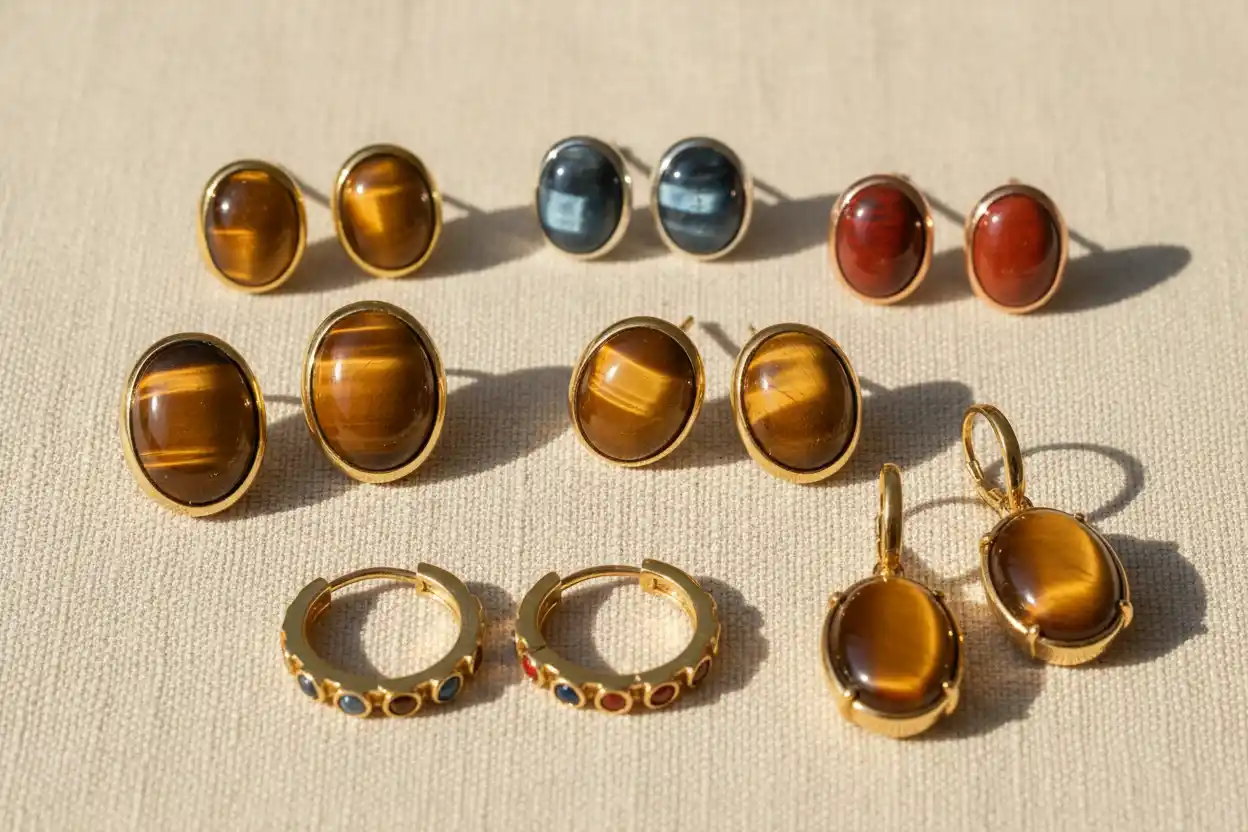

Tiger’s Eye earrings display moving bands of gold, bronze, brown, blue-gray or reddish light as the wearer turns their head. This shifting reflection, called chatoyancy, gives polished cabochons and beads a depth that ordinary opaque brown stones do not show.
Earrings are also one of the safest ways to wear Tiger’s Eye. Quartz-based hardness supports regular jewelry use, while the position near the face avoids much of the desk contact, impact and abrasion experienced by rings and bracelets.
A good pair depends on more than matching bead diameter. The two stones should coordinate in body color, pattern, polish, chatoyant-band direction, setting height and visible size.
Tiger’s Eye Earrings at a Glance
| Feature | What to Consider |
|---|---|
| Gem material | Chatoyant polycrystalline Quartz with aligned fibrous inclusions |
| Common colors | Golden brown, bronze, blue-gray and reddish brown |
| Optical effect | Chatoyancy or moving cat’s-eye band |
| Mohs hardness | Approximately 7 |
| Cleavage | None |
| Popular earring styles | Studs, bezels, halos, drops, hoops and clusters |
| Best everyday style | Low bezel or compact cabochon stud |
| Most important matching factor | Similar band direction and movement |
| Common treatment concerns | Heating, dyeing, bleaching and surface enhancement |
| Safe cleaning | Warm water, mild soap and a soft brush |
| Main setting concern | Protecting cabochon edges and drill holes |
| Common blue variety | Blue Tiger’s Eye or Hawk’s Eye |
What Are Tiger’s Eye Earrings?
Tiger’s Eye earrings may contain polished cabochons, round beads, faceted beads, carvings or inlaid pieces.
The material is a chatoyant Quartz aggregate containing aligned altered amphibole inclusions. Those fibrous inclusions create the bright moving line that gives the stone its eye-like appearance.
Golden Tiger’s Eye is the most familiar variety. Blue-gray material is commonly called Blue Tiger’s Eye or Hawk’s Eye, while reddish-brown material is sold as Red Tiger’s Eye.
The broad Tiger’s Eye meaning guide owns the mineral’s identity, formation and history. This page concentrates on earring style, matching, construction and care.
Why Tiger’s Eye Works Well in Earrings
Tiger’s Eye is predominantly Quartz and generally ranks near 7 on the Mohs scale. It resists many ordinary scratches better than feldspar, Calcite or Fluorite.
The material has no cleavage, although fractures, weak matrix zones and thin polished edges can still chip.
Earrings receive relatively little impact. They do not regularly contact desks, sinks, tools or door handles, making them safer than Tiger’s Eye rings and bracelets.
Movement also enhances chatoyancy. Each turn of the head changes the angle between the light, fibrous inclusions and viewer, allowing the bright band to travel across the stone.
Tiger’s Eye Stud Earrings
Stud earrings provide the simplest and most practical format.
Round cabochons create a classic eye-like effect because the curved surface allows the reflected band to move across the center. Oval cabochons produce a longer line and can make the stone appear larger.
A bezel protects the complete edge and reduces snagging. It is particularly useful for thin cabochons or material with small fractures near the girdle.
Prong-set studs expose more of the stone. The prongs should remain evenly spaced and should not rest over a visible weak area.
Large studs may tilt forward. Broad supportive backings can help the earrings sit flat against the lobe.
Bezel-Set Earrings
A bezel surrounds most or all of the Tiger’s Eye with metal.
The smooth border protects the polished edge and gives the stone a clean outline. It also prevents prongs from interrupting the moving band.
Full bezels suit daily wear. Partial bezels expose more of the stone but leave selected edges vulnerable.
The metal should follow the cabochon evenly. Gaps can allow movement, while excessive pressure may damage a fractured stone.
Yellow gold emphasizes the warm golden bands. White metal creates stronger contrast, especially with Blue Tiger’s Eye.
Prong-Set Tiger’s Eye Earrings
Prongs create a lighter visual setting and reveal more of the stone’s sides.
Four-prong settings work for oval and round cabochons when the stone is structurally sound. Six-prong settings provide additional security for larger pieces.
Because Tiger’s Eye is usually opaque, opening the back does not dramatically increase transmitted light. The main advantage is a less metal-heavy appearance and easier access for cleaning.
Prongs should remain smooth and substantial. Thin claws can catch hair and may eventually bend.
Inspect the pair periodically. A loose prong can release the stone even when the Quartz itself remains undamaged.
Tiger’s Eye Drop Earrings
Drop earrings suspend the stone below the lobe and allow greater movement.
Oval and pear-shaped cabochons suit the vertical format. Round beads can also create compact drops, while long carved shapes produce a stronger statement.
The movement makes chatoyancy especially noticeable. However, the two stones should show their strongest bands from similar front-facing angles.
Every connecting ring should remain securely closed. A weak open jump ring is often a greater loss risk than gemstone breakage.
Short drops work for regular wear. Long designs may tangle in hair, scarves or high collars.
Dangle and Chandelier Earrings
Dangles may combine several Tiger’s Eye beads, cabochons or color varieties.
A graduated design can move from small golden beads near the lobe to a larger cabochon below. Mixed blue, gold and red material can create a deliberate color sequence.
The components should not strike each other forcefully. Repeated contact can chip bead edges, scratch metal or loosen settings.
Chandelier earrings distribute weight over a broader structure. Total weight should be tested for more than a few minutes before the return period expires.
The back of the design must remain smooth against the neck. Rough galleries and exposed wires make long earrings uncomfortable.
Tiger’s Eye Hoop Earrings
Tiger’s Eye may appear as removable charms, fixed cabochons or bead drops on hoop earrings.
Small charms make a plain metal hoop more adaptable. Their loops must be narrow enough that they cannot slip over the open post.
Front-facing cabochons can be mounted directly on wider hoops. The setting should remain balanced so the heavy side does not rotate downward.
A hinged hoop should close with a distinct click. Misalignment, looseness or a weak latch presents a significant loss risk.
Inside-out gem-set hoops are less common with Tiger’s Eye because opaque cabochons require more space than small transparent faceted gems.
Cluster Earrings
Cluster earrings arrange multiple small Tiger’s Eye cabochons or beads into floral, geometric or asymmetrical patterns.
The style can provide more visible color without requiring two large perfectly matched stones.
Matching still matters. The bands should move in a coordinated way rather than pointing randomly in every direction unless the design intentionally creates a radiating effect.
A cluster with one dull or flat-looking stone may appear uneven.
Inspect the framework beneath the stones. It should remain strong enough to support every setting while allowing access for cleaning.
Blue Tiger’s Eye Earrings
Blue Tiger’s Eye, also called Hawk’s Eye, retains more of the blue-gray appearance associated with less-altered amphibole inclusions.
The color may range from slate blue and steel gray to blue-green or nearly black. Some stones contain golden areas where alteration progressed farther.
White gold and silver emphasize the cool tones, while yellow gold creates dramatic contrast.
The chatoyant band should remain visible rather than disappearing into an excessively dark background.
The Blue Tiger’s Eye meaning guide explains the variety’s identity and symbolism. The planned guide on where to buy real Blue Tiger’s Eye will own the full seller and authenticity workflow.
Red Tiger’s Eye Earrings
Red Tiger’s Eye ranges from rust and mahogany to deep reddish brown.
Some naturally reddish material exists, but heating commonly intensifies red color in commercial stones. Dye may also be used to create brighter burgundy or purple-red shades.
Treatment is not necessarily a problem when disclosed. It does affect authenticity expectations and price.
Look for color concentrated around drill holes, fractures or surface scratches, which may indicate dye.
The Red Tiger’s Eye meaning guide explains the variety. The planned red Tiger’s Eye buying guide will focus on treatment and seller evaluation.
Golden Tiger’s Eye Earrings
Golden-brown Tiger’s Eye is the classic form.
The strongest pieces show clear contrast between the moving gold band and darker brown background. Honey, bronze and chocolate zones may appear within one cabochon.
The band does not need to remain perfectly straight. Natural fibers may curve, producing waves or multiple changes across the surface.
Very dark material may look nearly black away from concentrated light. Examine the pair in ordinary indoor conditions rather than only under a jewelry spotlight.
Yellow gold creates a harmonious tonal look. White metal makes the golden band appear brighter.
Mixed-Color Earrings
A mixed pair may combine blue and gold Tiger’s Eye or use golden and red stones.
The design should look intentional. A blue stud on one ear and a golden drop on the other can work as an asymmetrical set when the scale and metal remain connected.
Matched earrings can also contain several colors in each stone. Natural transitional material may show blue-gray, gold and brown bands together.
Highly saturated green, purple or pink “Tiger’s Eye” is usually treated or may be an imitation. Accurate disclosure matters more than novelty.
Matching the Chatoyant Band
The stones should be compared while facing the same direction under one light source.
A strong pair has bands of similar width, brightness and movement. They do not need to be mirror images, but one should not look vivid while the other appears flat.
Orientation is especially important in stud earrings. A band that runs vertically in one stone and horizontally in the other will remain obvious around the face.
Drops can tolerate slightly more difference because they move. Even then, both stones should show their main effect when hanging naturally.
Matching by diameter alone is insufficient.
Evaluating Body Color
Golden stones should coordinate in warmth and darkness. One pale honey stone beside a deep chocolate cabochon may look mismatched even when their bands are similar.
Blue material should be compared for gray, green and golden modifiers.
Red stones should coordinate in saturation. Heat-treated and dyed material can produce color differences that become more obvious in daylight.
Natural variation can remain attractive. The pair should feel balanced rather than mechanically identical.
Evaluating Polish and Surface Condition
A good cabochon should have a smooth, even polish without deep scratches, pits or flat areas.
The dome must remain symmetrical enough for the band to move cleanly. Poor curvature can distort the optical effect.
Examine the girdle for chips. Small edge damage may be hidden beneath a bezel but can still indicate structural weakness.
Beads should have clean drill holes without radiating cracks.
Surface coatings may create an unusually glossy layer. A chipped area that reveals a different texture or color deserves closer examination.
Tiger’s Eye Versus Fiber-Optic Glass
Fiber-optic glass can produce an extremely sharp moving line.
Imitation beads may show unusually uniform color, identical bands and repeated patterns across the pair. Mold seams and gas bubbles can provide additional clues.
Natural Tiger’s Eye usually contains variation in band width, color and fiber direction.
Visual clues are not conclusive. Professional testing is appropriate when identity materially affects value.
The broad crystal identification guide explains why one home observation is rarely enough.
Tiger’s Eye Versus Pietersite
Pietersite also displays chatoyant blue, gold and red fragments.
Its pattern is generally brecciated, turbulent and storm-like. Tiger’s Eye more commonly shows organized parallel or gently curved bands.
The completed Tiger’s Eye versus Pietersite guide owns the detailed comparison.
A chaotic Tiger’s Eye pattern should not automatically be sold as Pietersite. Geographic source, structure and mineralogical context matter.
Choosing Earring Size
Small cabochon studs provide visible movement without much weight.
Medium stones show stronger chatoyancy and work well in bezels or halos. Larger earrings can become heavy because Tiger’s Eye is usually cut as a solid opaque cabochon.
Dimensions in millimeters provide more practical information than carat weight.
A halo enlarges the outline but adds setting weight and more maintenance.
Drops can use larger stones because their weight hangs below the lobe rather than projecting forward.
Earring Backs
Friction backs suit small and medium studs when they grip securely.
Broad disc backs help support larger cabochons and prevent forward tipping.
Screw backs provide stronger retention but take longer to fasten. Threaded posts may feel uncomfortable to some wearers.
Locking backs combine security with easier operation.
Lever backs work well for drop earrings. Open hooks should use small silicone stoppers when loss is a concern.
Metal Choices
Yellow gold emphasizes golden and red Tiger’s Eye.
Rose gold complements mahogany and copper-toned stones. It may reduce contrast with some reddish material.
White gold, platinum and silver provide strong contrast around golden or blue stones.
Blackened silver can create a dramatic setting for golden bands, though the finish may wear over time.
Metal sensitivity matters because posts pass through the skin. Ask about alloy content when nickel reactions are known.
Styling Tiger’s Eye Earrings
Golden Tiger’s Eye works naturally with cream, black, navy, olive, brown and denim.
Blue material suits cool gray, blue, charcoal and white clothing.
Red Tiger’s Eye pairs well with warm neutrals, burgundy and dark green.
Studs support casual and professional wear. Long drops and large cabochons make stronger evening statements.
Avoid combining the earrings with too many competing chatoyant or patterned gems near the face.
Symbolism
Modern crystal traditions associate Tiger’s Eye with confidence, grounded judgment, focus and measured courage.
Earrings place the stone near the face, but that physical location does not create a special medical or energetic effect.
The detailed spiritual discussion belongs in the dedicated Tiger’s Eye healing-properties guide.
A wearer may treat the pair as a reminder to look carefully before acting or to communicate with steady confidence.
Comparing Other Tiger’s Eye Jewelry
A Tiger’s Eye bracelet creates a moving sequence of multiple bands but receives more impact.
The planned Tiger’s Eye necklace guide will cover pendants, beads and chain construction.
The planned Tiger’s Eye ring guide will focus on protective settings and hand wear.
Earrings provide one of the best balances of visible chatoyancy and physical safety.
Cleaning and Care
Clean Tiger’s Eye earrings with lukewarm water, mild soap and a soft brush or cloth.
Work behind the settings and around the posts, where cosmetics and skin oils collect.
Rinse briefly and dry completely. Support the pair over a bowl or closed drain.
Avoid prolonged soaking when dye, bleaching, filling, glue or uncertain treatment may be present.
The completed guide to cleaning Tiger’s Eye jewelry provides the full process.
Storage
Keep each earring in a separate padded compartment with its backing.
Do not allow the pair to strike each other or harder gemstones.
Diamond, Sapphire and Topaz can scratch Tiger’s Eye. Quartz can also scratch softer stones stored beside it.
Keep long drops flat or suspended separately to prevent tangling.
Tiger’s Eye appears in the crystals beginning with T and gemstones beginning with T directories.
Frequently Asked Questions
1. Is Tiger’s Eye suitable for earrings?
Yes. Quartz-based hardness and the low-impact earring position make it well suited to studs, drops and hoops.
2. What makes Tiger’s Eye earrings shimmer?
Aligned fibrous inclusions reflect light as a moving band called chatoyancy.
3. How closely should Tiger’s Eye earrings match?
They should coordinate in body color, size, polish, band width and the direction from which the chatoyancy appears strongest.
4. Which setting protects Tiger’s Eye best?
A full or partial bezel provides strong edge protection and creates a smooth outline.
5. Is Blue Tiger’s Eye natural?
Natural blue-gray material exists and is also called Hawk’s Eye. Dyed and enhanced blue products are also sold.
6. Is Red Tiger’s Eye heat treated?
Much commercial red material has been heated, although naturally reddish stones can occur. Dye may also be used.
7. Can Tiger’s Eye earrings be worn every day?
Yes, with ordinary care. Remove long or heavy earrings before sleeping, bathing and sports.
8. Is Tiger’s Eye the same as Pietersite?
No. Pietersite usually has a brecciated, storm-like chatoyant pattern, while Tiger’s Eye more commonly shows organized parallel bands.
9. How can Tiger’s Eye be distinguished from fiber-optic glass?
Natural stones usually show varied color and banding, while glass may look unusually uniform. Professional testing is safest when identity matters.
10. Which metal looks best with Tiger’s Eye?
Yellow gold emphasizes golden bands, while white metal creates contrast. Blue material often works especially well with silver-colored metal.
11. Can Tiger’s Eye earrings be cleaned ultrasonically?
Hand cleaning is safer because treatments, fractures, glue and setting condition may be unknown.
12. How should Tiger’s Eye earrings be stored?
Store each earring separately with its backing, away from harder gemstones and heavy jewelry.