
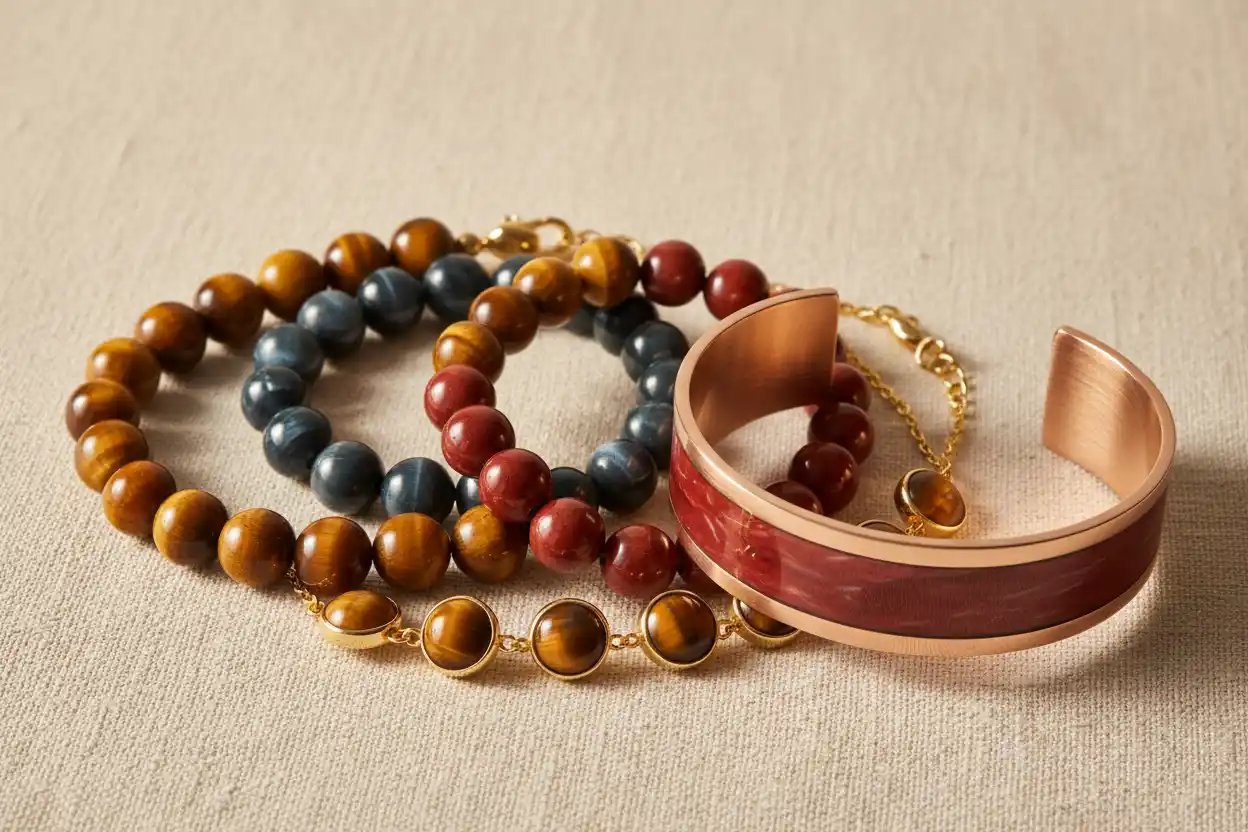

Tiger’s Eye bracelets display moving bands of golden, bronze, brown, blue or reddish light as the wrist turns. This shifting optical effect, called chatoyancy, gives even simple polished beads a sense of depth and movement.
Quartz provides useful everyday hardness, but bracelet quality depends on more than the gemstone name. The orientation of the chatoyant fibers, bead condition, stringing, clasp, treatment disclosure and fit determine whether the piece looks balanced and wears safely.
Tiger’s Eye Bracelets at a Glance
| Feature | What to Consider |
|---|---|
| Gem material | Chatoyant polycrystalline Quartz with aligned fibrous inclusions |
| Common colors | Golden brown, bronze, blue-gray and reddish brown |
| Optical effect | Chatoyancy or moving cat’s-eye band |
| Mohs hardness | Approximately 7 |
| Cleavage | None |
| Common styles | Beaded, faceted bead, station, charm, cuff and bangle |
| Most important visual factor | Sharp, well-oriented moving light band |
| Common treatments | Heating, dyeing and color enhancement |
| Common blue name | Blue Tiger’s Eye or Hawk’s Eye |
| Common red material | Often heat treated |
| Safest cleaning | Warm water, mild soap and a soft brush |
| Main wear concern | Bead fractures, elastic failure and surface abrasion |
What Is Tiger’s Eye?
Tiger’s Eye is a chatoyant Quartz material containing aligned, altered amphibole fibers.
When light reflects from the parallel fibrous structure, a bright band appears to move across the polished surface. This effect resembles the narrow reflected line seen in a cat’s eye.
The material is usually golden yellow, bronze or brown because iron-rich fibers have weathered toward iron oxides and hydroxides.
Less-altered blue-gray material is known as Blue Tiger’s Eye or Hawk’s Eye. Red material may occur naturally, but much commercial Red Tiger’s Eye has been produced or intensified through heating.
The main Tiger’s Eye meaning guide owns the full mineral identity and symbolism. This page focuses on bracelet design, construction and buying.
Why Tiger’s Eye Works Well in Bracelets
Tiger’s Eye ranks around 7 on the Mohs scale because Quartz forms most of the polished material.
It has no cleavage and generally handles ordinary jewelry wear better than feldspar, Calcite, Fluorite or Apatite.
Bracelets still encounter desks, doorframes and other hard surfaces. A bead can chip when it contains a fracture or receives a concentrated blow.
The optical effect benefits from movement. As the wrist turns, each bead reflects light from a different direction, creating an animated sequence of bands.
Commercial availability also makes matched bracelets relatively accessible compared with rare chatoyant gems.
Round Bead Bracelets
Round polished beads are the most common Tiger’s Eye bracelet format.
A good strand shows bright, mobile bands across most beads. The colors do not need to be identical, but the complete bracelet should look harmonious.
Inspect the beads from several directions. Some may show a strong line only at an angle because the rough was not oriented ideally before drilling.
Drill holes should look clean and centered. Chips or fractures extending outward can weaken the bead.
Large beads show the banding clearly but create a heavier bracelet. Smaller beads feel lighter and are easier to stack.
Elastic Tiger’s Eye Bracelets
Elastic bracelets are convenient and require no clasp.
The cord should be thick enough for the bead weight and preferably pass through the strand more than once when the hole size allows.
A visible knot is not necessarily poor workmanship, but it should be secure and positioned where it will not rub constantly against the skin.
Roll the bracelet over the hand rather than pulling it open sharply. Excessive stretching shortens the cord’s life.
Replace the elastic when it becomes loose, flattened, discolored or frayed. The gemstones may last for decades, while the stringing material remains consumable.
Knotted Bead Bracelets
Knots between beads reduce direct contact and limit loss if the cord breaks.
This construction is useful for valuable or unusually well-matched material. It can also improve flexibility.
The knots should remain consistent in size and lie close to each bead. Large gaps allow excessive movement.
Silk, synthetic cord and specialized knotting materials each have different wear behavior. The choice should match bead weight and exposure to moisture.
Knotted bracelets require professional restringing when the cord becomes stretched or dirty.
Wire-Strung Bracelets
Jewelry wire gives a bead bracelet greater structure and supports a clasp.
The wire should curve naturally without kinking. A sharply bent area can fail after repeated movement.
Crimp beads need smooth covers or careful finishing so they do not scratch the wrist.
The clasp and connecting rings should remain proportionate to the strand. A heavy bracelet needs stronger findings than a lightweight necklace.
Wire-strung construction works well for people who prefer a secure clasp to elastic.
Faceted Tiger’s Eye Beads
Faceting adds surface reflections to the internal chatoyancy.
A well-cut faceted bead can look bright and dynamic, but its edges experience more abrasion than a smooth round bead.
Adjacent faceted beads strike each other as the wrist moves. Knots or suitable spacers can reduce direct impact.
Metal spacers should have smooth edges. Hard or rough components can gradually mark the Quartz polish.
Inspect facet junctions for chips and uneven polishing before purchase.
Tiger’s Eye Station Bracelets
A station bracelet places individual cabochons or beads along a chain.
Bezel-set stations protect the edges and create a smooth profile. The setting can also keep the chatoyant direction facing outward.
Prong settings expose more of the gem but require regular inspection.
The stations should remain balanced so they do not flip constantly against the wrist.
An adjustable chain provides fitting flexibility, although the extension and clasp must support the gemstone weight.
Tiger’s Eye Charm Bracelets
A Tiger’s Eye charm can be a cabochon, bead, carving or small polished drop.
The connection ring should be soldered or securely closed. Open jump rings can pull apart when a charm catches on clothing.
A protective bezel is useful because charms swing and strike neighboring components.
Do not place Tiger’s Eye directly beside Diamond, Sapphire or rough metal charms that may scratch it repeatedly.
One well-positioned charm can provide the optical effect without the weight of a full bead strand.
Cuff and Bangle Designs
Tiger’s Eye cabochons can be set into cuffs and rigid bangles.
A rigid setting controls the gemstone’s orientation and prevents bead-to-bead impact.
Low bezels and flush settings offer the greatest protection. High clusters create stronger visual impact but are more likely to strike hard surfaces.
Hinged bangles require a properly aligned hinge and reliable clasp.
Open cuffs should not be bent repeatedly during wear. Constant reshaping weakens the metal and may transfer pressure into the stone.
Evaluating Chatoyancy
Chatoyancy is the defining visual feature of Tiger’s Eye.
A strong stone shows a narrow or moderately broad band that moves smoothly as the bead or cabochon turns beneath a direct light.
The band should contrast clearly with the body color. A dull or nearly stationary reflection may indicate weak orientation, low polish or an imitation.
Natural Tiger’s Eye often shows waves, bends and variations rather than perfectly identical lines.
Examine the bracelet as a complete strand. One or two quieter beads may be acceptable, but a premium bracelet should display movement across most of its surface.
Body Color
Classic Tiger’s Eye ranges from golden yellow and honey brown to bronze and deep chocolate.
Brighter gold bands usually create greater contrast, but darker material can feel more understated and formal.
Blue Tiger’s Eye appears gray-blue, slate, blue-green or nearly black depending on lighting.
Red stones range from rust and mahogany to vivid reddish brown. Color should not substitute for chatoyancy; a uniformly dyed red bead with little movement has lost much of the material’s appeal.
The completed guide to types of Tiger’s Eye compares golden, blue, red and other commercial varieties.
Blue Tiger’s Eye Bracelets
Blue Tiger’s Eye is also called Hawk’s Eye. The workbook’s alias rules route both names to the same canonical Blue Tiger’s Eye guide.
The blue-gray color represents less extensively altered amphibole fibers within the Quartz structure.
A blue bracelet may show silver, greenish or golden areas where alteration varies across the rough.
Natural blue material should display directional chatoyancy rather than a flat uniform coating.
Dyeing and mixed commercial material occur. The planned guide on where to buy Blue Tiger’s Eye will focus on authenticity and sellers.
Red Tiger’s Eye Bracelets
Much commercial red Tiger’s Eye has been heated to convert yellow-brown iron compounds toward red hematite-related color.
Heating can be stable and legitimate when disclosed. It changes the commercial description but does not turn the material into synthetic Quartz.
Some pieces may also be dyed to produce intense red, burgundy, purple or green shades.
Examine drill holes and fractures for concentrated color. A bright surface with pale interiors may indicate dye or coating.
The Red Tiger’s Eye guide covers the variety’s identity and symbolism, while the planned buying page for red material will address seller evaluation.
Mixed-Color Bracelets
A mixed bracelet may combine golden, blue and red Tiger’s Eye.
The design can show the material’s alteration sequence and color variety, but treatment disclosure remains important.
A natural-looking gradient moves gradually between blue-gray, gold and reddish brown. Highly saturated green, pink or purple beads are more likely to have been dyed.
Matching should focus on polish, bead size and chatoyancy rather than forcing every color to appear identical.
Mixed bracelets should still use stones with compatible drill holes and structural condition.
Tiger’s Eye Versus Pietersite
Pietersite contains broken and reoriented chatoyant fragments in a brecciated Chalcedony-rich material.
Its blue, gold and reddish flashes tend to appear chaotic or storm-like rather than in the orderly parallel bands of Tiger’s Eye.
The dedicated Tiger’s Eye versus Pietersite comparison provides the complete distinction.
A seller should not use the more expensive Pietersite name merely because a Tiger’s Eye bead has uneven banding.
Tiger’s Eye Versus Fiber-Optic Glass
Manufactured fiber-optic glass can imitate a sharp cat’s-eye band.
Glass imitations may show unusually uniform color, identical lines across every bead or a visual structure that looks too regular.
Mold seams, bubbles and a different surface feel can provide clues, although appearance alone is not definitive.
Natural Tiger’s Eye usually contains varied bands, color transitions and internal irregularities.
The broader guide to identifying crystals explains why several observations should be combined rather than relying on one home test.
Treatments and Disclosure
Heating is commonly associated with red Tiger’s Eye. Dyeing can produce intense red, green, blue or other colors.
Resin or polymer may occasionally stabilize fractures or improve polish. Coatings can also alter surface color.
A seller should describe the stone as natural-color, heated, dyed, stabilized or otherwise treated when known.
Treatment does not automatically make a bracelet unsuitable. It affects value, authenticity expectations and care.
The planned guide on where to buy real Tiger’s Eye will own the full authenticity and seller-selection process.
Bead Size
Small beads around 4–6 millimeters create a light, understated bracelet.
Medium beads around 8–10 millimeters provide a strong balance between visible chatoyancy and comfort.
Larger 12-millimeter or greater beads create greater impact but add weight and reduce internal bracelet circumference.
Two bracelets with the same outer length may fit differently when their bead diameters differ.
Measure the actual wrist and check the bracelet’s inner circumference rather than relying solely on bead count.
Bracelet Fit
A bracelet should move comfortably without sliding over the hand or striking surrounding objects excessively.
Elastic strands need enough stretch to pass the hand without remaining under constant tension.
Clasp bracelets commonly allow approximately one finger of ease, although personal preference varies.
A very loose bracelet encounters more impact. A tight bracelet strains elastic, wire, knots and drill holes.
Stacking several large bead bracelets also increases stone-to-stone contact.
Choosing Spacers and Metal
Gold-toned spacers emphasize golden bands. Silver and steel-colored components create stronger contrast with blue or dark-brown material.
Spacer edges must remain smooth. Sharp metal can damage cord or scratch polished beads.
Avoid placing Tiger’s Eye directly against Diamond or Sapphire beads.
Metal sensitivity should also be considered. Components touching the skin may contain nickel or other reactive alloys.
The bracelet should not depend on decorative spacers to compensate for weak gemstone quality.
Men’s and Women’s Tiger’s Eye Bracelets
Tiger’s Eye bracelets are not mineralogically gendered.
Large matte or polished beads are often marketed to men, while small beads, charms and fine metal settings may be marketed to women. These categories reflect retail convention rather than a rule.
Choose bead size, color and construction according to wrist dimensions and personal style.
Golden-brown Tiger’s Eye pairs naturally with leather and yellow metal. Blue material works well with silver-colored components, while red creates a warmer statement.
Wearing Tiger’s Eye With a Watch
A Tiger’s Eye bracelet can be worn beside a watch when the two do not strike each other constantly.
Hard metal cases, clasps and exposed edges may scratch the beads over time.
A softer strap presents less risk than a sharp metal bracelet, though repeated contact can still wear the polish.
Wearing the gemstone on the opposite wrist offers the greatest separation.
Check that the total stack does not restrict movement or circulation.
Everyday Durability
Quartz-based hardness makes Tiger’s Eye suitable for regular bracelet wear.
Nevertheless, bracelets experience more impact than earrings or necklaces. Remove the piece before lifting weights, working with tools, gardening or cleaning.
Do not wear an elastic bracelet in a swimming pool or hot shower. Water, heat and chemicals can shorten cord life even when the gemstones remain stable.
The completed gemstone hardness chart places Quartz relative to softer and harder jewelry materials.
Is Tiger’s Eye Safe to Handle?
Finished polished Tiger’s Eye jewelry can be handled normally.
The fibrous inclusions are enclosed within the Quartz-rich material rather than behaving like loose household insulation.
Cutting, drilling or grinding is a different activity. Quartz fabrication can release respirable silica dust, and Tiger’s Eye contains altered fibrous amphibole inclusions.
Lapidary work should use professional wet methods, extraction and appropriate protective controls. Do not dry-grind rough material at home or deliberately create dust.
Symbolism and Wrist Choice
Modern crystal traditions associate Tiger’s Eye with confidence, practical judgment, focus and measured courage.
Some practitioners wear it on the dominant wrist to represent action. Others choose the nondominant wrist for reflection and self-control.
There is no mineralogical rule assigning one wrist.
The planned Tiger’s Eye healing-properties guide will own the detailed spiritual associations, while this page keeps symbolism secondary to bracelet use.
Comparing Other Tiger’s Eye Jewelry
The planned Tiger’s Eye earrings guide will cover matching, backs and low-impact wear.
A planned Tiger’s Eye necklace can display larger cabochons with less desk contact.
The planned Tiger’s Eye ring guide will focus on protective settings and hand wear.
Bracelets offer the strongest moving display of multiple chatoyant stones, but they require reliable stringing and more impact awareness.
Cleaning a Tiger’s Eye Bracelet
Use lukewarm water, mild soap and a soft brush or cloth.
Clean around drill holes, spacers and clasps where skin oil and lotion accumulate.
Rinse briefly and dry thoroughly. Do not leave elastic or knotted cord soaking.
Quartz often tolerates ultrasonic cleaning, but a complete bracelet may contain dye, filling, fractures, glue, elastic or vulnerable metal parts. Hand cleaning is the safer default.
The completed guide to cleaning Tiger’s Eye jewelry provides the detailed process.
Storage
Store the bracelet in a padded compartment or fabric pouch.
Do not leave elastic stretched over a display cylinder for long periods.
Keep Tiger’s Eye away from Diamond, Sapphire, Topaz and other harder gemstones.
Fasten clasp bracelets before storage to prevent tangling. Lay rigid or wire-strung designs in their natural curve rather than folding them sharply.
Tiger’s Eye appears in the crystals beginning with T and gemstones beginning with T directories.
Final Perspective
A good Tiger’s Eye bracelet is defined by movement rather than color alone. The reflected bands should travel across the beads as the wrist turns, and the complete strand should feel balanced rather than assembled from unrelated leftovers.
After the visual effect, inspect the structure. Clean drill holes, secure stringing, accurate treatment disclosure and a comfortable fit matter more to long-term wear than an exaggerated spiritual claim or unusually bright dye.
Frequently Asked Questions
1. Is Tiger’s Eye durable enough for a bracelet?
Yes. Its Quartz-based hardness of about 7 and lack of cleavage make it suitable for regular bracelet wear with reasonable care.
2. What causes the moving band in Tiger’s Eye?
Aligned fibrous inclusions reflect light and produce chatoyancy, creating a band that appears to move across the polished stone.
3. Is Blue Tiger’s Eye natural?
Natural blue-gray material exists and is commonly called Blue Tiger’s Eye or Hawk’s Eye. Dyed and enhanced blue products also occur.
4. Is Red Tiger’s Eye natural?
Natural reddish material can occur, but much commercial red Tiger’s Eye has been heat treated. Dye may also be used.
5. How can I judge the quality of a Tiger’s Eye bracelet?
Look for mobile chatoyant bands, good polish, structurally sound beads, clean drill holes and harmonious color.
6. Which bead size is best?
Eight-to-ten-millimeter beads provide a popular balance of visible chatoyancy and comfort. Smaller or larger sizes may suit different wrists and styles.
7. How should an elastic Tiger’s Eye bracelet fit?
It should roll over the hand without extreme stretching and sit comfortably without constant tension or excessive looseness.
8. Can Tiger’s Eye be worn every day?
Yes, although it should be removed for exercise, manual work, swimming, bathing and household cleaning.
9. Is Tiger’s Eye dangerous because it contains altered crocidolite fibers?
Finished polished jewelry can be handled normally. Cutting and grinding are different because they can create hazardous mineral and silica dust and require professional controls.
10. Can a Tiger’s Eye bracelet go in water?
Brief hand cleaning is generally acceptable, but soaking can damage elastic, knots, glue, dye and metal components.
11. How can Tiger’s Eye be distinguished from fiber-optic glass?
Natural stones usually show varied color, bands and internal irregularities. Manufactured glass may appear unusually uniform, but professional testing is safest.
12. How often should a Tiger’s Eye bracelet be restrung?
Restring it when elastic becomes loose or frayed, knots stretch, wire kinks or the clasp connections show wear.