Gemstones That Start With T: A–Z Guide
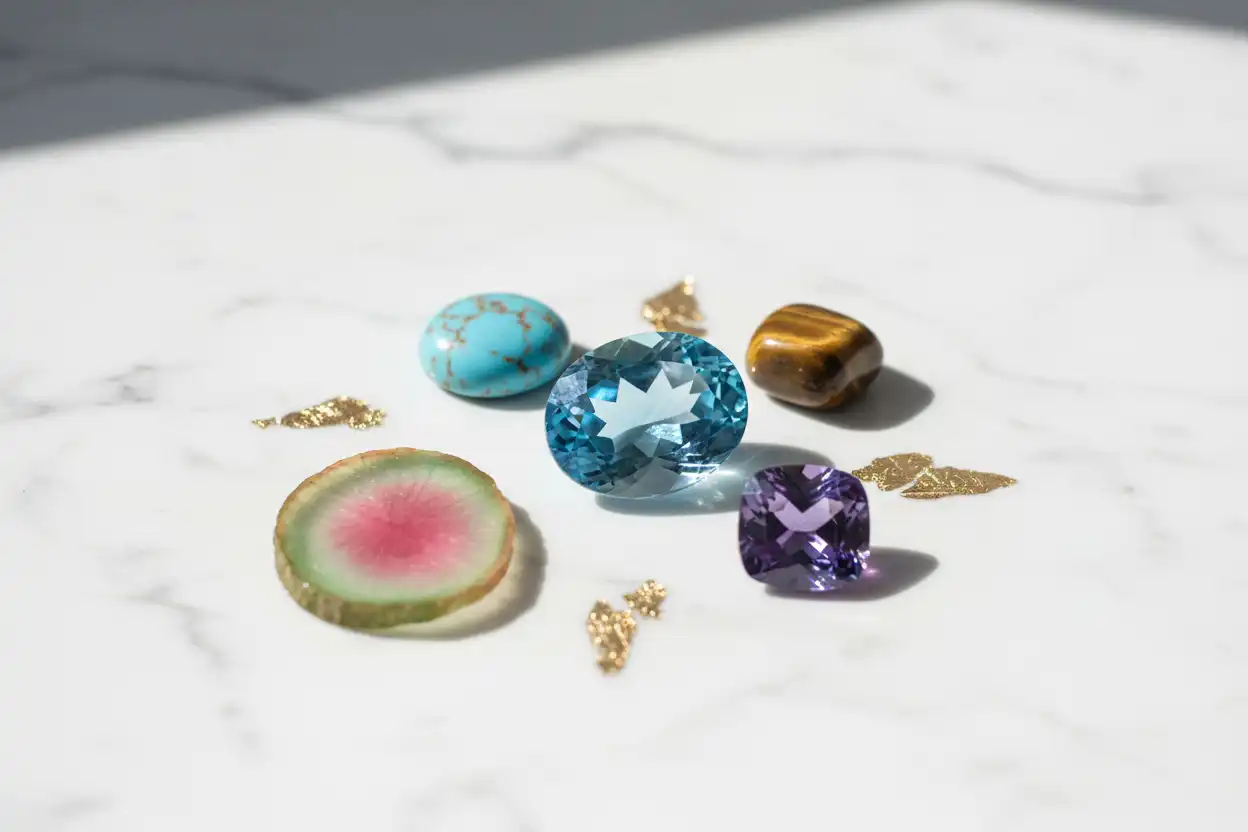
Gemstones and gem materials that start with T include taaffeite, tangerine quartz, tanzanite, tektite, thulite, Tiffany Stone, tiger’s eye, topaz, tourmalinated quartz, tourmaline, tree agate, tremolite, tsavorite, tugtupite and turquoise.
The T directory contains major fine-jewelry gems, rare collector stones, quartz varieties, volcanic and impact glass, ornamental rocks and potentially hazardous minerals.
Traditional meanings are symbolic associations rather than scientifically proven medical effects.
Continue from Gemstones That Start With S. For additional specimen-focused context, explore Crystals That Start With T.
T Gemstones at a Glance
| Gemstone or material | Typical appearance | Material type | Common use |
|---|---|---|---|
| Taaffeite | Mauve, violet, pink or colorless | Rare oxide gemstone | Collector fine jewelry |
| Tangerine Quartz | Clear quartz with orange iron coating | Quartz variety | Pendants and natural-crystal jewelry |
| Tanzanite | Blue to violet-blue | Zoisite gemstone | Fine rings, earrings and pendants |
| Tektite | Black, brown or green natural glass | Impact glass | Pendants and collector jewelry |
| Thulite | Pink to reddish pink | Zoisite variety | Cabochons, beads and carvings |
| Tiffany Stone | Purple, cream, blue and black patterns | Mixed lapidary material | Cabochons and pendants |
| Tiger’s Eye | Golden-brown chatoyant quartz | Quartz-rich material | Rings, beads and cabochons |
| Topaz | Colorless, blue, yellow, pink or orange | Silicate gemstone | Fine jewelry |
| Tourmalinated Quartz | Quartz with dark tourmaline needles | Included quartz | Cabochons and pendants |
| Tourmaline | Black, green, pink, blue or multicolored | Mineral group | Fine and ornamental jewelry |
| Tree Agate | White chalcedony with green dendrites | Chalcedony variety | Cabochons and beads |
| Tremolite | White, green or gray | Amphibole mineral | Collector specimens and rare carvings |
| Tsavorite | Vivid green | Grossular garnet | Fine jewelry |
| Tugtupite | Pink, red or pale color-changing material | Rare feldspathoid mineral | Cabochons and collector jewelry |
| Turquoise | Blue to green with or without matrix | Copper phosphate mineral | Rings, beads and inlay |
Taaffeite
Taaffeite is an exceptionally rare gemstone found in mauve, violet, pink, grayish-purple and nearly colorless material.
It was first recognized as a separate gem after a faceted stone was discovered among stones believed to be spinel.
Taaffeite is traditionally associated with individuality, perseverance and independent judgment.
Transparent stones are mainly used in collector jewelry because gem-quality material is scarce.
Laboratory identification is essential for valuable examples. Color, clarity, size and documentation influence the figures in the taaffeite price guide.
Tangerine Quartz
Tangerine quartz is quartz with orange, rust or reddish surface coatings and inclusions, commonly associated with iron oxides.
It may display:
- Pale peach films.
- Bright orange coating.
- Rust-colored patches.
- Internal orange clouds.
- Clear areas beneath the staining.
Tangerine quartz is traditionally associated with creativity, confidence and motivation.
Natural coatings may be uneven and concentrated around crystal faces or fractures.
Avoid acids and aggressive scrubbing that could remove or alter the surface coloration.
Tanzanite
Tanzanite is the blue to violet-blue gem variety of zoisite associated with deposits in Tanzania.
It is strongly pleochroic and may show:
- Blue.
- Violet.
- Purple.
- Grayish or brownish tones from different directions.
Tanzanite is traditionally associated with transformation, communication and personal insight.
Most commercial stones are heat-treated to improve blue and violet color. The enhancement is common but should be disclosed.
The guide to treated tanzanite explains treatment, synthetic substitutes and common buying concerns.
Tanzanite has cleavage and should be protected from sharp blows, steam and ultrasonic cleaning.
Tektite
Tektites are natural glasses formed when terrestrial material is melted and ejected during major meteorite impacts.
They commonly occur in:
- Black.
- Dark brown.
- Olive green.
- Yellow-green.
- Transparent or opaque forms.
Tektite is traditionally associated with major change, exploration and perspective.
It is natural glass rather than a mineral crystal.
Surface texture, locality, bubbles and shape can help distinguish genuine tektite from ordinary bottle glass or industrial slag.
Thin edges and natural pits make protective pendant settings preferable to rings.
Thulite
Thulite is a pink to reddish-pink manganese-bearing variety of zoisite.
Its colors include:
- Pale blush.
- Rose pink.
- Reddish pink.
- Pink with white or gray areas.
- Opaque mottled patterns.
Thulite is traditionally associated with confidence, emotional openness and creative expression.
It is commonly fashioned into beads, cabochons, carvings and pendants.
Thulite can resemble rhodonite, pink calcite and dyed materials. Dark veining, hardness and mineral structure may help separate them.
Tiffany Stone
Tiffany Stone is a commercial name for purple, cream, blue, white and black patterned lapidary material associated with western Utah.
Depending on the specimen, it may contain combinations of:
- Fluorite.
- Opal.
- Chalcedony.
- Quartz.
- Carbonate minerals.
- Manganese-rich material.
- Other altered minerals.
It is traditionally associated with creativity, adaptability and independent thinking.
Because Tiffany Stone is a mixed material, different areas can vary in hardness and chemical sensitivity.
Avoid acids, prolonged soaking and ultrasonic cleaning. Sellers should describe the underlying material rather than presenting the trade name as one mineral species.
Tiger’s Eye
Tiger’s eye is a chatoyant quartz material known for a moving band of reflected light.
Its colors include:
- Golden brown.
- Yellow.
- Red-brown.
- Blue-gray.
- Greenish or treated multicolored forms.
Tiger’s eye is traditionally associated with focus, discipline and practical confidence.
The chatoyant effect comes from aligned fibrous structures.
It is durable enough for rings, bracelets, pendants and beads when free from major fractures.
Explore the major color and treatment varieties in Types of Tiger’s Eye.
Topaz
Topaz is an aluminum silicate gemstone found in many colors.
These include:
- Colorless.
- Blue.
- Yellow.
- Golden orange.
- Pink.
- Peach.
- Brown.
- Rare red.
Topaz is traditionally associated with clarity, confidence and purposeful action.
Its high hardness makes it scratch-resistant, but perfect cleavage means a sharp blow can split the stone.
Blue, pink and rainbow commercial stones may owe their appearance to irradiation, heat or surface coatings. How to Spot Treated Topaz explains common enhancements.
Tourmalinated Quartz
Tourmalinated quartz is clear, smoky or milky quartz containing needle-like or rod-shaped tourmaline inclusions.
The inclusions are commonly black but may also be green or brown.
Tourmalinated quartz is traditionally associated with balance, boundaries and practical awareness.
It is used for:
- Cabochons.
- Beads.
- Pendants.
- Faceted collector stones.
- Natural-crystal jewelry.
Surface-reaching tourmaline needles and internal fractures can increase vulnerability to chipping.
Tourmaline
Tourmaline is a complex mineral group with one of the broadest gemstone color ranges.
Important varieties include:
- Black tourmaline.
- Green tourmaline.
- Pink tourmaline.
- Rubellite.
- Indicolite.
- Watermelon tourmaline.
- Paraíba tourmaline.
- Brown dravite.
Tourmaline is traditionally associated with protection, self-expression and adaptability.
Many crystals display color zoning or pleochroism.
Tourmaline has good hardness for jewelry, but elongated or heavily included stones can fracture. Explore the group in Types of Tourmaline.
Tree Agate
Tree agate is white, translucent or pale chalcedony containing green dendritic inclusions resembling branches, leaves or moss.
It generally lacks the regular banding found in many agates.
Tree agate is traditionally associated with growth, patience and gradual progress.
The inclusions are mineral formations rather than preserved plants.
Its chalcedony host provides good durability for beads, pendants and cabochons. Thin slices and stones with open cavities still need protection.
Tremolite
Tremolite is an amphibole mineral that may occur in white, gray, pale green or colorless material.
It can form:
- Bladed crystals.
- Massive material.
- Fibrous aggregates.
- Asbestiform habits.
Tremolite is traditionally associated with stability, awareness and practical caution.
Compact non-fibrous material may occasionally be carved or polished. Fibrous or unidentified specimens should not be cut, drilled, sanded or worn where dust could be released.
Use the precautions in the toxic crystals safety list when handling amphibole specimens.
Tsavorite
Tsavorite is a vivid green variety of grossular garnet colored primarily by chromium and vanadium.
Its colors range from:
- Yellow-green.
- Grass green.
- Emerald green.
- Deep bluish green.
Tsavorite is traditionally associated with prosperity, confidence and growth.
It is usually untreated and offers good brilliance and jewelry durability.
Tsavorite can resemble emerald, but the two differ in mineral family, inclusions and treatment patterns. Tsavorite vs. Emerald explains the distinction.
Tugtupite
Tugtupite is a rare mineral best known for pink, red and crimson material from Greenland.
Some specimens display:
- Strong fluorescence.
- Reversible color intensification after ultraviolet exposure.
- White or dark matrix.
- Translucent red areas.
- Pale color before activation.
Tugtupite is traditionally associated with renewal, confidence and rediscovering enthusiasm.
Gem-quality material is uncommon and usually cut as cabochons.
It appears among other scarce collector gems in the guide to the rarest gemstones in the world.
Turquoise
Turquoise is a hydrated copper-aluminum phosphate valued for blue, green and blue-green colors.
It may display:
- Uniform sky blue.
- Greenish blue.
- Black or brown matrix.
- Spiderweb patterns.
- Cream host-rock areas.
Turquoise is traditionally associated with protection, friendship and honest communication.
Natural turquoise is often porous. Commercial stones may be stabilized, dyed, waxed, reconstructed or imitated.
How to Spot Treated Turquoise explains common enhancements and disclosure terms.
Keep turquoise away from perfume, oils, cosmetics, acids and prolonged soaking.
Which T Gemstones Are Best for Jewelry?
Strong or practical choices include:
- Tourmaline.
- Tsavorite.
- Tiger’s eye.
- Topaz in protected settings.
- Turquoise with appropriate care.
- Taaffeite in collector jewelry.
Suitable for protected or occasional wear:
- Tanzanite.
- Thulite.
- Tugtupite.
- Tree agate.
- Tourmalinated quartz.
- Tektite.
- Tiffany Stone.
Tremolite should only be used when the material is confirmed non-fibrous and safe to work.
Buying and Treatment Notes
Look carefully for:
- Synthetic or misidentified taaffeite.
- Heated tanzanite.
- Dyed or coated Tiffany Stone.
- Heat-treated tiger’s eye.
- Irradiated, heated or coated topaz.
- Fracture-filled tourmaline.
- Composite tourmalinated quartz.
- Stabilized or dyed turquoise.
- Glass sold as tektite.
- Light-sensitive tugtupite displayed improperly.
Enhancement is not automatically negative, but treatment, origin and composition should be disclosed accurately.
Care Guide for T Gemstones
- Protect tanzanite, topaz and taaffeite from cleavage-related impact.
- Avoid acids on turquoise and mixed Tiffany Stone.
- Store tugtupite away from unnecessary prolonged intense light.
- Keep fibrous tremolite sealed and undisturbed.
- Protect exposed tourmaline and quartz inclusions from sharp knocks.
- Check natural glass for chipped edges.
- Keep porous turquoise away from oils and cosmetics.
- Avoid ultrasonic or steam cleaning when fractures, coatings or cleavage create risk.
Frequently Asked Questions
What is the most valuable gemstone that starts with T?
Fine Paraíba tourmaline belongs under P, while within T, exceptional taaffeite, tanzanite and tsavorite can command high prices.
Which blue gemstones start with T?
Tanzanite, turquoise, blue tourmaline and some Tiffany Stone material are notable examples.
Which green gemstones start with T?
Tsavorite, green tourmaline, tree agate and green turquoise are notable choices.
Is tektite a meteorite?
No. It is natural terrestrial glass formed during a meteorite impact.
Is Tiffany Stone one mineral?
No. It is a trade name for mixed lapidary material.
Is tiger’s eye naturally chatoyant?
Yes. Its moving reflective band comes from aligned internal structures.
Is topaz suitable for everyday rings?
It resists scratches well, but its perfect cleavage makes protective settings important.
Is turquoise safe in water?
Routine soaking is not recommended because turquoise may be porous, treated or chemically sensitive.
Continue the Gemstone Alphabet
Continue with Gemstones That Start With U, or browse all alphabetical directories through the Crystals 101 collection.