Where to Buy Real Red Tiger’s Eye and Avoid Glass Fakes
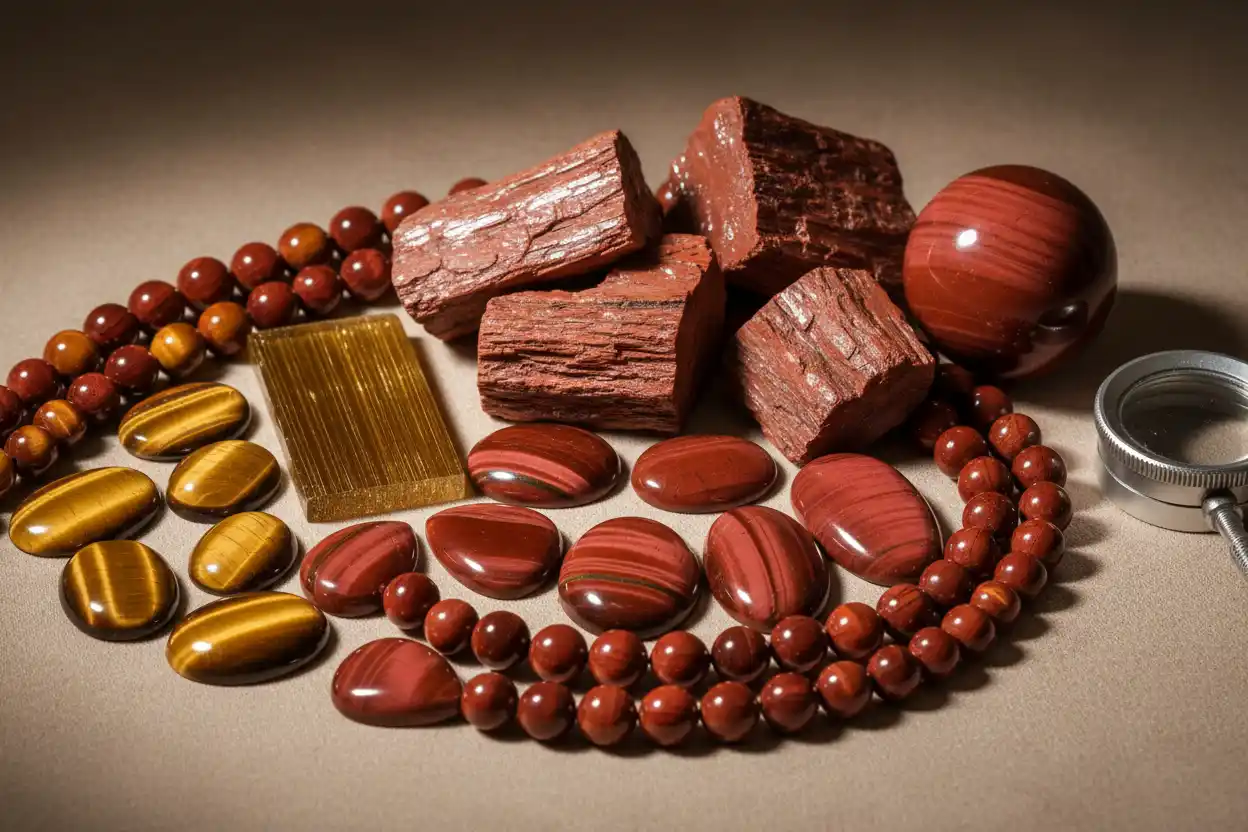
Real Red Tiger’s Eye is a chatoyant quartz material with a brick-red, mahogany, rust or reddish-brown body and a moving silky band of reflected light. It is also sold under the trade name Bull’s Eye.
Most commercial red material begins as natural golden or brown Tiger’s Eye and receives controlled heat treatment that changes its iron-related color toward red. The resulting stone remains genuine Tiger’s Eye, but its color has been enhanced and should be disclosed.
Naturally red or reddish-brown Tiger’s Eye can also occur through geological oxidation. However, separating natural red color from a carefully heated result may be difficult once the material has been cut and polished.
The Red Tiger’s Eye meaning and properties guide covers its identity and traditional symbolism. This buying guide focuses on chatoyancy, treatment disclosure, seller selection, fiber-optic glass, dye, value and jewelry quality.
Red Tiger’s Eye Belongs to the Quartz Family
Tiger’s Eye is a quartz-rich chatoyant material containing parallel fibrous structures inherited from or associated with amphibole growth and alteration.
The aligned fibers reflect light as a narrow moving band called chatoyancy. A properly oriented cabochon can produce an eye-like line that travels across the dome when the stone or light moves.
The Tiger’s Eye meaning and properties guide explains the parent material, while the types of Tiger’s Eye guide separates golden, blue, red and mixed varieties.
Red Tiger’s Eye retains the quartz-rich structure and fibrous optical arrangement of the parent material. Heat treatment changes the iron-related coloration without creating the chatoyant structure itself.
Most Commercial Red Tiger’s Eye Is Heated
Golden-brown Tiger’s Eye commonly contains yellow-to-brown iron compounds associated with the fibrous structure.
Heating can convert or alter those compounds toward red Hematite-rich coloration, producing stable brick-red or reddish-brown material.
This treatment is longstanding, inexpensive and widely accepted. It does not make the stone synthetic or glass.
Nevertheless, a seller should use a description such as:
“Natural Tiger’s Eye, heat-treated to produce red color.”
By contrast, phrases such as “completely untreated rare natural blood-red Tiger’s Eye” require meaningful provenance and treatment evidence.
Because natural oxidation and controlled heating can create related iron-oxide products, visual examination may not always prove how the final red color developed.
Choose the Product Form Before Shopping
| Red Tiger’s Eye product | Best source | Main buying concern |
|---|---|---|
| Natural rough | Quartz or lapidary supplier | Chatoyant orientation, color treatment and fractures |
| Slab | Specialist lapidary dealer | Fiber direction, usable eye and dye |
| Cabochon | Independent cutter | Centered chatoyant band and surface polish |
| Tumbled stone | Reputable crystal retailer | Weak eye, glass, resin and artificial color |
| Bead strand | Established bead supplier | Fiber-optic glass, dye and drill-hole cracking |
| Sphere | Experienced carving retailer | Full chatoyancy coverage and resin |
| Tower or carving | Stone seller with exact-item video | Carved form, weak eye and coating |
| Ring stone | Jeweler familiar with chatoyant quartz | Eye orientation, setting and disclosure |
| Pendant or earrings | Independent jeweler | Exact-item flash and construction |
| Natural-red premium specimen | Specialist dealer | Evidence supporting untreated color |
The optical effect is directional, so exact-item video is more useful than one highly selected photograph.
Where to Buy Genuine Red Tiger’s Eye
Specialist lapidary suppliers
A lapidary supplier should show rough, slabs and representative polished stones from the same parcel.
Ask for dry photographs under one directional light. Water and oil can deepen red color and make the surface look more polished than it is.
The supplier should identify the fiber direction. Rough cut across an unfavorable orientation may fail to produce a sharp eye.
Request treatment disclosure in writing. Unless strong evidence indicates otherwise, commercial red rough should be assumed to have been heated.
Gem and mineral shows
Shows allow direct comparison with golden Tiger’s Eye, Blue Tiger’s Eye, Pietersite, Carnelian and fiber-optic glass.
Move the stone beneath one small white light. Genuine chatoyancy should travel across the stone as a coherent band tied to its fibrous structure.
Use a loupe to inspect fibers, dye concentrations, coatings, bubbles and resin.
Do not scratch or heat merchandise. Those tests damage finished products and cannot establish the natural origin of the red color reliably.
Established online stores
The online gemstone buying guide explains seller identity, protected payment methods and return rights.
Request a continuous rotation under one stationary light. Several moving lamps can make a weak eye appear stronger and broader than it is.
Ask whether saturation and contrast were adjusted. Brick-red material can become vivid cherry red through editing.
The seller should show the front, back, edge and drill holes where appropriate.
Independent cutters and jewelers
A cutter who oriented the rough may know how much of the final eye comes from careful cutting rather than unusually strong raw material.
Ask to see the loose cabochon before setting. The line should remain centered and mobile when viewed from ordinary angles.
For jewelry, obtain written disclosure of heat, dye, resin, coating and backing.
What Genuine Red Tiger’s Eye Looks Like
Natural or heated material may appear:
- Brick red
- Rust red
- Mahogany
- Reddish brown
- Deep terracotta
- Red-black
- Burgundy brown
- Red with golden remnants
The chatoyant line may appear pale red, copper, gold, cream or silvery.
Color can vary across the fibrous bands. A stone may show red areas beside brown, gold or dark gray layers.
Fine fibers should run in a coherent direction. When the stone rotates, the eye moves perpendicular to those fibers.
The body is generally opaque, although thin edges can transmit some brownish or reddish light.
Genuine Tiger’s Eye normally has a silky rather than glittery appearance. Individual metallic sparkles are not the defining phenomenon.
How to Judge Chatoyancy
The sharpness of the eye is one of the most important quality factors.
Use one small light source, such as a focused lamp, rather than broad diffuse lighting. A narrow band should move smoothly as the cabochon turns.
A strong stone usually has:
- A clearly defined eye
- Good contrast between the eye and body
- Continuous movement
- Correct cutting orientation
- A symmetrical dome
- No large dead zones
- A useful viewing range
A diffuse sheen can still be natural, but it should cost less than a sharply chatoyant cabochon.
Very flat cuts often produce weak movement. An overly high dome can add unnecessary weight without improving the eye.
Red Tiger’s Eye Versus Golden Tiger’s Eye
Golden Tiger’s Eye has yellow, honey, brown and gold coloration.
Red Tiger’s Eye has stronger brick, mahogany or reddish-brown color, commonly because the golden material was heated.
The planned general guide to buying real Tiger’s Eye owns family-wide quality and seller considerations.
This page remains focused on red color origin and red-specific imitations rather than repeating every Tiger’s Eye variety.
A stone containing both gold and red bands may be sold as mixed Tiger’s Eye when neither color clearly dominates.
Red Tiger’s Eye Versus Blue Tiger’s Eye
Blue Tiger’s Eye, also called Hawk’s Eye, preserves blue-gray, green-blue or dark fibrous amphibole-related coloration.
The completed guide to buying real Blue Tiger’s Eye owns blue-specific dye, glass and treatment concerns.
Red and blue zones can occur within one piece, particularly where oxidation or heat alteration varies.
A blue-red mixed stone should not receive a rare-variety premium unless both colors are natural-looking and the treatment history is disclosed.
Red Tiger’s Eye Versus Pietersite
Pietersite is a brecciated chatoyant material containing broken, reoriented Tiger’s Eye or Hawk’s Eye fragments cemented by quartz.
Its fibers commonly swirl in several directions and create stormy patches rather than one orderly parallel eye.
The Tiger’s Eye versus Pietersite guide owns the complete comparison.
Red Tiger’s Eye generally has parallel fibers and a coherent moving band. Pietersite often displays chaotic flashes that activate in separate areas.
Red Tiger’s Eye Versus Carnelian
Carnelian is translucent orange-to-red Chalcedony.
It can show banding and iron-related color but normally lacks Tiger’s Eye’s parallel silky chatoyancy.
A red cabochon with diffuse translucency and no moving eye belongs more naturally in the Carnelian market.
The completed guide to buying genuine Carnelian covers heat, dye and glass in that separate material.
Red Tiger’s Eye Versus Red Jasper
Red Jasper is generally opaque, iron-rich silica material without a true moving eye.
The completed guide to buying real Red Jasper owns Jasper classification, dye and reconstructed products.
Red Jasper can occur naturally with Tiger’s Eye and Hematite in the rock known commercially as Tiger Iron. Such mixed material should be described as a multi-component rock rather than solid Red Tiger’s Eye.
Red Tiger’s Eye Versus Fiber-Optic Glass
Fiber-optic glass is one of the most convincing Tiger’s Eye imitations.
It contains parallel manufactured fibers that create an extremely sharp moving band. It may appear red, pink, blue, green, yellow or nearly any other color.
Warning signs include:
- Unnaturally uniform fibers
- Identical eye width across many beads
- Bright synthetic colors
- Perfectly smooth factory shapes
- Bubbles or glassy flow
- Repeated patterns
- No geological rough or source information
Fiber-optic glass can be attractive and durable when labeled correctly. It should not be sold as natural quartz.
The glass-versus-crystal guide provides broader separation methods.
Dyed Quartz and Dyed Tiger’s Eye
Pale quartz-rich material can be dyed red, while genuine Tiger’s Eye can receive dye to intensify weak color.
Artificial color may concentrate in fractures, pits, drill holes and porous fiber boundaries.
A chipped edge may reveal gold, gray or pale brown material beneath the red.
However, natural iron coloration can also vary around fractures. Therefore, one dark line is not conclusive.
Ask for treatment disclosure rather than relying only on visual inspection.
Painted, Coated and Lacquered Material
A transparent red coating can deepen a brown Tiger’s Eye surface.
Inspect the back, edges and drill holes for peeling, color loss or a different luster.
Clear lacquer may improve gloss or reduce surface abrasion without producing the red color. It should still be disclosed because it changes care requirements.
The gemstone treatments guide explains heat, dye, coating, filling and impregnation.
Resin and Reconstructed Products
Tiger’s Eye fragments or powder can be mixed with polymer and molded into beads, spheres and carvings.
The resulting object may contain genuine quartz material without being one continuous natural stone.
Mold seams, repeated patterns, polymer-rich chips and trapped bubbles support reconstruction.
Clear resin may also stabilize fractures in a solid natural piece. Limited filling and full composite construction should receive different descriptions.
How to Evaluate Rough and Slabs
Ask the seller to show the material dry and under one directional light.
The fibrous structure should extend through the stone rather than remain as a painted surface pattern.
Determine whether the rough can be cut perpendicular to the fibers to produce chatoyancy.
Inspect fractures that run along the fibrous layers. They can separate during sawing or drilling.
A large block with poor orientation may be worth less than a smaller slab that produces several sharp eyes.
How to Judge Cabochons
The eye should sit near the center of the dome and move smoothly from side to side.
Inspect the surface for pits, scratches and flat areas that interrupt the band.
The girdle should be even enough for secure setting. The back may be flat or lightly polished but should reveal color continuity and any treatment.
An excessively dark cabochon may show a narrow eye but lose most of its red body color in ordinary light.
Buying Beads and Bracelets
Natural strands should show modest variation in eye strength, red shade and fiber arrangement.
Inspect drill holes for dye, resin and radial fractures.
Perfectly identical red beads with the same bright white stripe can indicate fiber-optic glass.
Ask whether every bead is heated natural Tiger’s Eye or whether the strand includes Jasper, glass or reconstructed material.
Buying Spheres, Towers and Carvings
Request a complete rotation under one stationary light.
A sphere can display several eyes or broad bands as different fiber orientations cross the surface. However, some areas may remain optically quiet.
Most towers and carvings are manufactured shapes rather than natural crystals.
Check repaired points, thin projections, resin-filled seams and surface coating.
A dramatic photographed eye on one side should not be treated as full-object coverage.
Buying Red Tiger’s Eye Jewelry
Quartz-rich Tiger’s Eye generally has Mohs hardness around 6.5 to 7 and is practical for many jewelry forms.
The gemstone hardness chart provides scratch-resistance context. The gemstone toughness-versus-hardness guide explains why fiber boundaries and fractures still matter.
Pendants, earrings, bracelets and protected rings are generally suitable.
A bezel can protect cabochon edges while preserving the moving eye. The Tiger’s Eye ring guide and Tiger’s Eye bracelet guide cover form-specific construction.
Locality and Provenance
South Africa is the dominant commercial source of Tiger’s Eye, while material also occurs in Australia and other regions.
Appearance alone cannot prove a precise mine or country. A natural-red claim needs stronger evidence than an ordinary South African origin statement.
Ask for the supplier, mine district or original rough record when provenance affects price.
The ethical gemstone sourcing guide provides broader questions about mining, cutting labor and traceability.
Price and Value
Red Tiger’s Eye is generally affordable because heat-treated material is widely available.
Value depends on:
- Sharpness of the eye
- Contrast
- Eye movement
- Attractive red color
- Correct cutting orientation
- Polish
- Structural condition
- Size
- Treatment disclosure
- Craftsmanship
- Provenance
A small cabochon with a sharp centered eye can be worth more than a large dark sphere with weak chatoyancy.
A substantial natural-red premium is justified only when the seller provides credible evidence that the color was not produced by heat.
The gemstone pricing guide explains how treatment, cutting yield and workmanship affect price.
Questions to Ask the Seller
Ask whether the red color is natural, heat-treated, dyed or coated.
Request a moving-light video under one stationary lamp.
Confirm whether the object is natural Tiger’s Eye, fiber-optic glass, resin or reconstructed material.
Ask for front, back, edge and drill-hole views as appropriate.
Request the country of origin and the basis for any untreated-color claim.
Finally, confirm that the return policy allows nondestructive gemological inspection.
Professional Identification
Microscopy can reveal parallel natural fibers, dye, coatings, resin and glass structures.
Refractive index, specific gravity and Raman spectroscopy can confirm quartz and separate it from most glass and polymer products.
However, confirming natural Tiger’s Eye does not necessarily prove that the red color developed without heat.
A laboratory report may identify the material and visible treatments while remaining cautious about natural-versus-induced red color.
Cleaning and Storage
The completed Tiger’s Eye jewelry cleaning guide provides detailed care.
Use lukewarm water, mild soap and a soft cloth. Avoid harsh acids, bleach and abrasive cleaners.
Do not soak filled, coated or glued jewelry.
Store polished stones separately from diamonds, sapphires and other harder gems.
Frequently Asked Questions
1. Is Red Tiger’s Eye natural?
The underlying Tiger’s Eye is natural, but most commercial red material has been heat-treated to produce or strengthen its color.
2. Is heat-treated Red Tiger’s Eye fake?
No. It is genuine natural Tiger’s Eye with enhanced color, provided the treatment is disclosed.
3. Does naturally red Tiger’s Eye exist?
Yes. Natural geological oxidation can produce red-brown material, although proving untreated color can be difficult.
4. Is Red Tiger’s Eye the same as Bull’s Eye?
Bull’s Eye is a common trade-name synonym for Red Tiger’s Eye.
5. What creates its moving eye?
Parallel fibrous structures within the quartz-rich material reflect light as a mobile chatoyant band.
6. Is Red Tiger’s Eye the same as Carnelian?
No. Carnelian is translucent red-orange Chalcedony and normally lacks Tiger’s Eye chatoyancy.
7. Is it the same as Red Jasper?
No. Red Jasper is generally opaque and non-chatoyant, though it can occur with Tiger’s Eye in Tiger Iron.
8. Can glass imitate Red Tiger’s Eye?
Yes. Fiber-optic glass can produce an extremely sharp eye and is available in vivid red colors.
9. Can Red Tiger’s Eye be dyed?
Yes. Dye may intensify fractures, pores, drill holes and fibrous boundaries.
10. Is Red Tiger’s Eye suitable for everyday jewelry?
Sound cabochons are generally durable enough for regular wear in protective settings.
11. Do ordinary stones need laboratory reports?
Usually not. Reports are more useful for expensive natural-red claims or disputed glass and treatment identification.
12. What is the biggest warning sign in a listing?
Be cautious when a seller charges a large untreated premium but provides no treatment statement, provenance or moving-light evidence of natural fibrous chatoyancy.
Buy the Eye First and the Color Story Second
Red Tiger’s Eye should display a coherent silky band before its treatment history affects the price. Heat-treated material can be attractive, stable and genuine when represented honestly.
The red gemstones guide, red crystals guide, R crystal directory and R gemstone directory provide wider comparisons. Choose a seller who values optical quality and disclosure more than an unverifiable natural-red story.
Safety note: Finished Tiger’s Eye is suitable for normal handling. However, rough cutting, drilling, sanding or grinding can release hazardous crystalline-silica and amphibole-bearing dust. Use professional wet methods, effective extraction and appropriate respiratory and eye protection.