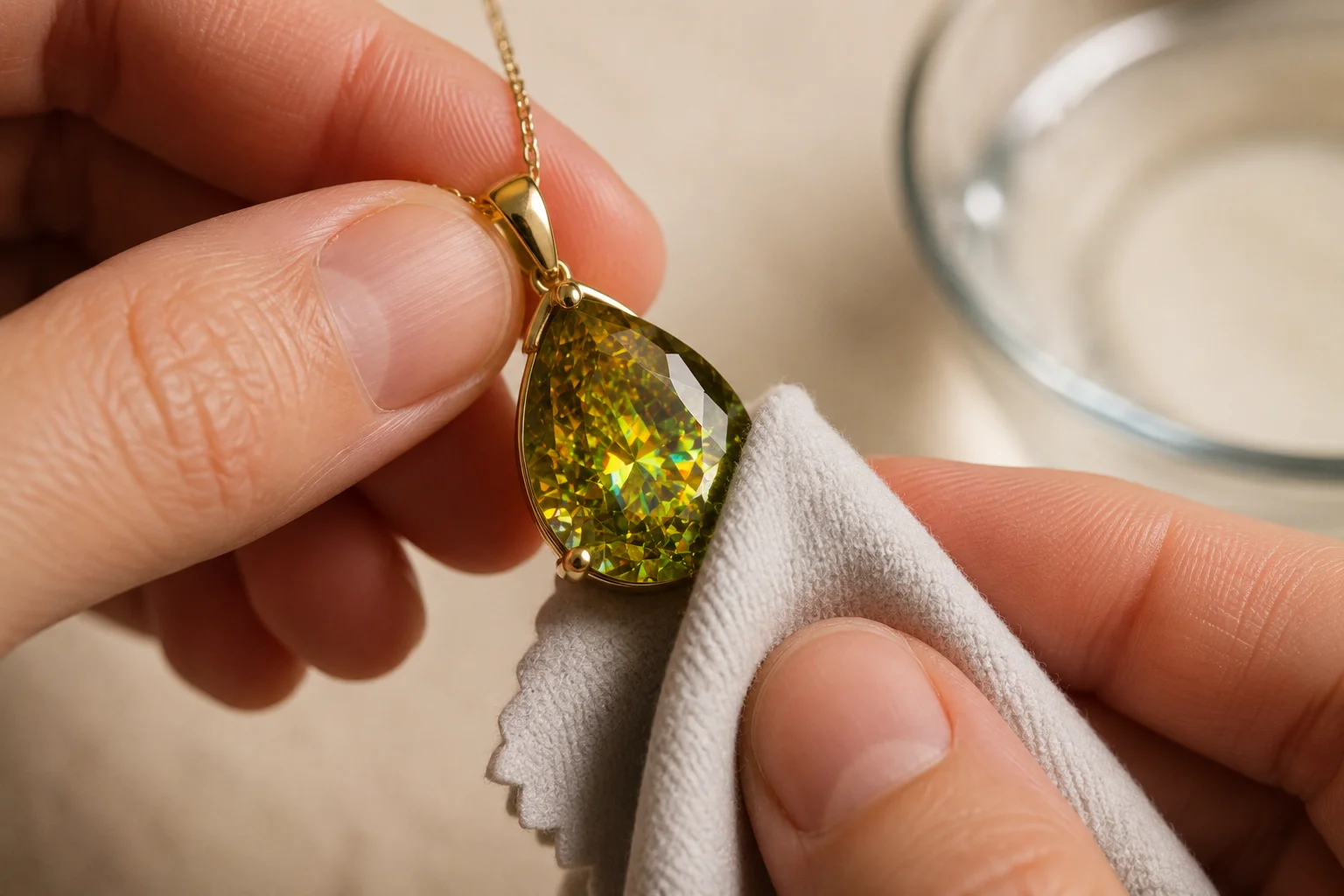
How to Clean Sphene Jewelry Safely
Sphene jewelry should be cleaned briefly with lukewarm water, mild liquid soap, and an exceptionally soft brush or cloth. Ultrasonic and steam cleaners should never be used because Sphene is relatively soft, brittle, inclusion-prone, and affected by a distinct cleavage direction.
This gemstone’s exceptional rainbow fire can make it appear more durable than it is. In practice, Sphene is better suited to earrings, pendants, collector jewelry, and carefully protected rings than to rough everyday wear.
Sphene and Titanite Are the Same Mineral
Sphene is the traditional gem-trade name for titanite, a calcium titanium silicate mineral.
The name titanite refers to its titanium content, while Sphene derives from a word associated with its common wedge-shaped crystals. Both names remain widely understood in gemological use.
Its geology, color, sources, symbolism, and optical properties belong to the broader Sphene guide.
| Property | Cleaning implication |
|---|---|
| Mineral name | Titanite |
| Gem-trade name | Sphene |
| Composition | Calcium titanium silicate |
| Typical colors | Yellow, green, yellow-green, orange, brown, or reddish |
| Mohs hardness | Approximately 5 to 5.5 |
| Cleavage | Good in one direction |
| Toughness | Poor to fair; generally brittle |
| Safest routine cleaning | Brief lukewarm soapy-water cleaning |
| Ultrasonic cleaning | Never recommended |
| Steam cleaning | Never recommended |
| Main risks | Scratching, cleavage, chipping, inclusions, heat, pressure, and setting wear |
The gemstone hardness chart explains why quartz-rich dust and many common gemstones can scratch Sphene.
Its low resistance to scratching is separate from the risk of breakage. That distinction appears in Gemstone Toughness vs Hardness and Gemstone Cleavage Explained.
Why Sphene Shows So Much Fire
Sphene has very strong dispersion, meaning it separates white light into spectral colors effectively.
A well-cut transparent gemstone can display flashes of red, orange, yellow, green, blue, and violet. Its dispersion can appear stronger than Diamond’s, although Sphene’s lower hardness makes the two unsuitable for direct durability comparison.
Strong birefringence can also create visible doubling of rear facet edges when viewed through the stone.
These optical properties are internal. Cleaning can remove oil that suppresses brilliance, but it cannot improve poor cut orientation, shallow faceting, worn facet junctions, or naturally weak color.
Do not polish Sphene at home to increase its fire. Removing material changes facet geometry and can permanently reduce brilliance.
Inspect the Stone Under Magnification
Examine Sphene beneath bright, indirect light and, when possible, low magnification.
Look for chipped facet junctions, worn edges, open fissures, healed fractures, loose prongs, bezel gaps, missing accent stones, and damaged metal.
Sphene may contain crystals, reflective particles, growth features, tubes, healed fissures, and other inclusions. These can be visually dramatic but may also influence structural durability.
Do not push a brush into an inclusion or surface-reaching break. Internal features are not removable dirt.
A stone that clicks, shifts, or has a visible fracture should receive professional attention before cleaning.
Protect Facet Edges from Abrasion
Sphene’s facet junctions can wear more quickly than those of Quartz, Garnet, Sapphire, Spinel, or Diamond.
Dry dust should be rinsed or lifted before the surface is rubbed. Grit containing quartz may scratch the polish.
Avoid paper towels, facial tissue, rough cotton, polishing cloths intended for metal, and brushes with stiff or split bristles.
Use a new soft makeup brush, a fine artist’s brush, or an exceptionally soft jewelry brush.
Even normal storage contact with metal chains can abrade exposed facets.
Check for Treatments and Assembly
Sphene is not commonly treated on a large commercial scale, but individual stones or jewels may be coated, filled, glued, repaired, backed, or assembled.
Surface-reaching fractures may contain oil, resin, or another material. Coatings can alter color or luster.
The wider treatment framework belongs to Gemstone Treatments Explained.
When treatment or construction is unknown, use a barely damp cloth rather than immersion.
Treatment should be disclosed before repolishing, resetting, soldering, or exposing the jewel to solvents.
Prepare a Padded Cleaning Area
Place a thick folded towel on the work surface. Sphene can chip if it slips onto a sink, tile, glass counter, or metal basin.
Fill a shallow bowl with lukewarm water and add only a few drops of mild liquid dish soap.
Prepare a second bowl of clean lukewarm water for rinsing.
Use an exceptionally soft brush or lint-free cloth. Do not use a standard medium toothbrush.
Avoid cleaning over an uncovered drain.
Clean Sphene Briefly
Dampen the brush or cloth with the mild solution.
Clean the crown, pavilion, girdle, prongs, bezel, and gallery with light movements. Support the jewel by its metal setting rather than pinching the gemstone.
Do not scrub repeatedly across facet junctions. Their sharpness contributes to brilliance but also makes them vulnerable to wear.
Keep the wash brief. Prolonged soaking offers no benefit and may affect filler, glue, antique repairs, plating, or companion stones.
When the stone contains visible fissures, wipe it instead of immersing it.
Rinse Without Temperature Change
Rinse the jewel briefly in clean lukewarm water or remove soap with a second damp cloth.
Keep the rinse close to the wash temperature. Sudden changes can stress inclusions, cleavage, and setting components.
Blot the piece with a soft lint-free cloth. Do not rub across the facets.
Allow hidden moisture to evaporate naturally at room temperature.
Do not use a hair dryer, radiator, steam jet, heated cabinet, or intense display lamp.
Never Use an Ultrasonic Cleaner
Sphene should never enter an ultrasonic cleaner.
Vibration can stress its cleavage direction, enlarge fissures, chip facet edges, disturb filling, or loosen the stone from its setting.
A machine may also generate heat and use cleaning fluid formulated for harder gemstones.
The broader equipment boundaries appear in Which Gemstones Can Go in an Ultrasonic Cleaner?.
Never Steam Clean Sphene
Steam combines concentrated heat, pressure, and rapid temperature change.
These conditions are unsuitable for a soft, brittle, cleavage-sensitive gemstone that may contain healed fissures and other inclusions.
Steam can also damage glue, filler, plating, soldered repairs, enamel, and companion stones.
Manual lukewarm cleaning is sufficient for routine care.
Cleaning a Sphene Ring
Sphene is a challenging choice for a ring because hands encounter desks, doors, counters, bags, tools, and household chemicals throughout the day.
A protective bezel, halo, low-profile setting, or substantial corner protection reduces risk but cannot make the gemstone suitable for rough wear.
Clean around the setting with minimal pressure. Remove the ring before typing at a hard desk for long periods, cleaning, exercising, gardening, cooking, swimming, or handling luggage.
A Sphene ring is generally better treated as occasional jewelry than as an unprotected everyday ring.
Cleaning Sphene Earrings
Earrings are among the safer jewelry formats for Sphene because they receive relatively little impact.
Clean posts, hooks, backs, baskets, and hinges separately.
Keep alcohol-based disinfectant on compatible metal fittings and away from the gemstone, filler, coatings, glue, and plated finishes.
Store each earring separately so its post and back cannot scratch the other stone.
Cleaning a Sphene Necklace or Pendant
A pendant offers better impact protection than a ring while allowing Sphene’s fire to remain visible.
Apply perfume, sunscreen, lotion, and hairspray before putting on the jewel.
Prevent the chain from rubbing against the stone. Support the pendant by its setting rather than gripping the Sphene.
Large stones should not swing freely against metal clasps, other pendants, or hard beads.
Cleaning a Sphene Bracelet
Sphene is poorly suited to exposed bracelet designs because the wrist repeatedly strikes desks and furniture.
When a bracelet contains Sphene, inspect every stone, link, hinge, clasp, and protective setting before cleaning.
Support the bracelet flat and wipe each gemstone individually.
Remove it before desk work, exercise, cleaning, travel handling, and any activity involving repeated wrist contact.
Sphene Versus Demantoid Garnet
Sphene and Demantoid Garnet can both show green-to-yellow color and strong fire.
Sphene is softer, strongly birefringent, and more cleavage-sensitive. Demantoid is a Garnet with greater hardness and different inclusions and optical properties.
The complete comparison belongs to Sphene vs Demantoid Garnet.
The individual comparison material is covered in the Demantoid Garnet guide.
Demantoid’s physical-care workflow belongs to How to Clean Demantoid Garnet Jewelry Safely.
Do not use scratching, heat, or machinery as an identification test.
Sphene Versus Peridot and Zircon
Yellow-green Sphene may resemble Peridot, while yellow, orange, or brown Sphene can resemble Zircon.
The Peridot guide owns the olivine material profile, and its cleaning requirements appear in How to Clean Peridot Jewelry Safely.
The tracker’s Zircon guide covers natural zircon, which should not be confused with cubic zirconia.
Zircon’s dedicated physical-care workflow belongs to How to Clean Zircon Jewelry Safely.
Because all these stones have different durability limits, unidentified jewelry should receive the gentlest manual method.
Buying, Price, and Cut Condition
The Sphene buying guide covers color, dispersion, clarity, doubling, cut, size, origin, durability, and setting quality.
Market factors belong to the Sphene price guide.
Examine secondhand Sphene closely. Rounded facet junctions, scratches, small chips, and worn polish can reduce brilliance substantially.
Cleaning can remove oil but cannot restore abraded facets. Repolishing may improve the surface, although it reduces weight and requires a lapidary experienced with cleavage-sensitive material.
Laboratory Reports and Documentation
Sphene can usually be identified through its optical properties, refractive behavior, dispersion, birefringence, and spectroscopy.
A report may be worthwhile for a large or valuable stone, especially when it could be confused with another high-dispersion gem.
The gemstone certification guide explains laboratory services, while How to Read a Gem Lab Report covers identity, measurements, comments, and limitations.
Keep reports, invoices, measurements, photographs, and repair records with the jewel.
Storage and Preventive Care
Store Sphene alone in a padded compartment or soft pouch.
Quartz, Garnet, Zircon, Topaz, Sapphire, Ruby, Spinel, Diamond, and many other gemstones can scratch it.
Do not stack jewelry on top of Sphene. Pressure against a prong, facet edge, or cleavage direction can cause damage.
Wrap chains and clasps separately so they cannot rub against the gemstone.
Frequently Asked Questions
1. What is the safest way to clean Sphene?
Use lukewarm water, a few drops of mild soap, and an exceptionally soft brush or cloth.
2. Can Sphene get wet?
Brief controlled washing is generally acceptable for a sound stone. Avoid soaking fractured, filled, glued, coated, antique, or loosely mounted jewelry.
3. Can Sphene go in an ultrasonic cleaner?
No. Vibration can damage cleavage planes, fissures, facet edges, filler, and settings.
4. Can Sphene be steam cleaned?
No. Steam introduces heat, pressure, and thermal shock.
5. Is Sphene the same as Titanite?
Yes. Titanite is the mineral name, while Sphene remains widely used in the gem trade.
6. Why does Sphene show so much rainbow fire?
It has exceptionally strong dispersion, which separates white light into spectral colors.
7. Is dish soap safe for Sphene?
A few drops of mild liquid soap are suitable. Avoid abrasives, strong alkalis, acids, and aggressive degreasers.
8. Can toothpaste polish Sphene?
No. Toothpaste can scratch its soft facets and damage the setting.
9. Is Sphene suitable for an everyday ring?
Generally not. It is relatively soft and cleavage-sensitive, so rings require protective settings and occasional wear.
10. Why do facet edges look doubled through Sphene?
Strong birefringence can create visible doubling of rear facet junctions.
11. Can scratched Sphene be polished at home?
No. Repolishing requires an experienced lapidary because facet geometry, weight, and cleavage must be managed carefully.
12. When should Sphene receive professional care?
Professional attention is appropriate for scratches, chipped facets, visible fissures, loose settings, filler, high-value stones, or reduced brilliance after cleaning.
Conclusion
Sphene’s exceptional fire comes with one of the stricter care profiles among transparent faceted gems. A brief lukewarm wash preserves brilliance without abrading facets or stressing its cleavage. When a stone remains dull, inspect for surface wear rather than using stronger chemicals—repolishing Sphene is a lapidary task, not a household cleaning step.