Best Gemstones for Investment: Value & Buying Guide
The best gemstones for investment are not simply rare stones, expensive stones or gemstones that a dealer predicts will rise in price. The strongest collector candidates usually combine exceptional natural quality, scarcity in the quality actually demanded by buyers, limited or no treatment, meaningful size, independent laboratory documentation and an established market capable of recognizing those attributes when the stone is eventually sold.
Fine natural ruby, exceptional sapphire and top-quality emerald occupy the deepest established colored-gem collector markets, while alexandrite, Paraíba-type tourmaline, premium spinel, tsavorite and natural fancy-color diamond can become significant specialist collectibles when quality is exceptional. Yet even these stones are illiquid physical assets rather than conventional investments with transparent exchange pricing, predictable income or guaranteed buyers.
That distinction matters. A gemstone bought at an aggressive retail markup can lose money even if the underlying market strengthens, because dealer margins, laboratory fees, auction commissions, insurance, shipping and the time needed to locate a specialist buyer can absorb a substantial portion of any increase.
The best gemstones for investment should therefore be approached as collectible tangible assets with uncertain financial outcomes, not as replacements for diversified financial investments.
Best Gemstones for Investment at a Glance
| Gemstone category | Collector-market strength | Features that support value | Main risk |
|---|---|---|---|
| Fine natural ruby | Very strong | Vivid color, minimal treatment, rare size, respected origin and reports | Extremely high entry price for top stones |
| Fine blue sapphire | Very strong | Fine color, no heat, important origin, rare size | Origin premium can be overpaid |
| Fine emerald | Very strong | Vivid color, transparency, minimal filling, desirable origin | Fractures and clarity enhancement complicate quality |
| Natural fancy-color diamond | Strong specialist market | Rare natural color, intensity, size, major grading report | Extremely specialized pricing |
| Alexandrite | Strong collector niche | Attractive color change, natural origin, rare size | Thin supply and thin resale market |
| Paraíba-type tourmaline | Strong specialist niche | Copper-bearing neon color, saturation, origin and laboratory evidence | Highly variable quality and terminology |
| Fine natural spinel | Growing specialist market | Vivid red, pink or cobalt-blue color, rare clean size | Smaller buyer pool than ruby or sapphire |
| Tsavorite garnet | Established niche | Vivid green, transparency, uncommon larger stones | Less market depth than emerald |
| Fine jadeite | Major specialist market | Color, translucency, texture, treatment status and craftsmanship | Complex treatment and valuation system |
| Rare collector gemstones | Very thin | Exceptional rarity, transparency, provenance and documentation | Rarity alone does not create liquidity |
The important phrase throughout this guide is fine quality. Ordinary examples of an expensive species are not automatically among the best gemstones for investment.
Are Gemstones Actually Good Investments?
Sometimes exceptional gemstones preserve or increase value, and top stones regularly attract strong competition within specialist dealer and auction markets. That does not make the category predictable.
Gemstones have several disadvantages as financial assets.
There is no centralized exchange posting one continuous price for a five-carat unheated ruby or a specific Colombian emerald. Every stone differs in color, transparency, cut, treatment, size, origin, inclusions and documentation.
Bid-ask spreads can also be substantial.
A retailer may sell a gemstone for considerably more than another dealer is prepared to pay for it immediately. That difference reflects retail overhead, inventory risk, expertise, financing, laboratory testing, marketing and the dealer’s need to resell the stone at a profit.
Gemstones also generate no interest, dividend or rental income while they are held.
For these reasons, the best gemstones for investment are usually better understood as a specialist collecting category in which financial value is possible, rather than a simple wealth-building product.
The wider mechanics of retail, wholesale and secondary-market pricing are explained in how gemstone prices work.
What Makes an Investment-Quality Gemstone Different?
Buying a ruby is not the same as buying an investment-quality ruby.
A commercial heated stone with dark color and obvious inclusions may be perfectly attractive in jewelry while having limited specialist resale appeal.
The best gemstones for investment usually distinguish themselves through several attributes occurring simultaneously.
Exceptional Color
For colored gemstones, color is generally the most important quality factor.
Hue should fall within a desirable range for the species, saturation should be strong without making the gem excessively dark, and tone should allow the stone to remain lively under normal lighting.
A prestigious origin cannot rescue poor color.
An unheated statement cannot rescue poor color.
Large carat weight cannot rescue poor color.
The market ultimately has to want what it sees.
Scarcity at That Quality Level
Rarity should be evaluated at the quality level, not merely the species level.
Quartz is common, but a unique museum crystal may still be collectible. Painite is far rarer as a mineral than sapphire, yet fine sapphire has a vastly deeper jewelry and collector market.
Likewise, ruby exists in commercial quantities, but a large transparent natural ruby combining exceptional red color and minimal treatment is genuinely scarce.
The best gemstones for investment balance geological scarcity with recognized buyer demand.
Treatment Status
Treatment can dramatically alter market position.
Conventional heating may be accepted in ruby and sapphire, but comparable unheated stones can command stronger premiums when their natural quality is exceptional.
Emerald presents a different treatment structure because clarity enhancement with oils or resins is common. An emerald with insignificant or minor enhancement may occupy a much stronger collector tier than one whose appearance depends heavily on filler.
Laboratory evidence is therefore essential whenever treatment status materially affects price.
Size
Price per carat often rises nonlinearly when fine material crosses into uncommon sizes.
The important threshold is different for every gemstone.
A size that is ordinary for aquamarine may be extraordinary for fine ruby or alexandrite.
This is why comparing stones by carat weight without understanding species-specific rarity can be misleading.
Documentation
The best gemstones for investment should have documentation proportionate to their value.
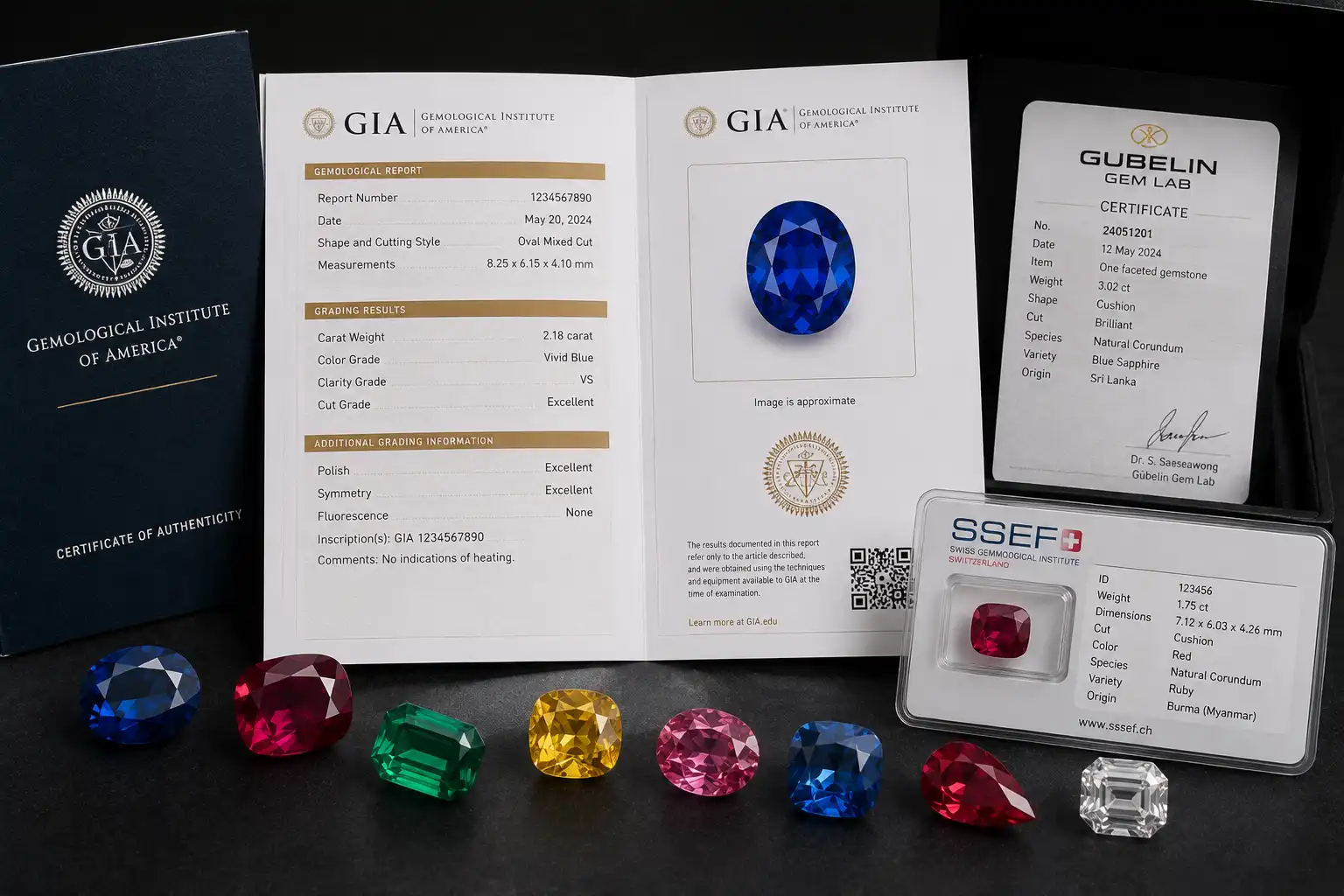
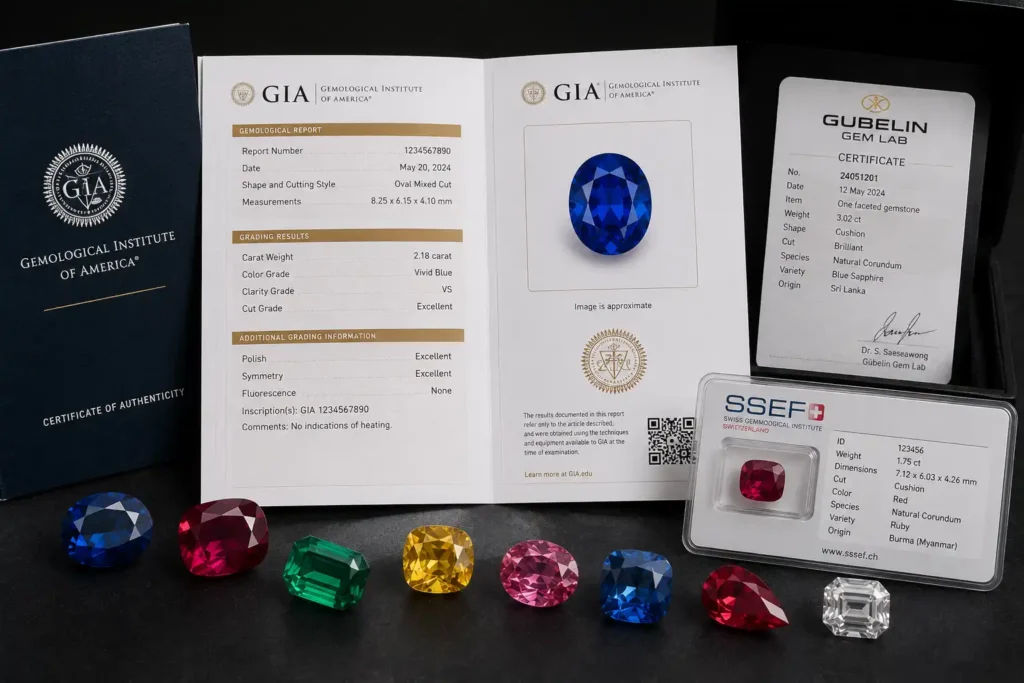
A respected gemological laboratory may establish:
natural versus laboratory-grown origin, detectable treatments, gemstone identity and, for certain species when evidence permits, an opinion on geographic origin.
A laboratory does not determine whether the purchase price is fair.
It determines facts that allow buyers to compare the stone with the correct market.
The distinctions among identification, treatment, origin and appraisal are covered in gemstone certification.
1. Fine Natural Ruby
Fine ruby belongs near the top of any discussion of the best gemstones for investment because exceptional stones combine global recognition, severe scarcity at large transparent sizes and an established international collector market.
Ruby is red corundum.
The strongest collector stones generally show vivid red to slightly purplish-red color, strong transparency, attractive cutting and limited treatment.
Unheated status can create a significant premium when the underlying stone is already beautiful.
Origin can add another layer of demand. Myanmar, particularly historic Mogok material, has an extraordinary collector reputation, while exceptional Mozambique ruby has established itself firmly within the high-end international market.
Origin should never be used as a substitute for quality.
A dull, fractured ruby from a famous source is not superior simply because of its geography.
The current ruby price guide explains how color, treatment, origin and size create distinct commercial tiers without assuming that all ruby behaves as one market.
Why Ruby Can Attract Collectors
The strongest ruby investment case is built around scarcity of truly exceptional natural material.
Large ruby rough often contains fractures, inclusions, dark zones or other limitations. Cutting further reduces available weight.
Consequently, increasing size while retaining vivid color and transparency can change the market dramatically.
Auction competition for landmark ruby demonstrates that exceptional material has an internationally recognized collector base.
However, auction records represent extraordinary gems.
They should not be used to predict returns for an ordinary one-carat commercial stone.
2. Fine Blue Sapphire
Sapphire offers one of the broadest markets among the best gemstones for investment.
Blue remains the dominant collector category, especially when a stone combines excellent face-up color, no evidence of heating, desirable size and credible origin documentation.
Historic Kashmir sapphire occupies an exceptional market position because early production was limited and the finest material can show a distinctive velvety blue appearance.
Fine Burmese and Sri Lankan sapphires also have established collector demand.
Again, quality comes first.
Geographic origin can increase value substantially when a gemstone already possesses exceptional beauty, but a famous location cannot transform poor material into an elite collectible.
The sapphire price guide separates commercial heated material from fine unheated and premium-origin sapphire so those markets are not treated as equivalent.
Fancy Sapphire Can Also Be Collectible
Blue is not the only possibility.
Fine Padparadscha sapphire, vivid pink sapphire and exceptional color-change sapphire can attract specialist buyers.
Their markets are narrower and terminology can become more complicated, particularly where a prestigious trade color depends on laboratory interpretation.
The best gemstones for investment generally benefit from broad recognition.
That gives fine blue sapphire an advantage over extremely obscure but theoretically rarer gemstones.
3. Fine Emerald
Emerald is another member of the traditional high-value colored-gem market, but evaluating it requires different expectations from ruby or sapphire.
Natural emerald is commonly included and fractured.
Clarity enhancement is widespread.
A fine emerald should therefore not be judged by demanding diamond-like internal perfection.
Color remains central: vivid green to bluish green, appropriate tone, good transparency and an attractive face-up appearance matter greatly.
Treatment level then changes the market tier.
An emerald with relatively minor clarity enhancement and fine natural appearance can be much more desirable than a stone whose apparent transparency depends heavily on filling.
Colombian origin has strong historical market recognition, while Zambia, Brazil, Afghanistan, Pakistan and several other sources can produce important material.
The emerald price guide explains why origin and treatment must be interpreted alongside visible quality rather than treated as automatic grades.
The Emerald Investment Problem
Emerald has a recognized international market, but individual stones vary enormously.
Two five-carat emeralds can occupy entirely different price categories if one has vivid color, high transparency and minimal enhancement while the other is dark, heavily fractured and extensively filled.
That means buying skill matters enormously.
A vague certificate stating only “natural emerald” provides insufficient information for a premium acquisition.
4. Natural Fancy-Color Diamonds
Natural fancy-color diamonds occupy a specialized position among the best gemstones for investment.
They are genuine diamonds whose value is driven strongly by natural body color rather than the near-colorless grading system used for conventional diamonds.
Yellow, pink, blue, green, orange and red diamonds belong to very different rarity tiers.
The market pays particular attention to:
- Natural origin of color
- Hue
- Tone
- Saturation
- Color distribution
- Carat weight
- Clarity when relevant
- Shape
- Provenance
- Major laboratory grading
Natural intense pink, blue, green, orange and red colors can be exceptionally rare.
However, this is a highly specialized market in which small changes in laboratory color terminology can materially affect value.
The colored diamond investment guide examines that market separately, including acquisition price, transaction costs and liquidity.
Fancy Color Is Not the Same as Treated Color
Color origin must be established.
Diamond color can be altered through irradiation, annealing, coating and other processes.
A treated-color diamond may be beautiful, but it belongs to a different market from a naturally colored collector stone.
For significant purchases, an established laboratory report is indispensable.
5. Alexandrite
Natural alexandrite combines mineral rarity, a recognizable optical phenomenon and excellent jewelry durability.
Its value depends strongly on color change.
The finest material should display two attractive appearances under different lighting environments and a strong transition between them.
A weak shift from gray-green to muddy brown does not become investment quality simply because the report says alexandrite.
Fine natural alexandrite also becomes increasingly scarce at larger transparent sizes.
That scarcity can make exceptional stones attractive to collectors.
Its disadvantage is market depth.
Far fewer buyers understand alexandrite than ruby, sapphire or emerald, so resale can require access to specialist dealers, collectors or auction channels.
Among the best gemstones for investment, alexandrite suits a knowledgeable collector more than a first-time buyer who expects immediate liquidity.
6. Paraíba-Type Tourmaline
Copper-bearing tourmaline capable of showing vivid blue, green-blue or neon-like colors has developed one of the strongest specialist markets outside the traditional ruby-sapphire-emerald group.
The trade term Paraíba may be applied to qualifying copper- and manganese-bearing tourmaline from more than one geographic source, so terminology needs careful handling.
Brazilian origin can create a major premium for suitable material, but copper-bearing stones from Mozambique and Nigeria also occupy important high-value categories.
Color is decisive.
A large weak grayish-green copper-bearing tourmaline does not automatically outrank a smaller stone with intense electric blue.
Treatment and origin documentation can also affect value.
Among the best gemstones for investment, Paraíba-type tourmaline has strong rarity appeal but a narrower and more specialized buyer base than ruby or sapphire.
That narrower market increases the importance of buying at a defensible price.
7. Fine Natural Spinel
Spinel has moved from historical misidentification with ruby to recognition as a major collector gemstone in its own right.
Fine red spinel can show exceptional saturation and transparency.
Vivid pink stones, including material associated with East African deposits, can also command strong demand, while cobalt-bearing blue spinel occupies an especially rare niche.
Spinel’s market is smaller than ruby’s.
That can work both ways.
Rare colors may attract sophisticated collectors, but a smaller buyer pool can make selling slower.
The spinel price guide explains why vivid red, strong pink and cobalt-blue stones belong to very different tiers from ordinary black, pale or gray spinel.
For the best gemstones for investment, fine spinel is better viewed as a specialist collectible with strong gemological merit rather than a guaranteed high-return asset.
8. Tsavorite Garnet
Tsavorite is a vivid green grossular garnet colored primarily by vanadium and chromium.
It offers several traits attractive to collectors: natural green color, good brilliance, no routine clarity enhancement comparable with emerald and increasing scarcity in fine larger sizes.
Most commercial tsavorite is relatively small.
As size increases while strong color and transparency remain intact, rarity can rise rapidly.
The difficulty is liquidity.
Emerald has vastly broader recognition among ordinary jewelry buyers.
Tsavorite’s strongest market is therefore more specialist.
The tsavorite price guide explains why vivid eye-clean stones at unusual sizes have better collector prospects than ordinary small commercial material.
Tsavorite can belong among the best gemstones for investment for an informed collector, but its narrower resale audience should be priced into the decision.
9. Fine Jadeite
Jadeite occupies a different market from transparent faceted gemstones.
Fine jadeite is evaluated through color, translucency, texture, evenness, proportions, carving quality, treatment and sometimes historical or artistic significance.
Exceptional vivid green translucent jadeite can command extraordinary prices in specialist Asian markets.
However, jade valuation is difficult for inexperienced buyers.
Polymer impregnation, bleaching, dyeing and composite material can dramatically change commercial classification.
Craftsmanship can also contribute substantially to value.
A finished jadeite bangle cannot be assessed like a loose sapphire using carat price alone.
For someone considering jadeite among the best gemstones for investment, specialist expertise and credible laboratory documentation are particularly important.
What About Rare Stones Like Painite or Benitoite?
Extreme mineral rarity attracts attention, but rarity alone does not create an investment market.
A gemstone requires buyers.
Painite, jeremejevite, benitoite, grandidierite, taaffeite and several other unusual materials can become valuable collector gems when transparent, beautifully colored, large for the species and independently documented.
Their markets are nevertheless thin.
That creates a paradox.
A stone may be far rarer geologically than sapphire while being harder to sell because only a small number of collectors understand or seek it.
The best gemstones for investment generally combine rarity and market recognition.
Buying an obscure species solely because a website calls it “one of the world’s rarest gemstones” is not a sound valuation method.
Why Rarity Alone Is Not Enough
Imagine two stones.
Stone A is a gemstone species with only modest public recognition, but the specimen is extremely rare.
Stone B is a fine unheated sapphire with exceptional blue color, respected documentation and a recognized collector origin.
Stone A might be geologically rarer.
Stone B may nevertheless have a much deeper international market and stronger comparable sales.
Value emerges from:
rarity × beauty × demand × documentation × marketability
If any one component is weak, rarity may not translate into resale strength.
This distinction is central to choosing the best gemstones for investment.
Color Is Usually the First Value Filter
GIA emphasizes color as the dominant quality factor for most colored gemstones.
That means a buyer should resist the temptation to prioritize a certificate before looking at the stone.
“Unheated” is valuable only if the sapphire or ruby is attractive.
“Colombian” is valuable only if the emerald has desirable appearance.
“Copper-bearing” matters only if the tourmaline’s actual color is appealing.
The best gemstones for investment are stones people will continue wanting to look at.
That sounds obvious, but provenance and rarity language can distract buyers from poor face-up appearance.
Treatment Must Be Understood, Not Merely Feared
Untreated material frequently receives the strongest collector premium, but a simplistic rule that every treated gemstone is worthless is incorrect.
Conventional heating is an established part of the ruby and sapphire market.
Many emeralds contain clarity enhancement.
The key is how treatment changes scarcity, stability and the relevant market tier.
A fine heated sapphire can remain valuable.
A weak unheated sapphire does not automatically become investment quality.
A heavily glass-filled ruby should not be valued like a conventionally heated ruby.
The best gemstones for investment are purchased after treatment is known and incorporated into the price, not after assuming that “natural” means untreated.
Geographic Origin Can Add Value—But Only After Quality
Geographic-origin premiums are real in parts of the colored-gem market.
Kashmir sapphire is perhaps the clearest example.
Burmese ruby and Colombian emerald can also receive meaningful premiums.
But GIA explicitly warns that poor material exists from famous locations.
A prestigious origin does not guarantee high quality.
Origin determination is also an expert opinion based on inclusion features, spectroscopy and chemical data, and some stones cannot be assigned conclusively.
A major purchase should therefore distinguish among:
seller claim → provenance documentation → laboratory origin opinion
These are not identical forms of evidence.
Size Creates Nonlinear Value
One of the strongest characteristics of the best gemstones for investment is rarity at meaningful size.
Suppose fine-quality one-carat stones are available but equivalent five-carat stones are exceptionally scarce.
The five-carat stone’s value may be much more than five times the one-carat price.
The per-carat rate itself rises because the larger gem belongs to a different scarcity tier.
This effect is particularly important in ruby, alexandrite, spinel and several collector gemstones.
It is weaker for minerals that naturally produce abundant large clean crystals.
Large size only creates a premium when large fine material is genuinely scarce.
Cut Quality Can Add or Destroy Value
Colored-gem cutting involves trade-offs.
Cutters frequently preserve weight because rare rough is expensive.
That can produce overly deep pavilions, asymmetry or unusual outlines.
Some compromise can be reasonable.
A poorly cut gemstone should nevertheless not receive a premium solely because the cutter retained extra weight.
Windowing can make the center look transparent and weak.
Severe extinction can make attractive rough appear almost black.
Uneven color zoning can dominate the face.
Fine cutting should preserve valuable color while producing a visually balanced gemstone.
When evaluating the best gemstones for investment, compare millimeter dimensions with carat weight so hidden pavilion depth does not masquerade as useful size.
Laboratory Reports Are Necessary but Not Sufficient
An important report can confirm valuable facts, but it does not tell you whether you paid too much.
A natural unheated ruby may be scientifically identified exactly as represented and still be an overpriced purchase.
The best gemstones for investment require two separate analyses:
What is the stone?
and
What is a defensible price for this particular stone?
The laboratory helps with the first question.
Comparable market evidence helps with the second.
Confusing those functions is one of the most common mistakes in high-value gemstone buying.
Provenance Can Create a Separate Premium
Provenance means documented ownership or history.
A stone once owned by a famous collector, royal family or important historical figure can attract value well beyond its underlying gemological characteristics.
Signed jewelry from major maisons can behave similarly.
Cartier, Van Cleef & Arpels, Bulgari, Harry Winston and other important jewelry houses have collector markets in which design, period, rarity and authorship contribute value beyond the component gemstones.
This means a signed ruby ring and an equivalent loose ruby are not necessarily comparable assets.
When provenance matters, preserve:
original invoices, laboratory reports, auction records, archival documentation, maker marks, fitted boxes and repair history.
Separating a historically important gem from its original mount can sometimes destroy part of the value you intended to preserve.
Liquidity Is the Most Overlooked Risk
A valuable gemstone can still take months or longer to sell at a satisfactory price.
This is liquidity risk.
The best gemstones for investment generally have broader specialist markets than obscure minerals, but even fine ruby and sapphire do not trade like listed shares.
Selling options can include:
- Specialist dealer sale
- Dealer consignment
- Auction
- Private collector transaction
- Jewelry resale
- Trade-in
Each route has different commissions, timing and price expectations.
A rapid sale usually requires accepting a lower price.
That is why whether gemstones hold their value should be considered before purchase rather than only when it is time to sell.
Retail Price Is Not Liquidation Value
Suppose a gemstone is listed for $20,000.
That does not establish a $20,000 immediately realizable value.
The retailer may have acquisition cost, laboratory expense, insurance, marketing, staff overhead, financing cost and profit margin embedded in the price.
A dealer buying the stone back must then repeat much of that process before selling it again.
The secondhand offer can therefore be substantially lower even if the underlying gemstone market has not declined.
This spread is one reason guaranteed-return promises around the best gemstones for investment should be treated skeptically.
Appraisal Value Is Not Resale Value
An insurance appraisal commonly addresses replacement cost.
It may estimate the amount required to replace a gemstone or finished jewel through a relevant retail channel.
That is different from the amount a dealer would pay you for the same piece today.
Likewise, an auction estimate is not a guaranteed hammer price.
A dealer asking price is not a completed transaction.
A gemstone buying guide should keep these values separate:
retail asking price
negotiated purchase price
insurance replacement value
auction estimate
auction hammer price
net auction proceeds
dealer buyback price
The best gemstones for investment should be evaluated with the value measure appropriate to the decision being made.
Why Commercial Jewelry Usually Performs Differently
A mass-market gemstone ring often contains several costs that a secondhand buyer may not fully repay:
retail markup, brand marketing, setting labor, ordinary accent stones and design premiums.
That does not make the jewelry a bad purchase.
Jewelry can provide years of use and emotional value.
It simply means that buying a retail gemstone ring and buying a collector-grade loose stone are different transactions.
For a financial-value objective, a top-quality loose stone with strong documentation may be easier to compare than a heavily branded commercial jewel unless the brand itself has established collectible value.
Buying the Best Gemstones for Investment
A disciplined acquisition process matters as much as stone selection.
Start with a defined gemstone category.
Then establish which quality factors actually create premiums within that category.
For ruby, treatment and color may dominate.
For sapphire, color, treatment, size and origin can interact strongly.
For emerald, color, transparency and enhancement become critical.
For fancy-color diamond, exact color grade and natural origin of color are fundamental.
Next, obtain the appropriate independent report.
Compare multiple stones rather than evaluating one seller’s inventory in isolation.
Request videos in neutral lighting.
Check dimensions against weight.
Understand return terms before sending payment.
The practical fraud and seller-verification safeguards in buying gemstones online become especially important when the purchase amount is significant.
Avoid “Investment Grade” as a Standalone Claim
“Investment grade” is not a universally standardized gemological grade.
A seller may use the phrase for marketing without defining measurable criteria.
Ask what specifically justifies the claim.
Is the color genuinely exceptional?
Is the stone untreated?
Is the size rare for the material?
Does a respected report support origin?
Are there comparable transactions?
What would make another dealer want to acquire this stone?
If the answer is only “this gemstone is rare,” the investment argument is incomplete.
Do Not Buy Based on Guaranteed Appreciation
No legitimate gemstone characteristic guarantees a future selling price.
Mine depletion does not guarantee demand.
Rarity does not guarantee liquidity.
Inflation does not guarantee gemstones will appreciate faster than transaction costs.
An auction record for an extraordinary specimen does not guarantee ordinary stones of the same species will follow the same trajectory.
The best gemstones for investment may have compelling collector fundamentals, but future value always remains uncertain.
Any seller promising a fixed annual return or guaranteed appreciation is making a financial claim that the gemstone itself cannot substantiate.
Diversification Still Matters
Gemstones should not be treated as a complete financial plan.
They are concentrated physical collectibles.
They can be lost, stolen, damaged, misidentified or difficult to liquidate.
Insurance can address some physical risks but creates additional cost.
Someone buying gemstones primarily for collecting may reasonably allocate money to an object they understand and enjoy.
Someone relying on them to fund a future financial obligation should understand that resale timing and price are unpredictable.
The best gemstones for investment are strongest when their owner can afford to hold them without being forced to sell during an unfavorable market.
Storage, Insurance and Documentation
A high-value loose gemstone should be stored securely and separately from harder stones that could scratch it.
Keep original reports rather than storing the gemstone and documentation together in one easily lost package.
Maintain high-quality photographs showing:
- Face-up appearance
- Profile
- Report number
- Dimensions
- Weight
- Distinctive inclusions or characteristics
For finished jewelry, photograph maker marks and serial numbers.
Insurance may require periodic valuation depending on the policy and object.
When the best gemstones for investment depend partly on provenance, preserving the paperwork is part of preserving the asset.
Frequently Asked Questions
What are the best gemstones for investment?
The best gemstones for investment candidates generally include exceptional natural ruby, sapphire and emerald, followed by specialist categories such as natural fancy-color diamond, alexandrite, Paraíba-type tourmaline, fine spinel, tsavorite and premium jadeite. Individual quality matters far more than the gemstone name alone.
Are gemstones a guaranteed investment?
No. Gemstones are illiquid physical collectibles with uncertain future prices. They generate no income and can involve large spreads between retail purchase price and resale value.
What gemstone has the strongest collector market?
Fine ruby, sapphire and emerald have among the most internationally established colored-gem collector markets. Natural fancy-color diamonds also have a major specialist market.
Is ruby one of the best gemstones for investment?
Exceptional natural ruby can be. Strong candidates combine vivid color, transparency, rare size, limited or no treatment, important documentation and strong market recognition. Ordinary commercial ruby should not be assumed to have the same financial characteristics.
Is sapphire a good gemstone to collect for value?
Fine unheated sapphire with excellent color, rare size and respected documentation can have strong collector appeal. Kashmir, Burmese and top Sri Lankan material can receive significant origin premiums, but quality remains more important than the country name alone.
Is emerald a good investment gemstone?
Fine emerald has an established international market, especially when color and transparency are strong and clarity enhancement is limited. Treatment level must be understood because heavily filled material belongs to a different market from minimally enhanced stones.
Are fancy-color diamonds better investments than colorless diamonds?
Natural fancy-color diamonds occupy a different rarity and collector market from conventional colorless diamonds. Certain rare natural colors can command extraordinary prices, but grading distinctions, acquisition price and liquidity require specialist expertise.
Is alexandrite one of the best gemstones for investment?
Fine natural alexandrite can be a significant collector gemstone when its color change is strong, both colors are attractive and the stone is large and transparent for the species. Its market is smaller than ruby or sapphire, so resale may take longer.
Is Paraíba tourmaline investment quality?
Exceptional copper-bearing tourmaline with vivid neon color, attractive transparency, useful size and strong documentation can have significant collector appeal. Origin and treatment should be established when they materially affect price.
Is spinel a good investment gemstone?
Fine natural red, vivid pink and cobalt-blue spinel can attract specialist collectors. The market is smaller than ruby or sapphire, so quality must be exceptional and purchase price disciplined.
Can tsavorite hold value?
Fine tsavorite has an established specialist market, particularly for vivid transparent stones in rare larger sizes. Its resale market is narrower than emerald’s, so liquidity should be considered.
Is a rare gemstone automatically a good investment?
No. Geological rarity does not guarantee buyer demand. A rare gemstone with weak color, poor transparency or little market recognition can be difficult to resell.
Does untreated always mean more valuable?
No. Untreated status can create a premium when the underlying gemstone is already beautiful. A poor-quality untreated stone can be worth less than an attractive appropriately treated example.
Why does gemstone origin matter?
Certain origins have historical reputations for producing exceptional material, and limited historic deposits can create scarcity. Origin only adds meaningful value when the stone itself has quality worthy of the premium and the origin claim is well supported.
Do larger gemstones always appreciate better?
No. Larger fine stones may receive nonlinear premiums when such sizes are genuinely scarce, but large poor-quality material can remain difficult to sell. Size must be combined with color, transparency, treatment and demand.
Do I need a laboratory report?
For a gemstone whose price depends on natural origin, treatment status, rare color or geographic origin, an independent report is essential. The report identifies important gemological facts but does not determine a fair purchase price.
Can I rely on an appraisal when buying an investment gemstone?
Not by itself. An insurance appraisal may estimate replacement value, which can be very different from fair transaction value or resale proceeds. Understand the purpose of the valuation before using the number.
Why might I lose money even if gemstone prices rise?
You may have purchased at a large retail markup, while resale can involve dealer discounts, auction commissions, laboratory fees and other transaction costs. Market appreciation must exceed those costs before a profit exists.
Should I buy investment gemstones already set in jewelry?
Loose gemstones can be easier to compare directly. However, important signed or historic jewelry may carry substantial collector value beyond the center stone. The answer depends on whether the setting adds recognized provenance or merely additional retail cost.
How quickly can investment gemstones be sold?
There is no guaranteed timeline. Exceptional stones may attract specialist buyers, but the gemstone market is substantially less liquid than major financial markets. Faster sales often require accepting lower offers.
What should I avoid when searching for the best gemstones for investment?
Avoid guaranteed-return claims, unsupported origin stories, vague “investment grade” labels, seller-issued certificates presented as independent evidence, undisclosed treatments, extreme retail markups and purchases based solely on rarity.
What is the safest way to approach the best gemstones for investment?
Treat them first as high-value collectibles. Buy exceptional quality that you understand, insist on independent documentation, compare real market evidence, preserve provenance and assume resale will require time and transaction costs. Any future appreciation should be considered uncertain rather than promised.