Actinolite Meaning: Mineral Identity, Nephrite & Safety
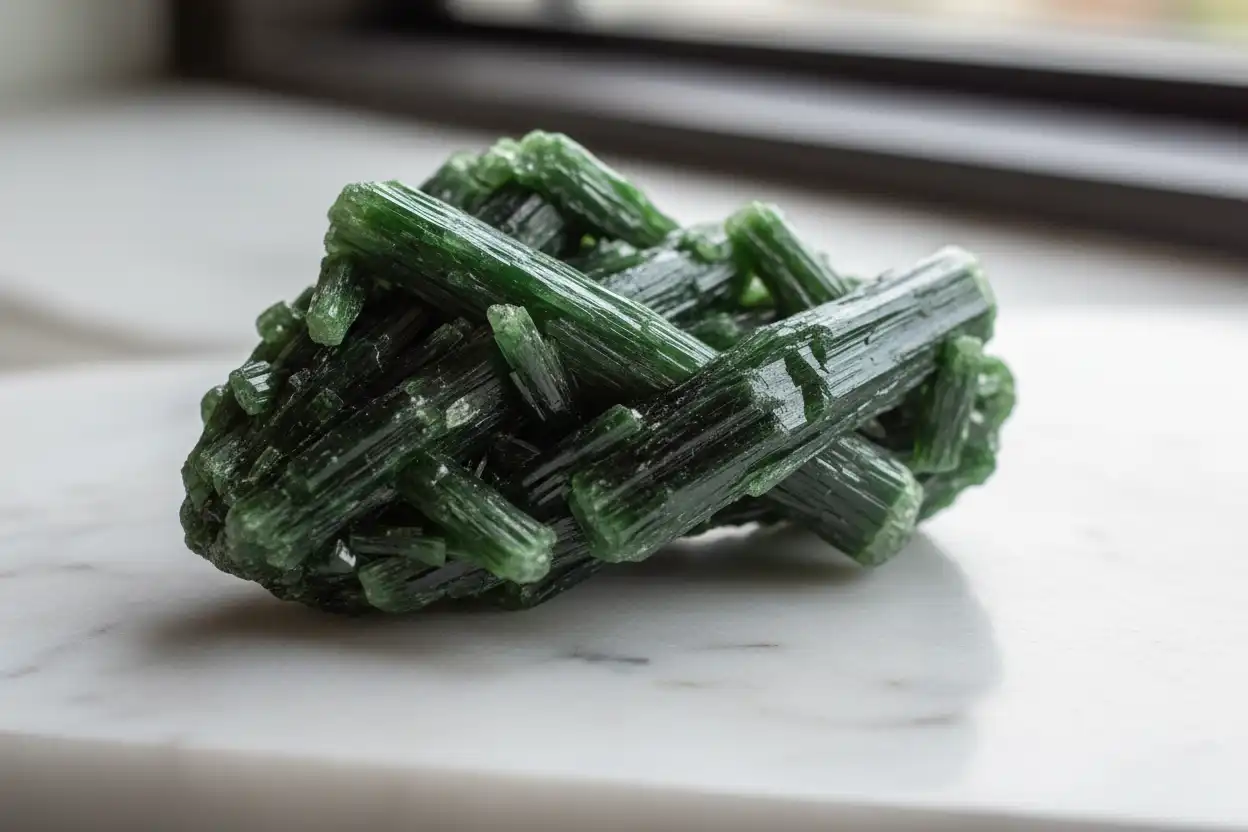
Actinolite meaning begins with a mineralogical distinction that many commercial descriptions overlook: actinolite is not a single-looking green crystal. It is a calcic amphibole capable of forming bladed crystals, radiating sprays, compact masses, parallel-fiber cat’s-eye material and extremely fine fibrous growth. It also contributes to nephrite, one of the two materials properly called jade. These different structures may share related chemistry while behaving very differently as specimens, gemstones and objects intended for handling.
The name is commonly associated with growth, direction, protection and connection with nature because actinolite is frequently green and may develop radiating forms. Those interpretations are cultural or personal symbolism, not measured effects of the mineral. Before considering symbolism, a collector should understand what the label identifies, whether the specimen is crystalline or fibrous, and whether a polished material is actinolite, nephrite or merely a jade-like imitation.
Actinolite belongs among the many naturally occurring green gemstones, but its identity cannot be established from color alone. Numerous green crystals overlap visually, and some commercial labels describe appearance rather than mineral composition.
Actinolite at a Glance
| Property | Actinolite information |
|---|---|
| Mineral class | Silicate |
| Mineral group | Calcic amphibole |
| Simplified formula | Ca₂(Mg,Fe²⁺)₅Si₈O₂₂(OH)₂ |
| Crystal system | Monoclinic |
| Typical color | Bright green, olive green, gray-green or deep green |
| Transparency | Transparent to translucent; aggregates may appear opaque |
| Mohs hardness | Approximately 5–6 |
| Specific gravity | Approximately 3.03–3.24 |
| Cleavage | Good amphibole cleavage intersecting near 56° and 124° |
| Luster | Vitreous on crystals; silky in some fibrous material |
| Common habits | Bladed, columnar, radiating, granular, massive or fibrous |
| Typical uses | Mineral specimens, cabochons, carvings and occasional faceted stones |
| Important relationship | One component of the tremolite–actinolite range and many nephrite aggregates |
| Primary caution | Fine or suspected asbestos-form material should not be disturbed |
These values describe the mineral generally, not a complete identification protocol. Natural amphiboles contain substitutions, inclusions and compositional variation, so properties can overlap with neighboring minerals. A measured result should therefore be interpreted as part of a group of observations rather than treated as conclusive by itself.
What Is Actinolite?
Actinolite is a calcium-magnesium-iron amphibole. Amphiboles are double-chain silicate minerals whose elongated crystal structures commonly produce prismatic, bladed or fibrous habits. The simplified actinolite formula shows magnesium and ferrous iron occupying related structural positions. Natural specimens may also contain smaller substitutions that make their chemistry more complicated than the ideal formula suggests.
Actinolite forms a compositional relationship with magnesium-rich tremolite and iron-richer ferro-actinolite. These names mark compositional regions rather than three completely unrelated substances. Visual examination may suggest where a specimen lies within this range, but color is not a sufficiently precise chemical measurement. Laboratory analysis may be required when the exact amphibole species matters.
The word actinolite comes from a Greek root referring to a ray, an allusion to the mineral’s radiating crystal habit. That origin describes its appearance rather than a supposed energetic emission. Radiating sprays can be attractive collector specimens, but they should not automatically be assumed suitable for unrestricted handling because crystal habit and fiber stability also matter.
The Actinolite Name Map
Commercial descriptions often collapse several related materials into the word “actinolite.” The following map separates mineral identity from structure and trade terminology.
| Name | What it identifies | What the name does not prove |
|---|---|---|
| Actinolite | A calcic amphibole within a defined compositional range | That every specimen is gem quality, nephrite or asbestos |
| Tremolite | The more magnesium-rich neighboring amphibole | That a pale amphibole can be identified visually with certainty |
| Ferro-actinolite | An iron-richer neighboring member | That every dark amphibole belongs to this composition |
| Nephrite | A tough, densely interlocking aggregate primarily composed of tremolite-actinolite amphiboles | That any actinolite crystal or parallel-fiber aggregate is jade |
| Byssolite | A collector term commonly applied to extremely fine, hairlike amphibole growth, often actinolite | That the material is a separate mineral species or safe to disturb |
| Cat’s-eye actinolite | Parallel fibrous material cut to show a moving light band | That the material has nephrite’s interlocking texture and toughness |
| Actinolite asbestos | Actinolite occurring in an asbestos-form fibrous habit | That all nonasbestiform actinolite presents the same exposure condition |
| “Green jade” | A broad commercial description that may refer to several materials | That the object is actinolite, nephrite or jadeite |
This distinction matters because species, texture and trade name answer different questions. “Actinolite” identifies mineral chemistry. “Nephrite” identifies a gem material whose interlocking structure creates exceptional toughness. “Cat’s-eye” describes an optical effect. “Asbestos-form” describes a fiber-producing habit with an inhalation hazard. One label should not be used as a substitute for all the others.
Is Actinolite the Same as Nephrite?
Actinolite and nephrite are related, but they are not interchangeable names. Nephrite is a compact gem material composed predominantly of tightly interlocking tremolite-actinolite amphibole fibers. This felted structure makes nephrite unusually tough even though the individual amphibole minerals are only moderately hard.
A well-formed actinolite crystal does not become nephrite simply because its chemistry falls within the same amphibole range. Parallel fibers are not necessarily nephrite either. The fibers must form the dense, interlocking microstructure responsible for jade’s characteristic toughness. This explains why chemistry alone cannot settle every jade identification.
The broader term jade includes nephrite and jadeite, two mineralogically different materials united by historical use and exceptional toughness. Readers comparing the commercial categories can review the principal types of jade and the structural differences between jadeite and nephrite. Jadeite itself is a pyroxene-rich material rather than an amphibole, as explained in the separate jadeite guide.
How Actinolite Forms
Actinolite commonly develops during metamorphism, when existing rocks are transformed by heat, pressure and chemically active fluids without completely melting. It can form during low-grade regional metamorphism or contact metamorphism involving magnesium-bearing carbonate rocks, mafic rocks and ultramafic rocks. It may occur with minerals such as chlorite, talc, albite, pumpellyite and epidote.
Its presence can provide geologists with information about the conditions under which a rock changed. Actinolite is particularly associated with metamorphic environments in which calcium, magnesium, iron, silica and water-bearing components can participate in mineral reactions. The exact assemblage depends on the starting rock, pressure, temperature and fluid chemistry.
This geological context also explains why actinolite may appear in very different forms. Open spaces can allow recognizable crystals or radiating clusters to grow, while deformation and replacement processes may produce compact or fibrous aggregates. A locality name alone does not determine whether the resulting material is a display crystal, a workable lapidary material or a specimen requiring controlled handling.
Why Is Actinolite Green?
Actinolite’s green color is principally connected with iron in its crystal structure. As ferrous iron substitutes for magnesium, actinolite commonly develops pale, yellowish, olive or deeper green coloration. Greater iron content can contribute to stronger color, but natural color does not increase according to a simple universal scale because composition, crystal thickness, inclusions, alteration and viewing direction also influence appearance.
Transparent crystals may display different green intensities when viewed from different crystallographic directions, an optical behavior called pleochroism. Thick, dark crystals can appear nearly opaque even when thinner edges transmit green light. Fine fibrous material may show a silky surface because closely aligned fibers reflect light collectively.
Color remains an unreliable standalone identification test. Diopside, chrome diopside, epidote, serpentine, jade and some varieties of tourmaline can all produce overlapping green appearances. Mineral structure and measured properties are more informative than a color match from a photograph.
How to Identify Actinolite
Preliminary identification begins with the complete specimen rather than one attractive surface. Observe the crystal habit, matrix, cleavage, luster, transparency and association with other minerals. Prismatic or bladed amphibole crystals may show two prominent cleavage directions intersecting at approximately 56° and 124°. This oblique amphibole cleavage can help separate actinolite from pyroxenes such as diopside, whose principal cleavage directions intersect much closer to a right angle.
Actinolite normally falls around 5–6 on the Mohs scale. That range can support an identification, but an unnecessary scratch test may damage a crystal, contaminate a specimen or release particles from questionable fibrous material. The gemstone hardness chart should be used to understand relative scratch resistance, not as permission to test an important specimen destructively.
Transparent or translucent material can be examined using refractive-index measurements, polarized light and magnification. However, actinolite’s properties overlap with adjacent amphibole compositions, and aggregates may not provide a surface suitable for conventional gemological instruments. Raman spectroscopy, X-ray diffraction or chemical analysis may be needed for a defensible species identification.
Identification becomes more complicated in compact green material. Nephrite can appear waxy and structurally dense, while some serpentine, quartz-rich materials, glass and dyed stones are sold under jade-related names. A responsible examination therefore distinguishes mineral species, aggregate structure and treatment. The site’s real-versus-fake jade guide explains why appearance-based home tests cannot reliably resolve every green carving.
A Practical Lookalike Checklist
| Possible material | Useful distinction from actinolite | Limitation |
|---|---|---|
| Epidote | Often pistachio green with different cleavage and optical behavior | Color and associated minerals can overlap |
| Diopside | Pyroxene cleavage is closer to 90° | Cleavage may be difficult to observe in a polished stone |
| Green tourmaline | Usually lacks actinolite’s amphibole cleavage and can show triangular crystal sections | Broken or polished material may hide diagnostic shape |
| Nephrite | Dense interlocking aggregate with exceptional toughness | Exact composition and texture may require laboratory examination |
| Jadeite | Pyroxene-based aggregate rather than amphibole-based nephrite | Trade labels often use “jade” without specifying the type |
| Serpentine | Commonly softer and may show greasy or waxy surfaces | Some compact specimens are visually convincing jade substitutes |
| Glass | May contain bubbles or flow features and lacks a natural crystal structure | High-quality imitations may require instruments |
| Dyed aggregate | Color may concentrate in fractures or surface-reaching pores | Even color does not prove that treatment is absent |
No single clue in this table is conclusive. The safest conclusion is sometimes “green amphibole requiring further analysis” rather than a species name unsupported by testing.
Cat’s-Eye Actinolite Is Not Automatically Cat’s-Eye Jade
Chatoyancy is the bright line that appears to move across certain cabochons as the stone or light source changes position. In actinolite, the effect can result from aligned parallel fibers or elongated internal structures. A cutter must orient the material correctly so the reflective structures run beneath the curved surface and produce a visible eye.
The term “cat’s-eye jade” can be misleading. Nephrite derives much of its toughness from fibers interlocking in multiple directions, while strongly parallel fibers can produce chatoyancy without forming the same felted structure. Gemological laboratories may therefore identify such material as cat’s-eye actinolite rather than nephrite jade.
This is not merely a vocabulary preference. It affects durability expectations and commercial disclosure. A customer who believes every cat’s-eye amphibole is nephrite may assume a degree of toughness the material does not possess. When buying a chatoyant stone, ask whether the identification is based on appearance, mineral chemistry, microstructure or an independent laboratory report.
Does Actinolite Contain Asbestos?
Actinolite can occur in an asbestiform habit, but the words actinolite and asbestos are not universal synonyms. Asbestiform actinolite develops as long, thin, flexible and separable fibers capable of producing respirable material. Other actinolite occurs as solid prismatic crystals, blades, compact masses or nonasbestiform particles.
The practical mistake is to treat every green crystal as hazardous asbestos or, at the opposite extreme, to assume every attractive fibrous specimen is harmless. Mineral species and growth habit must be considered separately. A photograph or shop label may be insufficient to determine whether a questionable specimen meets mineralogical or regulatory definitions.
The primary concern is inhalation of airborne fibers created or released when asbestos-form material is disturbed. Cutting, grinding, sanding, drilling, breaking, dry brushing and cleaning with compressed air can release dust or fibers. These activities should not be performed on suspected fibrous actinolite without professional identification, suitable controls and compliance with applicable regulations.
An intact polished cabochon and a loose friable fiber specimen are not equivalent exposure situations. Even so, a website cannot certify an individual object as safe from a description or image. Unknown fibrous specimens should remain enclosed, clearly labeled and undisturbed until assessed by a qualified mineral analyst, asbestos professional or relevant local authority. Keep them away from children, pets and frequently occupied surfaces.
Handling an Unknown Actinolite Specimen
If a specimen has hairlike growth, soft-looking fiber bundles, powdery broken areas or an uncertain asbestos-related label, do not test it by rubbing or pulling the fibers. Do not hold it close to the face, blow dust from it, place it in an ultrasonic cleaner or attempt to expose “better crystals” by removing matrix.
Place the specimen carefully in a closed rigid container without creating additional disturbance. Record the seller’s label, locality, photographs and purchase information. These details may help a specialist decide what analysis is appropriate. Do not mail a questionable loose sample to a laboratory until the laboratory has provided packaging and submission instructions.
Collectors should also distinguish health-risk assessment from mineral identification. Confirming that a specimen contains actinolite does not by itself quantify exposure, and a commercial mineral name does not replace an asbestos evaluation. Concerns about possible exposure require advice from an appropriately qualified health or occupational-safety professional.
Actinolite in Jewelry
Transparent facetable actinolite is uncommon, while translucent material is more likely to be fashioned as cabochons. Parallel internal structures may create cat’s-eye effects, and compact actinolite-bearing material can be carved or polished. Each form has different wear behavior.
Individual actinolite crystals are brittle and possess good cleavage. Rings and exposed bracelets therefore create greater impact risk than pendants, brooches or earrings. A protective bezel or low-profile setting can reduce exposed edges, but no setting eliminates cleavage. The difference between scratching and breaking is explained more fully in the guide to gemstone toughness versus hardness.
Nephrite’s toughness should not be transferred automatically to every actinolite gem. A parallel-fiber cat’s-eye stone may be less resistant to impact than a densely interlocking nephrite aggregate. Buyers should evaluate the actual material structure instead of relying on the shared amphibole relationship.
Treatments and Commercial Disclosure
Actinolite is not associated with one universally expected treatment, but individual objects may still be dyed, impregnated, coated, backed, assembled or stabilized. A polished green object may also be sold under an inaccurate mineral or jade name. “Natural actinolite” does not clarify whether a filler, surface modification or assembly is present.
Disclosure matters most when a seller uses jade terminology or assigns a substantial premium to color, chatoyancy or claimed origin. The treated jade guide illustrates why treatment questions should be separate from basic mineral identity. A material may be natural in origin while still having undergone a treatment that affects durability, appearance or value.
Request written answers rather than relying on vague descriptions such as “genuine crystal,” “natural jade stone” or “untreated-looking.” For a valuable purchase, the report should identify the material as specifically as the available testing allows and describe detected treatments or testing limitations.
How to Evaluate Actinolite Before Buying
Begin by asking what physical form is being offered: a prismatic mineral specimen, a compact aggregate, a polished cabochon, a cat’s-eye stone or a fibrous collector specimen. These are not interchangeable products. The seller should provide clear photographs of the front, back, edges and any damaged areas instead of displaying only the most attractive polished surface.
For gemstones, examine color distribution, transparency, fractures, polish, chatoyancy and cutting orientation. A valuable cat’s-eye should show a recognizable light band that moves across the cabochon under a single directional light. A broad eye may still be attractive, but photographs taken under extreme lighting can exaggerate the effect.
For specimens, assess crystal definition, matrix stability, repairs, coatings and the possibility of loose fibers. Ask whether the specimen has been stabilized or repaired and whether the supplied locality is documented. Provenance can add scientific and collecting value, but a locality claim is only as reliable as its supporting record.
For material sold as jade, follow the broader jade buying checklist and insist on clarity about whether the object is nephrite, jadeite or another green stone. Price should follow identity, structure, treatment, workmanship and documentation—not a loosely applied name. The jade price guide provides additional context for why verified identity can materially affect valuation.
What Determines Actinolite Value?
Actinolite does not have a single standardized per-carat market. Fine transparent crystals, aesthetic mineral specimens, cat’s-eye cabochons and compact carving material are evaluated by different criteria. Quoting one universal price range would hide these differences.
Transparent material may be judged by color, clarity, size, cut and rarity. Cat’s-eye cabochons depend heavily on the strength, movement and alignment of the eye, together with body color and structural stability. Mineral specimens are valued according to crystal form, condition, aesthetics, locality, matrix association and documentation. Fibrous specimens also carry handling and shipping considerations that may reduce their suitability for general collectors.
A jade-related trade label can increase the asking price without improving the identification. Buyers should compare the seller’s terminology with the mineral’s actual structure and request evidence when a premium depends on nephrite classification, unusual origin or treatment status.
How to Clean Actinolite
A polished, nonfibrous actinolite cabochon with no known coating or impregnation can usually be wiped with a soft damp cloth. If additional cleaning is necessary, use a small amount of mild soap and lukewarm water, then rinse carefully and dry with a lint-free cloth. Avoid hard brushes, sudden temperature changes, steam and ultrasonic equipment.
Jewelry care must account for the entire object. Adhesives, backing materials, fillers and delicate settings may be less stable than the visible stone. Inspect prongs, bezels and drilled areas without applying pressure to existing fractures.
Do not apply ordinary jewelry-cleaning instructions to a raw fibrous specimen. Such material should not be scrubbed, soaked, blown clean or handled repeatedly. The care process for compact nephrite jewelry is discussed separately in how to clean jade jewelry, but even that advice should not be assumed appropriate for unidentified fibrous actinolite.
Actinolite Meaning and Symbolism
Modern crystal traditions often associate green actinolite with growth, resilience, direction, protection and deliberate action. Its radiating crystals can serve as a visual metaphor for choosing a direction, while green coloration encourages associations with vegetation, renewal and gradual development.
These interpretations do not demonstrate that actinolite emits healing energy, treats disease, changes another person’s behavior or guarantees prosperity. Mineralogy can explain the crystal’s chemistry, structure, color and formation. It does not verify metaphysical effects.
A human-first use of symbolism is to turn the stone into a reflective cue. Someone who connects actinolite with direction might ask, “What is the next specific action within my control?” A person who associates it with growth could document one skill they are developing and one measurable step that supports it. The value comes from the person’s attention and behavior, not from a scientifically established force within the mineral.
Actinolite symbolism should also respect material safety. A meditation practice does not require touching, sleeping beside or carrying a loose fibrous specimen. A photograph, enclosed display specimen or confirmed polished material can hold the same personal symbolism without unnecessary disturbance.
Frequently Asked Questions
Is actinolite a gemstone?
Actinolite is a mineral, and some transparent, translucent or chatoyant material can be cut as a gemstone. Much actinolite is better suited to mineral collections than jewelry because crystal quality, cleavage, fractures and fiber habit vary considerably.
Is actinolite a type of jade?
Actinolite can be an important component of nephrite, but an individual actinolite crystal is not automatically jade. Nephrite requires a dense interlocking amphibole structure that creates unusual toughness. The distinction between the two accepted jade materials is also covered in jade versus jadeite.
Are actinolite and tremolite the same mineral?
They occupy neighboring compositional regions within the calcic amphibole group. Tremolite is more magnesium-rich, while actinolite contains more ferrous iron within the relevant structural position. Exact classification may require chemical analysis.
What causes actinolite’s green color?
Its green coloration is mainly associated with iron substituting for magnesium in the amphibole structure. Crystal thickness, composition, inclusions and viewing direction can change the apparent intensity.
Is all actinolite asbestos?
No. Actinolite can occur in prismatic, bladed, massive, granular, fibrous and asbestiform habits. Actinolite asbestos refers specifically to asbestos-form material. Visual uncertainty should be handled cautiously because mineral identification and fiber classification may require specialist examination.
Can actinolite be touched?
A solid polished object and a friable fibrous specimen present different handling conditions. Do not disturb, rub or test material that appears hairlike, dusty or easily separated. Keep an uncertain specimen enclosed and seek qualified guidance.
What is cat’s-eye actinolite?
It is actinolite material containing aligned structures that reflect a moving band of light when properly cut as a cabochon. Parallel-fiber cat’s-eye material should not automatically be called nephrite because it may lack nephrite’s interlocking texture and toughness.
Can actinolite be worn in a ring?
It can be used in jewelry, but individual actinolite crystals have cleavage and can be brittle. A protected setting and careful wear are advisable. Cat’s-eye material should be evaluated according to its structure rather than assumed to possess nephrite-level toughness.
How can actinolite be identified at home?
A collector can record color, habit, luster, matrix, apparent cleavage and locality, but home observations may only support a preliminary classification. Do not scratch or break fibrous material. Definitive separation from related amphiboles may require spectroscopy, diffraction or chemical analysis.
Does actinolite have healing properties?
There is no reliable scientific evidence that actinolite treats physical or psychological conditions. Healing descriptions belong to metaphysical traditions and should not replace medical care. The mineral can still be used as a personal symbol or reflective object without making health claims.
Final Perspective
The most useful interpretation of actinolite meaning begins by asking what kind of material is actually present. A bladed collector crystal, a nephrite aggregate, a cat’s-eye cabochon and an asbestos-form fiber specimen can be chemically related while differing greatly in structure, durability, use and handling requirements.
Actinolite is valuable as a geological indicator, mineral specimen, occasional gemstone and component of nephrite. Its green color and radiating forms also support symbolism involving growth and purposeful direction. Keeping those symbolic interpretations separate from gemological evidence makes the subject more accurate, safer and more useful.