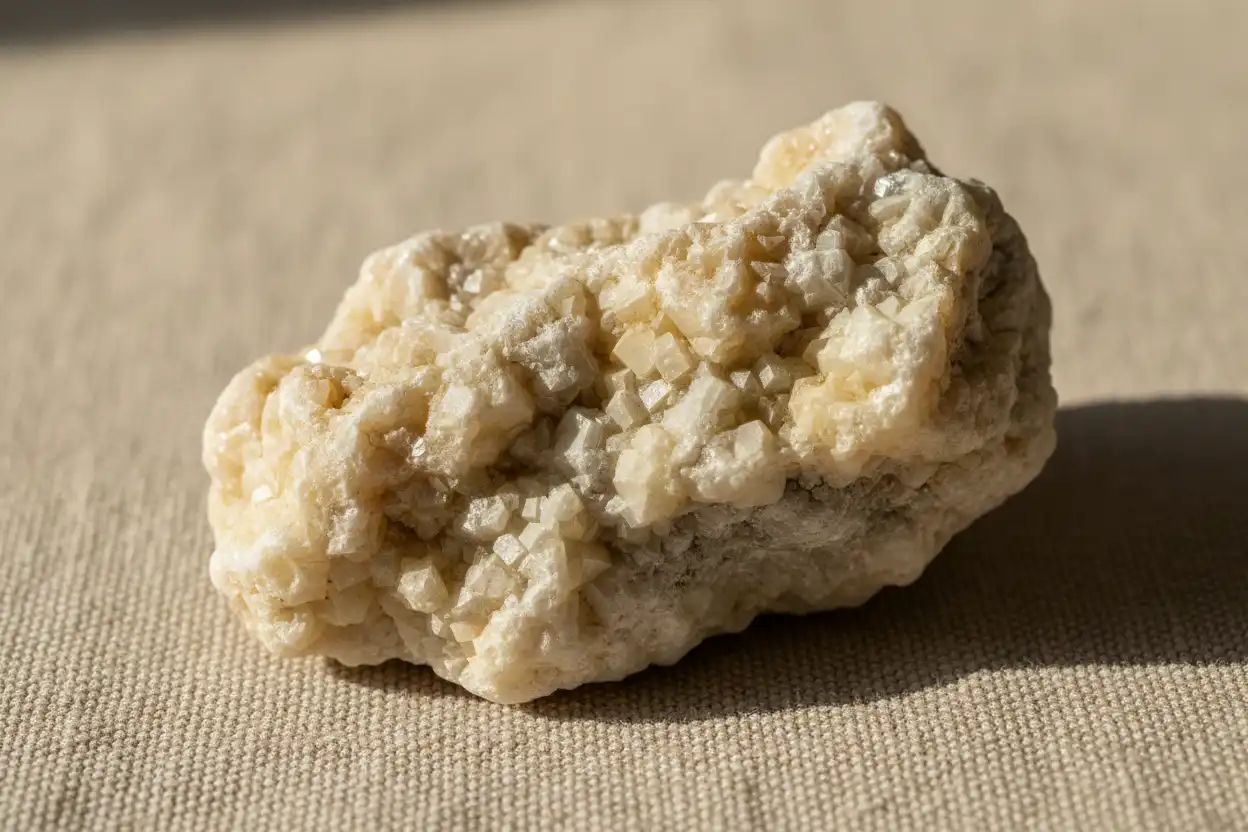
Alunite Meaning: Mineral Identity, History & Symbolism
Alunite is a potassium aluminum sulfate hydroxide mineral with the ideal formula KAl₃(SO₄)₂(OH)₆, best known geologically as a product of acidic sulfate alteration and historically as an important raw material for producing alum. Pure alunite is colorless, although natural specimens are commonly white, gray, yellowish, pinkish, reddish, or reddish brown because impurities, fine-grained textures, inclusions, and associated minerals modify their appearance.
That mineral identity provides the most useful foundation for alunite meaning. Alunite is not primarily a transparent jewelry gemstone, and its geological importance is much greater than its role in lapidary material. It can record interaction among sulfur-bearing fluids, volcanic or altered rocks, groundwater, and weathering processes, making a carefully documented specimen meaningful as geological evidence before any symbolic interpretation is added.
Within the broader Gemstone Guides, alunite is therefore best approached as a collectible mineral and geological indicator. It may also appear in broader alphabetical collections such as crystals that start with A, but the everyday word “crystal” should not obscure its specific sulfate-mineral identity.
Alunite Identity at a Glance
| Property | Alunite |
|---|---|
| Mineral class | Sulfate mineral |
| Mineral group | Alunite group |
| Ideal chemical formula | KAl₃(SO₄)₂(OH)₆ |
| Main structural elements | Potassium, aluminum, sulfate, hydroxyl |
| Crystal symmetry | Trigonal, commonly described using hexagonal crystallographic axes |
| Typical crystal forms | Rhombohedral or pseudocubic-looking crystals; tabular forms also occur |
| Common aggregate forms | Granular, dense massive, fibrous, columnar, porcelaneous |
| Color | Colorless when pure; white, gray, yellow, pinkish, red, reddish brown |
| Streak | White |
| Luster | Vitreous; sometimes pearly on cleavage surfaces |
| Transparency | Transparent to translucent in suitable crystals |
| Mohs hardness | About 3.5–4 |
| Cleavage | Perfect basal cleavage |
| Tenacity | Brittle |
| Specific gravity | Approximately 2.6–2.9 |
| Optical character | Uniaxial positive |
| Approximate refractive indices | ω ≈ 1.572; ε ≈ 1.592 |
| Closely related mineral | Natroalunite |
| Typical geological setting | Acid-sulfate alteration of aluminum- and potassium-bearing rocks |
| Common associates | Quartz, kaolinite, halloysite, pyrite, gypsum and related alteration minerals |
The chemistry distinguishes alunite immediately from many superficially pale collectible minerals. Albite, for example, is a sodium-rich feldspar rather than a sulfate, while afghanite is a complex aluminosilicate associated with the cancrinite-sodalite mineral family. A specimen’s pale color therefore contributes very little to a reliable identification unless its structure and physical properties agree.
The same principle applies to darker specimens. Aegirine is an iron-rich pyroxene, almandine garnet is an iron-aluminum silicate garnet, and actinolite is an amphibole. Alunite belongs to a completely different mineralogical system despite occasional visual overlap among massive or weathered specimens.
How Alunite Forms
Alunite forms when sulfate-bearing acidic fluids react with rocks containing available aluminum and potassium. In volcanic and hydrothermal terrain, those fluids can alter feldspars and other aluminosilicate minerals so extensively that the original rock fabric becomes partly or almost completely replaced by assemblages containing alunite, quartz, kaolinite, pyrophyllite, or related alteration minerals.
This geological environment is commonly called acid-sulfate or advanced argillic alteration. The phrase describes an alteration system rather than one single recipe, and alunite can develop through several distinct processes.
In a magmatic-hydrothermal environment, sulfur dioxide released from magma can participate in reactions that generate strongly acidic fluids. Those fluids attack volcanic rocks, leach mobile components, and permit alunite to crystallize where potassium, aluminum, sulfate, water, temperature, and chemical conditions are suitable.
A shallower steam-heated system can also produce acid-sulfate alteration. Hydrogen sulfide rising above deeper hydrothermal fluids may oxidize near the surface, generating sulfuric acid that reacts with surrounding rocks.
Alunite can additionally form through supergene processes when sulfide minerals exposed to oxygen and water oxidize near the surface. The resulting acidic sulfate solutions can react with aluminum-bearing material and form secondary alunite.
These origins matter because finding alunite does not, by itself, prove one specific hydrothermal history. Mineral assemblages, textures, field relationships, chemistry, stable-isotope measurements, and geological context are required before a particular formation mechanism can be assigned confidently.
That distinction is useful when comparing alunite with minerals such as adamite. Adamite commonly develops in oxidized zinc deposits under a different chemical system, demonstrating why the broad labels “secondary mineral” or “hydrothermal mineral” are not precise enough to explain how an individual specimen formed.
Why Geologists Pay Attention to Alunite
Alunite can be valuable as an alteration indicator because it occurs in strongly acidic geological environments associated with volcanic systems, hydrothermal alteration, weathered sulfide deposits, and some mineralized districts. Remote-sensing studies can even recognize spectral characteristics of alunite-bearing alteration zones over large areas.
Its presence is not an automatic declaration that commercially valuable ore exists.
Instead, alunite is one piece of evidence within a larger alteration assemblage. Quartz, kaolinite, pyrophyllite, pyrite, jarosite, gypsum, and other minerals may help define where the specimen sits within an alteration system and which geological process is most plausible.
This makes provenance particularly useful for alunite specimens. A documented piece from an alteration zone can carry geological information that an unlabeled white or pink mass on a market table cannot preserve.
Alunite and Natroalunite
One of the most important naming boundaries concerns natroalunite.
Ideal alunite contains potassium:
KAl₃(SO₄)₂(OH)₆
Natroalunite is the sodium-dominant analogue:
NaAl₃(SO₄)₂(OH)₆
Potassium and sodium can substitute for one another within this structural family, producing a compositional series rather than an absolute visual boundary. Natural material may therefore contain both components even when one dominates enough for a species name to be assigned.
A photograph cannot resolve that chemistry.
White rhombohedral crystals labeled “alunite” may look essentially indistinguishable from sodium-rich material to an unaided observer. When exact species identification matters, composition and structural data provide much stronger evidence than color, locality stereotypes, or commercial labels.
Alunite, Jarosite, and the Larger Mineral Group
Alunite also belongs to a broader structural family that includes jarosite and numerous related species. The simplified relationship is especially useful because alunite is aluminum-dominant whereas jarosite is iron-dominant.
That substitution produces meaningful differences in chemistry and appearance. Jarosite is commonly yellow, ocher, or brown because ferric iron is integral to its composition, while ideal alunite contains aluminum in the corresponding structural position.
Nature is less tidy than two ideal formulas suggest. Chemical substitutions occur within the alunite supergroup, so professional identification may rely on X-ray diffraction, Raman spectroscopy, elemental analysis, or a combination of methods when fine-grained material cannot be separated confidently by ordinary observation.
The important lesson is that “alunite-group mineral” and “alunite” are not always interchangeable statements. The first can identify a structural family while leaving the exact species unresolved.
What Causes Alunite’s Colors?
Pure alunite is colorless. Many natural specimens appear white because microscopic grains, internal interfaces, fractures, and aggregate texture scatter light rather than because white is an intrinsic pigment within the ideal formula.
Yellow, pink, red, reddish-brown, or gray appearances require greater caution.
Iron is one documented contributor. A USGS spectral-library alunite specimen described as pink was interpreted as receiving that color from a small amount of iron, which also affected its visible reflectance. Iron-rich staining from associated alteration minerals can additionally coat fractures, cavities, or grain boundaries without being structurally incorporated throughout the alunite.
Clay minerals, iron oxides, jarosite-group material, microscopic inclusions, and weathering products can further alter the observed color of a massive specimen.
This means color alone is particularly weak evidence for alunite identity.
A yellow specimen should not automatically be called alunite simply because alunite can be yellow, just as a yellow material is not automatically one of the transparent gems discussed in the yellow gemstones guide. Mineral identification starts with structure and properties rather than a color chart.
Alunite also lacks a defining color-change phenomenon comparable with alexandrite. If an alunite photograph looks dramatically different between images, ordinary lighting, white balance, surface moisture, background color, or editing should be considered before an unusual optical effect is proposed.
Diagnostic Characteristics of Alunite
Alunite identification is easiest when several observations converge.
Its hardness of approximately 3.5–4 makes it distinctly softer than common jewelry gemstones such as quartz or garnet. That softness can help explain scratched or worn surfaces on old specimens, but deliberate scratch testing is a poor identification method because it damages the specimen and still does not uniquely identify alunite.
Perfect basal cleavage and brittle tenacity provide another useful physical combination. Well-developed crystals may break preferentially along that structural direction, while granular material may obscure cleavage entirely.
Optically, alunite is uniaxial positive, with reference refractive indices around 1.572 and 1.592. Those values are relevant to mineralogical examination of suitable transparent grains, although much collected alunite is too fine-grained, cloudy, or massive for routine refractometer testing to be practical.
Specific gravity generally falls around 2.6–2.9. Again, a mixed rock specimen containing quartz, clay, pyrite, or other phases will not necessarily produce a density corresponding neatly to pure alunite.
Crystal morphology can provide another clue. Some alunite crystals develop rhombohedral forms whose angles make them look surprisingly cube-like, producing the traditional description “pseudocubic.” A cube-like appearance should not be mistaken for actual cubic crystal symmetry.
For fine-grained or ambiguous material, powder X-ray diffraction is considerably more authoritative because it addresses crystal structure directly. Raman spectroscopy and compositional analysis can further distinguish alunite from related sulfate minerals.
Original Alunite Evidence Ladder
The following evaluation framework separates observations that are useful at home from claims that require analytical evidence.
| Evidence level | Observation or test | What it can reasonably support | What it cannot prove |
|---|---|---|---|
| 1 — Visual | White, gray, yellow, pink or reddish material | Appearance is compatible with alunite | Mineral species |
| 2 — Context | Specimen comes from documented acid-sulfate alteration | Geological setting is compatible | Exact chemistry |
| 3 — Morphology | Rhombohedral or pseudocubic-looking crystals | Alunite becomes a plausible candidate | Alunite versus related species |
| 4 — Basic properties | White streak, low hardness, brittle behavior, cleavage | Narrows the possibilities | Potassium dominance |
| 5 — Optical data | Uniaxial-positive behavior and compatible refractive indices | Stronger support for alunite | Exact composition of mixed aggregates |
| 6 — Spectroscopy | Raman spectrum agrees with reference alunite | Strong mineralogical identification | Full chemical composition by itself |
| 7 — X-ray diffraction | Diffraction pattern matches alunite structure | High-confidence structural identification | Every trace impurity or provenance claim |
| 8 — Chemical analysis | Potassium-, aluminum- and sulfate-dominant chemistry is demonstrated | Can separate compositional relatives when combined with structural data | Geological origin without context |
| 9 — Provenance + analytical data | Documented locality, mineral assemblage and laboratory results agree | Defensible specimen identification and context | Unsupported stories about metaphysical effects |
This hierarchy prevents a common collecting error: allowing a seller’s mineral name to become the evidence for that same mineral name.
A Practical Alunite Specimen and Photo Checklist
When evaluating an alunite candidate, begin by documenting what actually exists rather than trying to force the specimen into an identification.
Photograph the complete specimen under neutral lighting, including matrix and associated minerals. Add a scale so that crystal size is preserved, then take closer images of cleavage surfaces, cavities, crystal forms, coatings, and color boundaries.
Photograph the specimen dry. A wet surface can deepen color and luster enough to make comparison photographs misleading.
Preserve every old locality label. A modest-looking historical specimen with credible provenance can be much more useful than a visually attractive unlabeled piece because alunite’s geological significance depends strongly on context.
If part of the specimen is pink or reddish, inspect whether the color appears within transparent crystals or primarily as surface staining around cavities and fractures. That observation cannot determine chemistry, but it can help distinguish body color from an obvious coating.
Do not scratch an attractive crystal merely to obtain a Mohs estimate. Use existing broken surfaces or professional tests when identification matters.
A handheld microscope can document associated grains, but visual inclusion matching should not be treated as laboratory confirmation. Fine-grained alunite, natroalunite, clay minerals, and related alteration products can require diffraction or spectroscopy to resolve.
This approach resembles the material-first method used for minerals such as agate: photographs preserve texture and context, while the actual mineral or material identity must come from properties rather than pattern recognition alone.
Names and Claims That Need Qualification
| Name or claim | What it can mean | What should not be assumed |
|---|---|---|
| Alunite | K-dominant aluminum sulfate hydroxide mineral | Every pale acid-alteration specimen is alunite |
| Alumstone | Historical/common name associated with alunite and alum production | The specimen itself is potassium alum |
| Alunite-group mineral | A member of the wider structural group | Exact species is necessarily alunite |
| Natroalunite | Sodium-dominant analogue of alunite | It can always be distinguished visually |
| Pseudocubic alunite | Rhombohedral crystals that visually resemble cubes | Cubic crystal symmetry |
| Pink alunite | Pink appearance may occur, including through iron-related effects | Pink color proves locality or purity |
| “Healing alunite” | Contemporary symbolic or metaphysical description | Demonstrated medical action |
| “Detox stone” | Spiritual or commercial terminology | Removal of toxins from the human body |
| “Rare alunite gemstone” | Could describe unusually attractive lapidary or crystalline material | Gem quality, rarity, or value without supporting criteria |
| “Natural alunite” | Natural geological origin if correctly identified | Untreated status, exact locality, or analytical confirmation |
“Alumstone” deserves particular attention because the historical relationship between alunite and alum can create confusion. Alunite is a mineral with its own chemical structure. Potassium alum is a different, highly hydrated sulfate compound that was historically manufactured from alunite through processing.
The words share an industrial history; they do not describe the same mineral.
The Documented History of Alunite
Alunite has a much stronger documented industrial history than spiritual history.
The Tolfa district near Rome became famous for alunite deposits that supplied material for the production of alum. Historical processing involved heating alunite-bearing rock, treating the altered material with water, concentrating the resulting solution, and crystallizing alum compounds.
Alum was economically important because it had applications in textile dyeing and numerous other crafts and industries. The exploitation of the Tolfa deposits therefore connected mineral geology with regional commerce, skilled labor, chemical processing, and the European textile economy.
The mineral’s naming history also reflects early attempts to classify alum-bearing rocks. An earlier mineral name, aluminilite, was eventually contracted into alunite, the name retained in modern mineralogy.
That record is better documented than claims that alunite possessed one universal ancient spiritual meaning. Historical industrial use should not be converted automatically into evidence that miners, craftspeople, physicians, or traders attributed today’s metaphysical properties to the mineral itself.
Alunite Is a Mineral, Not Alum, Amber, or Shell
Material classification matters because visually pale or polished objects are often grouped together in crystal retail environments even when they have completely different origins.
Alunite is a crystalline inorganic sulfate mineral. Amber is fossilized plant resin and therefore an organic gem material rather than a mineral. Ammolite is an organic gem material derived from ammonite shell, while abalone shell is a biological shell material built primarily from calcium carbonate and organic components.
Those distinctions affect far more than terminology. Formation, hardness, structure, chemical behavior, conservation requirements, scientific significance, and identification methods all change with material type.
A responsible meaning page therefore identifies the object before interpreting it.
Alunite Meaning in Modern Symbolism
Modern alunite meaning is commonly framed around clarity, simplification, balance, grounded reflection, release, or the removal of unnecessary complications. These themes appear in contemporary crystal culture, but they are interpretive associations rather than measurable mineral properties.
A more materially grounded interpretation can begin with alunite’s actual geology.
The mineral often forms where acidic fluids profoundly alter an existing rock. That process can serve as a metaphor for transformation through changed conditions—not because the mineral emits a transformative force, but because its geological history provides a tangible image through which a person can think about change.
Its historical connection with alum production can similarly inspire themes of usefulness, refinement, or making something practical from difficult material. Again, this is metaphor rather than mineral physics.
Someone might keep an alunite specimen near a desk as a reminder to separate evidence from assumptions, simplify a complicated decision, or reconsider conditions that have changed. The reflective practice belongs to the person; the specimen provides the chosen cue.
Readers exploring that distinction across spiritual-use content can use the Healing Crystal section, where symbolic traditions are kept separate from medical evidence.
Does Alunite Have Healing Properties?
There is no established scientific evidence that carrying, wearing, meditating with, sleeping near, or placing alunite on the body treats illness or produces a specific physiological healing effect.
Its potassium, aluminum, sulfate, and hydroxyl chemistry should not be interpreted nutritionally. Elements contained within a mineral crystal structure are not equivalent to dietary supplements, medicines, or biologically available doses.
Claims that alunite “detoxifies” the body are especially problematic because detoxification is performed by biological systems such as the liver, kidneys, lungs, gastrointestinal tract, and skin through defined physiological processes. A mineral specimen has not been shown to replace or enhance those processes through proximity.
Alunite may still be used as a visual focus during meditation, journaling, intention-setting, or reflective practice. Such use can be described accurately as symbolic or personal without converting it into a medical claim.
The broader evidence boundary for symbolic gemstone material is explained in the Gems Lore disclaimer.
Is Alunite Suitable for Jewelry?
Alunite is not an ideal everyday-wear gemstone.
Its Mohs hardness of approximately 3.5–4 makes it significantly softer than common ring stones, so ordinary contact with harder materials can scratch polished surfaces. Perfect basal cleavage and brittle behavior create additional vulnerability to chipping or splitting.
Some attractive crystals and compact material may be collected, polished, or occasionally fashioned for decorative use, but durability should be evaluated before placing alunite in exposed jewelry.
A protected pendant or collector object presents a different risk profile from a ring that repeatedly contacts desks, door handles, tools, countertops, and other hard surfaces.
This durability contrast becomes clearer when alunite is compared with harder silicate gems. Almandine garnet, for instance, has substantially greater scratch resistance and is far more established as a jewelry material.
Safe Ownership and Specimen Care
Alunite specimens should be handled primarily according to their physical condition. Crystalline pieces can be brittle, while massive specimens may contain soft alteration zones, porous areas, loose grains, clays, pyrite, gypsum, or other associated minerals.
Avoid dropping specimens or pressing directly on projecting crystals. A padded specimen box or stable display support is preferable for delicate pieces.
Dry dusting with a soft brush is a conservative first cleaning method. Aggressive scrubbing can damage soft crystal faces, while ultrasonic or steam cleaning provides little benefit for an unidentified mixed-mineral specimen and can create unnecessary mechanical or thermal stress.
Do not use acids as a home identification test. Chemical reactions can damage the specimen, alter associated minerals, and create exposure risks while still failing to provide a complete identification.
Avoid grinding, drilling, sanding, or pulverizing unknown mineral specimens without suitable mineralogical identification and dust controls. The bulk label “alunite” does not guarantee that the matrix contains no other mineral phases.
Mineral specimens should not be ingested or used to prepare drinking-water “elixirs.” A collectible object does not become safer for internal use simply because its principal mineral species is naturally occurring.
What Alunite Meaning Ultimately Represents
Alunite meaning becomes clearer when three forms of evidence remain separate.
Mineralogically, alunite is KAl₃(SO₄)₂(OH)₆, a relatively soft, brittle, uniaxial sulfate mineral belonging to the alunite group. Its structure, hardness, density, cleavage, optical properties, diffraction pattern, and chemistry can be measured.
Geologically, alunite records acidic sulfate alteration. It can form through magmatic-hydrothermal, steam-heated, and supergene processes, so a specimen’s texture, associated minerals, chemistry, isotopes, and locality matter when reconstructing its origin.
Historically and symbolically, alunite carries a well-documented connection with alum production and a much less standardized set of contemporary spiritual associations. Modern themes such as clarity, change, refinement, and balance can be meaningful as metaphors, but they are not mineralogical forces or medical effects.
That evidence boundary is what makes alunite especially interesting. Its pale surface can look visually modest, yet the mineral may preserve a record of aggressive acidic alteration, volcanic chemistry, historic extraction, and substantial changes to the rock in which it formed.
Other material-first references illustrate how differently minerals can arrive at their identities: albite through feldspar chemistry, afghanite through a complex blue aluminosilicate structure, and almandine garnet through iron-rich garnet chemistry. Alunite’s own story belongs to sulfate-rich alteration—and understanding that story is the most defensible foundation for alunite meaning.