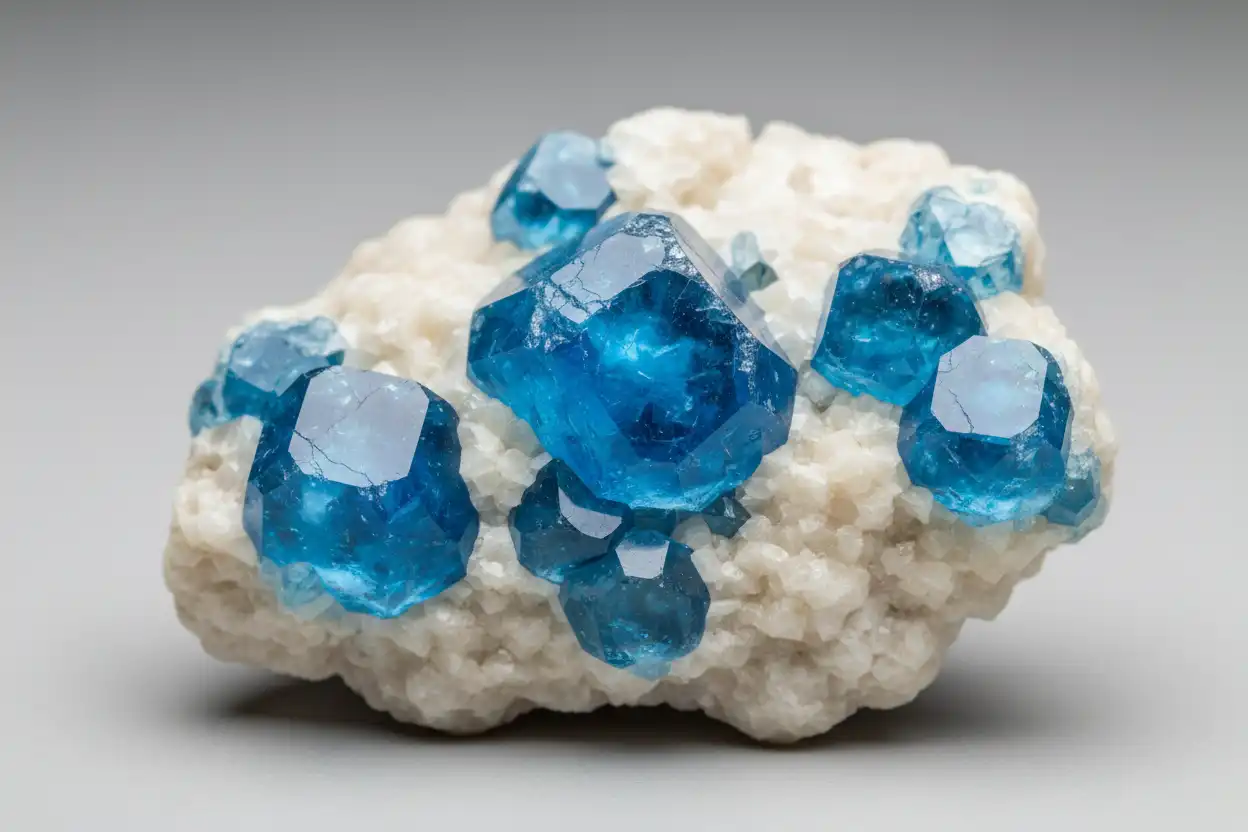
Afghanite Meaning: Identity, Blue Color & Provenance
Afghanite is a rare blue to nearly colorless aluminosilicate mineral best known from lapis-bearing rocks in Badakhshan, Afghanistan. It belongs to the cancrinite mineral group and contains sodium, calcium, potassium, silicon, aluminum, oxygen, sulfate, chloride, carbonate and water in proportions that can vary between specimens. Its saturated blue color invites comparisons with sodalite, haüyne and lazurite, yet afghanite has a different crystal structure and optical behavior. Gem-quality transparent material is scarce, while many specimens occur as grains, laths or small crystals within a pale or blue mineral matrix.
Afghanite meaning is often described through modern themes such as insight, clear thinking and truthful communication. Those associations are symbolic interpretations rather than measurable properties of the mineral. Afghanite’s verifiable identity comes from its chemistry, crystal structure, optical response, geological setting and laboratory testing. Keeping those facts separate from personal symbolism makes the mineral more interesting, not less.
Afghanite mineral identity
| Property | Afghanite |
|---|---|
| Material type | Mineral species |
| Mineral group | Cancrinite group |
| Mineral class | Framework aluminosilicate and feldspathoid |
| General formula | (Na,Ca,K)₈(Si,Al)₁₂O₂₄(SO₄,Cl,CO₃)₃·H₂O |
| Crystal system | Hexagonal |
| Typical color | Deep blue, medium blue, pale blue or nearly colorless |
| Transparency | Transparent to translucent |
| Luster | Vitreous |
| Mohs hardness | 5.5–6 |
| Cleavage | One perfect cleavage direction |
| Fracture | Conchoidal |
| Specific gravity | Commonly around 2.5–2.6 |
| Optical character | Uniaxial positive |
| Common habits | Tabular laths, slender crystals and rounded grains |
| Important occurrence | Lapis-bearing rocks and altered carbonate environments |
| Main jewelry concern | Cleavage, fractures and moderate hardness |
The compact formula commonly printed for afghanite is useful for classification, but it should not be treated as an inflexible recipe. Its framework and structural channels can accommodate varying proportions of sodium, calcium, potassium, sulfate, chloride, carbonate, hydroxyl and water. Laboratory analyses may therefore produce formulas that look different while still identifying the same mineral species. Chemical variation is normal in complex framework minerals and does not automatically indicate treatment or misidentification.
How afghanite forms
Afghanite is closely associated with chemically unusual rocks in which silica-poor, sodium-rich and sulfur-bearing conditions allow feldspathoid minerals to develop. At Sar-e-Sang in Badakhshan, it has been recorded in thin veinlets cutting lazurite crystals. The mineral assemblage can include lazurite-rich lapis lazuli, sodalite, nepheline, calcite, pyrite, diopside and vesuvianite. These companions provide geological context, but none proves that a blue grain is afghanite.
Afghanite has also been documented outside Afghanistan. Some occurrences are connected with silicated limestone fragments enclosed in volcanic material, while others occur in comparable alkaline or carbonate-rich environments. These localities can produce pale or nearly colorless material instead of the deep blue associated with Badakhshan. Color alone therefore cannot establish geographic origin.
A trustworthy locality statement should be supported by a chain of ownership, an original mine or dealer label, recorded acquisition information or analytical comparison with documented material. A seller’s country name is not equivalent to proof of origin, especially when specimens have passed through several mineral markets.
What causes afghanite’s blue color?
Gemological examination of blue afghanite has recorded absorption bands near 370, 590 and 895 nanometers. The absorption near 590 nanometers removes part of the yellow-orange region of visible light, allowing the observed blue to dominate. This is more precise than saying the stone is blue simply because it contains sulfur. Sulfur-bearing structural groups participate in the mineral’s chemistry, but the visible result depends on their form, position and interaction with the surrounding crystal structure.
Color varies with composition, concentration of color-producing centers, crystal thickness, transparency, inclusions and lighting. A thin pale crystal can look almost colorless under strong transmitted light, while a thicker crystal may appear noticeably darker. Matrix material can also influence the apparent color around a grain. Photographs should therefore include neutral lighting, a scale and more than one viewing angle when color is important to identification or value.
Afghanite may display blue pleochroism, meaning that its color changes in intensity when viewed along different crystallographic directions. Published gemological observations of transparent stones describe moderate blue to intense blue pleochroism. This directional color behavior provides useful evidence because cubic blue minerals such as sodalite and haüyne are optically isotropic and should not show true pleochroism.
Afghanite is not the same as lapis lazuli
Afghanite is a mineral species. Lapis lazuli is a rock made from several minerals. Fine lapis is generally dominated by lazurite, with varying amounts of calcite, pyrite and other components. Afghanite can occur inside this aggregate and may contribute paler blue areas, but its presence does not turn the whole rock into afghanite.
This distinction matters when a seller describes a blue cabochon as “afghanite lapis” or uses the terms interchangeably. A mixed, opaque material containing white calcite and metallic pyrite may be lapis lazuli even if afghanite occurs among its minor components. A transparent faceted stone represented as afghanite requires a mineral-species identification rather than a rock name. The practical differences between the two common blue materials are explained further in the lapis lazuli and sodalite comparison.
An evidence ladder for identifying blue afghanite
Color is the weakest starting point because afghanite, haüyne, sodalite, lazurite and blue glass can overlap visually. Identification becomes stronger as independent observations agree.
| Evidence level | Observation | What it can establish | Limitation |
|---|---|---|---|
| Visual | Blue color, vitreous luster and transparent or translucent body | Narrows the field of possibilities | Many unrelated materials look similar |
| Geological | Association with calcite, lazurite, diopside or other documented companions | Supports a plausible occurrence | Matrix can be assembled or mislabeled |
| Crystal form | Hexagonal habit or tabular laths | Consistent with afghanite | Broken grains may show no useful form |
| Polarized light | Double refraction or anisotropic behavior | Separates afghanite from many cubic lookalikes | Aggregate material and strained glass can confuse observations |
| Refractometer | Readings broadly around the low 1.52 to mid-1.53 range | Provides strong gemological evidence | Requires a polished surface and proper technique |
| Hydrostatic test | Specific gravity broadly near 2.5–2.6 | Helps test consistency | Inclusions, cavities and attached matrix alter results |
| Spectroscopy | Characteristic absorption behavior | Tests the color-producing system | Similar minerals can have overlapping bands |
| Raman or X-ray analysis | Structural match to a reference specimen | Can establish mineral identity | Requires suitable equipment and interpretation |
Published tests on a small group of transparent Afghan material recorded refractive indices of 1.530–1.538 and birefringence of 0.008. Older mineral data list slightly lower readings. This is not necessarily a contradiction; composition, sample condition and measurement method can shift reported values. An identification should consider a compatible range and several properties rather than rejecting a specimen because one reading differs by a few thousandths.
Afghanite, haüyne and sodalite
Afghanite can be confused with haüyne because both can be strongly blue, occur in related geological environments and contain similar major elements. The most useful distinction is structural and optical. Afghanite is hexagonal and anisotropic, while haüyne is cubic and singly refractive. Gemological testing of blue Afghan examples has also shown different refractive indices, specific gravity and ultraviolet reactions between the two minerals.
Fluorescence can support an identification but should never make it alone. Examined afghanites have been inert under long-wave ultraviolet radiation and inert to weak red under short-wave radiation, while tested haüyne showed a stronger orange reaction under long-wave ultraviolet. Other specimens may react differently because fluorescence depends on impurities, defects and treatments. A fluorescent fracture can even indicate residue or filling rather than the response of the host mineral.
Sodalite belongs to another closely related framework-mineral group and overlaps afghanite in color and hardness. Hackmanite is a color-changing variety of sodalite rather than a form of afghanite. Buyers comparing these materials should use the real and imitation sodalite tests and check whether a seller discloses dye, coating or other sodalite treatments. None of those home observations replaces Raman spectroscopy or X-ray diffraction when the exact species affects the price.
Afghanite and blue glass
Transparent blue glass can imitate almost any uncommon blue gem when a buyer relies on photographs. Rounded gas bubbles, curved flow lines, mold marks and unusually uniform color can support a glass identification, but modern glass may lack obvious bubbles. Glass is generally singly refractive, whereas afghanite is doubly refractive, although strain in glass can create anomalous reactions under crossed polarizers.
A scratch test is a poor solution. It can damage the specimen, and glass compositions cover a broad range of hardness. Refractive-index testing, magnification, specific gravity and spectroscopy provide more useful evidence without deliberately marking the surface. Similar restraint is important when assessing lapis-based objects because the real versus imitation lapis guide explains how dyed stone, reconstructed material, glass and plastic can imitate different aspects of natural lapis.
What inclusions reveal
Transparent afghanite may contain fractures, two-phase inclusions, unidentified prisms or crystals of associated minerals. Diopside inclusions have been confirmed in examined faceted material. Parallel internal breaks can correspond with afghanite’s perfect cleavage, although cleavage alone is not species-specific. A natural inclusion scene can support geological origin, but it should not be interpreted from one photograph without considering the entire stone.
Surface-reaching fractures deserve particular attention because resin may be introduced to stabilize a vulnerable stone or improve apparent transparency. Filled fractures can show flashes, altered luster, trapped bubbles or residue, but subtle filling can be difficult to confirm without magnification and controlled lighting. Treatment disclosure matters because a filler can affect durability, cleaning choices and value.
A provenance and specimen-record checklist
A useful specimen record preserves evidence that is often lost when a stone is resold. Record the seller’s exact description rather than rewriting it as certainty. Photograph the front, back, sides, matrix and label under neutral illumination. Include a scale, weight and dimensions. Note whether the material is rough, crystalline, cabochon-cut, faceted or part of a mixed rock. Keep invoices and previous labels even when their information conflicts.
The strongest record distinguishes five different statements: what the seller claimed, what can be observed, what instruments measured, what a laboratory identified and what remains unknown. “Purchased as Afghan material” is a transaction record. “Afghanite from Badakhshan” is an origin claim. “Identified as afghanite by Raman spectroscopy” is a species conclusion. These statements should not be collapsed into one sentence unless evidence supports all of them.
This method also prevents disputed names from becoming permanent facts through repetition. Market descriptions can survive for decades after their original basis has disappeared. A clear record allows a later owner, appraiser or laboratory to reassess the specimen without inheriting unsupported certainty.
Afghanite hardness and durability
Afghanite has a Mohs hardness of approximately 5.5–6. It can resist some light surface wear, but hardness measures resistance to scratching rather than resistance to breaking. The mineral has one perfect cleavage direction and may already contain fractures, making a sharp impact more serious than its hardness number suggests. The gemstone hardness chart provides scratch-resistance context, while the distinction between gemstone toughness and hardness explains why two stones with similar Mohs values can survive wear differently.
Faceted afghanite is better suited to pendants, earrings or protected collector jewelry than exposed rings and bracelets. A bezel or another protective setting can reduce edge impact, but it cannot remove cleavage. Large open-backed settings may display the color effectively while leaving the pavilion vulnerable. Jewelry should be removed before exercise, cleaning work or any activity involving impact, chemicals or abrupt temperature changes.
Cleaning and storage
Clean afghanite with a soft lint-free cloth. If more cleaning is needed and no filling has been disclosed, use a small amount of lukewarm water with mild soap, then wipe and dry the stone carefully. Avoid steam, ultrasonic equipment, acids, bleach, strong solvents and sudden temperature changes. A fracture-filled stone may require stricter care because heat or chemicals can alter the filler.
Mineral specimens on matrix should not automatically be immersed. Afghanite may be surrounded by calcite or other materials that respond differently to water and chemicals. A soft dry brush and controlled air blower are safer starting points for loose surface dust. Store faceted material separately from harder stones so sapphire, spinel, topaz or quartz cannot scratch it, and prevent the stone from striking metal edges or other gems.
Afghanite value factors
Afghanite does not have a simple standard price because transparent facetable material is scarce and the market is dominated by collectors rather than standardized jewelry grades. Color saturation, transparency, size, cutting quality, crystal completeness, matrix aesthetics, locality evidence and confirmed identity can all influence value. A tiny transparent crystal with reliable provenance may be more desirable than a larger opaque blue fragment with an uncertain label.
Treatments can change the comparison. Resin-filled fractures may improve stability or appearance, but the filler should be disclosed. A laboratory report can be especially useful for valuable transparent stones because haüyne, sodalite and glass can enter the same visual range. Rarity alone does not guarantee high value; demand, beauty, condition and confidence in the description also matter.
Afghanite meaning and symbolism
Modern afghanite meaning commonly centers on clarity, perspective, communication and truth. Its blue color encourages comparisons with other stones given similar symbolic roles, but the symbolism is not produced by refractive index, sulfate groups or crystal symmetry. It is a human interpretation attached to the mineral’s appearance, rarity and name.
There is not enough evidence to present modern crystal-healing claims as ancient Afghan tradition. Afghanite was named for the country connected with its best-known occurrence, but that scientific name does not prove a continuous historical spiritual practice involving the mineral species. Lapis lazuli has a long cultural history; afghanite as a separately identified mineral should not automatically inherit every belief associated with lapis.
Someone may use the stone as a personal reminder to verify claims, communicate precisely or preserve reliable records. That use is symbolic and behavioral. Afghanite has not been scientifically shown to treat illness, change brain function, remove harmful energy or produce guaranteed emotional outcomes. Medical or psychological concerns require appropriate evidence-based care.
Frequently asked questions
Is afghanite a gemstone?
Afghanite is a mineral species that can be used as a gemstone when sufficiently transparent and suitable for cutting. Most material is better known as a collector mineral or as a component of lapis-bearing rock.
Is afghanite the same as lapis lazuli?
No. Afghanite is one mineral, while lapis lazuli is a rock composed mainly of lazurite with calcite, pyrite and other minerals. Afghanite can occur as a component of lapis.
Is all afghanite blue?
No. Afghanite ranges from deep blue to pale blue and nearly colorless. Some non-Afghan occurrences are known for pale or colorless material.
How can afghanite be distinguished from haüyne?
Afghanite is anisotropic and can show double refraction and pleochroism. Haüyne is cubic and singly refractive. Refractive index, specific gravity, fluorescence and Raman testing can provide further separation.
Does afghanite fluoresce?
Some tested blue afghanite has been inert under long-wave ultraviolet and inert to weak red under short-wave ultraviolet. Reactions can vary, so fluorescence is supporting evidence rather than a final identification.
Can afghanite be worn in a ring?
It can be set in a ring, but its moderate hardness, perfect cleavage and common fractures make exposed ring wear risky. Pendants and earrings are generally safer choices.
Can afghanite be placed in an ultrasonic cleaner?
Ultrasonic cleaning is not recommended. Cleavage, fractures and possible resin filling create unnecessary risk.
Is afghanite commonly treated?
Treatment is not assumed for every specimen, but fracture filling has been documented in faceted material. Buyers should request written disclosure of any resin, coating or other enhancement.
How do I verify an afghanite specimen?
Begin with crystal form, matrix, pleochroism, refractive index and specific gravity. Valuable or ambiguous material should be confirmed through Raman spectroscopy, X-ray diffraction or another appropriate laboratory method.
What does afghanite symbolize?
Modern symbolism connects afghanite with clarity, truthful communication and perspective. These are personal or cultural associations, not scientifically demonstrated effects of the mineral.