Aegirine Meaning: Dark Pyroxene, Geology & Symbolism
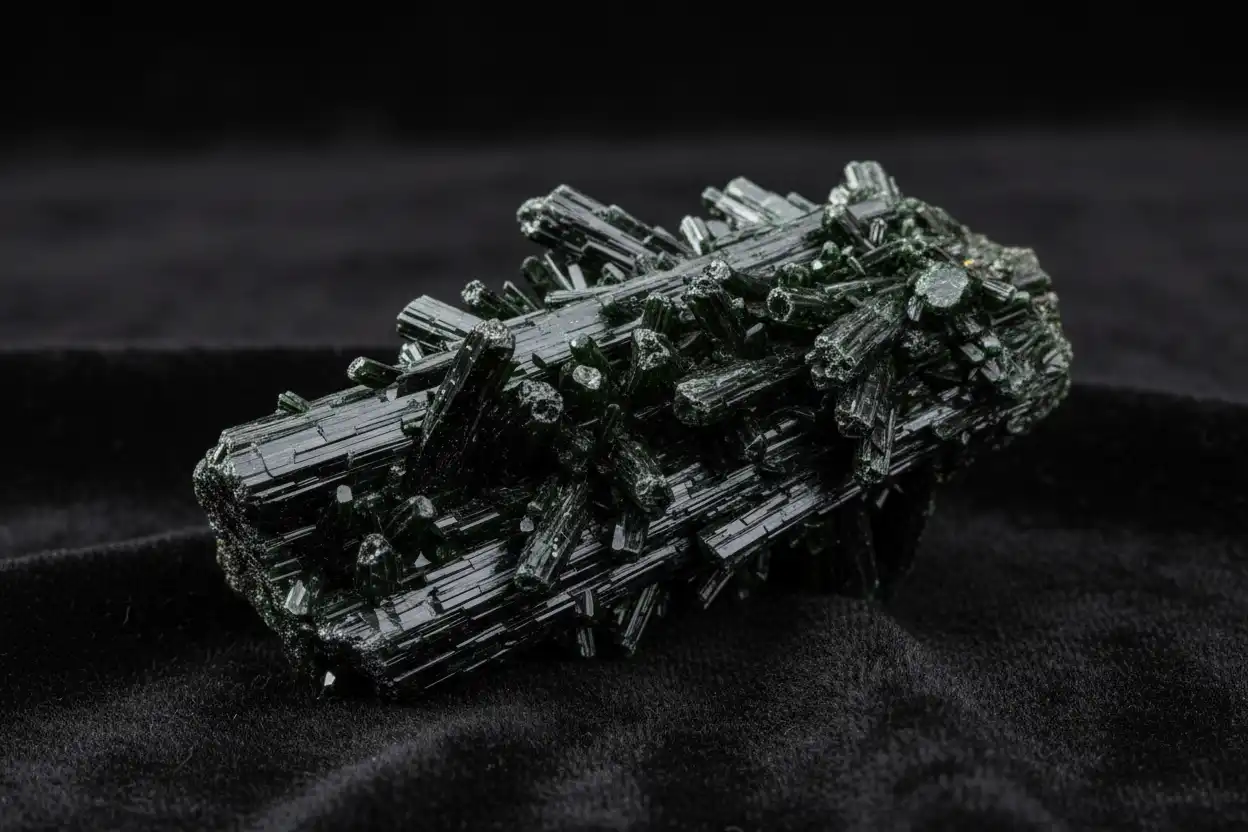
Aegirine is a sodium-iron clinopyroxene whose crystals usually appear black, greenish black or extremely dark green until strong light passes through a thin edge. Its elongated prisms, sharp terminations and glossy surfaces make it popular with mineral collectors, although the same appearance causes frequent confusion with dark amphiboles and iron-rich tourmaline.
The mineral’s identity is more specific than the broad commercial label “black crystal.” Aegirine contains sodium and ferric iron in a single-chain silicate structure, forms mainly in alkaline geological environments and shows the near-right-angle cleavage expected from a clinopyroxene. These traits separate it from many dark black crystals that resemble it in photographs.
Modern symbolism connects aegirine with integrity, boundaries, deliberate decisions and looking beyond an immediate impression. The physical reason for that last association is easy to see: a crystal that appears opaque black from one position may reveal green, yellow-green or brown-green through a thinner section. The color change is measurable optical behavior, while its personal meaning remains interpretive.
Aegirine Identity Card
| Property | Aegirine |
|---|---|
| Mineral group | Pyroxene |
| Subgroup | Clinopyroxene |
| Ideal formula | NaFe³⁺Si₂O₆ |
| Crystal system | Monoclinic |
| Common colors | Dark green, greenish black, reddish brown and black |
| Thin-section colors | Bright green, yellow-green, brown-green or yellowish brown |
| Transparency | Commonly translucent at thin edges to opaque in thick crystals |
| Luster | Vitreous to slightly resinous |
| Mohs hardness | Approximately 6 |
| Specific gravity | Approximately 3.50–3.60 |
| Cleavage | Good pyroxene cleavage intersecting near 87° and 93° |
| Fracture | Uneven |
| Tenacity | Brittle |
| Streak | Pale yellowish gray |
| Common habits | Prismatic, acicular, fibrous, radiating and spray-like |
| Typical setting | Alkaline igneous rocks, carbonatites, pegmatites and some metamorphic rocks |
| Primary use | Mineral specimens, rare collector gems and geological study |
The ideal formula represents the sodium and ferric-iron end member. Natural crystals can contain calcium, magnesium, ferrous iron, aluminum, titanium and other substitutions, so laboratory measurements may not match the ideal composition exactly.
Why Aegirine Is a Pyroxene
Pyroxenes are single-chain silicates built from linked silica tetrahedra. Their structure commonly produces two cleavage directions intersecting close to a right angle, which is one of the most useful ways to distinguish pyroxenes from visually similar amphiboles.
Aegirine is a sodium-rich pyroxene in which ferric iron occupies a major structural position. This differs from diopside, which is dominated by calcium and magnesium, and enstatite, which belongs to the magnesium-rich orthopyroxenes. Jadeite is another sodium-bearing pyroxene, but aluminum occupies the position held primarily by ferric iron in ideal aegirine.
These chemical differences affect color, geological occurrence, density and optical behavior. Membership in the same mineral family does not make the species interchangeable.
Why Aegirine Looks Black
Ferric iron strongly influences aegirine’s color and light absorption. A thick crystal can absorb enough visible light to appear opaque black, whereas a thin edge may transmit emerald green, grass green, yellow-green or brown-green. Strong directional absorption also produces pleochroism, meaning the observed color or intensity changes with crystal orientation.
This explains why online photographs can give contradictory impressions. One seller may describe a specimen as black because it was photographed against a light background, while another calls similar material green after illuminating thin crystal edges. Both descriptions can refer to the same underlying mineral.
Aegirine belongs naturally in comparisons of green crystals because its transmitted color is often green. However, most thick crystals do not resemble transparent commercial green gemstones when viewed under ordinary reflected light.
Surface condition also changes the appearance. Fresh crystal faces can be highly vitreous, while weathering, mineral coatings and microscopic damage create a duller or slightly resinous finish. An unusually bright surface is not proof of polishing, and a dull surface is not proof of imitation.
Crystal Shape and Terminations
Aegirine commonly forms elongated monoclinic prisms with lengthwise striations. Terminations range from blunt to steeply pointed, and some crystals become narrow enough to resemble needles. Groups may develop as diverging sprays, radial clusters or dense mats of acicular crystals.
Long crystals can be bent or twisted during growth or later geological deformation. A curve therefore does not automatically mean the specimen is artificial or repaired. The surface should be examined for continuous striations and uninterrupted crystal faces before deciding whether a change in direction is natural.
Sharp terminations increase visual appeal but are easily chipped. A crystal with one dominant point may photograph dramatically from the front while hiding contacts or broken secondary crystals behind it. Condition must be judged from multiple angles.
Geological Settings
Aegirine is strongly associated with sodium-rich alkaline environments. It occurs in alkaline igneous rocks, nepheline syenites, carbonatites and related pegmatites, where unusual concentrations of sodium, iron, zirconium and other elements allow distinctive mineral assemblages to develop.
The matrix may contain pale feldspar, white albite or grayish nepheline. These light minerals provide a strong visual contrast with dark aegirine prisms.
Alkaline complexes can also contain blue sodalite, red or pink eudialyte and bronze-bladed astrophyllite. A mixed specimen may therefore combine several intense colors that would be unusual in a more ordinary granite.
Aegirine is not limited to igneous rocks. It also occurs in some metamorphosed schists, gneisses, iron formations and blueschist-facies rocks, as well as rocks altered by sodium-rich fluids. The geological setting must be inferred from the complete mineral association rather than the aegirine crystal alone.
Aegirine and Arfvedsonite
Aegirine and arfvedsonite often occur together in alkaline rocks and may both form elongated crystals that appear almost black. Their visual similarity creates one of the most important identification problems for collectors.
Aegirine is a pyroxene, whereas arfvedsonite is a sodium amphibole. The most useful structural distinction is cleavage geometry. Aegirine’s principal cleavage directions intersect close to 90°, while amphibole cleavage intersects near 56° and 124°.
| Observation | Aegirine | Arfvedsonite |
|---|---|---|
| Mineral family | Clinopyroxene | Sodium amphibole |
| Ideal structural type | Single-chain silicate | Double-chain silicate |
| Cleavage relationship | Near 87° and 93° | Near 56° and 124° |
| Typical transmitted colors | Green, yellow-green or brown-green | Blue-green, blue-gray, green or violet-gray |
| Mohs hardness | Around 6 | Commonly around 5–6 |
| Crystal appearance | Sharp prisms, acicular sprays and pointed forms | Long prisms, blades and radiating groups |
| Common setting | Alkaline rocks and related pegmatites | Alkaline granites, syenites and pegmatites |
Cleavage is useful only when a suitable natural or broken surface is already visible. A valuable specimen should never be damaged merely to expose cleavage.
Because both minerals may occur on the same matrix, a specimen can contain aegirine and arfvedsonite together. Identifying one dark crystal does not establish the identity of every dark crystal on the piece.
Aegirine and Black Tourmaline
Iron-rich black tourmaline is another frequent lookalike. Most material sold under that name is schorl, a complex borosilicate rather than a pyroxene.
Tourmaline commonly develops a rounded triangular cross-section and heavy lengthwise striations. Aegirine prisms belong to the monoclinic system and do not show the characteristic triangular tourmaline cross-section. Tourmaline also lacks the prominent near-right-angle cleavage associated with pyroxenes.
The broader tourmaline mineral group is generally harder than aegirine, but scratch testing remains a poor approach for collectible specimens. Surface alteration, inclusions and testing pressure can produce misleading results or permanent damage.
A polished black piece loses most crystal-shape evidence. Refractive measurements, specific gravity, microscopy, Raman spectroscopy or X-ray diffraction may then be required. Color alone cannot separate these minerals within a broad list of black gemstones.
Aegirine and Other Green Pyroxenes
Aegirine can appear green enough at thin edges to resemble diopside or other green clinopyroxenes. Their shared cleavage geometry reflects their related structures, so mineral family identification does not always establish the exact species.
Chrome diopside is typically brighter and more transparently green in gem material, with chromium contributing to its color. Aegirine usually appears darker because of its ferric-iron-rich composition and strong absorption.
Jadeite can also contain dark or green areas, and compositions may extend toward aegirine-rich material. Dense jadeite aggregates differ greatly from free-standing aegirine prisms, but exact classification of a chemically intermediate pyroxene may require microprobe analysis.
The specimen’s locality and matrix help narrow the possibilities. A dark green prism in a sodium-rich alkaline pegmatite has different geological support from a transparent green crystal in a calcium-rich metamorphic environment.
Aegirine, Aegirine-Augite and Acmite
Aegirine represents a sodium–ferric-iron pyroxene end member. Natural crystals may move compositionally toward calcium-, magnesium- and ferrous-iron-bearing pyroxenes, producing material described as aegirine-augite.
Aegirine-augite is not a physical mixture of separate aegirine and augite crystals. It describes intermediate clinopyroxene chemistry within one crystal or compositionally zoned material. Dark color does not reveal where a specimen lies within that range.
Acmite is an older name commonly encountered on historic labels and in mineral collections. Modern mineralogical usage generally prefers aegirine, while acmite may survive as a synonym or historical variety term associated with pointed or brownish crystals.
Do not discard an old acmite label. Preserve it with the specimen and add a modern identification note, because the historic name can contribute to provenance even when nomenclature has changed.
The Dark-Prism Identification Matrix
| Evidence | What it can establish | What it cannot establish |
|---|---|---|
| Green transmitted edge | Supports a dark green rather than purely black body color | Does not prove aegirine |
| Near-right-angle cleavage | Supports a pyroxene structure | Does not separate every clinopyroxene |
| Triangular cross-section | Supports tourmaline rather than aegirine | May be hidden by damage or matrix |
| Oblique cleavage near 56°/124° | Supports amphibole | Requires a visible cleavage surface |
| Pale yellowish-gray streak | Consistent with aegirine | Streak testing can damage specimens |
| Pale feldspar or nepheline matrix | Supports an alkaline-rock association | Does not prove the dark crystal’s identity |
| Strong green-to-brown pleochroism | Supports aegirine’s optical behavior | May be difficult to observe in opaque material |
| Raman or diffraction match | Can provide strong mineral confirmation | Does not prove the claimed locality |
| Original mine label | Supports provenance | Does not guarantee correct identification |
The most reliable conclusion combines independent observations. The broader process for organizing visual, physical and instrumental evidence appears in how to identify crystals.
A Five-Frame Evidence Record
Dark crystals are difficult to document because a single exposure often loses either surface detail or transmitted color. Photographing five specific views produces a more useful record.
| Frame | Photograph |
|---|---|
| Full specimen | Entire crystal group, matrix and scale under neutral light |
| Termination | Close view of the principal crystal points and contacts |
| Cross-section | Accessible crystal end showing overall prism geometry |
| Thin edge | Strong backlight passing through the narrowest stable edge |
| Reverse | Matrix, trimming marks, mounting material and hidden repairs |
Record the specimen’s dimensions, weight, locality claim, previous labels, matrix minerals, visible cleavage, repairs and analytical results beside the images. Keep observations separate from conclusions. “Green light passes through the upper edge” is an observation; “confirmed aegirine from a named mine” requires additional evidence.
Avoid pushing a flashlight against a delicate termination. Place the light behind the specimen with enough distance to prevent heat buildup and accidental impact.
Optical Properties
Transparent or sufficiently thin aegirine is strongly pleochroic. Depending on direction, it can display deep emerald green, grass green, yellow-green, brownish green or yellowish brown. Thick crystals may remain too dark for this effect to be visible without intense transmitted light.
Its refractive indices are high compared with many familiar silicate gems, and dispersion can be moderate to strong. These properties can give thin crystal edges and rare faceted stones noticeable brightness, although strong absorption often prevents the brilliance expected from a conventional transparent gemstone.
Standard refractometer readings may be difficult to obtain from rough crystals because the necessary flat polished surface is absent. A partial or out-of-range reading should not be forced into a species identification.
Recognized Localities
Norwegian localities are historically important because aegirine was described from Norwegian material and named for Ægir, a figure associated with the sea in Norse mythology. The name reflects its geographic and linguistic history, not a scientific relationship with seawater.
Mont Saint-Hilaire in Quebec is known for diverse alkaline-complex minerals, including well-formed aegirine crystals. The Kola Peninsula contains aegirine in several unusual alkaline assemblages, while Greenland has produced classic material with feldspar and other sodium-rich minerals.
Mount Malosa in Malawi is associated with large, sharply formed dark crystals on pale matrix. Other occurrences include alkaline and carbonatite complexes in Brazil, Tanzania and parts of the United States.
A famous locality should be supported by a mine or district label, collection record or reputable dealer history. Crystal appearance may be characteristic, but it cannot prove origin by itself.
Aegirine as an Inclusion
Aegirine does not occur only as large external crystals. It can form microscopic individual prisms and radial sprays enclosed within other minerals.
Gemological research has identified bright yellowish-green aegirine inclusions in poudretteite using Raman analysis. In such circumstances, the inclusion can provide evidence about the geological environment and may help support an origin interpretation when combined with other features.
An inclusion should not be identified from color alone. The host gem’s identity, inclusion morphology, spectroscopy and known deposit geology must agree.
Can Aegirine Be Faceted?
Transparent faceting rough exists but is uncommon. Most crystals are too dark, fractured, strongly included or structurally important as specimens to justify cutting. Even a thin finished stone may retain pronounced directional darkness.
Aegirine measures approximately 6 on the Mohs gemstone hardness chart. It resists some scratches but remains softer than quartz, topaz, sapphire and many established jewelry gems.
Hardness does not prevent breakage. Aegirine is brittle and has good cleavage, so a sharp impact or poorly placed setting pressure can split a stone. The practical difference is covered in gemstone toughness versus hardness.
Faceted examples are best treated as collector gems. Pendants, enclosed displays and protected mounts are more appropriate than exposed rings or bracelets.
Specimen Quality and Value
Aegirine does not have one standardized price per carat because most material trades as mineral specimens. Crystal size matters, but form, condition, matrix and provenance frequently matter more.
Fine specimens show strong luster, recognizable faces, complete terminations and an arrangement that can be viewed without unstable support. Pale matrix improves contrast, while associated minerals may add interest when all components are correctly identified.
Contact points are not always damage. A crystal that grew against another mineral may have a naturally incomplete face, whereas a fresh break usually shows irregular texture and missing termination material. Sellers should distinguish growth contacts, extraction damage and repairs.
Glued crystals, restored terminations and artificial bases require disclosure. Repair does not automatically eliminate collector value, but an undisclosed reconstruction should not be priced as an intact natural group.
Aegirine Handling and Storage
Aegirine is not generally treated as a highly hazardous collector mineral, but ordinary mineral hygiene still applies. Do not ingest it, lick it, place it in drinking water or allow children to handle sharp crystals without supervision.
Cutting, drilling and grinding create fine mineral dust and should not be attempted without appropriate lapidary controls. The composition of associated matrix minerals may also be uncertain, making dust avoidance more sensible than assuming every component is harmless.
Long crystals need support beneath the matrix rather than pressure against their points. Store the specimen in a rigid box with enough clearance around the terminations, following the broader principles for safe crystal storage.
Dust should be removed only when necessary. Use a clean hand-operated air bulb at a distance or seek conservation assistance for fragile sprays. Avoid compressed air, ultrasonic vibration, steam and stiff brushes.
Aegirine Meaning and Symbolism
Modern aegirine symbolism commonly centers on integrity, personal boundaries, self-direction and examining what is hidden beneath an immediate impression. Its dark exterior and green transmitted color provide a natural metaphor for information that becomes visible only when conditions change.
Integrity can be interpreted as agreement between stated values and repeated behavior. A person using aegirine symbolically might choose one commitment, identify the action that supports it and record whether that action was completed. The mineral functions as a reminder rather than the cause of the behavior.
Boundary symbolism can likewise remain practical. A dark, sharply terminated crystal may represent stating a limit clearly, protecting time for an important responsibility or declining a demand that conflicts with an established priority.
Aegirine is also linked with independence and purposeful change in contemporary crystal traditions. These associations are not established medical, psychological or supernatural effects. The mineral cannot control another person, prevent harm, remove toxins or guarantee a desired result.
Its name’s connection with Ægir sometimes encourages modern water-related interpretations. That linguistic origin does not mean aegirine formed from seawater, carries an oceanic force or belongs to a documented ancient healing practice.
Questions About Aegirine
Is aegirine black or green?
Most thick crystals appear black or greenish black in reflected light. Thin edges and transparent fragments can transmit deep green, yellow-green or brown-green light.
Is aegirine a pyroxene?
Yes. It is a sodium–ferric-iron clinopyroxene with the ideal formula NaFe³⁺Si₂O₆.
Is aegirine the same as arfvedsonite?
No. Aegirine is a single-chain pyroxene, while arfvedsonite is a double-chain amphibole. Their cleavage angles and optical behavior differ.
Is aegirine black tourmaline?
No. Black tourmaline is usually schorl, an iron-rich borosilicate. Tourmaline commonly has a rounded triangular cross-section and lacks aegirine’s prominent pyroxene cleavage.
What is acmite?
Acmite is an older name associated with aegirine, especially pointed or historically described material. Preserve the term on old labels, but use aegirine as the principal modern mineral name.
What is aegirine-augite?
Aegirine-augite describes clinopyroxene with chemistry intermediate between aegirine-rich and augite-related compositions. Exact classification requires compositional analysis.
Why are some aegirine crystals bent?
Crystals can bend or twist during growth or geological deformation. Continuous faces and striations help distinguish natural curvature from a glued repair.
Can aegirine be worn in jewelry?
Rare transparent material can be faceted, but cleavage, brittleness and dark color make it better suited to protected collector pieces than exposed routine jewelry.
Does aegirine have healing properties?
No reliable scientific evidence shows that aegirine treats physical or psychological conditions. Its meanings belong to modern symbolic and spiritual practice.
How should aegirine be cleaned?
Avoid soaking, steam, ultrasonic equipment and stiff brushes. Stable specimens can receive cautious dry dust removal with a hand-operated air bulb, while fragile sprays may require professional conservation.