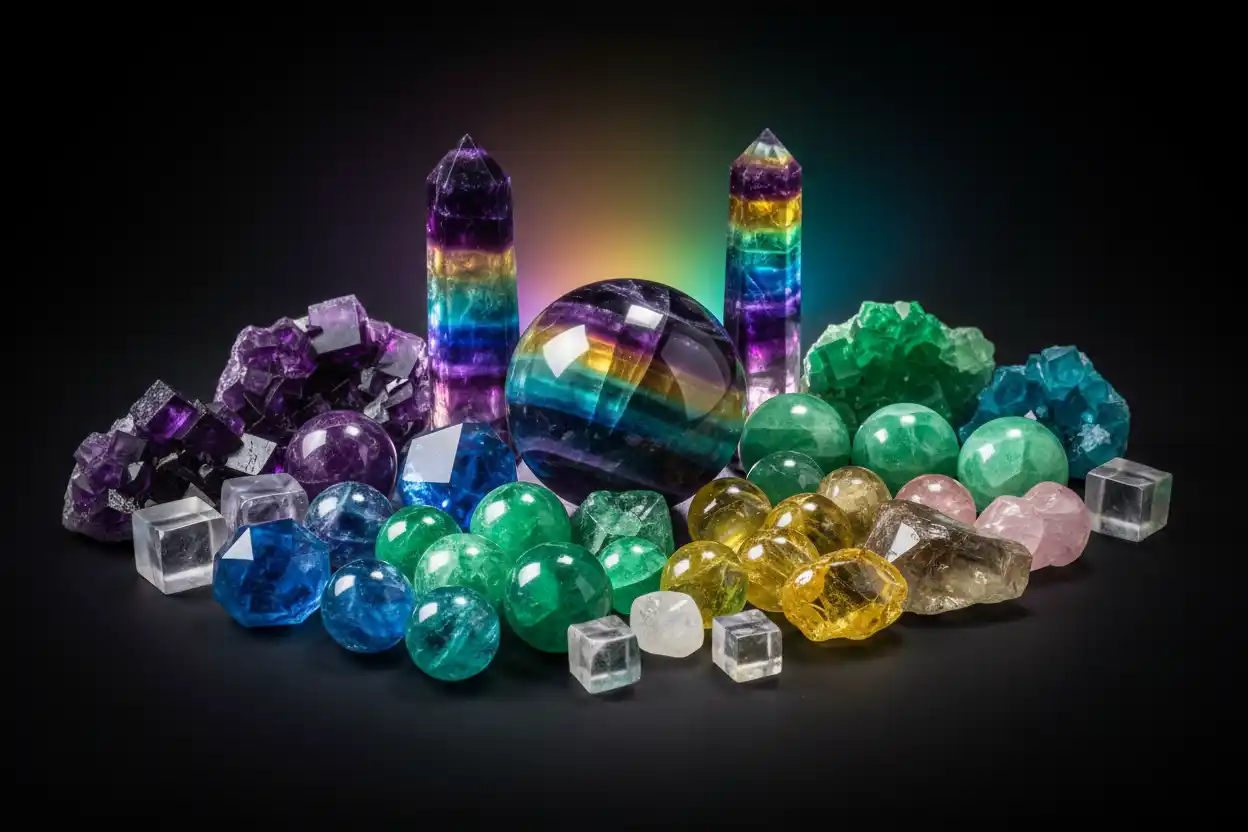
Fluorite Color Meaning: Causes, Varieties and Symbolism
Fluorite occurs in colorless, purple, green, blue, yellow, pink, red, brown, black and sharply banded multicolor crystals. Its colors come from a complex interaction among lattice defects, radiation damage, rare-earth elements, oxygen-related centers and growth history—not from one simple impurity assigned consistently to every hue.
Fluorite Color at a Glance
| Color | Typical Appearance | Likely Scientific Contributors | Common Market Form |
|---|---|---|---|
| Colorless | Water-clear to milky white | Relatively few visible-light-absorbing defects or impurities | Cubes, cleaved octahedrons and faceted collector gems |
| Purple | Lilac, violet, grape and deep purple | Radiation-related color centers, electron defects and calcium-rich defect aggregates | Cubic clusters, octahedrons and banded material |
| Green | Mint, grass, emerald, blue-green and forest green | Rare-earth ions and defect–impurity combinations; causes vary by locality | Cubes, daylight-fluorescent specimens and carvings |
| Blue | Pale blue, teal, cyan and deep blue | Yttrium-associated defect centers and other rare-earth or structural effects | Rare crystals and collector gems |
| Yellow | Lemon, golden, honey and brownish yellow | Oxygen-related molecular ions, defects and impurity complexes | Cubes, faceted gems and banded crystals |
| Pink | Pale rose, hot pink and magenta | Yttrium–oxygen-related centers, rare-earth impurities and defects | Alpine octahedrons, Chinese crystals and rare gems |
| Red | Crimson, wine red and reddish violet | Complex defects, trace elements and radiation-related centers | Rare crystals and thin transparent zones |
| Black | Smoky black to opaque | Intense radiation damage, calcium colloids and dense defect populations | Antozonite or fetid Fluorite and irradiated material |
| Rainbow | Purple-green-blue-yellow or multibanded | Changing growth chemistry, defect concentration and radiation exposure | Slices, cubes, towers and ornamental pieces |
Fluorite Is Naturally Colorless
Pure calcium fluoride, CaF₂, is colorless.
The parent Fluorite guide covers its cubic structure, hydrothermal formation, industrial role and physical properties.
Visible color develops when the ideal structure changes.
Possible causes include:
- Missing fluoride ions
- Electrons trapped in vacancies
- Calcium-rich defect aggregates
- Oxygen substituting within the structure
- Rare-earth elements replacing calcium
- Natural ionizing radiation
- Heat
- Repeated crystal-growth stages
- Microscopic inclusions
- Combinations of several mechanisms
The same color can arise through different mechanisms in different deposits.
Conversely, one trace element may influence color, fluorescence or both according to its valence state and surrounding defects.
Therefore, statements such as “green Fluorite always contains chromium” or “purple Fluorite is caused only by manganese” are unreliable.
What Is a Color Center?
A color center is a structural defect that absorbs part of visible light.
In Fluorite, a fluoride ion may be missing from its normal site. An electron can become trapped in that vacancy.
The trapped electron absorbs particular wavelengths. Light that is not absorbed reaches the viewer as visible color.
Radiation can create or modify these vacancies. Heat may erase, rearrange or change them.
Defects can also associate with yttrium, cerium and other rare-earth ions. The resulting complex absorbs light differently from a simple isolated vacancy.
This explains why Fluorite color can:
- Intensify near radioactive minerals
- Fade after heating
- Change after irradiation
- Form sharp zones
- Differ between nearby crystals
- Vary independently from fluorescence
Purple Fluorite
Purple is the most familiar Fluorite color.
Shades range from pale lavender to saturated violet and nearly black grape-purple.
Research has connected purple coloration with radiation-related defects, electron centers and, in some material, aggregates or nanoparticles of excess calcium.
Natural radiation from uranium, thorium and their decay products can create defects over geological time. The radioactive source may lie in surrounding rock rather than inside the Fluorite crystal itself.
Purple frequently forms along cube edges, corners or growth bands. Those areas may have incorporated different defect populations or received different radiation exposure.
Heating can weaken or remove some purple coloration. Subsequent irradiation may restore or alter it.
The separate Purple Fluorite guide owns locality, identification and material-specific care, while Purple Gemstones compares the hue with Amethyst, Sapphire and Spinel.
Purple Fluorite vs Amethyst
Fluorite vs Amethyst is one of the most important color-based comparisons.
Amethyst is purple Quartz with hardness 7 and no cleavage.
Fluorite has hardness 4 and four perfect octahedral cleavage directions.
Fluorite commonly forms cubes, octahedrons and cubic aggregates. Amethyst typically forms six-sided Quartz prisms and pyramidal terminations.
Both can show color zoning. Therefore, purple color alone provides little identification value.
A scratch test is unnecessary and damages the softer Fluorite. Crystal form, cleavage, refractive properties and spectroscopy provide safer evidence.
Green Fluorite
Green Fluorite ranges from pale mint to deep forest green.
The scientific cause varies. Rare-earth ions, including samarium in particular valence states, can contribute in some specimens. Yttrium, cerium, oxygen and lattice defects may also participate.
A green crystal from England may not share the same color center as a green crystal from China or Namibia.
Some green Fluorite appears blue-green in daylight and more yellow-green indoors. Lighting spectrum, body thickness and fluorescence influence the result.
The best-known British material from the Rogerley Mine can fluoresce strongly in daylight rich in ultraviolet wavelengths. This response can make the crystal appear especially vivid.
The dedicated Green Fluorite guide owns source, specimen and buying intent. Its alternatives appear in Green Gemstones.
Blue Fluorite
Blue Fluorite is less common than purple and green.
Colors include:
- Pale sky blue
- Cyan
- Turquoise-blue
- Teal
- Blue-violet
- Deep electric blue
Research has associated some blue color with yttrium-related electron centers. Rare-earth impurities and radiation-created defects may interact.
Blue body color should not be confused with blue fluorescence. A colorless, yellow or green Fluorite can emit blue light under ultraviolet radiation.
The hue also changes with thickness. A pale-blue edge can become deep teal or nearly black through the center of a large crystal.
Transparent blue faceted stones attract collectors but require cautious handling because color rarity does not improve hardness.
Blue Fluorite belongs visually among Blue Gemstones, though its softness prevents it from functioning like Sapphire, Spinel or Aquamarine in everyday rings.
Yellow Fluorite
Yellow Fluorite ranges from pale lemon to golden, honey and brownish yellow.
Oxygen-related molecular ions and defect centers are among the documented contributors to yellow coloration.
Rare-earth elements and irradiation history can modify the hue.
Yellow zones commonly occur beside purple or green bands. Their sequence records changes during crystal growth rather than later painting.
Honey-colored Fluorite may look similar to Citrine, Yellow Calcite or Topaz. However, its low hardness, perfect cleavage and cubic habit separate it.
The dedicated Yellow Fluorite guide covers source and material intent, while Yellow Gemstones provides broader comparisons.
Pink Fluorite
Pink Fluorite is uncommon and especially important in Alpine mineral collections.
Colors range from nearly colorless blush to rose, salmon, magenta and reddish pink.
Research has associated some pink or rose color with yttrium–oxygen-related centers. Rare-earth chemistry and structural defects can also contribute.
Classic Alpine pink Fluorite commonly forms octahedrons on smoky Quartz or light-colored matrix.
China, Pakistan and additional localities produce pink crystals in cubic or modified habits.
Pink photographs are easy to oversaturate. Neutral-light video and a white reference card help reveal whether the crystal is pale rose or intense magenta.
Pink Fluorite belongs among Pink Gemstones, but its primary market is specimen collecting rather than durable jewelry.
Red Fluorite
True red Fluorite is rare.
Many examples described as red are actually:
- Deep reddish purple
- Magenta
- Pink in transmitted light
- Brown-red
- Purple over red matrix
- Photographically oversaturated
Authentic red zones may arise through complex defect and impurity interactions.
A high price based on red color deserves careful verification. Photographs should show the specimen under neutral daylight and incandescent light without selective editing.
The seller should also distinguish red body color from red fluorescence.
Colorless and White Fluorite
Colorless Fluorite has relatively few defects that absorb visible wavelengths.
Fine crystals can be water-clear, while internal cleavage, inclusions and surface etching make others appear cloudy.
White material may result from:
- Microscopic inclusions
- Fine fractures
- Grain boundaries
- Weathering
- Partial dissolution
- Dense drusy texture
- Colorless crystals over pale matrix
Colorless Fluorite can be faceted, but its low refractive index produces gentle brilliance rather than the intense return associated with Diamond or Zircon.
Clear crystals provide useful windows into phantoms, inclusions and internal cleavage.
Black and Antozonite Fluorite
Very dark Fluorite can result from intense radiation damage and dense defect populations.
Antozonite, historically called fetid Fluorite, may release a strong odor when crushed. Research has linked the odor in some material to trapped elemental fluorine.
The dark color may involve calcium colloids or nanoparticles created through radiation-related breakdown of the ideal lattice.
Antozonite should remain intact. Crushing it for identification is unsafe and unnecessary.
A black specimen may also contain bitumen, manganese oxides, sulfides or dark matrix. Therefore, black appearance alone does not establish antozonite.
Rainbow Fluorite
Rainbow Fluorite contains several color bands or zones.
Common sequences include:
- Purple and colorless
- Green and purple
- Blue-green and violet
- Yellow and purple
- Green, blue and clear
- Purple edges around a pale core
Each zone records a different crystal-growth stage.
Fluid temperature, trace-element concentration, oxygen conditions and defect chemistry changed while the crystal enlarged.
Radiation may modify some zones after growth. Therefore, present-day color does not always represent the exact color the crystal had when it formed.
The dedicated Rainbow Fluorite guide owns banding, source and care intent. Other multicolor materials appear in Rainbow Gemstones.
Edge and Corner Zoning
Cubic Fluorite often concentrates purple or blue color at edges and corners.
Those areas represent growth sectors with slightly different structure, impurity uptake or defect populations.
The center of a face and the edge may therefore react differently to radiation or heat.
A cut slice through a cube can reveal:
- Square outlines
- Concentric color bands
- Edge-rich zones
- Phantom cubes
- Clear cores
- Repeated purple-green layers
These patterns are natural when they continue through the interior.
Surface dye normally concentrates in fractures and pores rather than creating geometrically consistent internal cubes.
Phantoms
A Fluorite phantom preserves an earlier stage of crystal growth.
The crystal pauses, changes chemistry or receives a thin coating. Later Fluorite grows around the earlier cube or octahedron.
A phantom may appear through:
- Color contrast
- Included particles
- A thin mineral coating
- Etched surfaces
- Cloudy growth layers
- Different fluorescence
Phantoms can add specimen value when they remain sharply defined.
A cloudy central cube should not automatically be called a phantom unless its geometry follows the earlier crystal form.
Body Color vs Fluorescence
Fluorite gave its name to fluorescence, but the two types of color are separate.
Body color is visible under ordinary light because the crystal absorbs selected wavelengths.
Fluorescence is light emitted after ultraviolet energy excites electrons or impurity ions.
A purple crystal may fluoresce blue. A green crystal may fluoresce violet, white or not at all.
Europium commonly activates blue fluorescence in some Fluorite. Additional rare-earth ions can produce green, yellow, red or white emissions.
The strength also varies between deposits and individual growth zones.
UV response should therefore not be used as the only authenticity test.
Daylight Fluorescence
Some Fluorite responds strongly enough to ultraviolet wavelengths in daylight that its visible appearance changes outdoors.
Rogerley green Fluorite is a well-known example. Indoors, the crystals may look forest green. In sunlight, blue or violet fluorescence can create an intense blue-green glow.
The effect depends on:
- UV content of the light
- Crystal transparency
- Fluorescent activators
- Surface condition
- Body color
- Viewing angle
Window glass blocks part of the ultraviolet spectrum, so a stone may look different beside a closed window than outdoors.
Does Fluorite Color Fade?
Some Fluorite colors are unstable under heat, intense light or prolonged ultraviolet exposure.
Purple, blue and green defect-related colors can weaken when heat rearranges the lattice or empties electron traps.
Not every specimen fades at the same rate. Locality, defect type, irradiation history and color mechanism matter.
The conservative approach in Crystals That Fade in Sunlight is appropriate:
- Avoid permanent windowsill display
- Use cool LED lighting
- Limit strong UV exposure
- Keep specimens away from heat
- Photograph before long-term display
- Record any visible change
Sunlight should not be used deliberately to test whether color is natural.
Irradiated Fluorite
Irradiation can create or intensify purple, blue, green, yellow, brown and black color.
Natural Fluorite is also exposed to geological radiation, so detecting color centers does not by itself prove artificial treatment.
Treatment assessment considers:
- Color distribution
- Source history
- Dose-related darkness
- Spectroscopy
- Heat response
- Residual radioactivity where applicable
- Comparison with known natural material
Commercially irradiated Fluorite should be disclosed.
Properly processed material is not expected to remain dangerously radioactive, but informal irradiation without regulated controls creates uncertainty.
Heat Treatment
Heating can lighten, remove or change Fluorite color.
A purple stone may become pale or colorless as defect centers disappear. Other stones can shift toward blue, green or yellow depending on the original centers.
Heat also increases the risk of cleavage and thermal shock.
Therefore, a color-change experiment can destroy both specimen value and structural integrity.
A treated stone remains Fluorite, but its present color no longer represents only natural geological processes.
Dye and Coating
Fluorite is less routinely dyed than porous Agate or Howlite, yet treatment remains possible.
Dye can concentrate in:
- Cleavage cracks
- Surface pits
- Drill holes
- Grain boundaries
- Fracture networks
Coatings can create metallic, rainbow or exceptionally saturated surfaces.
A coated stone may show:
- Scratched color
- Color only on exposed faces
- Uneven wear at facet edges
- Film-like iridescence
- Bubbles
- Different color beneath a chip
The inspection methods in How to Spot Dyed Crystals and How to Spot Fake Crystals help identify obvious enhancement.
Color and Fluorite Value
Fluorite has no universal ranking in which one color is always most valuable.
Commercial purple and green pieces are widely available.
Blue, pink, red and unusual multicolor crystals can receive premiums when their color is natural, attractive and tied to a desirable locality.
Faceted commercial Fluorite commonly sells for approximately $5–$30 per carat. Better blue, vivid green, multicolor or precision-cut collector stones may range from $30 to $100 per carat or more.
Common polished pieces and small clusters often cost $5–$50.
Fine matrix specimens from China, England, Illinois, Spain, Namibia or Pakistan commonly range from $100 to several hundred dollars.
Exceptional classic-locality pieces, large transparent cubes, Alpine pink octahedrons and significant historic specimens may cost thousands.
Current listings illustrate the range: ordinary faceted lots remain inexpensive, while attractive Rogerley and Illinois specimens commonly carry several-hundred-dollar asking prices.
What Makes a Fluorite Color Valuable?
Natural Appearance
Color should remain attractive without extreme editing or artificial lighting.
Saturation
Strong color is desirable only when the crystal retains visible depth and luster.
Color Rarity
Pink, red, electric blue and certain combinations are less common than ordinary purple.
Zoning
Sharp phantoms and balanced bands can add value.
Transparency
Gemmy color zones display greater internal depth.
Crystal Form
Complete cubes, octahedrons and interpenetrant twins receive more demand than broken cleavage fragments.
Locality
A recognized source can matter as much as hue.
Fluorescence
Strong or unusual UV response adds collector interest but does not replace visible-light quality.
Condition
Cleavage chips and bruised edges reduce value sharply.
Treatment Disclosure
Natural, irradiated, heated, dyed and coated color belong to different market categories.
Color and Jewelry Suitability
Fluorite’s color can be spectacular, but the stone is not durable.
It defines 4 on the Gemstone Hardness Chart.
Quartz dust, glass and many household objects can scratch it.
Four perfect octahedral cleavage directions create a greater structural risk. The mechanism is explained in Gemstone Cleavage Explained.
Therefore, color should not determine whether a Fluorite belongs in a ring.
Earrings, protected pendants and collector settings are safer. Faceted stones are often stored loose rather than mounted.
Cleaning Colored Fluorite
Use a dry microfiber cloth or a brief lukewarm mild-soap rinse.
Avoid soaking, especially when the stone contains fractures, coatings or matrix minerals.
Never use ultrasonic cleaning. Vibration can exploit perfect cleavage.
Steam and hot water can cause thermal shock and may alter unstable color centers.
Acids should also be avoided. Fluorite is calcium fluoride, and strong acid contact can release hazardous fluoride compounds.
For nonphysical spiritual care practices, How to Cleanse and Charge Fluorite provides options that do not require sunlight, saltwater or heat.
Buying Fluorite by Color
The Fluorite Buying Guide should be applied before accepting a rare-color premium.
Request photographs under:
- Neutral daylight-equivalent light
- Ordinary indoor light
- Long-wave UV if fluorescence matters
- Short-wave UV when safe and relevant
The seller should disclose whether the image uses backlighting. Thin Fluorite can look far brighter over a light panel than it does in ordinary display.
Ask for:
- Exact locality
- Dimensions
- Crystal size
- Repairs
- Cleavage damage
- Color treatment
- Fluorescence
- Matrix minerals
- Dry unedited video
Color names such as neon, Paraíba, Emerald green or Ruby red are descriptive marketing rather than formal Fluorite grades.
Fluorite Color Symbolism
Fluorite’s symbolism is largely modern and often borrowed from general color associations.
Colorless Fluorite
Colorless material is commonly associated with openness, neutrality and precision.
The interpretation reflects visual transparency rather than a scientifically measured mental effect.
Purple Fluorite
Purple is often linked with reflection, imagination and contemplation.
The meaning follows broader modern purple symbolism and Fluorite’s popularity in spiritual retail.
Green Fluorite
Green commonly represents renewal, growth and equilibrium.
Its geological color, however, comes from defects and impurity centers rather than biological growth.
Blue Fluorite
Blue is often interpreted through calm communication, distance and clear expression.
The association is cultural and does not mean the stone changes speech or cognition.
Yellow Fluorite
Yellow is commonly linked with curiosity, visibility and optimism.
Its defect-related color provides no scientific evidence of improved confidence or concentration.
Pink Fluorite
Pink is often associated with tenderness, affection and emotional openness.
These ideas come from color symbolism rather than a demonstrated mineral effect.
Rainbow Fluorite
Multicolor banding is commonly interpreted as flexibility or the coexistence of several perspectives.
A more grounded meaning comes from its formation: each band records a changed stage of fluid chemistry or crystal growth.
Black Fluorite
Black material may be associated with boundaries and seriousness.
In scientific terms, its darkness can record intense radiation damage and defect concentration.
None of these colors has been demonstrated to treat illness, alter mood or influence external events.
Frequently Asked Questions
What is the rarest Fluorite color?
True red, vivid pink and strong natural electric-blue material are among the least common. Locality, crystal quality and treatment status still determine value.
What causes purple Fluorite?
Radiation-related defects, trapped electrons and calcium-rich defect aggregates can contribute. The exact mechanism varies among deposits.
What causes green Fluorite?
Rare-earth ions and defect–impurity combinations are important. Green does not indicate one universal trace element.
Is blue Fluorite naturally irradiated?
Natural radiation can contribute to blue defect centers, but blue material can also be treated artificially. Laboratory context is needed.
Is Rainbow Fluorite dyed?
Most banded Rainbow Fluorite is naturally zoned. Dye and coatings exist, so fractures and surfaces should still be inspected.
Does every Fluorite glow under UV light?
No. Fluorescence varies by locality, impurities, defects and growth zone.
Is fluorescence the same as body color?
No. Body color appears under ordinary light, while fluorescence is emitted after ultraviolet excitation.
Can sunlight fade Fluorite?
Some defect-related colors may weaken under prolonged strong light or heat. Conservative shaded display is advisable.
Which Fluorite color is most valuable?
No color is universally most valuable. Rare natural hue, transparency, zoning, crystal form, condition and locality must be evaluated together.
Can Fluorite color identify its source?
Color may suggest a locality, but many deposits produce overlapping hues. Provenance cannot be established reliably from color alone.
The most useful color description states the hue, zoning, lighting response and treatment status separately instead of assigning scientific or symbolic meaning from one photograph.
Disclaimer: Fluorite is soft, perfectly cleavable and acid-sensitive. Do not ingest it, place it in drinking water, heat it, acid-test it or grind it dry. Strong acids can produce hazardous fluoride compounds, while matrix specimens may contain lead-, arsenic- or sulfide-bearing minerals.