Rainbow Gemstones: Types, Optical Effects and Jewelry Uses
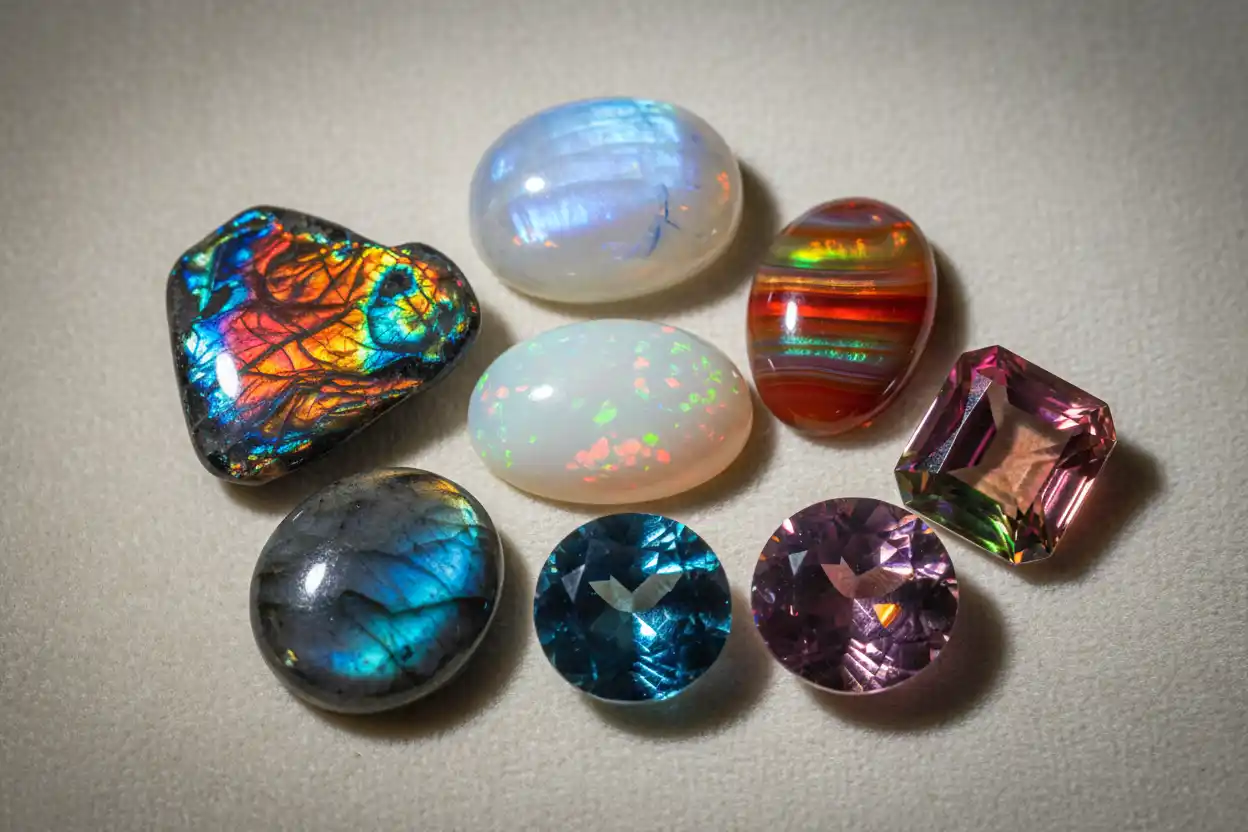
Rainbow gemstones display multiple colors through several distinct mechanisms. Precious opal produces play-of-color, labradorite produces labradorescence, Ammolite and nacre produce interference colors, and multicolor tourmaline records changes in chemical composition during crystal growth.
Other rainbow appearances are manufactured. Mystic topaz, aura quartz and some decorative stones receive thin surface coatings that create iridescence. The resulting color can be attractive, but its origin and durability differ from a natural internal optical phenomenon.
This guide focuses on gemstone identity, color mechanism, treatments, durability, jewelry uses and concise symbolism. The rainbow crystals guide retains meditation, intention setting and belief-based practices.
Rainbow Gemstones at a Glance
| Gemstone or material | Rainbow mechanism | Approximate durability | Best jewelry use | Main buying concern |
|---|---|---|---|---|
| Precious opal | Diffraction-based play-of-color | Moderate to delicate | Pendants, earrings and protected rings | Body type, stability, treatment and construction |
| Ammolite | Interference within fossil shell layers | Delicate | Protected pendants and earrings | Stabilization, doublets and triplets |
| Labradorite | Labradorescence | Moderate | Cabochon pendants, earrings and protected rings | Flash orientation and fractures |
| Spectrolite | Strong multicolor labradorescence | Moderate | Fine cabochons and collector jewelry | Accurate use of the Finnish trade name |
| Rainbow moonstone | Multicolor labradorescence in transparent labradorite | Moderate | Pendants, earrings and careful-wear rings | Misidentification and assemblages |
| Fire agate | Interference over layered iron oxides | Good with care | Cabochons and protected rings | Cutting depth and visible fire |
| Iris agate | Diffraction through fine agate banding | Good with care | Thin slices and pendants | Effect may require transmitted light |
| Iris quartz | Natural iridescent near-surface or fracture structures | Good with care | Specimens and pendants | Confusion with coated aura quartz |
| Rainbow obsidian | Iridescence from layered volcanic glass | Moderate | Cabochons and pendants | Orientation, glass fracture and imitations |
| Rainbow lattice sunstone | Aventurescence and oriented inclusion effects | Moderate | Collector cabochons | Rare trade material and origin |
| Mother of pearl | Interference in layered nacre | Delicate | Earrings, pendants and inlay | Dye, coating and surface wear |
| Pearl with orient | Iridescence in nacre | Delicate | Earrings and necklaces | Nacre quality, treatment and matching |
| Rainbow hematite | Nanoscale surface or coating effects | Variable | Specimens and occasional jewelry | Natural versus treated surface |
| Bornite | Thin-film oxidation tarnish | Soft to moderate specimen use | Specimens and pendants | Peacock-ore ambiguity |
| Mystic topaz | Artificial thin-film coating | Topaz body is hard; coating is vulnerable | Earrings and pendants | Coating abrasion and disclosure |
| Aura quartz | Artificial metallic coating | Quartz body is durable; coating is vulnerable | Pendants and decorative crystals | Coating identity |
| Watermelon tourmaline | Fixed natural color zoning | Good with care | Slices, pendants and protected rings | Zoning, filling and authenticity |
| Ametrine | Purple-yellow quartz zoning | Good | Rings, earrings and pendants | Natural versus synthetic or treated material |
| Rainbow fluorite | Fixed color zoning | Delicate | Pendants and collector pieces | Cleavage, scratching and dye |
| Bismuth | Oxide-film interference, usually on manufactured crystals | Brittle | Decorative pendants and specimens | Manufactured crystal form |
Iridescence
Iridescence is a broad optical term for colors that change with illumination or viewing direction because light waves interact with fine structures.
The effect can occur near a surface, within layered material, around a fracture or across a repeated nanoscale structure.
Not every multicolor gemstone is iridescent. Watermelon tourmaline and rainbow fluorite contain visibly different bodycolor zones that remain in place. Their colors do not move like opal play-of-color.
Likewise, dispersion or fire in diamond and zircon is not identical to opal play-of-color. Dispersion separates white light as it passes through a faceted gemstone, producing small spectral flashes from the cut. Play-of-color comes from organized internal structures within the gem material.
Precious Opal
Opal is the best-known rainbow gemstone.
Precious opal contains sufficiently ordered silica structures to diffract visible light. The resulting play-of-color may appear as pinfire, broad flash, rolling flash, harlequin-like blocks or other patterns.
Red is often highly valued because longer-wavelength color requires an internal structure capable of producing that diffraction. Brightness, pattern, bodycolor, transparency and directional coverage also affect quality.
The types-of-opal guide explains white, black, boulder, crystal, fire and other body types.
The opal buying guide owns full quality assessment, while the opal price guide retains market figures.
Treatments and construction matter. Solid opal, doublets, triplets, dyed material, smoke-treated Ethiopian opal and synthetic opal occupy different categories. The treated-opal guide owns those boundaries.
Ammolite
Ammolite is iridescent fossilized ammonite shell material associated primarily with southern Alberta, Canada.
Its thin aragonite layers interfere with light to create red, orange, yellow, green, blue and violet. Fracture patterns may produce sheet, dragon-skin or stained-glass appearances.
The color-bearing layer is thin and fragile. Most finished gems receive stabilization, backing or a transparent cap.
A doublet combines Ammolite with a backing. A triplet generally adds a protective transparent top. These constructions are standard when disclosed, but they should not be priced or described as thick solid Ammolite.
The types-of-Ammolite guide and Ammolite buying guide own variety and construction details.
Labradorite
Labradorite is a plagioclase feldspar famous for labradorescence.
Blue and green are common, but fine stones may display gold, orange, violet and broad multicolor flashes. The effect arises from light interacting with microscopic feldspar structures.
Cutting orientation is critical. A cabochon that looks brilliant from the rough’s correct direction may appear dull if the face is cut at the wrong angle.
The types-of-labradorite guide explains ordinary labradorite, spectrolite and related market forms.
The labradorite buying guide owns flash coverage, bodycolor, orientation and fractures.
Spectrolite
Spectrolite is the trade name associated with Finnish labradorite showing strong spectral labradorescence.
The best material may display several saturated colors across a dark body. Blue, green, yellow, orange and violet can appear in distinct zones or broad fields.
Not every rainbow labradorite should be called spectrolite. Provenance and trade usage matter.
The stone shares feldspar’s cleavage and moderate hardness, so protective cabochon settings are preferable.
Rainbow Moonstone
Rainbow moonstone is transparent to translucent labradorite displaying blue or multicolor labradorescence.
It is related to traditional moonstone but is not the same feldspar variety. The accepted trade name should not erase that distinction.
Fine material combines a clean or lightly included body with strong blue, green, yellow or orange flash that remains visible across a useful range of movement.
The types-of-moonstone guide explains traditional moonstone, rainbow moonstone, peach, gray and other market categories.
Imitation assemblages and coated products exist. The where-to-buy-rainbow-moonstone guide owns buyer verification.
Fire Agate
Fire agate is chalcedony containing thin iron-oxide layers that produce iridescent red, orange, yellow, green and violet.
The color often follows rounded botryoidal contours. A skilled cutter carefully removes overlying chalcedony without grinding away the fire-bearing layer.
High-quality fire agate displays bright, well-defined colors from several angles. Weak material may show only brown bodycolor and small isolated flashes.
Its quartz-based body provides better scratch resistance than opal or fluorite, although irregular cavities and thin edges still need protection.
Iris Agate
Iris agate reveals spectral colors when extremely fine chalcedony banding diffracts transmitted light.
A slice may look like ordinary pale agate until held against the correct light. The rainbow can then appear as narrow parallel bands or a broader spectral field.
The phenomenon differs from opal play-of-color because it depends on fine agate banding and often requires transmitted illumination.
Thin slices should be mounted in ways that allow light to reach the material.
Iris Quartz
Natural iris quartz may show spectral colors related to fine near-surface structures, thin internal fractures or repeated microstructures.
The effect can appear only on selected crystal faces or along one internal plane. Polishing or recutting may weaken or destroy it.
Artificially coated quartz is much more widely available. A buyer should ask whether the rainbow originates within the quartz or from a metallic surface film.
The quartz guide owns family mineralogy, while the treated-clear-quartz guide covers coating and synthetic concerns.
Rainbow Obsidian
Rainbow obsidian is natural volcanic glass displaying colored sheen from aligned internal layers or inclusions.
The effect may appear as concentric arcs, broad bands or isolated areas of purple, green, gold and blue.
Cut orientation determines whether the color appears. A rough piece can look nearly black until polished along the correct plane.
Because obsidian is glass, it can chip into sharp edges. Pendants, beads and protected cabochons are safer than high exposed rings.
Rainbow Lattice Sunstone
Rainbow lattice sunstone is a rare feldspar material known for aventurescence and a lattice-like multicolor effect produced by oriented inclusions.
It differs from ordinary sunstone, whose glitter commonly comes from reflective copper, hematite or other platelets.
A strong lattice pattern should be visible under movement and supported by credible provenance. Generic aventurescent feldspar should not inherit the rare trade name automatically.
The types-of-sunstone guide owns the broader variety structure.
Pearl and Mother of Pearl
Pearl may show overtone and orient above its bodycolor. Orient appears as shifting rainbow colors produced by layered nacre.
Mother of pearl is nacreous shell material cut into beads, inlay, carvings and flat jewelry components.
Both materials are soft. Perfume, acids, abrasives and rough storage can dull their surfaces.
The types-of-pearl guide covers cultured-pearl categories and colors, while types of mother of pearl covers shell sources and material forms.
Rainbow Hematite
Natural rainbow hematite can display metallic purple, blue, green, yellow and orange.
In some material, orderly nanoscale structures create the color. In other specimens, tarnish, coatings or surface alteration may be responsible.
The hematite meaning guide owns mineral identity, while the planned authentication and buying pages should be used before paying a natural-rarity premium.
A surface effect may be beautiful but vulnerable to polishing and abrasion.
Bornite, Chalcopyrite and Peacock Ore
Bornite develops blue, purple and green tarnish as its surface oxidizes.
Chalcopyrite may also tarnish naturally, but intensely colored commercial pieces are often treated chemically.
Peacock ore is therefore an ambiguous trade name. It may refer to bornite, treated chalcopyrite or another metallic specimen.
The exact mineral and color origin should be disclosed. Surface tarnish can wear away, change or continue reacting during storage.
Mystic Topaz
Mystic topaz is generally colorless topaz covered with a thin artificial coating.
The film produces green, purple, blue, gold and pink reflections. Its color belongs primarily to the coating rather than the topaz body.
Topaz itself is hard, but it has perfect cleavage. The coating creates an additional vulnerability to abrasion, polishing and repair.
Earrings and pendants protect the surface better than frequently worn rings. Clean only with mild soapy water and a soft cloth.
Aura Quartz
Aura quartz uses quartz as a base for a thin metallic coating.
Gold, titanium, platinum and other materials may be used in different commercial processes and trade styles. The resulting iridescence can be bright and stable enough for careful display, but it is not natural quartz color.
Coated quartz should not be sold as a newly discovered natural variety. The treatment and base material should be stated.
The gemstone-treatments guide owns the general coating framework.
Watermelon Tourmaline
Watermelon tourmaline shows natural pink-to-red and green zoning, commonly with a pale intermediate layer.
The color records changes in the chemistry of the pegmatite fluid during crystal growth. It is not an interference effect.
Slices display the zoning most directly. Faceted stones may show pink and green along their length or across the face.
The watermelon-tourmaline price guide owns value factors, while the buying guide handles filling, composites and color quality.
Ametrine
Ametrine combines amethyst and citrine color within quartz.
The purple and yellow sections result from different iron-related color states. A skilled cut can divide the colors, blend them or repeat them through reflections.
Synthetic and treated quartz may imitate natural ametrine, so important stones should have accurate disclosure.
It provides multicolor bodycolor rather than a moving rainbow phenomenon.
Rainbow Fluorite
Rainbow fluorite displays fixed green, purple, blue, yellow and colorless growth zones.
Its color patterns can be dramatic in cubes, slices, carvings and cabochons. However, the mineral’s Mohs hardness of 4 and perfect cleavage make it unsuitable for demanding jewelry.
Protected pendants and collector pieces are more practical than rings.
The where-to-buy-rainbow-fluorite guide owns dye, composite and seller checks.
Bismuth
Bismuth develops iridescent oxide colors as its surface reacts with oxygen.
The stepped hopper crystals commonly sold are usually manufactured through controlled melting and cooling. Natural bismuth exists, but it rarely forms the large perfect rainbow shapes familiar in crystal shops.
Bismuth is brittle and comparatively soft. It is best used in pendants, display objects and protected designs.
Manufactured origin should be disclosed without describing the material as fake; the element is genuine, while the crystal form is human-produced.
Fire Versus Play-of-Color
Faceted diamond, zircon, sphene and some other gems separate white light into spectral flashes called dispersion or fire.
These flashes depend strongly on refractive index, dispersion and cut. They usually appear as small colored reflections from facets.
Opal play-of-color comes from diffraction within the material itself. Labradorite and nacre use other interference mechanisms.
A seller should not use “rainbow fire” as though it identifies one gemstone or proves natural origin.
Natural Versus Treated Rainbow Effects
A natural optical effect develops from the gem’s structure or inclusions. An artificial rainbow effect may come from coating, chemical tarnishing, dye, foil or assembled construction.
Treatment does not automatically make a gemstone undesirable. Mystic topaz and aura quartz can be attractive when priced and described honestly.
The laboratory-grown-versus-natural gemstones guide explains why treatment, laboratory growth and imitation are different categories.
A report may be worthwhile when natural origin, treatment or rare trade identity materially affects price.
Durability and Jewelry Selection
Rainbow sapphire or durable multicolor tourmaline generally tolerates wear better than opal, Ammolite, fluorite or pearl.
Labradorite, moonstone and rainbow obsidian require protection from hard blows. Ammolite and nacre need protection from abrasion and chemicals.
Coated gems should not be polished aggressively. Their base stone’s hardness does not protect the surface film.
The gemstone-hardness chart provides scratch-resistance context, but toughness, cleavage and surface construction must also be considered.
Buying Rainbow Gemstones
Ask what creates the color. The answer should distinguish play-of-color, labradorescence, orient, zoning, tarnish and coating.
Request images or video under movement. A single still photograph cannot demonstrate how widely an optical effect remains visible.
The description should identify natural or laboratory-grown origin, treatment, assembled construction, dimensions and care requirements.
The gemstone-certification guide explains when professional reports add value. For remote purchases, follow how to buy gemstones online.
Rainbow Gemstone Meanings
Rainbow gemstones commonly symbolize creativity, integration, hope and changing perspective.
Opal may represent expressive imagination. Labradorite and rainbow moonstone are associated with transition and perception. Ammolite symbolizes deep time and adaptation. Multicolor tourmaline can represent emotional complexity held within one structure.
These meanings remain cultural and personal. Their value does not increase automatically with brightness, price or rarity.
Frequently Asked Questions
1. What is the best-known natural rainbow gemstone?
Precious opal is the best-known gemstone displaying shifting spectral play-of-color.
2. Which rainbow gemstone is most durable?
Durable multicolor sapphire and tourmaline generally outperform opal, fluorite, pearl and Ammolite. Exact durability depends on treatment, inclusions and setting.
3. Is rainbow moonstone real moonstone?
It is usually transparent labradorite sold under an accepted trade name, rather than traditional potassium-rich moonstone.
4. Is Ammolite an opal?
No. Ammolite is iridescent fossilized ammonite shell material, whereas opal is hydrated silica.
5. Is mystic topaz naturally rainbow-colored?
No. Its appearance comes from an artificial thin-film coating applied to topaz.
6. Is rainbow fluorite iridescent?
Usually not. Its multicolor appearance comes from fixed growth zoning.
7. What is the difference between fire and play-of-color?
Fire is spectral dispersion from facets in gems such as diamond or zircon. Play-of-color is diffraction-based iridescence within precious opal.
8. Why does labradorite look gray from some angles?
Labradorescence is directional. When the stone moves away from the correct viewing geometry, its bodycolor becomes more visible than the flash.
9. Can rainbow gemstones be used in rings?
Some can. Sapphire, tourmaline and quartz-based stones are more practical, while opal, Ammolite, fluorite and pearl require greater protection.
10. Are all peacock-ore specimens natural bornite?
No. The name may refer to bornite, chemically treated chalcopyrite or other sulfides with colorful surfaces.
11. Can a laboratory identify rainbow-gem treatments?
Many coatings, assembled stones, synthetic materials and treatments can be detected, although the level of certainty depends on the material and test.
12. How should coated rainbow gemstones be cleaned?
Use mild soapy water and a soft cloth. Avoid abrasives, polishing compounds, ultrasonic cleaning and buffing that could remove the coating.
Rainbow gemstones demonstrate that color can be structural rather than simply chemical. Opal diffracts light, feldspar produces labradorescence, nacre creates orient, tourmaline records changing growth chemistry, and coatings manufacture an optical surface. Once the color mechanism is understood, the buyer can choose the material for what it genuinely offers instead of treating every spectral flash as the same phenomenon.
Rainbow materials appear in Gemstones That Start With R and Crystals That Start With R.
Rainbow gemstone meanings and healing associations are cultural or contemporary spiritual interpretations. Gemstones do not diagnose, prevent or cure medical or mental-health conditions. Natural optical phenomena, treated surfaces, manufactured materials and assembled stones should be disclosed and cared for according to their actual construction.