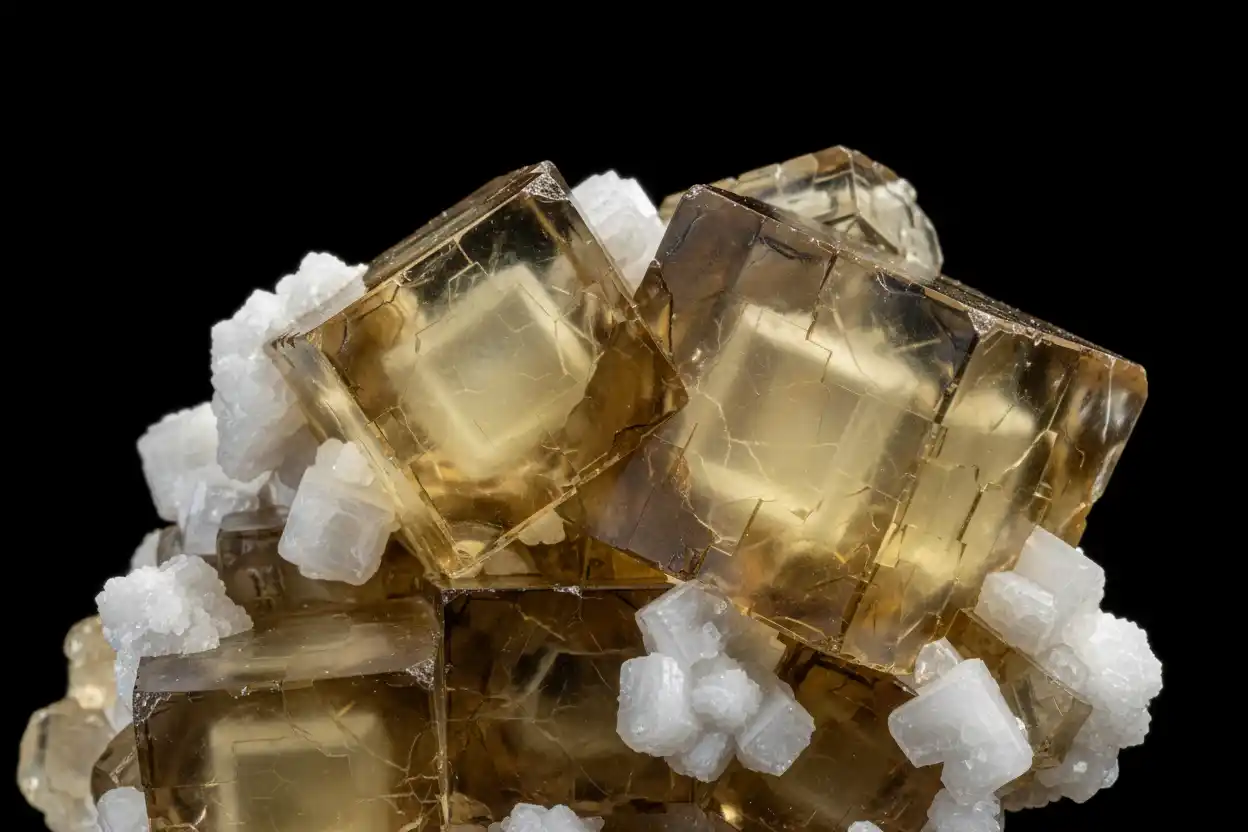
Yellow Fluorite: Meaning, Properties & Symbolism
Yellow fluorite is calcium fluoride whose color ranges from pale lemon and champagne to honey, golden yellow and amber-brown. Its color can result from structural defects, radiation-related color centers, rare-earth elements and oxygen-related molecular centers, with the dominant mechanism varying among deposits.
Fine yellow fluorite forms transparent cubes, octahedra and color-zoned crystals. However, its softness, perfect cleavage and potential for light-driven fading make it primarily a collector mineral rather than an everyday jewelry stone.
Yellow Fluorite at a Glance
| Property | Yellow Fluorite |
|---|---|
| Mineral species | Fluorite |
| Chemical formula | CaF₂ |
| Mineral class | Halide |
| Typical colors | Pale lemon, golden yellow, honey, champagne, amber, yellow-green and yellow-brown |
| Possible color causes | Color centers, oxygen-related centers, rare-earth impurities, radiation and structural defects |
| Crystal system | Cubic or isometric |
| Common habit | Cubes, octahedra, dodecahedral modifications, interpenetrant twins, granular and massive |
| Luster | Vitreous |
| Transparency | Transparent to opaque |
| Refractive index | Approximately 1.433–1.448 |
| Optical character | Isotropic |
| Specific gravity | Approximately 3.18 |
| Mohs hardness | 4 |
| Cleavage | Perfect octahedral cleavage in four directions |
| Tenacity | Brittle |
| Luminescence | Variable; may fluoresce blue, violet, white, yellow, orange or other colors |
| Common use | Mineral specimens, carvings, cabochons and rare collector faceted stones |
| Main care concern | Cleavage, scratching, thermal shock and possible sunlight fading |
What Is Yellow Fluorite?
Yellow fluorite is a yellow-colored variety of fluorite rather than a separate mineral species.
Its essential composition remains CaF₂.
Pure fluorite is colorless. Visible color develops when impurities, vacancies, trapped electrons and other defects alter the way the crystal absorbs light.
The parent fluorite guide owns family-level mineralogy and broad history.
The complete color and structural range appears in Types of Fluorite, while Fluorite Color Meaning and Symbolism compares the modern meanings assigned to multiple colors.
This page focuses only on yellow fluorite’s color, formation, identification, value and care.
Yellow Fluorite Colors
Pale Lemon Fluorite
Pale lemon fluorite may appear almost colorless under cool lighting.
Thin crystals can show a soft yellow glow, while thicker areas appear more saturated.
A faint color is not necessarily low quality when transparency and crystal form are exceptional.
Golden Yellow Fluorite
Golden fluorite displays a stronger warm yellow without dominant brown or orange.
Transparent golden cubes from Spain, France and other European localities are highly collectible.
The term golden fluorite is descriptive and does not identify one chemical variety.
Honey Fluorite
Honey-yellow fluorite ranges from golden amber to yellow-brown.
It can resemble honey calcite, yellow topaz or citrine when polished.
Locality, cleavage and optical properties must therefore accompany color terminology.
Champagne Fluorite
Champagne fluorite has a pale yellow, beige or grayish-yellow body.
Some commercial specimens contain subtle purple, blue or green zoning around the yellow center.
Yellow-Green Fluorite
Yellow fluorite can grade toward chartreuse or olive green.
The boundary with green fluorite is visual and commercial rather than mineralogical.
A seller should describe the actual hue instead of forcing an intermediate stone into one rigid category.
Yellow-Brown Fluorite
Brownish-yellow material may contain dense color centers, iron-bearing inclusions or surface staining.
Some specimens darken toward amber or smoky brown at their cores.
What Causes Yellow Fluorite’s Color?
No single mechanism explains every yellow fluorite deposit.
Fluorite can develop color centers when lattice defects trap electrons.
Natural radiation from nearby uranium, thorium or other radioactive minerals can create or modify these defects over geological time.
Rare-earth elements may influence absorption and luminescence.
Research on yellow hydrothermal fluorite from some European barite-fluorite veins has linked color to oxygen-related molecular centers and interactions involving cerium.
Other deposits may have different causes.
Therefore, a yellow fluorite should not be assigned one impurity merely from its appearance.
Yellow Fluorite Versus Yttrian Fluorite
Yttrian Fluorite contains appreciable yttrium replacing part of the calcium.
Yttrian material can be gray, lavender, brown, yellowish or another color.
Yellow color does not prove yttrium enrichment.
Likewise, chemically verified yttrian fluorite does not have to be yellow.
Elemental analysis is required when the rare-earth variety name affects value.
Color Zoning and Phantoms
Yellow fluorite commonly shows internal zones of purple, blue, green or colorless material.
Color zoning can follow cubic growth sectors, producing concentric squares visible through the crystal face.
A crystal may contain a yellow core with a blue or purple rim.
Phantoms preserve the outline of an earlier growth stage. They appear as internal cubes, cloudy layers or color boundaries.
Fine phantoms increase collector appeal when they remain sharp and symmetrical.
Zoning can also record changes in fluid chemistry, radiation exposure and defect concentration during growth.
Crystal Habits
Cubic Yellow Fluorite
Cubes are the best-known habit.
Yellow Spanish fluorite commonly forms transparent honey-colored cubes with bright surfaces.
Cubic faces may contain stepped growth, etched patterns and internal phantoms.
Octahedral Fluorite
Natural octahedra occur, although many loose octahedral pieces are cleavage fragments.
Fluorite breaks readily along octahedral planes, producing smooth triangular faces.
A seller should not describe every cleavage fragment as a complete natural crystal.
Modified Cubes
Dodecahedral and octahedral modifications can bevel cube edges and corners.
These combinations create more complex reflections and can increase specimen interest.
Interpenetrant Twins
Fluorite commonly forms penetration twins.
A twin may appear as two cubes passing through one another or as an enlarged complex cluster.
Massive Yellow Fluorite
Massive material is used for carvings, spheres and decorative objects.
It commonly contains purple, green, white and clear zones along with yellow areas.
How Yellow Fluorite Forms
Fluorite commonly forms from hydrothermal fluids moving through fractures and porous rocks.
Calcium-bearing fluids react with dissolved fluorine and precipitate CaF₂ as temperature, pressure and chemistry change.
Many yellow specimens come from barite-fluorite and lead-zinc veins.
Fluorite also forms in carbonate-hosted deposits, granitic pegmatites, greisens, skarns and carbonatites.
It frequently grows with quartz, calcite, barite, dolomite, galena, sphalerite and pyrite.
Repeated fluid pulses create several crystal generations and color zones.
Later oxidation or radiation can modify the original color after crystallization.
Moscona Mine, Spain
The Moscona Mine in Asturias is one of the best-known sources of yellow fluorite.
It produces transparent honey-yellow cubic crystals, commonly smaller than a few centimeters but arranged into attractive clusters.
White calcite and barite frequently accompany the fluorite.
Internal phantoms and stepped growth can add complexity.
Fine Moscona specimens combine bright luster, clean transparency and a warm uniform body color.
They should not be confused with similarly colored material from other Spanish mining areas where crystal habit and associations differ.
Illinois-Kentucky Fluorspar District
The Illinois-Kentucky district produced yellow, purple, blue and multicolored fluorite from Mississippi Valley-type deposits.
Some crystals contain yellow centers with pale blue or purple outer zones.
Chalcopyrite inclusions may occur along color boundaries.
Historic mine closures and limited old-stock supply add collector interest to well-documented specimens.
Locality labels should identify the individual mine whenever possible because district-wide appearance varies considerably.
Morocco
El Hammam and other Moroccan fluorite deposits produce yellow, green, purple and multicolored cubes.
Some modern yellow specimens form large stepped cubes with strong luster.
Color can be uniform or zoned with blue and green.
Moroccan commercial material ranges from small inexpensive specimens to large cabinet pieces priced in the hundreds of dollars.
France and Germany
French localities such as Fontsante have produced yellow and multicolored fluorite.
German hydrothermal veins, including parts of the Erzgebirge, are important to scientific research on the causes of yellow fluorite color.
Historic European specimens may carry premiums for locality, old labels and distinctive crystal associations.
China and Other Sources
China supplies a large share of modern commercial fluorite in yellow, green, purple, blue and color-zoned forms.
Hunan and Inner Mongolia are among the widely represented sources.
Mexico, Pakistan, Namibia, Russia, England and Canada also contain yellow or yellow-zoned fluorite.
Origin should be supported by a reliable label because appearance alone cannot separate many deposits.
Fluorescence
The phenomenon of fluorescence was named after fluorite, but not every specimen fluoresces.
Yellow fluorite may emit blue, violet, white, cream, orange, yellow or green under ultraviolet light.
The response depends on rare-earth elements, organic matter, defects and locality.
Shortwave and longwave lamps can produce different reactions.
A nonfluorescent yellow crystal can still be genuine fluorite.
Conversely, strong fluorescence does not prove that a stone is fluorite because many other minerals and coatings glow.
Sunlight Fading
Some fluorite colors fade under prolonged sunlight or ultraviolet exposure.
Color centers can be altered when light releases trapped electrons or changes defect states.
The sensitivity varies greatly by locality and individual crystal.
One yellow specimen may remain stable for years under ordinary room light, while another becomes paler after repeated bright-window exposure.
A faded color generally cannot be restored reliably without further irradiation or treatment, which would alter the specimen.
Important yellow fluorite should be displayed under low-UV LED lighting and stored away from direct sunlight.
Yellow Fluorite Versus Yellow Calcite
Yellow calcite has hardness 3 and perfect rhombohedral cleavage.
Fluorite has hardness 4 and perfect octahedral cleavage.
Calcite reacts immediately with dilute acid, while fluorite requires different chemical precautions.
Transparent calcite shows very strong double refraction. Fluorite is isotropic and does not double images in the same way.
Calcite commonly forms rhombohedra and scalenohedra, while fluorite commonly forms cubes.
Yellow Fluorite Versus Citrine
Citrine is quartz with hardness 7.
It lacks fluorite’s perfect octahedral cleavage and is much more durable in jewelry.
Citrine commonly forms six-sided quartz crystals, while fluorite forms cubes and octahedra.
A faceted yellow fluorite can resemble citrine, but its lower refractive index, isotropic behavior and cleavage distinguish it.
Yellow Fluorite Versus Yellow Topaz
Yellow topaz has hardness 8 and significantly greater jewelry durability, although it also has strong cleavage.
Topaz is denser and has different refractive properties.
Its natural crystal form is orthorhombic and prismatic rather than cubic.
Yellow fluorite is normally a specimen or collector gem, while topaz has a much larger faceted-jewelry market.
Yellow Fluorite Versus Yellow Apatite
Yellow apatite has hardness 5 and a hexagonal crystal system.
It commonly forms prismatic crystals rather than cubes.
Apatite is doubly refractive, while fluorite is isotropic.
Faceted stones may require refractive-index and spectroscopic testing for confident separation.
Inclusions and Internal Features
Yellow fluorite may contain chalcopyrite, pyrite, calcite, barite, quartz and fluid inclusions.
Metallic chalcopyrite crystals can gather along color-zone boundaries.
Cloudy phantoms record earlier growth surfaces.
Fluid inclusions provide information about hydrothermal temperature and salinity.
Cleavage fractures appear as reflective triangular or stepped planes.
Iron-oxide staining can coat the surface and create a misleading yellow-brown appearance.
Identifying Yellow Fluorite
Fluorite’s cubic crystal symmetry offers a strong initial clue.
Its hardness of 4 separates it from calcite but remains far below quartz.
Perfect octahedral cleavage can produce triangular internal cracks and loose octahedral fragments.
Its refractive index near 1.434 is low compared with most faceted gemstones.
Fluorite is isotropic under polarized light, although strain can create anomalous effects.
Raman spectroscopy and X-ray diffraction provide conclusive mineral identification.
The general process in How to Identify Crystals should replace destructive home testing.
The dedicated Fluorite vs Amethyst page covers one of the most common quartz comparisons.
Treatments and Synthetic Fluorite
Fluorite can be irradiated to create or intensify purple, blue, green and other colors.
Heating may lighten, remove or alter radiation-related color.
Yellow color can also be changed through irradiation and thermal treatment, though no single standardized process applies to every material.
Surface coatings and dyes can create artificial yellow, rainbow or metallic appearances.
Fracture filling and resin impregnation may stabilize carvings and low-quality rough.
Synthetic calcium fluoride is manufactured for optical windows, lenses, lasers and scientific applications.
Laboratory-grown CaF₂ can be highly transparent and doped with rare-earth elements.
Synthetic optical fluorite should not be sold as a naturally mined yellow specimen.
The disclosure framework appears in Gemstone Treatments Explained and Lab-Grown vs Natural Gemstones.
Cutting and Polishing
Transparent yellow fluorite can be faceted into attractive collector stones.
Its low refractive index produces softer brilliance than topaz, sapphire or zircon.
Color zoning can be oriented deliberately to create yellow centers, contrasting rims or split-color designs.
Perfect cleavage makes cutting difficult. Pressure applied along the wrong direction can split the rough suddenly.
Heat from polishing can extend fractures or alter color.
Massive material is fashioned into spheres, carvings and cabochons, but its surface scratches easily.
Fine natural crystals should usually remain uncut because their form, zoning and locality create more value than a faceted stone would.
Hardness, Cleavage and Jewelry Suitability
Fluorite defines hardness 4 on the gemstone hardness chart.
It can be scratched by steel, quartz dust and most jewelry gemstones.
Perfect cleavage in four directions creates a serious impact risk.
The difference between scratching and breaking is explained in Gemstone Toughness vs Hardness.
The cleavage mechanism is covered in Gemstone Cleavage Explained.
Yellow fluorite is unsuitable for everyday rings and bracelets.
Collector pendants and earrings can be worn occasionally when the stone is protected, but display remains the safest use.
Yellow Fluorite Prices in 2026
Small yellow fluorite thumbnails commonly retail for approximately $10–$40.
Commercial miniatures and modest cubic clusters generally range from $40–$150.
Current examples include small Moroccan material around $10, ordinary Spanish specimens around $25–$65, and better selected pieces around $100–$200.
Fine Moscona, French, Moroccan, Chinese or historic Illinois specimens commonly range from $150–$750.
Large, highly transparent, strongly zoned or historically important specimens may exceed $750–$2,500.
Exceptional museum-quality fluorite can sell for substantially more.
Faceted yellow fluorite generally ranges from approximately $20–$100 per carat, although unusually large, clean or precision-cut collector stones may exceed those figures.
No standardized color-grading market exists, so specimen form and locality usually matter more than carat weight.
What Determines Value?
Transparency and luster are central.
A bright yellow cube with reflective faces generally commands more than a dull opaque mass.
Color saturation should remain attractive without becoming muddy or brown.
Crystal form, twins, phantoms and color zoning can add substantial value.
Mineral associations such as white calcite, barite or metallic chalcopyrite improve contrast.
Condition matters because fluorite chips and cleaves easily.
Locality and provenance create strong premiums for historic Illinois, European and classic mine material.
Sunlight fading, treatment and repaired crystals reduce value when undisclosed.
Buying Guidance
Use Where to Buy Real Fluorite for the complete seller checklist.
Request photographs taken under neutral light rather than warm bulbs that exaggerate golden color.
Ask whether the specimen has been irradiated, heated, coated, dyed, repaired or stabilized.
Confirm the mine and country when a locality premium is requested.
Inspect cube corners and edges for cleavage chips.
Ask whether the photographs are recent because light-sensitive material may change after long display.
For expensive faceted stones, obtain laboratory identification and treatment disclosure.
Do not pay a yttrian-fluorite premium based on yellow color alone.
Cleaning, Water, Heat and Sunlight
Remove dust with a soft brush or hand air blower.
Brief gentle washing may be acceptable for a stable untreated specimen, but prolonged soaking is unnecessary.
The general guidance in Which Crystals Can and Cannot Go in Water should be applied conservatively to fractured or repaired fluorite.
Avoid ultrasonic and steam cleaners.
Do not use acids. Strong acids can react with calcium fluoride and create hazardous fluorine-containing compounds.
Keep yellow fluorite away from direct sunlight and intense ultraviolet display.
The complete light-sensitivity context appears in Crystals That Fade in Sunlight.
For belief-based cleansing practices, use the dry methods in How to Cleanse and Charge Fluorite.
Meaning and Symbolism
Modern crystal traditions associate yellow fluorite with concentration, organization, confidence and separating useful information from distraction.
Its cubic form encourages symbolism involving structure, clear boundaries and orderly thinking.
The possibility of color fading also supports a personal reminder to protect attention from prolonged exposure to draining environments.
Golden-yellow material is sometimes associated with optimism and learning.
These interpretations are cultural, spiritual or personal rather than scientifically demonstrated effects.
Yellow fluorite appears in collections of yellow crystals and yellow gemstones, though its fragility makes it more suitable for collection than everyday jewelry.
Frequently Asked Questions
1. Is yellow fluorite a separate mineral species?
No. It is yellow-colored fluorite with the same CaF₂ composition as other fluorite colors.
2. What causes fluorite to become yellow?
Color centers, radiation, rare-earth elements, oxygen-related molecular centers and structural defects can all contribute, depending on the deposit.
3. Is yellow fluorite natural?
Natural yellow fluorite is well documented, although irradiation, heating, coating and dye can also alter fluorite color.
4. Does yellow fluorite always fluoresce?
No. Some specimens glow strongly, some weakly and others do not fluoresce.
5. Can yellow fluorite fade in sunlight?
Yes. Some fluorite color centers are light-sensitive, and prolonged sunlight can make the crystal paler.
6. Is yellow fluorite the same as yttrian fluorite?
No. Yttrian fluorite is defined by yttrium content, not yellow color. Chemical analysis is required.
7. How can yellow fluorite be distinguished from yellow calcite?
Fluorite is harder, commonly forms cubes and has octahedral cleavage. Calcite has rhombohedral cleavage and reacts rapidly with dilute acid.
8. Can yellow fluorite be faceted?
Yes, but it is cut mainly for collectors because its hardness and perfect cleavage make it unsuitable for normal jewelry.
9. Is Moscona yellow fluorite valuable?
Fine transparent Moscona cubes with good luster, phantoms and undamaged edges are collectible and can command strong prices.
10. Can yellow fluorite go in water?
Brief gentle contact may be acceptable for untreated stable material, but soaking is unnecessary and can affect fractures, repairs and matrix.
11. How much is yellow fluorite worth?
Small specimens may cost $10–$40, while fine collector pieces commonly sell for hundreds of dollars. Exceptional historic specimens can exceed $1,000.
12. Does yellow fluorite have scientifically proven healing properties?
No. Its symbolism may hold personal meaning, but scientific evidence does not establish healing effects.
Yellow fluorite combines apparent simplicity with complex color chemistry. A transparent honey-colored cube may owe its appearance to growth defects, oxygen-related centers, rare-earth traces and geological radiation, while its long-term preservation depends on protecting those same color centers from excessive light.
Yellow fluorite appears in Crystals That Start With Y and Gemstones That Start With Y.
Safety disclaimer: Do not grind fluorite or expose it to acids. Cutting creates mineral dust, while strong acids can react with calcium fluoride to form hazardous fluorine-containing compounds. Use professional wet cutting, ventilation and appropriate protective equipment.