
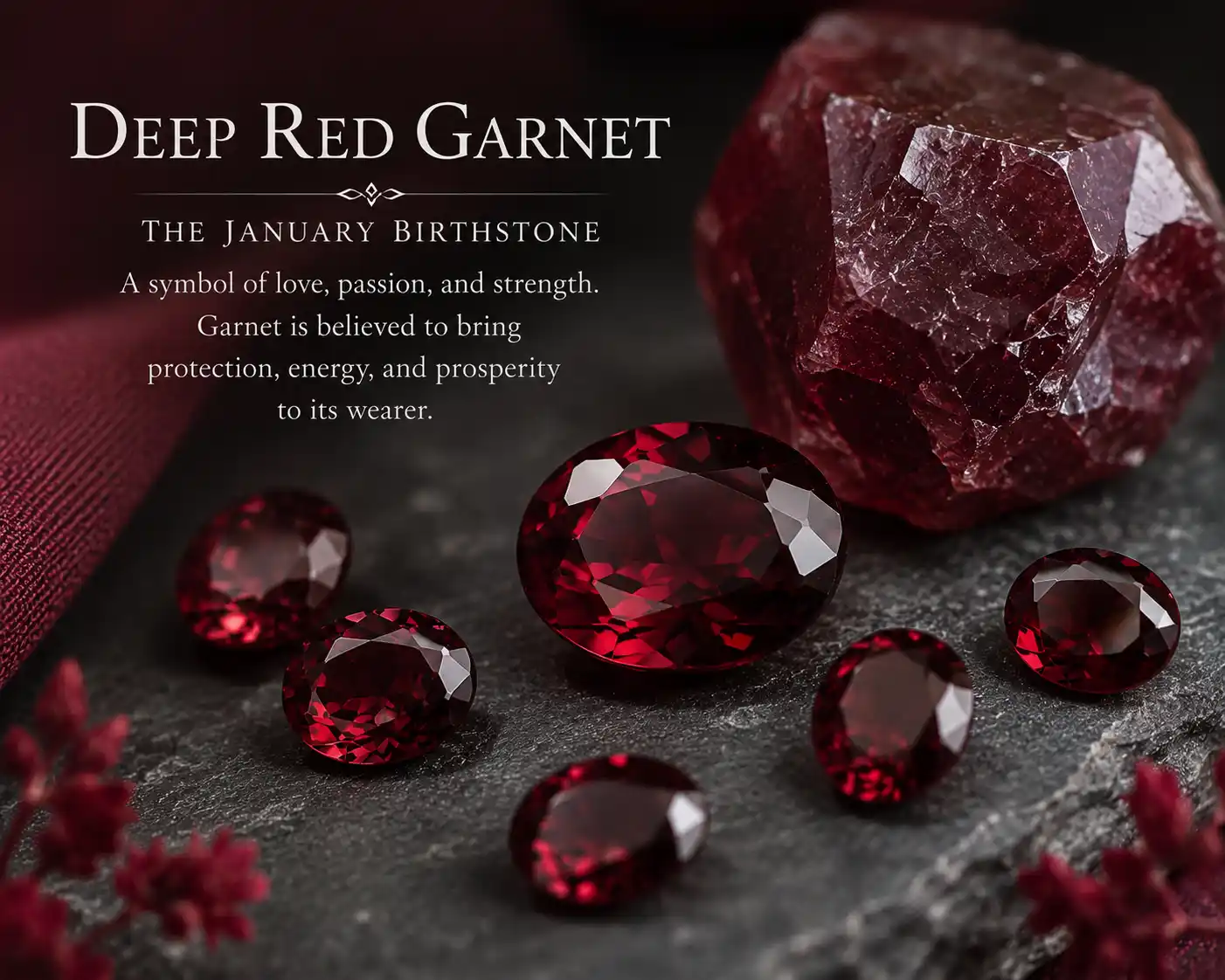
January Birthstone: Garnet’s Meaning, Color & History

Garnet is January’s birthstone, but the name does not describe one uniformly dark-red gem. Garnet is a mineral group whose gem varieties can appear red, purple, pink, orange, yellow, green, brown, colorless, and—in rare cases—blue or color-changing.
Red garnet remains the historic image most closely associated with January. Its resemblance to pomegranate seeds influenced the modern name, while its long use in Egyptian necklaces, Roman signet rings, medieval ornaments, Bohemian jewelry, and Victorian designs gave the stone a history far older than the standardized modern birthstone calendar.
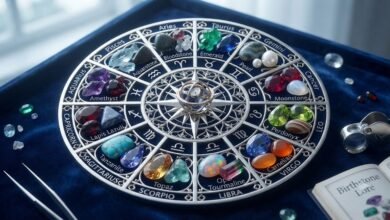
The complete birthstones-by-month guide places garnet within the annual sequence. This page owns the January-specific story: why garnet represents the month, what colors and varieties qualify, how its meaning developed, and what practical properties matter to January-born wearers.
January Birthstone at a Glance
| Feature | January birthstone details |
|---|---|
| Primary birthstone | Garnet |
| Mineral identity | A group of related silicate minerals |
| Best-known color | Deep red |
| Other colors | Purple, pink, orange, yellow, green, brown, colorless and rare blue |
| Common red varieties | Almandine, pyrope and rhodolite |
| Important orange varieties | Spessartine and hessonite |
| Important green varieties | Tsavorite and demantoid |
| Mohs hardness | Approximately 6.5–7.5, depending on composition |
| General toughness | Fair to good |
| Cleavage | No pronounced cleavage in common gem garnets |
| Historical associations | Protection, friendship, constancy, vitality and safe travel |
| Modern anniversary association | Second wedding anniversary |
| Safest routine cleaning | Warm water, mild soap and a soft brush |
| Main buying issue | “Garnet” covers varieties with very different rarity, color and value |
Why Is Garnet the January Birthstone?
The association developed through historical birthstone traditions that linked gemstones with calendar months, religious lists, zodiac signs, talismanic use, color, and jewelry practice.
Modern commercial birthstone lists eventually standardized garnet for January. The choice was practical as well as symbolic: red garnets had a long history in European jewelry, were widely recognized, occurred in sizes suitable for many types of jewelry, and could be sourced across a broad price range.
Unlike months with several accepted modern birthstones, January is strongly centered on garnet. The mineral group’s color diversity now gives January-born buyers many alternatives to the traditional red stone without abandoning the recognized birthstone.
Where the Name Garnet Comes From
The name garnet is commonly connected with the medieval Latin word granatus, meaning grain or seed. The reference points to the resemblance between small red garnet crystals and the glossy red seeds inside a pomegranate.
The comparison is especially convincing for deep red pyrope and almandine. Nevertheless, it can mislead modern buyers into believing that every garnet must be red.
The full garnet meaning guide owns the mineral group’s broader identity, formation, symbolism, and uses.
Garnet Is a Mineral Group
Garnets share a related crystal structure but vary chemically. Several end-member species and natural mixtures produce the colors used in jewelry.
The principal gem-related garnet species include:
- Pyrope
- Almandine
- Spessartine
- Grossular
- Andradite
- Uvarovite
Natural gems often fall between ideal end members. Rhodolite, for example, generally represents a pyrope-almandine mixture rather than a separate mineral species.
The types-of-garnet guide owns the complete species, variety, color, composition, and trade-name classification.
Red January Garnets
Red remains January’s classic birthstone color. However, several garnet compositions produce distinct reds.
Almandine
Almandine garnet commonly appears deep red, brownish red, purplish red, or nearly black in thick material. It is one of the most abundant gem garnets and has supported beads, cabochons, carved stones, and faceted jewelry for centuries.
Fine almandine can be transparent and rich in color, although overly dark stones may show limited brightness.
Pyrope
Pyrope garnet is associated with deep, fiery red and purplish red. Historic Bohemian garnet jewelry often used small pyrope-rich stones clustered closely together.
Its Greek-derived name is commonly interpreted as “fiery-eyed,” an appropriate description for bright red material under warm light.
Rhodolite
Rhodolite garnet usually displays a lighter, more purplish or raspberry-red appearance than traditional dark almandine.
Its combination of transparency, relatively bright tone, and attractive pink-purple component makes rhodolite a popular modern January birthstone choice.
Orange January Garnets
Orange garnets give January-born buyers a warmer alternative to red.
Spessartine
Spessartite garnet ranges from yellowish orange and mandarin orange to reddish orange.
Fine vivid orange material can be rare and valuable. Included stones may show characteristic internal features, but buyers should distinguish attractive inclusions from durability-threatening fractures.
Hessonite
Hessonite is an orange to reddish brown variety of grossular. Its appearance can range from honey and cinnamon to warm amber-like orange.
The internal texture of hessonite may look roiled or granular under magnification, a feature that can help trained gemologists distinguish it from some alternatives.
Green January Garnets
Green garnets demonstrate how far the group extends beyond the pomegranate-red stereotype.
Grossular and Tsavorite
Grossular garnet occurs in colorless, yellow, orange, red-brown, and green material.
Tsavorite is the vivid green grossular variety colored mainly by vanadium and chromium. Fine tsavorite can rival emerald in color while generally offering greater toughness and less routine treatment.
Larger fine tsavorites become increasingly rare, so size can have a strong effect on value.
Demantoid
Demantoid garnet is the green gem variety of andradite. It has high dispersion, which can produce flashes of spectral color when the bodycolor and cut allow them to remain visible.
Some Russian demantoid contains valued horsetail-like fibrous inclusions. Their presence can support origin and collectability in context, but open fractures still reduce durability.
Other Garnet Colors
Garnets can also appear pinkish orange, purple, yellow, brown, nearly colorless, and rare blue-green or blue.
Color-change garnets may shift between greenish, bluish, purplish, reddish, or brownish appearances under different light sources. These stones remain uncommon and should be evaluated separately from ordinary red January jewelry.
The dedicated garnet color meaning guide explains traditional symbolism assigned to red, green, orange, purple, black, and other colors.
From a gemological perspective, color may indicate a likely composition, but laboratory testing provides stronger identification.
Ancient Garnet History
Garnet has been used since the Bronze Age as a gemstone and abrasive.
In ancient Egypt, red garnets appeared in necklaces and personal ornaments, including objects associated with elite and funerary contexts.
Roman engravers carved garnet intaglios for signet rings. The engraved stone could be pressed into wax to secure or authenticate documents.
Ancient writers sometimes used the word carbuncle for glowing red stones. That term did not identify garnet with modern precision and could refer to several red gems.
The dedicated history and origin of garnet owns the complete chronological account. Within the January birthstone story, these early uses explain why red garnet carried strong associations long before modern month lists.
Garnet in the Middle Ages
Red garnet remained popular among clergy, nobility, merchants, and travelers during the Middle Ages.
Traditional lore associated the stone with protection, constancy, guidance, friendship, and safe return. Some stories treated its red glow as a source of illumination or direction, although such accounts belong to legend rather than physical mineral behavior.
Garnet also appeared in religious ornament, seals, rings, brooches, and decorative metalwork.
These associations later helped shape modern birthstone descriptions emphasizing loyalty, protection, vitality, and enduring affection.
Bohemian Garnet and Victorian Jewelry
The development of major red garnet deposits in Bohemia, now part of the Czech Republic, supported a regional cutting and jewelry industry.
Bohemian pyrope became particularly influential during the nineteenth century. Jewelers set numerous small red stones close together in brooches, necklaces, bracelets, hair ornaments, rings, and tiara-like forms.
The clustered designs maximized the visual effect of relatively small gems and created the dense red appearance now associated with Victorian garnet jewelry.
Antique examples require careful inspection. Foil-backed construction, replacement stones, worn prongs, repairs, and closed settings can affect both appearance and care.
January Birthstone Meaning
Traditional and modern sources commonly associate the January birthstone with:
- Protection
- Friendship
- Loyalty
- Constancy
- Vitality
- Passion
- Courage
- Safe travel
- Prosperity
- Renewal
Those meanings developed through historical lore, red color symbolism, religious writing, jewelry traditions, and contemporary crystal practice.
They are not universal across every culture or garnet color. Green tsavorite may receive modern associations with growth and prosperity, while orange spessartine may be linked with creativity or motivation.
Symbolism should remain distinct from medical claims. Wearing garnet has not been scientifically shown to improve circulation, cure inflammation, restore fertility, prevent injury, or treat emotional disorders.
Garnet and January Zodiac Signs
January spans parts of Capricorn and Aquarius.
The Capricorn birthstone guide owns zodiac-specific associations for people born during the Capricorn portion of January.
The Aquarius birthstone guide covers Aquarius traditions for later January birthdays.
Month birthstones and zodiac gemstones are separate systems. A January-born Aquarius can use garnet as a month birthstone even when another gemstone appears in a zodiac list.
Where January Garnets Come From
Different garnet varieties form in different geological environments and occur across many countries.
Red almandine and pyrope are widespread in metamorphic and igneous rocks. Important commercial sources have included India, Sri Lanka, Mozambique, Tanzania, Madagascar, the United States, Brazil, and historical Bohemian deposits.
Spessartine occurs in pegmatites and metamorphic environments, with notable material from Namibia, Nigeria, Mozambique, Tanzania, Madagascar, and other regions.
Tsavorite is associated with metamorphic rocks in East Africa, especially Kenya and Tanzania. Demantoid sources include Russia, Namibia, Madagascar, Iran, Italy, and other localities.
A locality claim should be supported by documentation rather than inferred from color.
Is Garnet Durable Enough for January Jewelry?
Most gem garnets have a Mohs hardness between approximately 6.5 and 7.5. They generally lack pronounced cleavage and provide fair-to-good toughness.
That makes many garnets suitable for rings, earrings, necklaces, pendants, bracelets, brooches, and beads.
Variety and condition still matter. Demantoid lies near the softer end, uvarovite druse is vulnerable because crystals can detach from matrix, and surface-reaching fractures can weaken any garnet.
The dedicated guide, Is Garnet Durable Enough for Everyday Wear?, owns the full comparison of varieties, jewelry forms, impact risks, cleaning equipment, and repair.
Garnet Birthstone Jewelry
January birthstone jewelry can use traditional red garnet or any clearly identified garnet variety.
Rings emphasize color and personal symbolism but encounter the greatest impact. Earrings provide the safest environment for rare or included stones. Necklaces suit larger gems, beads, and antique-inspired designs, while bracelets require attention to contact and stringing.
The dedicated January birthstone jewelry gift guide owns style selection, budgets, metals, sizing, gift occasions, and practical buying decisions.
A January gift does not need to use the darkest possible red. The recipient’s preferred color and lifestyle should guide the variety.
Buying a January Birthstone
The garnet buying guide explains color, clarity, cut, size, treatment, identification, and seller disclosure.
Important questions include:
| Buying question | Why it matters |
|---|---|
| Which garnet variety is it? | Almandine, rhodolite, tsavorite and demantoid have different markets |
| Is the color natural? | Most garnet is untreated, but disclosure remains important |
| Are fractures present? | Surface-reaching fractures affect durability |
| Is the stone too dark? | Some red garnets lose brightness in thick cuts |
| Does the cut return light? | Windowing and extinction reduce appearance |
| Is the locality documented? | Color does not prove origin |
| Does the report match the stone? | Valuable rare garnets may justify laboratory identification |
| Is the price variety-appropriate? | Common red garnet and fine green garnet should not be valued alike |
The dedicated garnet price guide owns market values and price factors.
Cleaning Garnet
Warm water, mild soap, and a soft brush provide the safest general cleaning method.
Ultrasonic cleaning may be suitable for some sound, untreated garnets, but it should be avoided when fractures, filling, delicate antique construction, matrix, or uncertain treatment are present. Steam cleaning is not recommended.
The complete procedure appears in How to Clean Garnet Jewelry Safely.
Questions about soaking, sunlight, saltwater, pools, and long-term exposure belong to Is Garnet Safe in Water and Sunlight?.
Frequently Asked Questions
1. What is the official January birthstone?
Garnet is the standard modern January birthstone.
2. Is January’s birthstone always red?
No. Garnets can be orange, yellow, green, purple, pink, brown, colorless, and rare blue or color-changing combinations.
3. Why is garnet associated with January?
Garnet’s long jewelry history, traditional protective symbolism, broad availability, and established place in modern birthstone lists contributed to the association.
4. What does the January birthstone symbolize?
Common meanings include protection, friendship, loyalty, vitality, courage, constancy, prosperity, and safe travel. These are traditional or symbolic associations.
5. Which red garnet is best for a January gift?
Almandine offers classic deep red, pyrope offers fiery red, and rhodolite provides a lighter raspberry or purplish red. The best choice depends on color preference and budget.
6. Can tsavorite be used as a January birthstone?
Yes. Tsavorite is a green grossular garnet and therefore belongs to the January birthstone group.
7. Is demantoid a January birthstone?
Yes. Demantoid is an andradite garnet and can represent January, although it is rarer and generally more expensive than common red garnet.
8. Is garnet also a wedding-anniversary gemstone?
Garnet is commonly associated with the second wedding anniversary.
9. Is garnet durable enough for a daily ring?
Many garnets can handle regular wear with sensible care. A secure setting, sound stone, and removal during impact-prone activities improve durability.
10. Are January garnets normally treated?
Most garnets are not routinely treated. Rare fracture filling and unusual enhancements can occur, so sellers should still disclose known treatment.
11. Does garnet have scientifically proven healing powers?
No. Garnet’s healing meanings belong to spiritual and traditional practice and should not replace medical or psychological care.
12. Is garnet the same as ruby?
No. Garnet is a silicate mineral group, while ruby is red corundum. Their hardness, composition, optical properties, value, and treatments differ.
January’s birthstone is far more varied than the familiar dark-red image suggests. Red almandine, pyrope, and rhodolite connect the month with its longest jewelry traditions, while orange spessartine, green tsavorite, brilliant demantoid, and rare color-change garnets give modern buyers a much broader palette. The birthstone’s enduring appeal rests on that combination of history, color diversity, practical wearability, and symbolism—not on one shade or one price tier.
Garnet symbolism and crystal-healing traditions are not scientifically established treatments for physical or mental health conditions. Do not use a birthstone to diagnose illness, replace medication or therapy, delay professional care, or guarantee protection, prosperity, recovery, or other outcomes.