

Birthstones connect each calendar month with one or more gemstones, creating a familiar framework for birthday jewelry, personal symbolism and meaningful gifts. Garnet represents January, amethyst marks February, diamond belongs to April and sapphire represents September, while several months have two or three accepted stones.
The modern list did not emerge from one uninterrupted ancient tradition. Religious interpretations, regional customs and jewelry-industry standardization all influenced the chart used today. Consequently, some months have alternatives that differ substantially in color, rarity, durability and price.
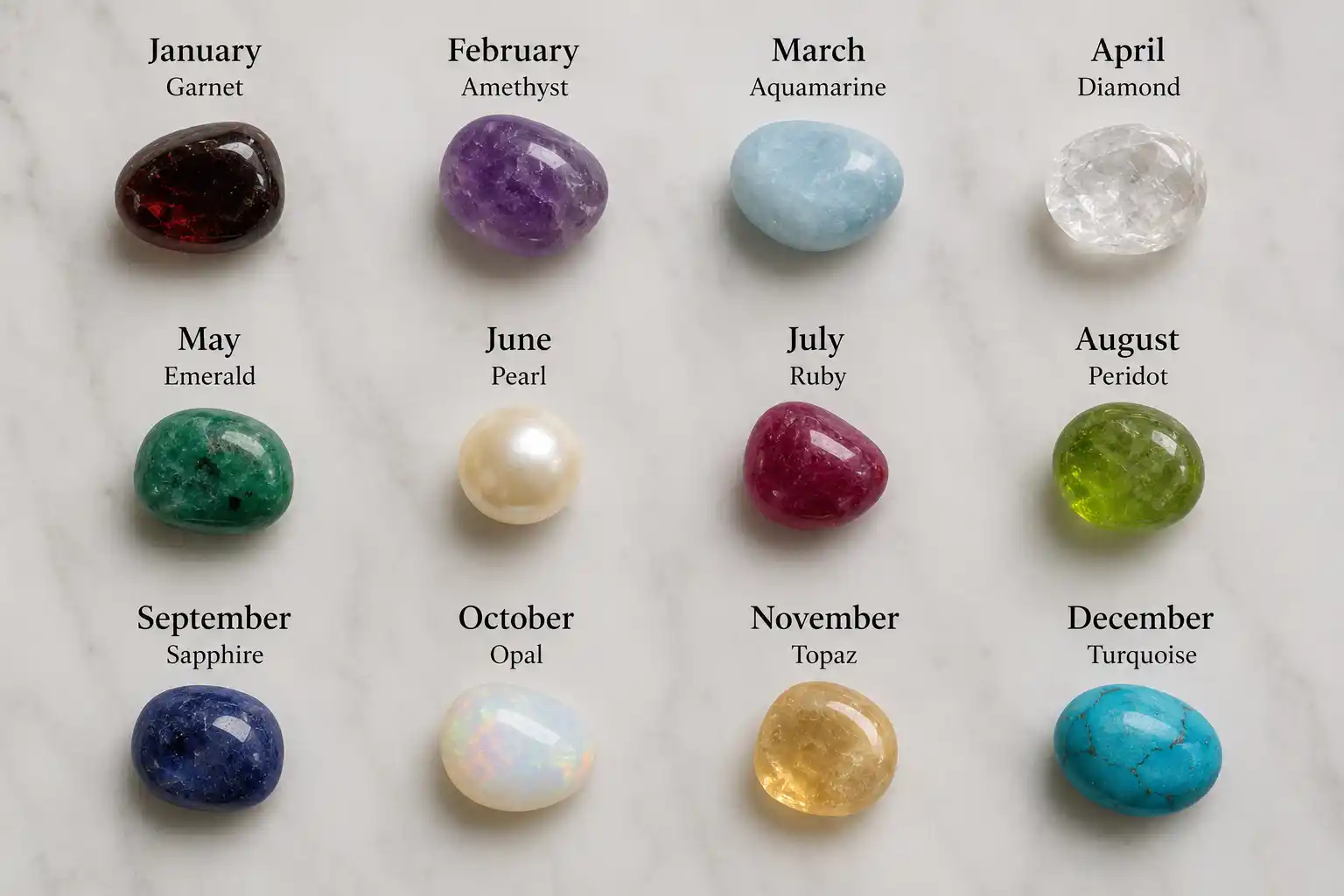
Birthstone Chart by Month
| Month | Recognized birthstone or birthstones | Typical colors |
|---|---|---|
| January | Garnet | Red, orange, green, pink, purple and color-change |
| February | Amethyst | Pale lilac to deep reddish purple |
| March | Aquamarine and bloodstone | Blue to greenish blue; dark green with red markings |
| April | Diamond | Colorless, yellow, brown, black and fancy colors |
| May | Emerald | Green to bluish green |
| June | Pearl, moonstone and alexandrite | White and many pearl colors; white glow; green-to-red color change |
| July | Ruby | Pinkish red to deep red |
| August | Peridot, spinel and sardonyx | Green; many spinel colors; layered red-brown and white |
| September | Sapphire | Blue and nearly every color except red |
| October | Opal and tourmaline | Multicolored play-of-color; nearly every body color |
| November | Topaz and citrine | Yellow, orange, blue, pink, colorless and brown |
| December | Turquoise, tanzanite and zircon | Blue-green, blue-violet and many zircon colors |
Why Do Some Months Have More Than One Birthstone?
Birthstone lists developed through different periods and traditions. Some associations trace back to interpretations of ancient religious gemstone lists, while others grew through regional custom, popular jewelry use and formal industry updates.
Certain historic stones became too rare, expensive or unfamiliar for broad consumer use. Adding alternatives allowed more people to find jewelry in different colors and price ranges.
June demonstrates this flexibility particularly well. Pearl supplies an organic gem with soft luster, moonstone offers a floating optical glow and alexandrite provides rare color change.
August follows a similar pattern. Peridot supplies the signature green stone, spinel offers stronger durability and many colors, while sardonyx preserves an older carved-stone tradition.
Multiple options do not make one stone false or inferior. They reflect the way birthstone customs have changed across time and markets.
Modern Birthstones Versus Older Traditions
The chart most shoppers recognize today is a modern standardized list. However, older charts may substitute or add stones such as lapis lazuli, rock crystal, chrysoprase or other materials.
A traditional label does not always mean that the assignment is older in every country. Different regions preserved different combinations.
For practical purposes, modern birthstones provide the clearest starting point for jewelry purchases. Historical alternatives remain useful when a recipient prefers a different color, has a family tradition or wants an unusual material.
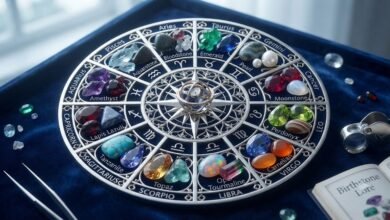
Birthstones also differ from zodiac birthstones. Monthly stones follow the calendar, while zodiac stones follow astrological signs that cross two months.
January Birthstone: Garnet
Garnet is January’s birthstone and one of the most diverse gemstone groups.
Red almandine and pyrope provide the familiar January appearance. However, garnet also occurs as orange spessartite, green tsavorite and demantoid, purple-red rhodolite and several other varieties.
Traditional garnet meanings include commitment, friendship, vitality and protection during travel. Those themes helped it become a popular gift between close companions.
Most garnets work well in earrings, pendants and rings, although durability varies among species and individual stones.
Dark red material can appear nearly black indoors. Therefore, lively color under ordinary light generally matters more than maximum depth of tone.
The January birthstone guide explains garnet varieties, history and selection. The companion January birthstone jewelry guide compares wearable gift formats.
February Birthstone: Amethyst
Amethyst is February’s birthstone and the purple variety of quartz.
Its color ranges from pale grayish lavender to richly saturated violet with red or blue flashes. Angular color zoning is common because purple develops unevenly within the growing crystal.
Amethyst traditionally represents moderation, clear judgment and spiritual reflection. Its historic connection with sobriety survives today as symbolism rather than a literal ability to prevent intoxication.
The gemstone ranks 7 on the Mohs scale and lacks cleavage, making it suitable for many jewelry types. Nevertheless, some material can fade after prolonged intense light or heat exposure.
Large clean crystals are available, so amethyst jewelry can provide substantial size without an exceptional budget.
The February birthstone guide owns its complete birthstone history. Readers choosing a gift can use the February birthstone jewelry guide.
March Birthstones: Aquamarine and Bloodstone
March has two birthstones with completely different appearances.
Aquamarine is transparent blue to greenish-blue beryl. It commonly symbolizes calm communication, courage and safe travel, reflecting its sea-related name and sailor traditions.
Aquamarine ranks 7.5–8 on the Mohs scale and generally has good toughness. Earrings and necklaces provide especially practical formats, while protected rings can handle regular wear.
Heating commonly reduces green or yellow components and leaves a purer blue appearance.
Bloodstone is an opaque chalcedony variety, usually dark green with red iron-oxide spots or patches. Traditional meanings include courage, endurance and vitality.
The March birthstone guide explains how aquamarine and bloodstone share the month. The March birthstone jewelry guide helps match each material with a suitable setting.
For the transparent option’s broader profile, see the aquamarine meaning guide.
April Birthstone: Diamond
Diamond is April’s birthstone and consists of carbon arranged in a cubic crystal structure.
It defines 10 on the Mohs scale, providing greater scratch resistance than any other natural gem material. However, diamond has cleavage directions and can chip from a concentrated blow.
Colorless and near-colorless diamonds remain the most familiar, while yellow, brown, pink, blue, green, red and black stones provide alternatives.
Diamond traditionally represents strength, clarity, commitment and endurance.
Natural and laboratory-grown diamonds share the basic diamond composition and structure. Their formation, rarity, price behavior and documentation differ, so origin must be disclosed clearly.
Cut quality strongly affects brilliance, fire and scintillation. A smaller well-cut stone can look more compelling than a larger poorly proportioned diamond.
The April birthstone guide explains history and the Four Cs. The April birthstone jewelry guide covers rings, earrings, necklaces and alternative materials.
May Birthstone: Emerald
Emerald is May’s birthstone and the green to bluish-green variety of beryl.
Chromium, vanadium or both produce its color. Unlike aquamarine, fine emerald commonly contains visible inclusions and surface-reaching fractures.
Color receives greater attention than flawless clarity. A richly colored emerald with characteristic inclusions may be more desirable than a cleaner but weakly colored stone.
Oil and resin treatments are common because they reduce the visibility of fractures. Treatment type and stability can affect value, cleaning and repair.
Emerald traditionally symbolizes renewal, growth, wisdom and enduring love.
Earrings and pendants protect it more effectively than exposed daily-wear rings. When used in a ring, the gemstone benefits from a protective setting and careful handling.
The May birthstone guide covers its history and quality factors. The May birthstone jewelry guide owns gift-format selection.
June Birthstones: Pearl, Moonstone and Alexandrite
June offers three recognized choices.
Pearl forms within a mollusk and consists largely of calcium-carbonate structures and organic material. Its value depends on luster, surface, shape, size, color and matching.
Cultured pearls include freshwater, Akoya, Tahitian and South Sea varieties. Because their surfaces are soft and chemically sensitive, earrings and necklaces provide safer wear than exposed rings.
Moonstone is a feldspar valued for adularescence, a floating light effect that moves across a properly oriented cabochon.
Its cleavage and moderate hardness require protective settings. White, peach, gray and darker varieties occur.
Alexandrite is a rare color-change chrysoberyl. Fine natural stones shift from green or blue-green in cooler light toward red, raspberry or purple under warmer illumination.
Laboratory-grown alexandrite can produce a stronger and more accessible color-change effect but must be identified by origin.
The June birthstone guide compares all three materials. The pearl meaning guide, moonstone meaning guide and alexandrite meaning guide retain their material-specific profiles.
July Birthstone: Ruby
Ruby is July’s birthstone and the red variety of corundum.
Chromium produces its red color, which can range from pinkish red to deeper red with purple or orange components.
Ruby ranks 9 on the Mohs scale and generally performs well in frequently worn rings. Consequently, it is one of the strongest colored gemstones for daily jewelry.
Traditional symbolism connects ruby with passion, courage, vitality and status.
Heat treatment is common. Glass filling, diffusion and laboratory growth require separate disclosure because they affect value and care differently.
Fine ruby can be exceptionally expensive, but smaller natural stones and clearly disclosed laboratory-grown material provide broader options.
The July birthstone guide owns its history and quality factors. The July birthstone jewelry guide compares ring, earring, pendant and bracelet choices.
August Birthstones: Peridot, Spinel and Sardonyx
Peridot is August’s signature green gemstone.
It is gem-quality olivine colored by iron that forms part of its chemistry. Consequently, peridot always remains within a green-to-yellow-green range.
The stone forms mainly in Earth’s mantle and can reach the surface through volcanic processes. Rare olivine also occurs in meteorites, although ordinary peridot should not be assumed extraterrestrial.
Spinel provides August with a harder and more colorful alternative. It occurs in red, pink, purple, blue, orange, gray, black and other colors.
Red spinel was historically confused with ruby, including in famous royal collections.
Sardonyx is banded chalcedony with contrasting sard and onyx layers. Its structure made it an important material for cameos, intaglios and seals.
The August birthstone guide compares all three. Its companion August birthstone jewelry guide helps select a practical format.
September Birthstone: Sapphire
Sapphire is September’s birthstone.
It is corundum in every color except red, which is classified as ruby. Blue remains the traditional September choice, but pink, yellow, green, purple, orange and colorless sapphires are available.
Sapphire ranks 9 on the Mohs scale, making it one of the strongest gemstones for rings and bracelets.
Traditional meanings include loyalty, wisdom, truth and disciplined commitment.
Heat treatment is common. Diffusion, filling and laboratory growth create distinct disclosure and value categories.
A smaller lively sapphire generally provides better beauty than a large stone that appears overly dark or poorly cut.
The September birthstone guide explains the gemstone’s colors and history. The sapphire meaning guide provides the broader material profile.
October Birthstones: Opal and Tourmaline
October combines two of the gem world’s broadest visual categories.
Opal may display play-of-color, in which spectral flashes move across the surface as the stone or light changes angle. White, black, crystal, boulder, fire and Ethiopian opals have different structures and care requirements.
Some opals are hydrophane, porous or vulnerable to cracking. Doublets and triplets combine thin opal layers with backing and protective components.
Tourmaline occurs in nearly every color. Pink and green are especially associated with October, while rubellite, indicolite, Paraíba-type and watermelon tourmalines occupy distinctive markets.
Tourmaline generally suits most jewelry, although brittle crystals, inclusions and thin shapes require suitable settings.
The October birthstone guide compares both stones. The opal meaning guide and tourmaline meaning guide retain their separate identities.
November Birthstones: Topaz and Citrine
November uses topaz and citrine.
Topaz occurs naturally in colorless, yellow, brown, pink, orange and other colors. Most commercial blue topaz receives irradiation and heat treatment.
The gemstone has Mohs hardness 8 but perfect cleavage. A sharp impact can therefore split or chip it despite its useful scratch resistance.
Citrine is yellow to orange quartz. Natural yellow quartz exists, although much commercial citrine began as amethyst that was heated.
Citrine ranks 7 on the Mohs scale and works in most jewelry formats with sensible care.
Both stones traditionally symbolize warmth, optimism, generosity and prosperity.
The November birthstone guide explains their differences. The topaz meaning guide and citrine meaning guide own their broader mineral profiles.
December Birthstones: Turquoise, Tanzanite and Zircon
December has three blue-associated choices.
Turquoise is an opaque blue to greenish-blue phosphate mineral that may contain visible host-rock matrix. Natural, stabilized, dyed, reconstructed and imitation products occupy different market categories.
Tanzanite is a blue-to-violet variety of zoisite found commercially in a restricted area of northern Tanzania. Most material receives heat treatment to reduce brownish or greenish components.
Its moderate durability makes earrings and pendants safer than exposed everyday rings.
Zircon is a natural gemstone that should not be confused with cubic zirconia. It occurs in blue, colorless, yellow, brown, red and green.
Blue zircon is commonly produced through heat treatment. Zircon can display exceptional brilliance but may show facet-edge abrasion during regular wear.
The turquoise meaning guide, tanzanite meaning guide and zircon meaning guide explain the three materials individually.
Birthstones and Zodiac Signs
A monthly birthstone follows the calendar month. A zodiac birthstone follows an astrological sign, whose date range crosses parts of two months.
For example, Aquarius includes late January and much of February. A month-based approach therefore assigns garnet to January-born Aquarians and amethyst to February-born Aquarians.
A zodiac correspondence list may add several symbolic stones beyond those monthly choices.
Neither system is a scientific predictor of personality, health or future events. The lists function as cultural and symbolic traditions.
The dedicated Aquarius birthstone guide and Aries birthstone guide show how the two systems can be kept separate.
Birthstones and Anniversary Gemstones
Birthstone and anniversary charts occasionally overlap but follow different organizing principles.
Diamond marks April and also appears in anniversary traditions. Ruby represents July and major wedding milestones, while sapphire serves September and later anniversaries.
A gift can combine both traditions when a birthday and anniversary occur together.
The anniversary gemstones by year guide provides the formal sequence. The best anniversary gemstone gifts guide focuses on practical gift selection.
Choosing a Birthstone
Begin with the recipient’s month, then consider the available alternatives.
Color preference should receive strong weight. A June-born person who dislikes pearls may prefer moonstone or alexandrite.
Next, consider durability. Sapphire, ruby, diamond and spinel support frequent rings, while pearl, opal and tanzanite perform better in earrings and pendants.
Treatment and origin also matter. Laboratory-grown diamond, ruby, sapphire and alexandrite can make meaningful birthstone jewelry when disclosed accurately.
Finally, select a piece the recipient will wear. Birthstone status cannot make an uncomfortable ring or unsuitable color into a successful gift.
Birthstone Jewelry Care
Different birthstones cannot be cleaned through one universal method.
Diamond, sapphire, ruby and spinel tolerate regular wear well, although settings still require inspection.
Pearl, turquoise and opal need greater protection from chemicals, soaking and abrasion. Emerald commonly contains fracture treatments that make heat and ultrasonic cleaning risky.
Topaz has cleavage, while moonstone and tanzanite require protection from impact.
The gemstone hardness chart explains scratching, but hardness alone does not settle care. The guide to gemstone toughness versus hardness provides the necessary impact context.
Frequently Asked Questions
1. What are the birthstones for all twelve months?
January is garnet; February is amethyst; March is aquamarine and bloodstone; April is diamond; May is emerald; June is pearl, moonstone and alexandrite; July is ruby; August is peridot, spinel and sardonyx; September is sapphire; October is opal and tourmaline; November is topaz and citrine; December is turquoise, tanzanite and zircon.
2. Why do some months have multiple birthstones?
Lists changed through history, regional tradition and jewelry-industry updates. Alternatives also provide different colors, availability and price levels.
3. Is there one official worldwide birthstone list?
No single global authority controls every cultural tradition, although a widely recognized modern list is used across the jewelry industry.
4. What is the rarest birthstone?
Fine natural alexandrite is among the rarest commonly listed birthstones. Exceptional ruby, emerald, fancy diamond and some opal can also be extremely rare.
5. What is the most durable birthstone?
Diamond has the greatest scratch resistance. Sapphire and ruby also provide excellent durability for everyday jewelry.
6. Which birthstones are best for daily rings?
Diamond, sapphire, ruby and spinel offer the strongest general choices. Other stones can work when protected and worn carefully.
7. Which months have three birthstones?
June, August and December each have three widely recognized stones.
8. Can I wear a birthstone from another month?
Yes. Birthstone traditions do not restrict who can own or wear a gemstone.
9. Can a laboratory-grown gemstone count as a birthstone?
Yes. A laboratory-grown diamond, ruby, sapphire or alexandrite has the relevant gem identity but must be disclosed as laboratory-grown.
10. Are birthstone meanings scientifically proven?
No. Symbolic meanings and traditional powers are cultural beliefs rather than scientifically established effects.
11. Do birthstones have to be natural?
No. Natural, laboratory-grown and accurately identified alternative materials can all carry personal birthstone symbolism.
12. How should I choose between multiple stones for one month?
Compare color, durability, price, treatment, jewelry format and personal meaning. The most wearable option is usually stronger than the most traditional one.
A Calendar Tradition With Room for Choice
Birthstones create an accessible way to connect gemstones with personal dates, but the chart should remain a starting point rather than a rule.
Months with several stones offer useful flexibility, and even single-stone months allow choices in color, origin, size and jewelry style. The best birthstone is the material the wearer understands, likes and can care for—not simply the most expensive entry in the month’s list.