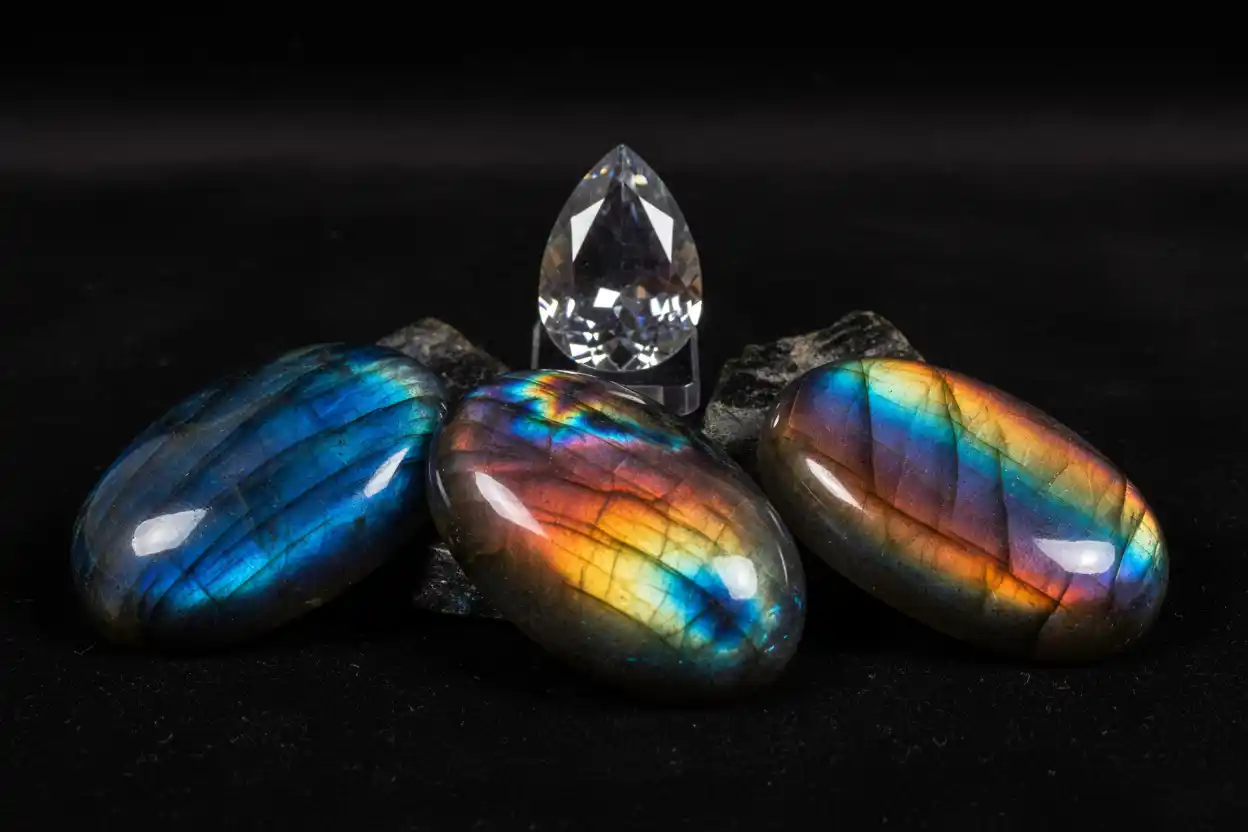
Spectrolite: Meaning, Properties & Symbolism
Spectrolite is the trade name for exceptionally vivid labradorite from Finland, especially material associated with the Ylämaa area in the country’s southeast. It commonly has a dark grey-to-nearly-black body crossed by sharply defined flashes of blue, green, yellow, orange, red, and purple produced by microscopic intergrowths within the feldspar.
Not every colorful labradorite qualifies as spectrolite in the strict trade sense. Material from Madagascar, Canada, or another source may show excellent full-spectrum labradorescence, but Finnish origin remains central to the established name.
Spectrolite at a Glance
| Property | Spectrolite |
|---|---|
| Composition | Calcium-sodium plagioclase feldspar in the labradorite range |
| Group or type | Finnish variety of labradorite; plagioclase feldspar |
| Color | Dark grey, charcoal, blue-grey, or nearly black with blue, green, yellow, orange, red, purple, and multicolor flash |
| Crystal system or texture | Triclinic; lamellar exsolution texture |
| Habit | Blocky, tabular, cleavable masses; commonly part of anorthosite rock |
| Luster | Vitreous to pearly on cleavage surfaces |
| Transparency | Translucent at thin edges to opaque face-up |
| Mohs hardness | Approximately 6–6.5 |
| Cleavage | Two perfect-to-good directions meeting near 90 degrees |
| Tenacity | Brittle |
| Common uses | Cabochons, pendants, rings, earrings, carvings, slabs, display pieces |
| Primary care concern | Cleavage, chipping, surface abrasion, orientation-dependent flash, and undisclosed origin |
What Is Spectrolite?
Spectrolite is a locality-linked variety of labradorite, itself a member of the plagioclase branch of the feldspar group.
Its base mineral consists of a solid solution between sodium-rich albite and calcium-rich anorthite. Labradorite occupies an intermediate-to-calcium-rich portion of that compositional series.
The word spectrolite refers to the unusually wide spectral range shown by fine Finnish material. Blue and green are common, but top pieces may also display yellow, orange, copper-red, violet, and several colors at once.
The name should not be used as a generic synonym for every high-quality labradorite. Finnish origin, strong dark-body contrast, and broad saturated labradorescence define its established trade identity.
Spectrolite belongs among phenomenal materials in the wider guide to types of gemstones. It is also included in the crystals that start with S and gemstones that start with S directories.
Spectrolite Versus Ordinary Labradorite
All spectrolite is labradorite, but not all labradorite is spectrolite.
Ordinary commercial labradorite commonly comes from Madagascar and displays blue, green, or blue-green flash over a medium-to-dark grey body. Orange, yellow, and multicolor pieces also occur.
Finnish spectrolite usually has a darker body and a stronger surface-like iridescence. Opaque iron-oxide inclusions reduce the depth to which light travels, making the colors appear close to the polished surface.
Fine examples may display sharp boundaries between blue, green, gold, red, and purple areas. These geometric zones can look almost painted, though the color arises inside the feldspar.
Origin remains the decisive naming boundary. A spectacular Madagascar stone is still Madagascar labradorite unless the term spectrolite is being used loosely or incorrectly.
The dedicated labradorite price guide owns broader labradorite valuation. Spectrolite usually occupies the upper end of that family when origin and quality are credible.
How Labradorescence Forms
Spectrolite’s color is not ordinary body pigmentation. The phenomenon, known as labradorescence, develops through optical interference inside microscopic intergrowths.
At high temperature, the feldspar can hold a more uniform mixture of sodium-rich and calcium-rich components. During extremely slow cooling, the composition separates into alternating lamellae too small to see without advanced microscopy.
These layers have slightly different refractive indices. Light reflects from multiple internal boundaries, and the reflected waves reinforce or cancel one another according to layer thickness and viewing angle.
Thin paired layers favor blue. Greater periodic thickness produces green, yellow, orange, and red, while gradual changes can create a continuous spectrum.
This nanometer-scale Bøggild intergrowth is highly regular in fine labradorite. Consequently, the reflected color can be intense and sharply bounded.
The effect remains strongly directional. A stone that appears brilliant from one angle may look dark grey when tilted only a few degrees.
Why Finnish Spectrolite Looks So Dark
Many Finnish labradorites contain abundant opaque iron-oxide inclusions. These inclusions darken the body and prevent light from traveling deeply into the stone.
Because the reflected color returns from shallower internal layers, the labradorescence can appear as a vivid coating across the surface.
The dark background also increases visual contrast. Blue, green, gold, red, and purple flashes look brighter against charcoal or black than they would against a pale transparent body.
Darkness alone does not define quality. A piece that remains black from nearly every angle has weak commercial appeal, regardless of origin.
The finest material balances a deep body color with a broad, bright, accessible flash that appears without extreme lighting.
Geological Formation in Finland
Finnish spectrolite occurs in anorthosite and related coarse-grained igneous rocks in southeastern Finland. Anorthosite consists largely of calcium-rich plagioclase feldspar.
These rocks belong to the wider geological environment of the Wiborg rapakivi granite complex, formed roughly 1.6–1.7 billion years ago.
Slow cooling allowed feldspar compositions to unmix into the fine lamellae responsible for labradorescence. Later fracturing, uplift, and erosion exposed the rock close enough to the surface for quarrying.
The Ylämaa area became especially associated with spectrolite during the twentieth century. Quarrying related to defensive construction revealed strongly iridescent feldspar, after which Finnish geologists and lapidaries developed the material’s commercial identity.
Mining and cutting later became part of regional craft and jewelry production. Authentic locality information may therefore include Ylämaa, southeastern Finland, or a specific quarry within the region.
Colors and Flash Patterns
Blue remains common and can range from electric cobalt to deep indigo. Green may appear emerald, teal, grass green, or blue-green.
Yellow and gold flashes often form broad plates or wedges. Orange, copper, and red are less common and attract greater collector interest when saturated.
Purple may occur as narrow bands, broad violet areas, or transitions between blue and red. Strong purple and red together are particularly sought after.
A single polished surface can display:
- One broad blue or green sheet
- Split-color zones
- Full rainbow bands
- Concentric or curved flashes
- Geometric blocks
- Feathered color edges
- Multiple colors visible at one angle
- Different color sets under different rotations
Brightness, coverage, color rarity, viewing range, and pattern all affect quality. A small stone with a broad red-purple flash may be more desirable than a much larger piece showing only a narrow blue line.
Spectrolite fits within collections of blue gemstones, green gemstones, and purple gemstones, although no single color category represents its full effect.
Spectrolite Versus Rainbow Moonstone
Rainbow moonstone is also labradorite in most gemological usage, despite its moonstone trade name.
Rainbow moonstone commonly has a colorless, white, or pale body with blue or multicolor iridescence appearing from deeper inside the stone.
Spectrolite has a much darker body, and its color generally appears closer to the surface because opaque inclusions limit light penetration.
Traditional moonstone usually belongs to potassium-rich feldspar intergrowths and shows adularescence—a softer floating light—rather than the sharp spectral zones typical of labradorite.
The labradorite vs moonstone comparison owns the detailed distinction among labradorescence, adularescence, body color, composition, and testing.
Spectrolite Versus Larvikite and Sunstone
Larvikite is an igneous rock composed largely of feldspar. It can show broad silver-blue reflections, but its granular rock texture differs from a single labradorite crystal.
A polished larvikite surface normally contains multiple interlocking mineral grains. Spectrolite is cut from an individual feldspar crystal or a feldspar-dominant area with a coordinated flash.
Sunstone is another phenomenal feldspar. Its aventurescence comes mainly from reflective platelets of copper, hematite, or related inclusions rather than the nanoscale interference structure responsible for labradorescence.
Sunstone sparkle appears as individual flashes or glitter. Spectrolite usually returns a continuous broad sheet of spectral color.
A material can theoretically display more than one optical effect if it contains both suitable exsolution layers and reflective inclusions. Nevertheless, the dominant effect determines the ordinary trade description.
Inclusions and Internal Features
Opaque iron-oxide inclusions contribute to the dark Finnish body color. Under magnification, they may appear as fine dust, plates, clouds, or irregular particles.
Polysynthetic twinning can create parallel lines through feldspar. Cleavage planes, healed fractures, open cracks, and fine internal stress features are also common.
The labradorescent color itself originates from submicroscopic layers and cannot be resolved with an ordinary loupe. A loupe reveals the surrounding inclusions and surface condition rather than the full interference structure.
Some pieces contain pale feldspar zones, black mineral grains, weathered surfaces, or attached anorthosite matrix.
Surface-reaching fractures may be filled with polishing compound, oil, wax, or resin. Bright reflections along a crack should not be confused with true labradorescence.
How to Identify Spectrolite
A credible identification requires two conclusions: the material is labradorite, and its provenance is Finnish.
Labradorite has a hardness around 6–6.5 and two prominent cleavage directions meeting near 90 degrees. Fresh surfaces may show a pearly luster along cleavage.
Specific gravity commonly falls around 2.68–2.72. Refractive indices vary with composition but generally lie near the upper 1.55s to high 1.56s.
Polysynthetic albite twinning can appear as fine parallel lines under magnification or polarized light. These lines support a plagioclase identity.
Labradorescence should move with the stone and arise from within the feldspar. A fixed metallic film, glitter layer, or foil reflection suggests coating or assembly.
Raman spectroscopy, refractive-index testing, specific gravity, microscopy, and chemical analysis can confirm feldspar. They cannot always prove geographic origin without reference data and provenance.
The how to identify crystals guide provides the general testing framework. For valuable spectrolite, a traceable Finnish supply chain may be more useful than a report that identifies only labradorite.
Treatments and Surface Enhancement
Fine spectrolite is generally expected to have natural labradorescence and natural body color. Routine heat treatment does not create the established effect.
Oil or wax may conceal fine scratches and deepen the dark surface. These treatments usually provide only temporary improvement.
Resin can fill fractures, stabilize slabs, or strengthen weak carving rough. Filled cracks may become visible as glossy lines or ultraviolet-reactive zones.
A black backing can intensify contrast in thin cabochons. Backing is not necessarily deceptive when disclosed, but it changes construction and care.
Surface coatings, metallic foil, dichroic films, and resin layers can imitate or exaggerate iridescence. Scratches through a coating may expose the ordinary glass or feldspar beneath.
Doublets may combine a thin labradorite layer with a stronger backing. Glue lines at the girdle and differing lusters can reveal assembly.
The gemstone treatments explained guide covers coating, filling, backing, impregnation, and composite construction.
Synthetic Spectrolite and Imitations
Laboratory-grown feldspar exists for research, but synthetic spectrolite is not an established jewelry category.
Manufactured glass can imitate a dark body and multicolor flash through metallic foil, dichroic layers, iridescent coatings, or embedded glitter.
Resin composites can contain labradorite chips, crushed material, pigment, and reflective film. Such products should be identified as composites rather than solid natural stone.
Coated black glass may appear spectacular in one photograph but show bubbles, mold seams, low hardness, and surface-only color under magnification.
Ordinary labradorite from Madagascar is the most common naming substitution. It is genuine natural feldspar, but it should not be represented as Finnish spectrolite without evidence of origin.
The difference between a natural substitute, imitation, composite, and laboratory-grown material is explained in lab-grown vs natural gemstones.
Cutting and Orientation
Orientation determines whether valuable rough becomes a vivid gemstone or a nearly black polished piece.
A cutter examines freshly wetted surfaces and rotates the rough beneath a directional light to locate the strongest flash plane. The selected face is marked before sawing.
The broad polished surface is generally placed close to the plane that reveals labradorescence. Even a small orientation error can reduce coverage or move the brightest color to the stone’s edge.
Cabochons are often cut with low domes, flat tables, freeform outlines, or gently curved surfaces. Excessively high domes can distort or hide the flash.
Cleavage creates risk during sawing, grinding, drilling, and polishing. The cutter may sacrifice weight to remove cracks and avoid vulnerable directions.
Calibrated shapes waste more rough than freeforms because natural color zones rarely align with standard ovals or rectangles. This is one reason precision-cut multicolor stones can cost more.
A final polish must remove fine scratches without rounding away the carefully oriented face. Surface haze significantly reduces the contrast and sharpness of the phenomenon.
Durability and Jewelry Suitability
Spectrolite has moderate hardness but imperfect toughness. It resists scratches better than calcite, fluorite, and apatite, yet quartz and harder gems can abrade it.
Two strong cleavage directions make impact the larger concern. A blow against a countertop or doorframe can split the stone.
Pendants, earrings, brooches, and protected rings are practical choices. Bezel settings guard exposed edges more effectively than high prongs.
Daily rings remain possible but require realistic expectations. The wearer should remove them before manual work, exercise, cleaning, gardening, and bathing.
Bracelets expose the stone to repeated impact and rubbing. Beads may also strike one another and develop chips around drill holes.
Jewelers should avoid direct torch heat and excessive pressure during setting or repair. Existing fractures and fillers must be identified first.
Spectrolite Value and July 2026 Asking Prices
Spectrolite is generally priced by the finished piece rather than through a consistent per-carat schedule. Color, brightness, flash coverage, pattern, orientation, Finnish provenance, polish, and size matter more than weight alone.
As of July 2026, small commercial cabochons sold as Finnish spectrolite commonly carry asking prices around $10–$40. These pieces often show blue or green flash and may have limited color coverage.
Better documented cabochons with broad blue-green, gold, or multicolor display commonly appear around $40–$120.
Rare purple, orange, red, or strongly rainbow stones with wide-angle flash may ask approximately $120–$300 or more. Current marketplace examples include specialist cabochons priced above $200 when color, size, and Finnish provenance are emphasized.
Commercial rough and small slabs often range from $20–$100, while large color-rich display pieces can reach several hundred dollars.
Finished silver jewelry commonly appears around $100–$400. Designer work, gold settings, exceptional cutting, and rare flash colors can raise the total beyond $500.
Low prices do not automatically indicate imitation, because some small genuine stones are inexpensive. However, a seller offering hundreds of identical “Finnish spectrolite” cabochons without traceable sourcing deserves scrutiny.
Buying Spectrolite
Ask one question before evaluating price: is the material documented as Finnish?
A seller should provide a credible source, supplier history, quarry information, or at least a consistent Ylämaa or southeastern Finland provenance. A generic “spectrolite-grade labradorite” description signals that the name is being used for appearance rather than origin.
Request a video of the exact stone rotating slowly under one fixed white light. The video should include both the best angle and the darker off-angle appearance.
Photographs need to show the front, back, edge, and dry surface. Constantly wet photographs can exaggerate polish and hide scratches.
Evaluate flash coverage as well as color. A rare red flash occupying five percent of the face may be less visually useful than a broad bright green-blue display.
Inspect cleavage cracks, pits, filled fractures, thin edges, and backing. Ask directly about resin, oil, wax, coating, glue, and doublet construction.
A labradorite buying guide provides broader purchasing checks, although Finnish provenance remains the additional requirement for spectrolite.
Cleaning and Storage
Clean spectrolite by hand with lukewarm water, mild soap, and a soft cloth or brush. Rinse briefly and dry it immediately.
Avoid prolonged soaking when fractures, backing, glue, resin, coatings, or uncertain treatments are present.
Do not use steam. Rapid heating and cooling can stress cleavage planes or damage fillers.
Ultrasonic cleaning is also inadvisable for fractured or cleaved feldspar. The guide to gemstones in ultrasonic cleaners explains why vibration can enlarge internal weaknesses.
The dedicated how to clean labradorite jewelry guide owns detailed setting-specific care instructions.
Store each piece in a padded compartment away from quartz, topaz, sapphire, and diamond. Do not allow cabochons to rub face-to-face.
Spectrolite Meaning and Symbolism
Spectrolite’s symbolism is largely modern, shaped by its Finnish origin, dark body, and sudden spectral color.
The contrast between an almost black surface and a hidden rainbow commonly represents unrealized potential, changing perspective, and discovering information that was present but not immediately visible.
Its shifting colors may symbolize adaptability, creativity, curiosity, and the ability to hold several viewpoints at once.
Some contemporary crystal traditions associate spectrolite with intuition, protection, self-trust, or moving through uncertain transitions. Others use it as a reminder to pause and examine a situation from another angle.
Its Finnish setting and visual resemblance to auroral color can also inspire themes of northern landscapes, seasonal change, persistence, and light emerging from darkness.
These meanings belong to cultural, spiritual, and personal interpretation. Scientific evidence does not show that spectrolite treats disease, changes brain function, predicts events, or creates guaranteed protection.
Frequently Asked Questions
1. Is spectrolite a separate mineral?
No. It is a Finnish trade variety of labradorite, which belongs to the plagioclase feldspar series.
2. Must spectrolite come from Finland?
Under the established trade usage, yes. Colorful labradorite from other countries remains labradorite rather than true Finnish spectrolite.
3. What causes spectrolite’s rainbow colors?
Light interferes within nanoscale alternating feldspar layers formed through exsolution during slow cooling.
4. Does spectrolite contain metallic rainbow inclusions?
No. Its broad colors arise from internal interference rather than metal flakes or a surface pigment.
5. Why does spectrolite look black from some angles?
Labradorescence is directional, and opaque inclusions darken the body when the reflective layers are not aligned with the viewer.
6. Is spectrolite rarer than Madagascar labradorite?
Authentic high-quality Finnish material is less widely available, especially when it shows broad red, orange, purple, or full-spectrum flash.
7. Is rainbow moonstone the same as spectrolite?
No. Both are commonly labradorite, but rainbow moonstone has a pale transparent body, while spectrolite has a dark Finnish body and surface-like color.
8. Can spectrolite be faceted?
It can be cut with flat facets or tablets, but cabochons and freeforms usually display its directional flash more effectively.
9. Is spectrolite suitable for an everyday ring?
It can be worn carefully in a protective setting, but cleavage and moderate hardness make unrestricted daily wear risky.
10. Is spectrolite commonly treated?
Most quality material is expected to be untreated, although oil, wax, resin filling, backing, coating, and composite construction can occur.
11. How can Finnish origin be confirmed?
Traceable dealer provenance, quarry documentation, supplier records, and consistent collection history are usually more practical than visual appearance alone.
12. What most affects spectrolite value?
Brightness, color rarity, flash coverage, viewing range, pattern, cutting orientation, surface condition, size, and credible Finnish provenance determine value.
Spectrolite earns its premium when it combines more than a dramatic photograph. Authentic origin, wide-angle color, skilled orientation, and clean disclosure distinguish a serious Finnish gemstone from ordinary labradorite carrying a fashionable label.