Sunstone: Meaning, Healing Properties & Uses
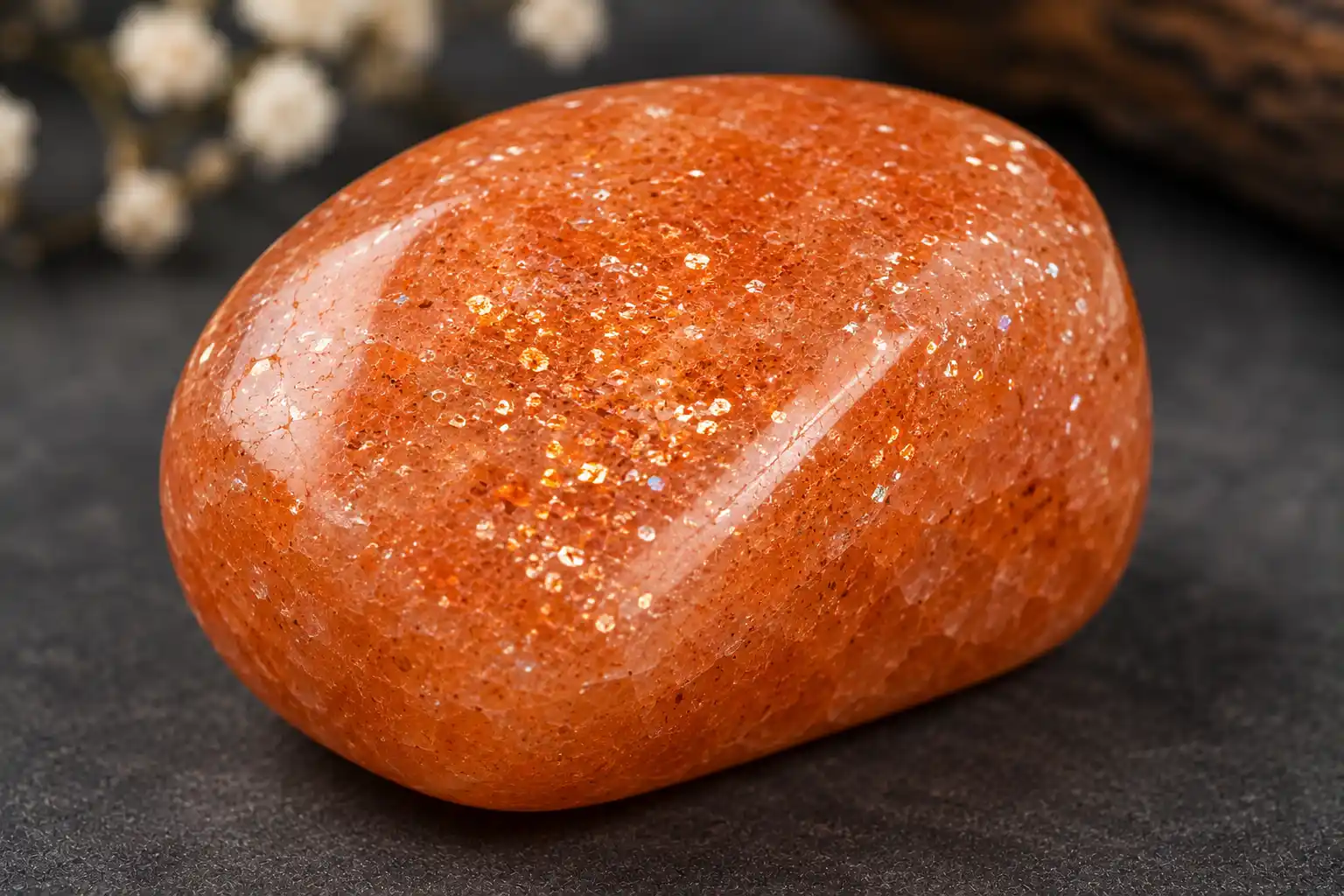
Sunstone is a feldspar gem known for warm peach, orange, red, gold and sometimes green colors, often accompanied by a metallic sparkle called aventurescence. Reflective platelets inside the feldspar catch light and produce glitter, broad flashes or glowing coppery clouds.
The name does not identify one single feldspar species. Sunstone may occur in orthoclase, oligoclase, labradorite and related feldspars, while the celebrated Oregon variety is naturally copper-bearing labradorite.
Sunstone at a Glance
| Property | Sunstone |
|---|---|
| Mineral family | Feldspar |
| Possible feldspar types | Orthoclase, oligoclase, labradorite and related compositions |
| Typical colors | Peach, orange, yellow, gold, red, pink, brown, colorless and green |
| Optical effect | Aventurescence or metallic schiller |
| Common inclusions | Hematite, goethite, ilmenite or native copper |
| Crystal system | Monoclinic or triclinic, depending on feldspar species |
| Luster | Vitreous |
| Transparency | Transparent to opaque |
| Mohs hardness | Approximately 6–6.5 |
| Cleavage | Two prominent directions |
| Fracture | Uneven to conchoidal between cleavage surfaces |
| Common uses | Faceted gems, cabochons, beads, carvings and specimens |
| Main care concern | Scratching, cleavage, impact and thermal shock |
| Important locality variety | Oregon Sunstone |
What Is Sunstone?
Sunstone is a trade and gemological name applied to feldspar that displays a sunlike appearance through color, reflective inclusions or both.
The parent feldspar family includes several of Earth’s most abundant rock-forming minerals. Different Sunstones occupy different parts of that family rather than sharing one fixed chemical formula.
Some material belongs to potassium feldspar, such as orthoclase. Other Sunstone is plagioclase feldspar, including oligoclase or labradorite compositions.
This variation affects refractive index, density, crystal system and inclusion type, although the materials share similar hardness, cleavage and general care needs.
What Causes Aventurescence?
Aventurescence is the glittering or metallic-looking reflection produced by flat inclusions inside a translucent or transparent material.
In many Sunstones, tiny hematite, goethite or ilmenite-related platelets create the flash. The inclusions may appear gold, orange, red or brown.
The platelets are usually oriented along internal structural planes. As the stone turns, they reflect light strongly from some directions and disappear from others.
Dense inclusions can make a stone opaque and intensely glittery. Sparse inclusions may produce isolated flashes inside transparent feldspar.
Oregon Sunstone contains native copper platelets rather than the iron-bearing inclusions typical of many other sources. The complete Oregon Sunstone guide explains that variety’s color and geology.
Sunstone and the Feldspar Family
Feldspar minerals divide broadly into potassium feldspars and plagioclase feldspars.
Orthoclase Sunstone belongs to the potassium-rich side. Oligoclase and labradorite Sunstones belong to the sodium-calcium plagioclase series.
Moonstone is another feldspar gem, but its floating glow is called adularescence. It usually forms through layered feldspar structures rather than metallic platelets.
Labradorite displays labradorescence, a broad spectral optical effect created by light interacting with fine internal layers. Oregon Sunstone has a labradorite composition but is valued largely for copper-related color and schiller.
The guide to types of Sunstone separates these varieties without treating every color as a new mineral species.
How Sunstone Forms
Feldspar crystallizes in igneous rocks, pegmatites and some metamorphic environments.
Sunstone develops when suitable reflective minerals or native metals form or become arranged inside the growing feldspar. The inclusions may separate from the host crystal as it cools, producing thin oriented platelets.
Oregon Sunstone crystallized in basaltic lava flows. As the feldspar developed, copper became incorporated into the crystals and later formed microscopic to visible particles and platelets.
Other Sunstones occur in granitic, pegmatitic and metamorphic settings. The geological environment influences whether the inclusions are copper, hematite or another reflective material.
Weathering can release the feldspar from its host rock, allowing loose crystals and fragments to collect in soil or sediment.
Important Sources
Oregon in the United States is the most famous source of transparent copper-bearing Sunstone. Material comes from volcanic areas in the south-central and southeastern parts of the state.
India supplies substantial peach, orange, reddish and aventurescent Sunstone for beads, cabochons and carvings. The material frequently contains reflective iron-bearing platelets.
Norway has historically produced aventurescent feldspar with reddish or golden flashes. Sunstone also occurs in Tanzania, Madagascar, Canada, Russia, Australia and additional feldspar-bearing regions.
A locality name should be supported by provenance. Color and sparkle alone cannot establish geographic origin.
Oregon Sunstone
Oregon Sunstone is a natural copper-bearing labradorite feldspar. It can occur colorless, pale yellow, pink, salmon, orange, red, green, blue-green or multicolored.
Copper influences both body color and aventurescence. Some stones contain visible metallic platelets, while others show red or green color with little obvious sparkle.
Red-green bicolor and strongly pleochroic gems are especially distinctive. Fine transparent material can be faceted for high-end jewelry.
Oregon Sunstone is also the official state gemstone of Oregon. Its distinct mineral and market identity deserves separate treatment from common opaque peach bead material.
Sunstone Colors
Peach and apricot are the most familiar commercial colors. They may appear translucent with subtle internal glitter.
Orange and reddish-orange material creates a stronger fiery appearance. Brown modifiers become more obvious when the stone is dark or heavily included.
Colorless and pale-yellow Oregon Sunstone can contain brilliant copper schiller. Pink and salmon stones often combine warm body color with reflective inclusions.
Red is among the most sought-after Oregon colors, especially when it remains bright and transparent. Green material is rarer, and red-green combinations can show dramatic zoning.
Sunstone also appears within the orange gemstones guide and red gemstones guide.
Crystal Habit and Rough Appearance
Sunstone rough may occur as blocky feldspar crystals, cleavage fragments, rounded alluvial pieces or massive material.
Transparent Oregon crystals can show flat faces and clear color zoning. Copper platelets may be visible to the unaided eye.
Commercial Indian rough often appears granular or massive with peach body color and numerous reflective specks.
Fresh cleavage surfaces can look smooth and bright. However, cleavage also creates weaknesses that cutters must consider when orienting and polishing the stone.
Physical Properties
Sunstone generally has a Mohs hardness near 6–6.5. It resists some ordinary scratches but remains softer than Quartz.
The gemstone hardness chart shows why household dust can gradually abrade feldspar surfaces.
Two prominent cleavage directions make Sunstone vulnerable to splitting or chipping after a sharp impact. A stone can be reasonably hard while still having limited toughness.
Its luster is vitreous on polished surfaces. Transparency varies from opaque material packed with inclusions to clear faceted gems.
Sunstone Meaning and Symbolism
Modern crystal traditions associate Sunstone with optimism, vitality, independence, confidence and the willingness to be visible.
Its warm color and reflective flashes naturally invite symbolism based on sunlight. Some people use it as a reminder to approach opportunities with openness rather than fear.
The stone is also connected with personal authority. In this context, confidence does not mean controlling other people; it means recognizing personal responsibility and acting according to values.
These meanings belong to spiritual and cultural traditions rather than measurable mineral properties.
Healing Properties in Crystal Traditions
Sunstone is commonly described as a stone of emotional warmth and renewed enthusiasm.
Practitioners may hold it while identifying one action that could restore movement after a period of discouragement. The stone serves as a physical reminder rather than the cause of motivation.
Some traditions associate Sunstone with reducing dependence on external approval. A reflective exercise might involve distinguishing genuine collaboration from the habit of waiting for permission.
Others use the gem during gratitude practices because its sparkle encourages attention to moments of pleasure or progress.
Claims that Sunstone treats depression, hormonal disorders, digestive illness or chronic pain are not supported by clinical evidence.
Solar Plexus Chakra Associations
Sunstone is often linked with the solar plexus chakra because modern chakra systems associate that center with yellow, fire, confidence and purposeful action.
The related solar plexus chakra crystals guide places Sunstone among Citrine, Tiger’s Eye, Pyrite and other symbolic choices.
A person might hold Sunstone during a goal-setting meditation or place it beside a written boundary statement.
Chakras are spiritual concepts rather than anatomical organs, and the gem does not independently create confidence.
Sacral Chakra Associations
Orange Sunstone is also associated with the sacral chakra, a modern symbolic center related to creativity, emotion and adaptability.
The sacral chakra crystals guide compares Sunstone with Carnelian, Orange Calcite and other warm-colored stones.
Some practitioners use it when beginning creative work or rebuilding a sense of play after excessive pressure.
The solar plexus and sacral associations can overlap because Sunstone symbolism combines creativity with the confidence to act.
Meditation and Reflective Uses
A polished Sunstone can serve as a visual focus. Turn it slowly and observe how the flashes appear and disappear.
Use that changing light as a prompt to consider which strengths are already present but not visible in every situation.
Another practice involves naming one opportunity, one fear and one manageable next step. Keep the stone beside the written action until it is completed.
The material does not supply an answer. Its purpose is to make the reflective routine tangible.
Common Uses
Transparent Sunstone is faceted into ovals, cushions, rounds, pears and specialty cuts. Fine Oregon material can appear in high-end designer jewelry.
Opaque and translucent material is cut into cabochons, beads, palm stones, spheres and carvings.
Natural crystals and copper-rich rough are collected as mineral specimens. A well-documented locality specimen may be valuable even when it is not suitable for cutting.
Lapidaries may orient cabochons to show broad aventurescence or cut transparent areas to maximize brilliance and color.
Sunstone Jewelry
Sunstone bracelets keep the warm color visible to the wearer but require impact protection and secure stringing.
Sunstone earrings offer one of the safest formats because they receive little abrasion.
A Sunstone necklace can accommodate larger cabochons and faceted gems while keeping them away from hand impact.
A Sunstone ring requires the greatest protection. Bezel settings and low profiles are preferable for frequent wear.
Yellow and rose gold complement warm colors, while white metal creates stronger contrast with red, green and copper schiller.
Cutting Sunstone
A cutter must orient Sunstone according to color zoning, cleavage and the direction of the reflective inclusions.
If the platelets are viewed edge-on, aventurescence may disappear. The best orientation places the inclusion plane where it will face the viewer.
Cleavage complicates sawing, faceting and polishing. Excess heat or pressure can open a fracture.
Transparent material may be faceted, while heavily included rough generally performs better as a cabochon.
A deep cut can preserve weight but darken the stone. A shallow cut may create a visible window through the center.
Identifying Sunstone
Sunstone should display feldspar properties rather than those of glass or Quartz.
Natural aventurescence is generally directional. The flashes change as the stone turns and may vary in size and concentration.
Goldstone often contains numerous glittering crystals distributed more evenly through manufactured glass. Molded shapes, gas bubbles or unnaturally uniform sparkle may indicate an imitation.
Aventurine is usually Quartz and is harder than feldspar. It may display green, orange, brown or blue colors with different inclusion textures.
The general crystal identification guide explains how hardness, luster, structure and inclusions should be combined.
Sunstone Versus Goldstone
Goldstone is a man-made glass containing metallic crystals. Despite its name, it is not a natural feldspar or a form of Sunstone.
Goldstone’s glitter is often dense, uniform and distributed throughout the glass. Sunstone’s inclusions tend to follow internal structural directions.
Goldstone may contain visible rounded bubbles and has glass-like fracture rather than feldspar cleavage.
Both can be attractive, but sellers should identify them accurately.
Sunstone Versus Aventurine
Aventurine is generally a Quartz variety containing reflective minerals.
Its sparkling effect is also called aventurescence, and the term itself was derived historically from glassmaking rather than from one mineral species.
Aventurine has a Mohs hardness near 7, while Sunstone is usually 6–6.5. Their fracture, feldspar cleavage and inclusion textures differ.
The shared optical word does not mean that the stones belong to the same mineral family.
Treatments and Misrepresentation
Some feldspar in the wider market has been altered through diffusion or other processes to introduce copper-related color.
Material sold as natural Oregon Sunstone should have credible provenance when the price depends on its origin and copper content.
Dyeing, coating, resin filling and imitation glass may occur in lower-cost products. Dye can concentrate in cracks and drill holes.
A seller should disclose treatment and avoid using “Oregon” as a generic quality term.
The Sunstone buying guide covers authenticity, quality and seller questions in detail.
Value Factors
Color, transparency, aventurescence, cutting, size and origin influence value.
Common opaque peach bead material is widely available. Transparent red, green, multicolored and strongly copper-bearing Oregon gems can be much more valuable.
Aventurescence should appear attractively oriented. Dense copper can create an impressive glow but may reduce transparency.
Large fine gems rise in price when color remains vivid and cutting remains lively.
The dedicated Sunstone price guide provides current market context without turning the meaning page into a pricing article.
Cleaning and Care
Use lukewarm water, mild soap and a soft brush. Rinse briefly and dry with a lint-free cloth.
Avoid ultrasonic and steam cleaning. Vibration, high heat, cleavage and hidden fractures can damage the stone.
Do not expose Sunstone to sudden temperature changes or harsh household chemicals.
The complete guide to cleaning Sunstone jewelry explains care for beads, settings and treated material.
For spiritual care, the guide to cleansing and charging Sunstone covers gentle dry methods.
Storage
Store Sunstone separately from Quartz, Spinel, Topaz, Sapphire and Diamond.
Use a padded compartment or fabric pouch. Do not allow loose beads or crystals to strike metal edges.
Natural crystal specimens should be supported so that projecting corners and cleavage surfaces do not bear the full weight.
Sunstone appears in the crystals beginning with S and gemstones beginning with S directories.
Final Perspective
Sunstone is best understood as a feldspar phenomenon rather than one fixed mineral formula. Different feldspar hosts and reflective inclusions create the range from peach glittering beads to transparent red-green Oregon gems.
Its warm appearance explains the modern symbolism of confidence and optimism, but its mineral structure explains how it should actually be handled. Protect the cleavage, choose honest disclosure and let color and aventurescence—not exaggerated claims—determine the quality of the piece.
Frequently Asked Questions
1. What mineral is Sunstone?
Sunstone is an aventurescent variety of feldspar. It may occur in orthoclase, oligoclase, labradorite and related feldspar compositions.
2. What causes Sunstone’s sparkle?
Thin reflective platelets create aventurescence. Many stones contain iron-bearing inclusions, while Oregon Sunstone contains native copper.
3. Is Oregon Sunstone different from ordinary Sunstone?
Yes. It is a natural copper-bearing labradorite from Oregon and can show colorless, yellow, pink, red, green and multicolored appearances.
4. Is Sunstone the same as Goldstone?
No. Sunstone is natural feldspar, while Goldstone is manufactured glass containing metallic crystals.
5. Is Sunstone the same as Aventurine?
No. Aventurine is usually Quartz. Both may display aventurescence, but they have different compositions and physical properties.
6. What does Sunstone symbolize?
Modern traditions associate it with optimism, confidence, independence, creativity and purposeful action.
7. Is Sunstone suitable for everyday jewelry?
It can be worn carefully, particularly in earrings and necklaces. Rings and bracelets require protective settings and more maintenance.
8. Can Sunstone go in water?
Brief washing is normally acceptable for sound untreated material. Avoid soaking stones with fractures, dye, resin, glue or uncertain matrix.
9. Can Sunstone fade in sunlight?
Normal brief wear is generally less concerning than prolonged display, heat or treatment sensitivity. Conservative storage protects both natural and treated material.
10. How can real Sunstone be identified?
Look for feldspar properties, directional natural inclusions, realistic color variation and appropriate hardness. Professional testing is safest for valuable stones.
11. Is green Sunstone natural?
Natural green Oregon Sunstone exists, although it is uncommon. Strong origin and treatment claims deserve documentation.
12. How should Sunstone be cleaned?
Use lukewarm water, mild soap and a soft brush. Avoid steam, ultrasonic equipment, abrasives and sudden temperature changes.
Sunstone’s confidence, abundance, chakra and emotional-healing associations belong to spiritual traditions and are not scientifically established medical effects. Do not use crystals in place of professional healthcare. Feldspar can scratch, cleave and chip, so handle it gently and avoid aggressive cleaning.