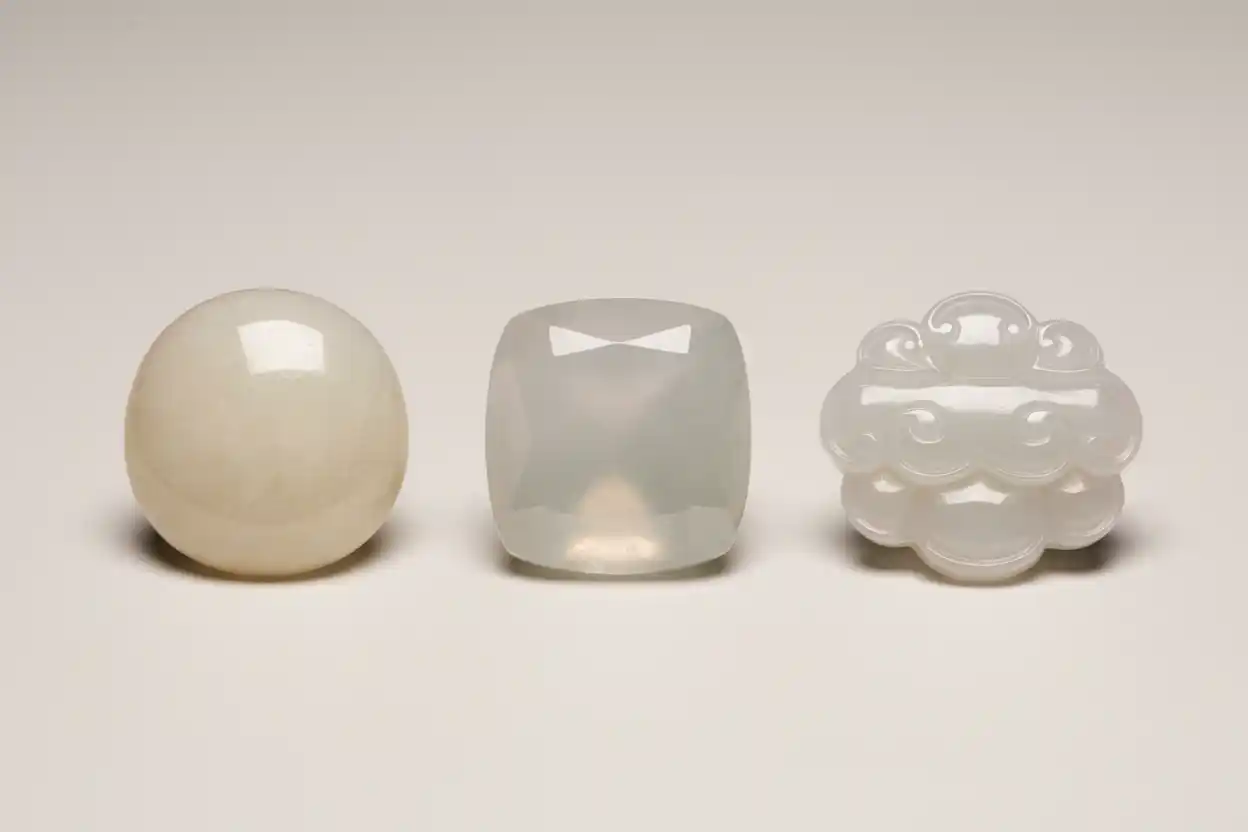
White Jade Meaning, Types, Value and Identification
White jade is a commercial and cultural name that can refer to two different natural materials: white nephrite and white jadeite. Both qualify as genuine jade, yet they differ in mineral composition, internal texture, density, market grading and typical sources.
The most important buying question is therefore not simply whether a stone is white. A seller should identify whether it is nephrite, jadeite, treated material or a pale imitation marketed under a jade-like trade name.
White Jade at a Glance
| Property | White Nephrite | White Jadeite |
|---|---|---|
| Mineral identity | Tremolite-actinolite amphibole aggregate | Jadeite-rich pyroxene aggregate |
| General composition | Ca₂(Mg,Fe)₅Si₈O₂₂(OH)₂ | NaAlSi₂O₆ |
| Typical color | Cream, ivory, gray-white, warm white and occasionally very pure white | Colorless, white, gray-white, icy white or white with colored patches |
| Structure | Interlocking fibrous and felted crystals | Interlocking granular crystals |
| Luster | Waxy to greasy | Vitreous to waxy |
| Transparency | Opaque to translucent | Opaque to highly translucent |
| Refractive index | Approximately 1.606–1.632 | Approximately 1.66 |
| Specific gravity | Approximately 2.90–3.03 | Approximately 3.30–3.36 |
| Mohs hardness | 6–6.5 | 6.5–7 |
| Toughness | Exceptional | Excellent |
| Cleavage in aggregate | Usually inconspicuous because of interlocking texture | Usually inconspicuous in compact aggregate |
| Common use | Bangles, carvings, beads, pendants and ceremonial objects | Cabochons, bangles, beads, carvings and fine jewelry |
| Main buying concern | Imitations, dyed artificial skin and unsupported Hetian claims | Bleaching, polymer impregnation, dye and composite treatments |
What Is White Jade?
Modern gemology uses jade primarily for nephrite and jadeite. Under specific conditions, some green omphacite-rich material may also enter the jade category, but that issue does not define ordinary white jade.
White nephrite is an interlocking aggregate dominated by tremolite. As iron increases toward actinolite, the color typically becomes greener or darker.
White jadeite consists mainly of microscopic jadeite crystals. Pure jadeite is colorless, so low concentrations of coloring elements can produce white or near-colorless material.
The distinction appears in detail in Jadeite vs Nephrite. The broader cultural and mineral context remains with the parent jade guide.
Is White Jade Nephrite or Jadeite?
It can be either.
White nephrite has a long history in China, Central Asia and other cultures. Its exceptionally fine fibrous structure produces a waxy or oily-looking surface.
White jadeite is less common in historical Chinese objects because jadeite entered Chinese markets much later. It can appear chalky and opaque or highly translucent and icy.
The two materials cannot be separated reliably by color. Density, refractive index, internal texture and spectroscopy provide stronger identification.
A listing that says only natural white jade remains incomplete. Buyers should ask which jade material is present.
The parent Types of Jade page classifies the main minerals, colors and commercial categories without duplicating this page’s white-specific intent.
What Makes Jade White?
Pure tremolite is colorless to white. Increasing iron in the tremolite-actinolite series produces green, gray or darker tones.
Therefore, fine white nephrite generally contains relatively little iron and has a dense, evenly interlocked texture.
White jadeite similarly contains low levels of chromium, iron and other coloring elements. Its appearance depends strongly on grain size, transparency and light scattering.
Microscopic pores, crystal boundaries and inclusions create milk-white or cloudy appearances. Finer, more uniform texture generally produces smoother translucence.
Brown, yellow or orange surface areas on river-worn nephrite can form through weathering and iron-oxide staining. This natural skin may add cultural and collector value when its origin is credible.
White Nephrite
White nephrite is typically creamy, ivory, gray-white or warm white rather than paper white.
Its fibers interlock in a felted texture, creating exceptional resistance to breaking. This toughness allowed early craftspeople to carve thin, complex objects with hand tools and abrasives.
Fine material has a smooth, greasy or waxy luster. It may glow softly at thin edges without appearing glassy.
Chinese markets often place the highest value on evenly textured, minimally included white nephrite with a warm, subtle translucence.
However, the phrase white nephrite covers a broad range, from inexpensive carving rough to historically important material valued at extraordinary prices.
Mutton-Fat Jade
Mutton-fat jade is the traditional premium description for exceptionally fine white nephrite.
The term does not mean the stone resembles bright white plastic. Fine material often shows a warm creamy or slightly yellowish white, dense texture and soft oily luster.
It is strongly associated with Hetian or Hotan nephrite from Xinjiang, China, particularly river-worn pebble material known as seed jade.
Authentic naturally weathered skin may appear brown, yellow or orange over the white interior.
Because that skin can increase value, traders sometimes dye ordinary white nephrite or polish primary rough into artificial pebbles.
“Mutton-fat jade” has no universal laboratory grade comparable with a diamond color grade. The term should be supported by nephrite identification, treatment testing, provenance and careful quality evaluation.
White Jadeite and Ice Jade
White jadeite ranges from opaque white to highly translucent, nearly colorless material.
The term ice jade or icy jadeite usually describes high translucence and clean texture rather than one formal mineral variety.
Some icy jadeite appears colorless, while other pieces have faint blue, gray, green or lavender undertones.
Translucent white jadeite can resemble rock crystal, chalcedony or glass, but its density and granular texture differ.
Not every white jadeite qualifies as high-grade ice jade. Opaque chalky material with coarse grains occupies a much lower market tier.
The dedicated jadeite guide retains jadeite mineralogy beyond the white color category.
White Jade Color and Symbolism
White jade has acquired associations with purity, integrity, wisdom, mourning, protection and social status in different cultural settings.
Those meanings developed through long histories of jade carving and ritual use rather than from one universal color rule.
Modern crystal traditions often connect white jade with calm decision-making, fairness and releasing unnecessary mental clutter.
The broader symbolic differences among jade colors belong to the jade color meaning guide.
Cultural associations should be described respectfully rather than reduced to simplistic promises about luck, wealth or health.
How White Nephrite Forms
Nephrite forms when calcium- and magnesium-rich rocks undergo metamorphism or hydrothermal alteration.
One important pathway involves the reaction of dolomitic marble with silica-bearing fluids. Tremolite crystals grow and interlock into compact nephrite.
Another pathway develops along contacts between serpentinite and other rocks, where fluids redistribute calcium, magnesium and silica.
Low iron favors white and pale material. Higher iron generally produces green or gray nephrite.
Pressure and deformation align and intertwine the microscopic fibers, contributing to the material’s unusual toughness.
How White Jadeite Forms
Jadeite forms mainly in high-pressure, relatively low-temperature metamorphic zones associated with subduction.
Oceanic crust and sediments descend beneath another tectonic plate. Fluids and pressure transform sodium- and aluminum-rich components into jadeite-bearing rock.
The material commonly occurs in veins or blocks within serpentinite-related settings.
Myanmar is the dominant historical source of gem jadeite, including white and near-colorless material.
Jadeite formation differs substantially from nephrite formation, even though both materials entered the jade category because of appearance, durability and carving history.
Important White Nephrite Sources
Xinjiang in western China is the most culturally famous source, especially material associated with the Kunlun Mountains and river systems around Hetian.
Russia produces white and pale nephrite, including dense Siberian material used for carving and jewelry.
Canada is a major nephrite producer, although much Canadian material is green. Pale and white material also occurs.
Kazakhstan, Taiwan, New Zealand, Australia and the United States contain additional nephrite deposits.
Origin claims require evidence. A white stone cut and sold in Xinjiang is not automatically Hetian-mined nephrite.
Important White Jadeite Sources
Myanmar remains the most important commercial source of jadeite.
Guatemala produces jadeite in white, green, blue, lavender and other colors, often with different textures from Burmese material.
Japan has historically important jadeite deposits, although production and collecting restrictions limit ordinary commercial supply.
Smaller occurrences exist in Russia, Kazakhstan and other high-pressure metamorphic regions.
Geographic origin can influence value, but species, treatment, texture and translucence matter more than an unsupported country label.
Internal Texture and Inclusions
White nephrite shows interlocking fibers under magnification. Fine material can look remarkably uniform, while coarser material displays visible bundles, cloudy areas and black mineral inclusions.
Graphite, magnetite, chromite and other minerals may create dark spots.
Natural weathered skin can cover part of a nephrite pebble. Its boundary should follow natural surface features rather than forming a flat painted layer.
White jadeite has a granular or interlocking crystalline texture. Coarse grains create a sugar-like appearance, while fine grains improve translucence.
Fractures may contain iron staining, dye, polymer or wax. Under reflected light, heavily treated surfaces can show resinous areas or networks of etched grain boundaries.
Small colored patches are not automatically treatments. Natural green, lavender or brown zones can occur within white jadeite.
White Jade Versus White Quartz
Milky quartz and white chalcedony are common jade imitations.
Quartz has a hardness of 7 and a lower specific gravity than both jadeite and nephrite.
Massive quartz tends to have a glassier luster and lacks nephrite’s fibrous texture.
Chalcedony may have a waxy surface similar to nephrite. However, its refractive index, density and microscopic structure differ.
The comparison principles in Jade vs Jadeite and Real vs Fake Jade help separate these materials.
White Jade Versus Serpentine
Serpentine is widely sold under names such as new jade, Korean jade or mountain jade.
It is generally softer than true jade and often feels waxy or greasy.
Some serpentine contains veins and color patterns that resemble nephrite. However, its density and optical properties differ.
A trade name containing jade does not make serpentine genuine jade.
White Jade Versus Calcite and Marble
White calcite and marble are significantly softer and react with acid.
They can accept detailed carving but scratch and chip more easily than jade.
Names such as Afghan jade may refer to calcite, serpentine or another pale ornamental stone.
A low price and chalky appearance should prompt verification, especially when the seller avoids naming jadeite or nephrite.
White Jade Versus Howlite
Howlite is a white calcium borosilicate commonly marked by gray or black veining.
Its hardness is approximately 3.5, far below jade.
Howlite is porous and readily absorbs dye. It is often used to imitate turquoise but may also appear in white-jade listings.
Identifying Real White Jade
The first goal is to confirm whether the stone is nephrite or jadeite.
A refractive-index reading near 1.61 supports nephrite, while a spot reading near 1.66 supports jadeite.
Specific gravity provides another useful distinction. Jadeite is significantly denser than nephrite.
Microscopy reveals fibrous nephrite texture or granular jadeite structure.
Infrared spectroscopy, Raman spectroscopy and chemical analysis can confirm identity and detect many treatments.
A sound or temperature test cannot prove authenticity. Glass, quartz and treated stone can produce misleading results.
The complete testing workflow appears in Real vs Fake Jade and How to Identify Crystals.
Jade Treatment Categories
Type A Jadeite
Type A jadeite has not undergone polymer impregnation or dyeing. Traditional wax finishing may be accepted within this category.
The designation describes treatment status, not necessarily high quality.
Type B Jadeite
Type B jadeite has undergone chemical bleaching to remove stains and impurities, followed by polymer impregnation to strengthen the etched structure.
The treatment can improve translucence and appearance but may reduce long-term stability.
Type C Jadeite
Type C jadeite has been dyed.
Type B+C Jadeite
This material has undergone both bleaching and polymer impregnation as well as dyeing.
White jadeite may be bleached and impregnated even when no strong colored dye is present.
Treatments Applied to White Nephrite
Nephrite can be waxed, dyed, bleached, coated, filled or impregnated.
Artificial brown or orange skin is especially relevant to white pebble material sold as high-grade Hetian seed jade.
Dye may concentrate in cracks, pits and surface pores.
Cavities can also be filled with polymer or another material before polishing.
Treatment detection may require laboratory spectroscopy because visual inspection alone can miss clear fillers.
The broader treatment framework appears in How to Spot Treated or Synthetic Jade.
Synthetic Jade and Composites
True synthetic jadeite has been produced experimentally, but it does not represent the primary consumer-market problem.
Imitations are much more common. They include quartz, glass, serpentine, calcite, howlite and manufactured ceramic.
Reconstituted products combine jade fragments or powder with resin.
Doublets may place a thin natural jade layer over another material.
Dyed quartzite can resemble translucent white or pale jadeite.
A laboratory report should describe the material and any detectable treatment rather than merely using the word jade.
Cutting and Carving
Jade is generally cut rather than faceted. Cabochons, beads, bangles, plaques, seals and carvings display its texture and toughness.
Nephrite’s interlocking fibers allow very thin or intricate carving without immediate breakage.
Jadeite also has excellent toughness, though coarse or fractured pieces can fail along grain boundaries.
White material requires careful polishing because scratches and orange-peel texture show clearly on a pale surface.
A cutter studies inclusions and colored zones before shaping. Natural skin may be retained deliberately to create contrast and support provenance.
Bangles demand particularly sound rough because hidden fractures can cause failure during cutting or wear.
Hardness, Toughness and Jewelry Suitability
White jade combines moderate hardness with exceptional practical toughness.
Jadeite measures approximately 6.5–7, while nephrite measures approximately 6–6.5 on the gemstone hardness chart.
The difference between hardness and breakage resistance is explained in gemstone toughness versus hardness.
The interlocking structure makes jade far more resistant to breaking than many single crystals with similar hardness.
White jade works well in jade rings, jade necklaces, jade earrings and jade bracelets.
Nevertheless, thin bangles can still crack when dropped onto tile or concrete.
White Jade Prices in 2026
White jade does not have one meaningful per-carat price because the term covers two minerals, numerous treatments and objects valued partly for carving.
Small commercial white nephrite cabochons and beads commonly retail for approximately $5–$50 per piece.
Better untreated white nephrite pendants, bracelets and carvings often range from $100–$1,000.
Fine, evenly textured white nephrite with credible Hetian or Siberian provenance can reach several thousand dollars per carving or jewelry item.
Exceptional documented mutton-fat seed jade can command far higher prices, especially when cultural importance, natural skin and master carving combine.
Commercial opaque white jadeite cabochons may sell for approximately $20–$200.
Fine translucent Type A white or icy jadeite can range from hundreds to several thousand dollars per finished piece.
Top-quality jadeite jewelry with exceptional translucence, carving, provenance or accompanying diamonds may exceed these broad ranges dramatically.
The complete valuation framework remains with the Jade Price Guide.
What Determines White Jade Value?
Correct mineral identification comes first. White nephrite and white jadeite occupy different markets.
Treatment status follows closely. Untreated material generally commands more than dyed, bleached or polymer-impregnated material of similar appearance.
Color should be even and visually pleasing. Fine nephrite may show warm cream rather than stark white.
Texture matters enormously. Fine grains or fibers improve translucence, surface smoothness and polish.
Cracks, black spots, cloudy patches and coarse grains generally reduce value unless the pattern contributes to an artistic carving.
Translucence is especially important for white jadeite, while oily luster and fine texture are central to premium white nephrite.
Carving quality, age, artist, provenance and cultural context can add more value than raw material weight.
Buying Guidance
Use the Jade Buying Guide for the full purchase workflow.
Ask whether the piece is nephrite or jadeite. Avoid listings that use both names interchangeably.
Request treatment disclosure and an independent laboratory report for any expensive item.
Do not accept a generic authenticity certificate that merely repeats the seller’s description.
Inspect white jade under transmitted and reflected light. Look for fractures, coarse texture, dye concentration and polymer-filled areas.
For claimed Hetian seed jade, evaluate provenance and natural skin carefully. Artificially dyed skin is a known market problem.
Compare objects of similar species, treatment, translucence and workmanship rather than using weight alone.
Cleaning, Water, Heat and Storage
Clean jade with lukewarm water, mild soap and a soft cloth or brush.
The complete process appears in How to Clean Jade Jewelry.
Warm, soapy water is the safest general choice because treatment status may be uncertain.
Avoid harsh acids, bleach and strong solvents. They may damage wax, dye, polymer and metal settings.
Ultrasonic and steam cleaning should be avoided when the stone is treated, fractured or mounted in delicate jewelry.
Brief water contact is normally acceptable, but prolonged soaking is unnecessary.
Heat can damage polymer impregnation, wax and adhesive. Never expose jade jewelry to a jeweler’s torch without removing the stone.
Store individual pieces so metal fittings and harder gems do not abrade the polished surface.
Meaning and Symbolism
White jade has long-standing cultural associations that vary by region and historical period.
In Chinese traditions, fine white nephrite has been linked with virtue, refinement, moral integrity, wisdom and social status.
Modern crystal practices commonly associate white jade with calm, fairness, clear judgment and peaceful resolution.
Some people wear it as a reminder to respond thoughtfully rather than react impulsively.
These meanings are cultural, spiritual or personal rather than scientifically demonstrated effects.
White jade also appears in modern lists of white crystals and white gemstones, although its historical significance extends far beyond color-based crystal lists.
Frequently Asked Questions
1. Is white jade real jade?
It can be. Genuine white jade is either white nephrite or white jadeite. Many pale imitations are also sold under jade-like trade names.
2. Is white jade nephrite or jadeite?
Both minerals occur in white. A seller should identify which one is present rather than using jade alone.
3. What is mutton-fat jade?
Mutton-fat jade is a traditional premium term for exceptionally fine, warm white nephrite with dense texture and oily luster.
4. Is mutton-fat jade always from Hetian?
The term is strongly associated with Hetian nephrite, but sellers sometimes apply it loosely. Provenance and testing remain essential.
5. What is ice jade?
Ice jade usually refers to highly translucent jadeite with a clean, icy appearance. It is a trade-quality description rather than a separate mineral.
6. Why is white jade sometimes yellow or cream?
Small amounts of iron, microscopic inclusions and light scattering can produce warm ivory, cream or gray undertones.
7. Is Afghan jade genuine jade?
Often it is calcite, serpentine or another ornamental material. The trade name does not prove nephrite or jadeite.
8. How can white jade be distinguished from quartz?
Jade has different density, refractive index and internal texture. Laboratory testing provides a dependable answer.
9. Is white jade treated?
It can be waxed, bleached, polymer-impregnated, dyed, coated or filled. Treatment is especially important in jadeite grading and nephrite pebble imitations.
10. Can white jade go in water?
Brief cleaning with warm, soapy water is generally safe. Avoid soaking treated, glued or heavily fractured jewelry.
11. How much is white jade worth?
Commercial pieces may cost under $50, while fine untreated nephrite or translucent Type A white jadeite can sell for hundreds or thousands of dollars. Exceptional mutton-fat jade can command much more.
12. Does white jade have scientifically proven healing properties?
No. Its cultural and personal symbolism can be meaningful, but scientific evidence does not establish healing effects.
White jade cannot be evaluated by color alone. The finest purchase begins with a precise mineral name—nephrite or jadeite—followed by treatment testing, texture, translucence, provenance and workmanship. Without those details, even an attractive white carving remains an uncertain material behind a famous name.
White jade appears in Crystals That Start With W and Gemstones That Start With W.