White Gemstones: Names, Meanings, Properties and Uses
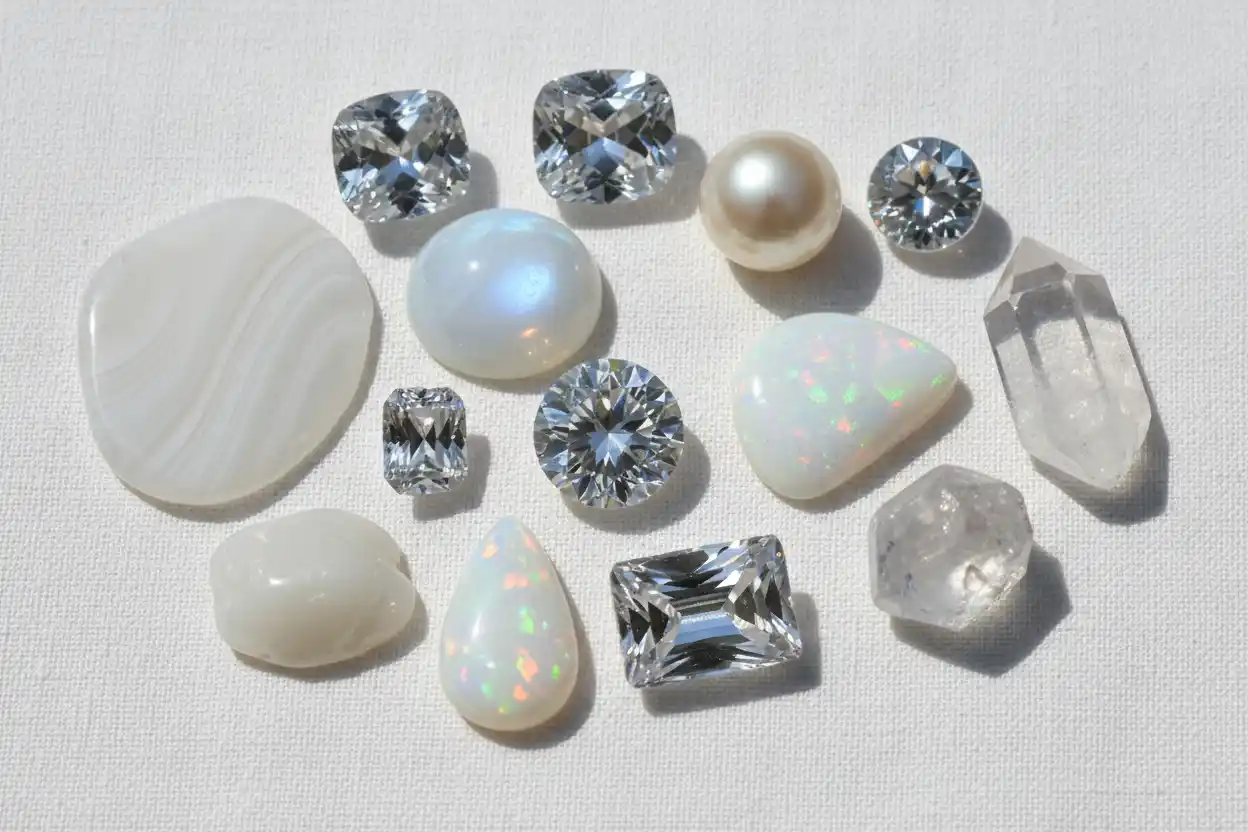
White gemstones include transparent colorless gems, opaque white stones, milky minerals, pearly organic materials and gems with silvery optical effects. Their shared appearance does not make them one mineral family.
Diamond consists of crystalline carbon, White Sapphire belongs to the Corundum family, White Topaz is an aluminum fluorosilicate, Moonstone is Feldspar and Pearl is an organic gem produced by a mollusk. Each has different durability, value, treatment and care requirements.
Within spiritual and cultural traditions, white gemstones commonly symbolize clarity, peace, renewal, sincerity, transition and simplicity. These meanings vary among cultures and individuals and are not scientifically demonstrated healing effects.
The completed white crystals guide owns the wider list of collector crystals and soft display minerals. This article concentrates on materials used as cut gems, cabochons, carvings, beads and jewelry.
What Counts as a White Gemstone?
The white-gemstone market includes three main visual groups.
Colorless transparent gems transmit most visible light without a noticeable body color. Diamond, White Sapphire, White Topaz, Zircon, Goshenite and Rock Crystal fall into this group.
White-bodied gems scatter light and appear milky, snowy, cream or opaque. White Jade, White Agate, Howlite and White Calcite are examples.
Pearly or phenomenal gems show optical effects over a white or colorless body. Moonstone displays adularescence, White Opal may show play-of-color and Pearl reflects light through layers of nacre.
A gemstone may shift between groups. A Moonstone can be transparent with blue sheen, translucent white with silver sheen or nearly opaque and cloudy.
Therefore, the word white should be treated as a visual category rather than a mineralogical definition.
White Gemstones at a Glance
| White gemstone | Material type | Typical appearance | Traditional association | Common use |
|---|---|---|---|---|
| Diamond | Crystalline carbon | Colorless, bright and brilliant | Commitment and endurance | Fine jewelry and engagement rings |
| Laboratory-grown Diamond | Laboratory-grown carbon crystal | Diamond-like brilliance | Innovation and intentional choice | Fine jewelry |
| Moissanite | Laboratory-created silicon carbide | Bright with strong rainbow fire | Individuality and resilience | Engagement and fashion jewelry |
| White Sapphire | Colorless Corundum | Clear with restrained brilliance | Sincerity and discipline | Rings, earrings and pendants |
| White Zircon | Natural zirconium silicate | Brilliant with strong fire | Wisdom and protection | Collector and fine jewelry |
| White Topaz | Colorless Topaz | Bright, clear and glassy | Honesty and clear communication | Affordable jewelry |
| Goshenite | Colorless Beryl | Clear and understated | Truth and openness | Collector gems and jewelry |
| Rock Crystal | Colorless Quartz | Clear to included | Clarity and focused intention | Carvings, jewelry and crystal collections |
| White Spinel | Natural or synthetic Spinel | Clear with crisp brilliance | Renewal and perseverance | Jewelry and collector stones |
| White Moonstone | Feldspar | White body with floating sheen | Cycles and intuition | Cabochons and symbolic jewelry |
| White Opal | Hydrated silica mineraloid | White body with possible spectral flashes | Imagination and change | Cabochons and fine jewelry |
| White Jade | Jadeite or Nephrite | Cream to translucent white | Peace and steady judgment | Carvings, bangles and cabochons |
| White Agate | Chalcedony | White, banded or translucent | Stability and composure | Beads, cabochons and carvings |
| Howlite | Calcium borosilicate hydroxide | White with gray or black veins | Patience and reflection | Beads and ornamental carvings |
| White Calcite | Calcium carbonate | Milky to translucent white | Release and fresh perspective | Display pieces and carvings |
| Pearl | Organic nacreous gem | White with cream, rose or silver overtones | Wisdom and maturity | Necklaces, earrings and rings |
| Mother of Pearl | Organic shell nacre | Pearly white and iridescent | Protection and nurturing | Inlay, carvings and jewelry |
The meanings in this table are traditional associations rather than medical or scientific claims.
Diamond
Diamond is crystalline carbon and the best-known colorless gemstone.
It combines exceptional scratch resistance with high brilliance, fire and scintillation when cut effectively.
Traditional symbolism links Diamond with commitment, endurance, clarity and lasting bonds. Its use in engagement jewelry strengthened those associations, although Diamond has also appeared in ceremonial, royal and religious objects.
Natural Diamonds form deep within Earth and reach the surface through volcanic processes. Laboratory-grown Diamonds form through technological processes that reproduce the pressure-temperature or chemical environment needed for Diamond growth.
Diamond can chip despite its hardness. Cleavage and exposed corners require suitable settings and routine inspection.
Laboratory-Grown Diamond
Laboratory-grown Diamond has the same essential composition and crystal structure as natural Diamond but a manufactured origin.
Within contemporary symbolism, some wearers associate it with technological progress, transparent personal choice and creating new traditions.
Those meanings are modern interpretations rather than properties of the material.
Laboratory-grown Diamond should always be disclosed clearly. It is not a Diamond simulant because it is Diamond, but it is not mined Diamond.
The distinction affects rarity, pricing, supply and resale expectations rather than basic hardness or Diamond identity.
Moissanite
Moissanite used in jewelry is laboratory-created silicon carbide.
Its optical character includes strong brilliance and substantially visible rainbow fire. Consequently, it may appear more colorful than Diamond in direct lighting.
Traditional and modern spiritual interpretations often connect Moissanite with resilience, confidence and choosing an individual path. These associations developed largely through its modern jewelry use.
Moissanite is highly suitable for rings, earrings and pendants because of its durability.
It must be sold as Moissanite rather than laboratory-grown Diamond.
White Sapphire
White Sapphire is colorless or nearly colorless Corundum.
It has Mohs hardness 9, making it one of the most practical white natural gemstones for frequently worn jewelry.
Traditional meanings include sincerity, loyalty, discipline and clear judgment.
White Sapphire has less dispersion than Diamond and Moissanite. Its appearance can feel calmer and less rainbow-filled.
Natural and synthetic White Sapphire both exist. Heat and other treatments should be disclosed when detectable or known.
Its cut has a major effect on brightness because poorly proportioned stones can show central windows.
White Zircon
Natural Zircon is one of the oldest known minerals in Earth’s crust and should not be confused with Cubic Zirconia.
Colorless Zircon has high brilliance and strong fire, which led to centuries of use as a Diamond substitute.
Traditional associations include wisdom, protection, prosperity and restful sleep, although interpretations vary.
Zircon is more brittle and abrasion-prone than Sapphire or Diamond. Facet edges can become worn in rings that receive heavy daily use.
Heat treatment may produce or alter some Zircon colors. Natural-versus-treated appearance can require laboratory evaluation.
White Topaz
White Topaz is colorless Topaz.
It has a clean, transparent appearance with lower brilliance and fire than Diamond, Moissanite or Zircon.
Traditional symbolism connects White Topaz with honesty, direct communication, intention and mental order.
Topaz has Mohs hardness 8 but perfect cleavage. Therefore, it can split after a sharp blow even though it resists many scratches.
It is used in earrings, pendants, bracelets and carefully worn rings.
Names such as Quartz Topaz or Diamond Topaz are misleading when the material is actually Quartz or Topaz rather than the gem implied by the name.
Goshenite
Goshenite is colorless Beryl, placing it in the same mineral family as Emerald, Aquamarine and Morganite.
It commonly appears transparent and understated, with lower dispersion than Diamond.
Traditional meanings emphasize truth, openness, clear speech and simplicity.
Goshenite can make attractive faceted gems, especially when clean and well cut. However, cutting for weight retention can create broad windows.
Coatings, foil backing or assembled stones may alter the appearance of colorless Beryl and should be disclosed.
Its moderate-to-good durability makes it suitable for pendants, earrings and protected rings.
Rock Crystal
Rock Crystal is the historical name for transparent Clear Quartz.
The tracker treats Rock Crystal as a Clear Quartz synonym rather than a separate mineral.
Traditional meanings commonly include clarity, focus, amplification and intention setting. Scientific evidence does not show that Quartz amplifies health effects or the properties of other stones.
Clear Quartz can contain veils, fluid inclusions, negative crystals, Rutile, Tourmaline and many other minerals.
It has Mohs hardness 7 and works for carvings, beads, pendants and occasional rings.
Glass and synthetic Quartz can imitate unusually clear finished pieces.
White Spinel
White or colorless Spinel is a natural magnesium aluminum oxide gem, although truly colorless natural material is uncommon.
Spinel has Mohs hardness 8 and generally good toughness. Its crisp appearance can make it suitable for everyday jewelry.
Traditional associations include renewal, perseverance and restoring enthusiasm.
Synthetic colorless Spinel is more common than high-quality natural material in some parts of the jewelry market. It has also been used to imitate other gems.
A meaningful natural-origin premium should be supported by a gemological report.
White Moonstone
White Moonstone is Feldspar displaying adularescence, a floating light that seems to move beneath the surface.
The body may be colorless, milky white, cream or gray-white, while the sheen can be white, silver or blue.
Traditional meanings focus on cycles, intuition, transition, reflection and emotional awareness.
Moonstone is usually cut as a cabochon because the curved surface displays the optical effect.
Cleavage and moderate hardness make protective settings important.
Rainbow Moonstone is generally transparent Labradorite rather than the same Feldspar composition as traditional orthoclase Moonstone, although both belong to the Feldspar family.
White Opal
White Opal is Opal with a white or light body.
Precious White Opal displays play-of-color, while common White Opal may have no spectral flashes.
Traditional symbolism includes imagination, creativity, adaptation and personal expression.
Opal is hydrated silica rather than a conventional crystal with one regular lattice. Its water content and internal structure contribute to its optical appearance and care requirements.
Heat, dehydration, sudden temperature changes and impact can damage susceptible Opal.
Doublets and triplets contain assembled layers and should be identified separately from solid Opal.
White Jade
White Jade may consist of Jadeite or Nephrite.
Nephrite usually has a fibrous interlocking texture and exceptional toughness. Jadeite is a pyroxene mineral that can range from opaque to highly translucent.
Traditional meanings connect White Jade with peace, fairness, wise decisions and emotional steadiness.
Numerous white stones are sold incorrectly as Jade. Serpentine, Quartz, Calcite, Marble, glass and resin can imitate its appearance.
Bleaching, polymer impregnation, dye and assembled material also occur. A significant purchase should receive a report identifying the Jade species and treatment.
White Agate
White Agate is a white, cream or pale banded variety of Chalcedony.
Its layers may be obvious or extremely subtle. Some stones are translucent at the edges, while others appear nearly opaque.
Traditional associations emphasize composure, stability, gentle boundaries and balance.
White Agate is durable enough for beads, cabochons, carvings and everyday jewelry.
Commercial material may be bleached, dyed, assembled or confused with white Chalcedony.
Its Quartz-family hardness provides better wearability than Calcite, Selenite or Pearl.
Howlite
Howlite is naturally white or cream and commonly marked by gray or black veining.
Traditional meanings focus on patience, calm routines, self-reflection and slowing reactive behavior.
Howlite is porous and frequently dyed blue to imitate Turquoise. White products can also receive resin or coating.
It is softer than Quartz and can scratch in bracelets or rings.
Howlite works best in beads, pendants, worry stones and ornamental carvings that avoid heavy impact.
Its visual veining should continue naturally rather than appear printed onto a resin surface.
White Calcite
White Calcite is a calcium carbonate mineral.
It can appear milky, translucent or transparent and commonly displays rhombohedral cleavage.
Traditional meanings include release, mental openness and viewing a situation from a fresh angle.
Calcite has Mohs hardness 3 and reacts with acids.
It is better suited to display, carving and low-impact decorative use than conventional daily jewelry.
Vinegar, lemon juice, descaling products and acid-based cleaners can etch the surface permanently.
Pearl
Pearl is an organic gem formed when a mollusk deposits layers of nacre around a nucleus or irritant.
White cultured pearls can show cream, rose, silver, green and blue overtones.
Traditional symbolism includes wisdom, maturity, purity, patience and the value of gradual growth.
Pearl quality depends on luster, surface, shape, color, nacre quality, size and matching.
Pearl is soft and chemically sensitive. Apply cosmetics and perfume before putting on Pearl jewelry, and wipe it with a soft damp cloth after wear.
Pearls need occasional exposure to normal humidity and should not be stored in excessively dry conditions.
Mother of Pearl
Mother of Pearl is the iridescent nacreous lining of certain mollusk shells.
It differs from Pearl because it forms as part of the shell rather than as a separate rounded gem.
Traditional associations include nurturing, protection, adaptability and emotional resilience.
Mother of Pearl is used for inlay, beads, watch dials, cameos and lightweight jewelry.
Its thin layers can chip, peel or separate. Acids, cosmetics and abrasion can damage the nacre.
Imitations include coated plastic, glass and printed shell patterns.
White Gemstones for Engagement Rings
The dedicated white engagement-ring stones guide compares daily-wear durability, brilliance, reports and setting requirements.
Diamond, laboratory-grown Diamond, Moissanite and White Sapphire are the strongest mainstream choices.
Spinel, Zircon, Goshenite and Quartz can work for careful wear.
Moonstone, Opal, Pearl and White Topaz require more protection or occasional use.
The best choice follows the wearer’s routine rather than color alone.
White Gemstones for Necklaces
Necklaces place less impact and abrasion on a gemstone than rings.
Therefore, softer materials such as Moonstone, Opal, Pearl, White Calcite and Howlite become more practical.
A pendant can also display unusual shapes, carvings and large cabochons that would feel cumbersome on a hand.
Check the bail, drill hole and backing for stress. Pearl and Mother of Pearl should not rub continuously against rough metal edges.
White Gemstones for Earrings
Earrings are another suitable form for delicate white materials.
Moonstone, Pearl, White Opal, Goshenite and White Topaz can provide light movement and reflective effects without frequent surface contact.
Matched pairs should have comparable color, transparency, optical effect and cut.
Natural stones do not need identical internal patterns. Excessive uniformity can indicate synthetic or manufactured material.
Secure backs and lightweight settings reduce loss and strain.
White Gemstones for Bracelets
Bracelets receive frequent impacts against desks, doors and other jewelry.
Durable choices include Diamond, White Sapphire, Moissanite, White Jade and White Agate.
Howlite, Pearl, Moonstone and Opal require greater care.
Inspect drill holes regularly because friction can weaken cord and create chips.
Avoid stacking soft white materials against Diamond or Sapphire bracelets.
White Gemstones for Carvings
White Jade, White Agate, Rock Crystal, Howlite and Mother of Pearl are established carving materials.
The best choice depends on toughness, grain, transparency and intended detail.
Nephrite supports thin, durable carving better than cleavable Calcite. Rock Crystal takes a bright polish but can fracture around inclusions.
Howlite and Calcite are easier to shape but less resistant to wear.
Large white carvings may be assembled, backed or stabilized. Edge and base photographs help reveal construction.
Choosing White Gemstones by Traditional Meaning
For symbolic clarity, people commonly choose Diamond, Clear Quartz, White Sapphire or White Topaz.
For peace and steady judgment, White Jade and White Agate are frequent choices.
For cycles and transition, White Moonstone is the traditional option.
For creativity and changing perspectives, White Opal is commonly selected.
For maturity and patience, Pearl remains one of the strongest cultural symbols.
For reflective routines, Howlite is popular in worry stones and beads.
These meanings can support personal rituals but should not replace practical decisions, professional advice or medical care.
White Gemstones and Light Performance
White and colorless gemstones can look very different under the same light.
Diamond combines brilliance, fire and sharp scintillation.
Moissanite creates more abundant spectral flashes.
White Sapphire has calmer reflections.
Zircon displays strong fire but may show doubled facet edges.
Goshenite, Topaz and Quartz appear clearer and more glass-like.
Moonstone produces an internal floating sheen, while Opal can display moving spectral patches.
Pearl and Mother of Pearl reflect light through nacreous layers.
Choose the optical effect that appeals naturally rather than expecting every white stone to imitate Diamond.
Treatments and Synthetic Materials
White gemstones may receive:
- Heat treatment
- Irradiation
- Fracture filling
- Polymer impregnation
- Bleaching
- Coating
- Foil backing
- Dye
- Surface waxing
- Assembly into doublets or triplets
Synthetic Sapphire, Spinel, Opal, Quartz and Diamond are manufactured counterparts with broadly corresponding composition and properties.
Moissanite and Cubic Zirconia are manufactured gemstones that commonly serve as Diamond alternatives.
Imitation glass and resin may only reproduce appearance.
The gemstone treatments guide explains the distinctions among natural, treated, synthetic and imitation materials.
Cleaning White Gemstones
Do not use one cleaning method for every white stone.
Diamond, Sapphire, Moissanite and durable Quartz may tolerate mild soap and lukewarm water when untreated and structurally sound.
Opal, Moonstone, Pearl, Mother of Pearl, Howlite and polymer-treated Jade require gentler care.
Avoid steam and ultrasonic cleaning on fracture-filled, glued, porous, cleavable or organic materials.
Acids damage Pearl, Mother of Pearl, Calcite and other carbonate materials.
When identity or treatment is uncertain, use a clean soft cloth and consult a jeweler before applying liquids or machines.
Storing a Mixed White-Gemstone Collection
Store each piece separately.
Diamond and Sapphire can scratch most other white stones.
Pearl and Mother of Pearl need soft pouches and should not contact metal chains or faceted gems.
Opal should avoid extreme dryness and heat.
Moonstone and Topaz need protection from impact and cleavage-related damage.
Retain laboratory reports, invoices and treatment records with the jewelry.
A white appearance makes different stones look compatible, but their physical properties can be radically different.
Frequently Asked Questions
1. What is the most valuable white gemstone?
Fine natural Diamond generally has the largest established market, although exceptional Jadeite, Opal, Pearl and rare collector gems can also be highly valuable.
2. Are white gemstones actually white?
Some have white bodies, while others are transparent and colorless. Moonstone, Opal and Pearl may combine a white body with optical effects.
3. Which white gemstone is hardest?
Diamond is the hardest natural gemstone, reaching 10 on the Mohs scale.
4. Which white gemstone has the most rainbow fire?
Moissanite commonly displays more visible spectral fire than Diamond, while colorless Zircon can also show strong dispersion.
5. Is White Sapphire a Diamond?
No. White Sapphire is colorless Corundum, while Diamond is crystalline carbon.
6. Is White Zircon the same as Cubic Zirconia?
No. Zircon is a natural mineral, while Cubic Zirconia is a manufactured simulant.
7. Is Rock Crystal a separate gemstone from Clear Quartz?
No. Rock Crystal is the traditional name for transparent colorless Quartz.
8. Is White Jade always genuine Jade?
No. Genuine White Jade must be Jadeite or Nephrite. Many white substitutes are marketed inaccurately as Jade.
9. Which white gemstones are best for delicate jewelry?
Pearl, Moonstone, Opal and Mother of Pearl are well suited to earrings and pendants when their care requirements are respected.
10. Can white gemstones be synthetic?
Yes. Laboratory-grown Diamond, Sapphire, Spinel, Quartz and Opal exist, while Moissanite and Cubic Zirconia are commonly manufactured.
11. What do white gemstones traditionally symbolize?
Common associations include clarity, peace, sincerity, renewal, wisdom and new beginnings, although interpretations vary.
12. What should I ask before buying a white gemstone?
Ask for the exact material identity, natural or laboratory origin, treatments, composite construction, durability and return policy.
Let the Optical Effect Define the White Stone
White gemstones do not need to imitate one another. Diamond can sparkle sharply, Moonstone can glow, Opal can flash with spectral color and Pearl can reflect a soft nacreous luster.
Choose the material whose real appearance and care requirements fit the intended jewelry. A correct name and transparent treatment history matter more than whether a seller calls the stone pure white.
Wellness note: Gemstone meanings are cultural and spiritual traditions rather than scientifically proven health effects. Do not ingest stones, prepare gemstone water or use jewelry as a substitute for professional medical or mental-health care.