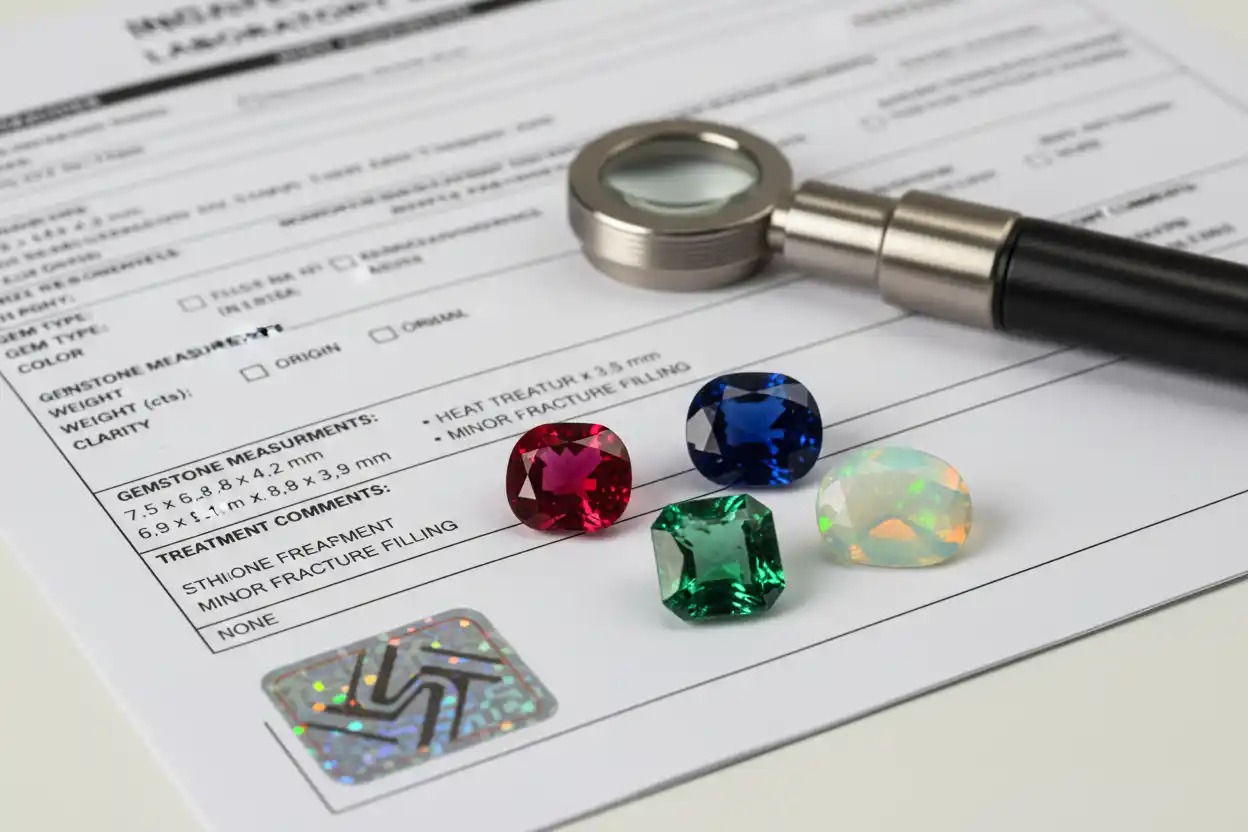
How to Read a Gem Lab Report
A gemstone laboratory report records what an independent laboratory observed and concluded about a specific stone. Depending on the report type, it may identify the material, distinguish natural from laboratory-grown origin, list detectable treatments, describe color and measurements, or offer an opinion about geographic origin.
A report is not automatically a quality grade, appraisal, warranty, mine certificate, or guarantee of future value. Its usefulness depends on the laboratory, service ordered, analytical scope, wording, date, and whether the document matches the gemstone being purchased.
Reading only the headline conclusion can conceal important qualifications. Treatment details, origin limitations, comments, residues, mounting restrictions, and report-verification information often appear elsewhere on the page.
Gem Lab Report Sections at a Glance
| Report field | What it usually tells you | What to verify |
|---|---|---|
| Laboratory name | Who examined the stone | Reputation, independence, and correct website |
| Report number | Unique document identifier | Online verification and matching archived data |
| Date | When the examination occurred | Whether the stone was altered afterward |
| Item description | Loose stone, mounted jewelry, rough, cabochon, or faceted gem | Whether mounting limited the examination |
| Shape and cut | Outline and cutting style | Match with the physical gemstone |
| Weight | Measured carat weight or mounted estimate | Loose versus mounted status |
| Measurements | Length × width × depth | Match with the stone and identify recutting |
| Color | Laboratory description under its procedures | Whether seller wording adds unsupported trade terms |
| Transparency | Transparent, semitransparent, translucent, or opaque | Consistency with the actual stone |
| Identification | Mineral, species, or variety conclusion | Exact wording rather than seller paraphrase |
| Natural or lab-grown | Formation origin | Whether simulants and assembled products were excluded |
| Treatment | Detectable heat, filling, diffusion, dye, coating, or other enhancement | Type, degree, permanence, and care implications |
| Geographic origin | Laboratory opinion about source | Whether origin was requested and determinable |
| Comments | Qualifications and additional observations | Residues, color stability, limitations, or special terminology |
| Photograph | Visual reference | Shape, color, inclusions, and outline |
| Security features | QR code, hologram, watermark, or digital record | Authenticity and tampering |
A Report Is Not the Same as a Certificate
The word certificate is used casually in gemstone sales, but laboratories generally issue reports rather than guarantees.
A report records an expert conclusion based on the specimen, methods, knowledge, reference data, and technology available at the time of examination.
It does not promise that:
- Every seller statement is correct.
- The stone has a specific retail value.
- Its geographic origin is certain beyond all dispute.
- No future test will refine the conclusion.
- The gem will never change or become damaged.
- The report remains valid after recutting or treatment.
- Another laboratory will always reach identical wording.
The gemstone certification labs comparison explains how GIA, AGL, GRS, and other laboratories differ. This page concentrates on interpreting the document already in front of you.
Start With the Laboratory
Before reading the gemstone conclusion, identify who issued the report.
A professional laboratory should provide:
- A verifiable business identity
- Published report services
- Contact information
- Qualified gemological personnel
- Analytical equipment appropriate to the material
- Security features
- Report-verification procedures
- Clear limitations and terms
A retailer’s in-house authenticity card may be useful as a sales record, but it does not carry the same independence as an external laboratory examination.
Unknown laboratories require closer scrutiny, particularly when the stone carries major treatment, origin, or rarity premiums.
Verify the Report Number Online
Many established laboratories maintain an online report-check service or digital archive.
Enter the report number directly on the laboratory’s official website rather than following a seller-provided lookalike link. Compare the archived information with the paper or digital document.
Verify:
- Report number
- Date
- Gemstone identity
- Weight
- Measurements
- Shape
- Color
- Treatment
- Geographic origin
- Photograph, when displayed
Online verification proves that a report number exists and shows what the laboratory archived. It does not prove automatically that the gemstone in front of you is the same item.
Match the Report to the Gemstone
A genuine report can be paired with the wrong stone accidentally or deliberately.
Compare the physical gemstone with:
- Weight
- Length
- Width
- Depth
- Shape
- Cutting style
- Color
- Photograph
- Inclusion pattern
- Chips or cavities
- Mounted or loose status
The carat-versus-millimeter chart helps identify measurements that appear inconsistent with the stated weight or material.
Small measurement differences can result from rounding. Large differences may indicate recutting, an incorrect report, or a switched stone.
Check the Report Date
A report describes the gemstone at the time it was examined.
Afterward, the stone may have been:
- Recut
- Repolished
- Fracture filled
- Oiled again
- Coated
- Irradiated
- Heated
- Mounted
- Removed from a setting
- Chipped or repaired
An older report is not automatically invalid. However, high-value purchases should be rechecked when ownership changes or when the present weight, dimensions, treatment, or condition no longer matches.
Read the Item Description
The document should state whether the laboratory examined a loose faceted stone, cabochon, rough specimen, bead, carving, pearl, or mounted jewel.
Mounted stones can limit access to the pavilion, girdle, back, drill holes, adhesive layers, and exact weight. A laboratory may still identify the gemstone, but some conclusions can be restricted.
A closed setting may conceal:
- Backing
- A doublet or triplet layer
- Filling
- Damage
- Engraving
- Adhesive
- Exact dimensions
- The lower half of a cabochon
The gemstone doublets and triplets guide explains why construction can be difficult to assess in closed settings.
Understand Shape and Cutting Style
Shape describes the outline, such as oval, round, pear, cushion, rectangular, or freeform.
Cutting style describes the facet arrangement or form, such as brilliant cut, step cut, mixed cut, cabochon, bead, carving, or polished slice.
Shape and cut are descriptive rather than automatic quality grades. A report stating oval mixed cut does not mean the stone has excellent symmetry, brilliance, or proportions.
Unless the laboratory provides a dedicated grading service, cut quality must be evaluated separately.
Read the Weight Correctly
A loose stone’s weight is normally measured directly in carats.
For mounted jewelry, the report may omit the weight or use an estimated figure. Determine which applies before comparing the stone with price-per-carat listings.
One carat equals 200 milligrams, but the relationship between weight and visible size depends on density and cut.
Do not assume a report proves that a gemstone faces up well. A deep sapphire or zircon can match its weight perfectly while appearing small.
Compare the Measurements
Gemstone measurements are commonly listed as length × width × depth.
Round stones may use diameter × depth, while irregular or mounted items may receive modified measurements.
Use the dimensions to:
- Match the report to the stone
- Detect possible recutting
- Evaluate face-up spread
- Identify excessive depth
- Plan a setting
- Compare similar weights
- Confirm that photographs show the correct item
A seller should not omit depth when it is available. Length and width alone cannot reveal hidden pavilion weight.
Read the Color Description Literally
A laboratory color description may be broader or more restrained than the seller’s marketing language.
For example, a report may state:
- Red
- Purplish red
- Blue
- Violetish blue
- Greenish blue
- Yellowish green
- Pinkish orange
- Orangy pink
The seller may add pigeon blood, royal blue, vivid, neon, investment color, or another commercial expression.
Determine whether that premium term appears on the laboratory report or only in the listing.
Color descriptions can also vary among laboratories because lighting, master references, terminology, and service policies differ.
Understand the Identification Conclusion
The identification section may state a mineral, species, variety, or trade-recognized material.
Examples include:
- Natural corundum, variety ruby
- Natural beryl, variety emerald
- Natural tourmaline
- Natural opal
- Cultured pearl
- Laboratory-grown sapphire
- Glass
- Composite stone
- Jadeite jade
- Nephrite jade
Preserve the exact wording. Do not convert natural tourmaline into Paraiba tourmaline unless copper-bearing identity is established, or natural corundum into padparadscha sapphire unless the report applies that designation.
Natural Does Not Mean Untreated
Natural describes geological formation. Treatment describes what happened after the gemstone formed or was mined.
A report can correctly state natural ruby and also state:
- Indications of heating
- Lead-glass filling
- Diffusion
- Residues in fissures
- Surface coating
Likewise, natural emerald may be clarity enhanced with oil or resin, and natural turquoise may be stabilized or dyed.
The gemstone treatments guide explains the major enhancement categories and their care implications.
Read Treatment Wording Precisely
Treatment wording carries substantial value consequences.
These phrases do not mean the same thing:
| Report wording | General interpretation |
|---|---|
| No indications of heating | The laboratory did not detect evidence of heat under its examination |
| Indications of heating | Evidence supports heat treatment |
| Heating with minor residues | Heat occurred and a limited amount of foreign residue is present |
| Heating with significant residues | More substantial residue or filling affects the stone |
| Clarity enhanced | Oil, resin, glass, or another material reduces visible fissures |
| Diffusion treated | Color-causing elements were introduced through treatment |
| Surface coated | An applied film contributes to color or appearance |
| Dyed | Color was added through a coloring substance |
| Color stability tested | The laboratory performed a defined stability observation |
| Treatment not determined | The available evidence did not permit a conclusive answer |
“No indications” reflects the laboratory’s observation and methods. It should not be rewritten as guaranteed never treated.
Understand Degrees of Clarity Enhancement
Emerald, ruby, turquoise, jade, opal, and other materials can contain enhancement whose extent matters.
A report may describe treatment as:
- Minor
- Moderate
- Significant
- Insignificant
- Faint
- Prominent
- Type A, B, or C
- H, E, or another laboratory-specific code
Always use the issuing laboratory’s legend or explanatory notes. The same word or letter may not carry identical meaning across different organizations.
An emerald with minor oil and one with significant resin enhancement should not be treated as commercially equivalent.
Read Geographic Origin as an Opinion
A geographic-origin conclusion represents the laboratory’s opinion based on available evidence, reference samples, chemistry, spectroscopy, inclusions, growth features, and current knowledge.
It does not prove:
- The exact mine
- The precise village
- Who extracted the stone
- Ethical working conditions
- Legal export history
- An unbroken supply chain
Origin may also be unavailable for some gem species or inconclusive for atypical material.
A report stating Myanmar, Mozambique, Sri Lanka, Colombia, or another country can influence value, but it should not replace color, transparency, treatment, cutting, and condition.
Not Every Report Includes Origin
An identification report and an identification-and-origin report are different services.
A standard report may identify a natural sapphire and list heat treatment without offering any country conclusion.
Do not treat a blank origin field as proof that the stone came from the seller’s claimed locality.
For origin-sensitive purchases, confirm that the specific origin service was ordered and that the laboratory offers origin determination for that material.
The ruby buying guide and sapphire buying guide explain why treatment and origin premiums require separate evidence.
Read the Comments Section
The comments or additional-information section may contain the most commercially important wording on the report.
It can mention:
- Treatment residues
- Fissure filling
- Color stability
- Assembled construction
- Natural versus artificial color
- Special variety terminology
- Limitations caused by mounting
- Engraving
- Laser inscription
- Unusual inclusions
- Follow-up testing
- Report policies
Never evaluate a document from its headline conclusion alone.
A seller who shares only the front summary while withholding comments may be omitting material information.
Understand Trade Color Terms
Some laboratories provide trade color terminology for selected stones, while others avoid or restrict it.
Terms such as pigeon blood, royal blue, cornflower blue, Paraiba, padparadscha, and vivid green can involve laboratory-specific policies.
The padparadscha sapphire buying guide explains why color balance, stability, and treatment matter before that designation applies.
The Paraiba tourmaline buying guide explains why copper-bearing identity must be established rather than inferred from turquoise color.
Seller-added terms should remain separate from formal report conclusions.
A Report May Not Grade Quality
Many colored-stone identification reports do not assign a complete quality grade.
They may record color and transparency while leaving the buyer to evaluate:
- Saturation
- Tone
- Clarity
- Brilliance
- Windowing
- Extinction
- Symmetry
- Face-up size
- Durability
- Market demand
Some laboratories offer optional colored-stone grading services using proprietary systems. That grade applies within that laboratory’s methodology rather than as one universal global standard.
The broader gemstone-pricing guide explains why a report conclusion cannot determine retail price by itself.
A Report Is Not an Appraisal
A gemological report addresses identity and related findings. An appraisal estimates value for a stated purpose, such as insurance replacement, estate division, resale, or taxation.
A laboratory report may prove that a stone is an unheated natural ruby from Myanmar. It usually does not state what a buyer should pay.
An appraisal may contain a dollar amount but rely on another laboratory’s identification.
For an expensive purchase, use both services appropriately rather than asking one document to perform both roles.
Understand Laboratory-Grown Wording
A report may use terms such as:
- Laboratory-grown
- Synthetic
- Laboratory-created
- Man-made
- Hydrothermal
- Flux-grown
- Flame-fusion
- CVD-grown
- HPHT-grown
Laboratory-grown gems can share essentially the same mineral composition and structure as natural counterparts. Their formation origin, supply, rarity, and pricing differ.
The lab-grown-versus-natural gemstone guide owns the broader buying comparison.
Do not interpret synthetic as imitation. A synthetic ruby is laboratory-grown corundum, while red glass is a simulant.
Read Pearl Reports Differently
Pearl reports may address whether an item is natural or cultured and may describe mollusk environment, growth structure, color treatment, or internal features.
Pearls are usually measured in millimeters rather than evaluated primarily through carat weight.
The pearl buying guide explains luster, surface, nacre, matching, shape, and size. A pearl report can establish formation type and treatment without assigning the complete visual quality of a strand.
Read Opal Reports for Construction
Opal may be solid, boulder, matrix, doublet, triplet, synthetic, treated, or imitation material.
A report can clarify whether dark bodycolor results from natural structure, smoke, dye, sugar-acid treatment, backing, or assembly when detectable.
The opal buying guide explains why side and back inspection remain necessary even when a report accompanies the stone.
Check Security Features
Modern reports may contain:
- Holograms
- Watermarks
- QR codes
- Microprinting
- Embossing
- Laminated security layers
- Digital links
- Report-number databases
- Laser inscription references
Security features should match the issuing laboratory’s published format.
A convincing-looking card can still be counterfeit. Verify the number independently and contact the laboratory when the archived information differs.
Be Careful With Edited or Altered Reports
Warning signs include:
- Different fonts
- Misaligned text
- Changed color fields
- Missing security marks
- Blurred treatment wording
- Cropped comments
- Replaced photographs
- Handwritten alterations
- Incorrect website domains
- Report numbers that return another stone
Request the complete uncropped document rather than a screenshot containing only the seller’s preferred conclusion.
Buying a Gemstone With a Report Online
Before payment, obtain:
- Full front and back images
- Report number
- Online verification result
- Current gemstone photographs
- Weight and dimensions
- Treatment wording
- Origin wording
- Comments
- Return period
- Permission for independent rechecking
Follow the transaction safeguards in how to buy gemstones online.
An expensive stone should be sold subject to confirmation that it matches the report and that no undisclosed treatment or damage occurred after testing.
Frequently Asked Questions
1. Does a gem lab report prove a gemstone is valuable?
No. It can establish identity, treatment, and sometimes origin, but market value also depends on color, clarity, cut, size, demand, condition, and purchase context.
2. Is a gemstone report the same as an appraisal?
No. A report records gemological conclusions, while an appraisal estimates financial value for a defined purpose.
3. What does “no indications of heating” mean?
It means the laboratory did not detect evidence of heating using its procedures and available evidence. It is not an unlimited historical guarantee.
4. Does “natural ruby” mean unheated ruby?
No. A natural ruby can be heated, diffusion treated, glass filled, coated, or otherwise enhanced.
5. Can two laboratories disagree?
Yes. Borderline color designations, treatment interpretation, and geographic-origin opinions can differ because laboratories use different reference data, policies, terminology, and methods.
6. Does an origin report prove the exact mine?
Usually not. It generally offers a country or broad geographic opinion rather than a precise mining location.
7. How can I verify a report?
Use the official laboratory website or contact the laboratory directly, then compare the archived details with the physical gemstone.
8. Can a real report be paired with the wrong gemstone?
Yes. Match weight, measurements, shape, color, photograph, and inclusions rather than trusting the report number alone.
9. Does a report grade gemstone quality?
Some specialized services do, but many identification reports do not provide a complete quality grade.
10. Is an old report still valid?
It may remain useful, but the gemstone should be rechecked if it was recut, treated, repaired, damaged, or transferred in a high-value sale.
11. Can a mounted gemstone receive a report?
Yes, but the mounting can limit weight measurement, pavilion inspection, treatment detection, and construction assessment.
12. Should every gemstone have a laboratory report?
No. Reports are most useful when identity, treatment, origin, rarity, or value justifies the testing cost.
Conclusion
A gem report is most useful when every line is read literally. Verify the laboratory and report number, match the measurements and photograph to the stone, and study treatment and comments before focusing on origin or prestige terminology. The document should reduce uncertainty, not replace visual inspection, seller disclosure, return rights, or independent judgment.