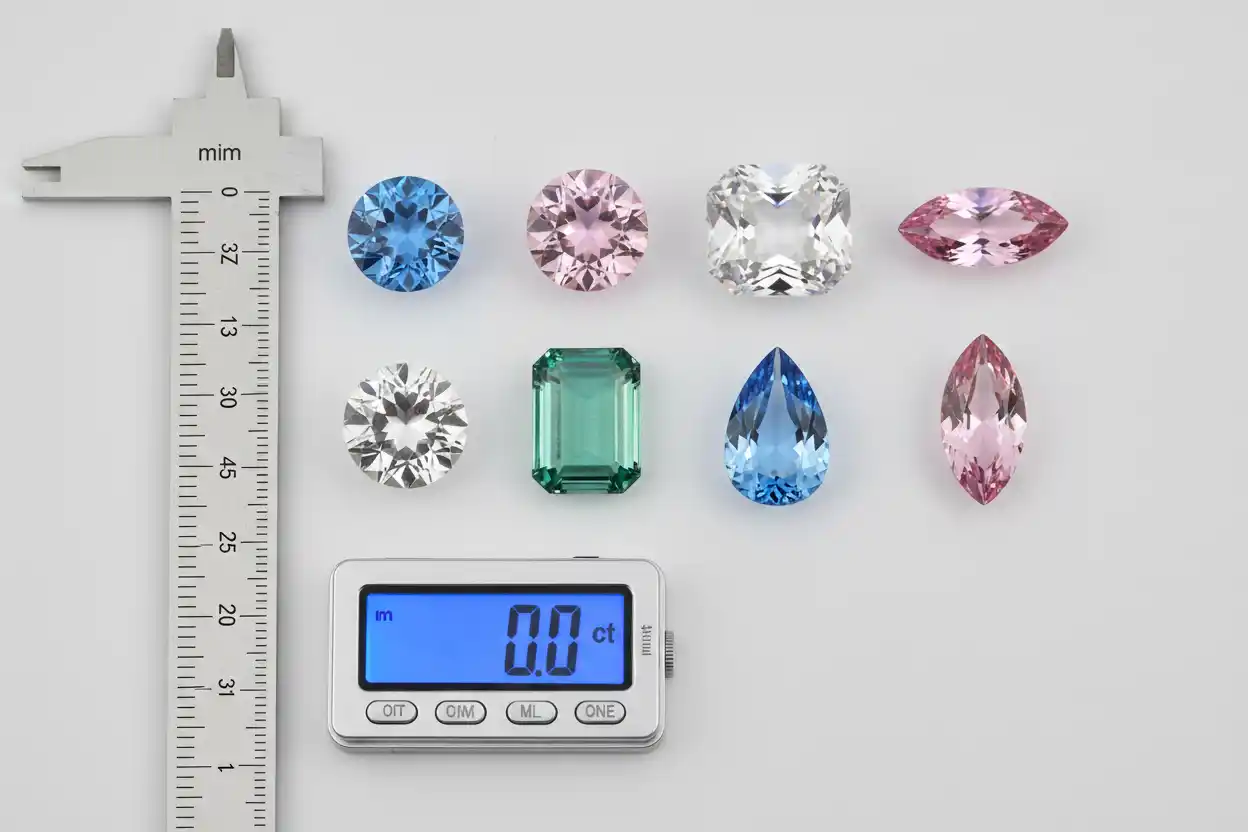
Carat vs Millimeter Size Chart: Gem Dimensions by Shape
A carat vs millimeter size chart is useful because carats and millimeters answer different questions. Carat measures weight, while millimeters measure physical dimensions. A gemstone weighing 1 carat is not automatically a particular width, length, or face-up size, because its density, shape, depth, cutting proportions, girdle thickness, and hidden weight below the girdle all affect how much mass is packed into those dimensions.
That distinction matters whenever you compare loose gemstones, replacement stones, engagement-ring centers, colored gems, calibrated settings, or online listings. Two stones can weigh exactly 1 carat and look substantially different in size. Conversely, two stones measuring 6.5 mm across can have different weights because one is deeper, denser, or cut in a different shape.
The most practical rule is simple:
Use carats to compare mass and millimeters to compare physical fit and visible dimensions.
For valuation and purchasing topics where weight is only one part of the decision, the broader Buying & Value section provides supporting guides.
Carat and Millimeter Are Not Interchangeable Units
One metric cannot be converted universally into the other.
A metric carat equals 0.2 grams, so carat weight is an actual mass measurement:
1 carat = 0.20 grams = 200 milligrams
Millimeters describe length. For a gemstone, a listing may provide dimensions such as:
8.0 × 6.0 × 4.0 mm
For an oval, that generally represents length × width × depth. A round stone may be listed as diameter × depth, while an irregular gem can require several measurements to describe it adequately.
Because one unit measures mass and the other measures distance, a conversion becomes possible only after additional information about shape, volume, proportions, and density is introduced.
Quick Carat vs Millimeter Size Chart for Round Diamonds
Round brilliant diamonds provide the closest thing to a familiar carat-to-millimeter reference because their proportions and density fall within relatively predictable ranges when cut conventionally.
The figures below are practical approximations for normally proportioned round brilliant diamonds. Individual stones can differ.
| Approx. carat weight | Approx. diameter |
|---|---|
| 0.10 ct | 3.0 mm |
| 0.20 ct | 3.8 mm |
| 0.25 ct | 4.1 mm |
| 0.33 ct | 4.4 mm |
| 0.40 ct | 4.8 mm |
| 0.50 ct | 5.1 mm |
| 0.60 ct | 5.4 mm |
| 0.70 ct | 5.7 mm |
| 0.75 ct | 5.8–5.9 mm |
| 0.80 ct | 6.0 mm |
| 0.90 ct | 6.2–6.3 mm |
| 1.00 ct | 6.4–6.5 mm |
| 1.25 ct | 6.9–7.0 mm |
| 1.50 ct | 7.3–7.4 mm |
| 1.75 ct | 7.7–7.8 mm |
| 2.00 ct | 8.1–8.2 mm |
| 2.50 ct | 8.8–8.9 mm |
| 3.00 ct | 9.3–9.4 mm |
| 4.00 ct | about 10.2 mm |
| 5.00 ct | about 11.0 mm |
These are not grading standards. A deep 1-carat round may measure noticeably below 6.5 mm, while a shallow stone may spread wider but sacrifice desirable proportions, durability, or optical performance.
The chart is therefore a screening tool, not proof that a particular stone is well cut.
Approximate Dimensions for 1-Carat Diamond Shapes
Shape changes visible dimensions dramatically because the same mass is distributed differently.
| Diamond shape | Typical approximate dimensions near 1 ct |
|---|---|
| Round | 6.4–6.5 mm diameter |
| Princess | 5.4–5.7 × 5.4–5.7 mm |
| Cushion | 5.8–6.3 × 5.8–6.3 mm |
| Oval | 7.5–8.2 × 5.5–6.0 mm |
| Pear | 8.0–8.7 × 5.3–5.8 mm |
| Marquise | 9.5–10.5 × 4.8–5.3 mm |
| Emerald cut | 6.7–7.2 × 4.8–5.2 mm |
| Radiant | 6.0–6.5 × 5.2–5.8 mm |
| Asscher-style | 5.4–5.7 × 5.4–5.7 mm |
These ranges illustrate face-up geometry rather than prescribe ideal proportions. An elongated oval can appear considerably longer than a round stone of the same carat weight, but some of that apparent size comes from shape rather than greater surface area.
The same principle applies even more strongly to colored gemstones because density varies from one mineral species to another.
Why a 1-Carat Gemstone Is Not Always 6.5 mm
The familiar idea that “1 carat equals about 6.5 mm” comes from normally proportioned round diamonds.
It should not be applied universally.
A 1-carat quartz, sapphire, zircon, opal, tourmaline, or emerald can occupy a different volume because each material has a different specific gravity.
The relationship is:
Weight = volume × density
For two stones with identical shape and dimensions, the denser material weighs more.
For two stones with identical carat weight, the denser material generally occupies less volume.
That single principle explains much of the confusion surrounding gemstone size charts.
Density Changes the Carat-to-Millimeter Relationship
Consider gemstones cut to approximately the same external volume.
| Gem material | Approx. specific gravity | Relative weight at similar volume |
|---|---|---|
| Opal | ~2.1–2.2 | Much lighter than diamond |
| Quartz | ~2.65 | Lighter |
| Beryl | ~2.7–2.8 | Lighter |
| Tourmaline | ~3.0–3.2 | Moderately lighter |
| Diamond | ~3.52 | Reference point |
| Topaz | ~3.5–3.6 | Similar |
| Spinel | ~3.6 | Slightly heavier |
| Grossular garnet | ~3.6 | Slightly heavier |
| Corundum | ~4.0 | Heavier |
| Zircon | commonly ~4.6–4.7 | Substantially heavier |
A round quartz gemstone measuring roughly like a 1-carat diamond will generally weigh less than 1 carat because quartz is less dense.
A zircon with the same external dimensions can weigh substantially more because zircon is much denser.
This is one reason comparing a buy zircon listing directly with a diamond size chart can produce misleading expectations.
Original Decision Matrix: Carat or Millimeters?
The most useful measurement depends on the decision being made.
| Your question | Carat matters most | Millimeters matter most | What else must be checked |
|---|---|---|---|
| Will the stone fit an existing setting? | Low | Very high | Shape, girdle, depth |
| Which stone looks larger face-up? | Moderate | Very high | Outline and depth |
| What is the stone’s actual mass? | Essential | Low | Accurate calibrated scale |
| Is the price per carat reasonable? | Essential | Moderate | Quality and treatment |
| Can two gems use the same mounting? | Low | Essential | Pavilion and girdle geometry |
| Is a gemstone unusually deep? | Moderate | Essential | Cut proportions |
| Does a stone hide weight below the girdle? | High | High | Depth percentage |
| Is one species denser than another? | Moderate | Moderate | Specific gravity |
| Which earring pair looks evenly matched? | Moderate | High | Diameter, depth, color |
| Will a replacement stone fit? | Low | Essential | Exact seat dimensions |
| Does 1 carat look large for the material? | High | High | Density and cut |
| Is an online listing complete? | High | High | Photos, treatment, identity |
The matrix shows why serious buying decisions should rarely use only one measurement.
The Three Measurements That Matter Most
For most loose gemstones, record:
Length × width × depth
For a round gem, diameter and depth are generally sufficient.
For an oval, pear, marquise, rectangle, cushion, emerald cut, or another non-round outline, all three dimensions matter because face-up size and hidden depth can vary independently.
A listing giving only “10 mm stone” is incomplete if the shape is elongated or irregular.
Similarly, a listing stating only “2 carats” says almost nothing about how large the stone will look.
Face-Up Size Is Different From Total Volume
Consumers usually judge apparent gemstone size from the top.
That visible footprint is called face-up size.
A gemstone can have a large face-up outline yet relatively little depth, or a smaller outline with a deep pavilion carrying substantial hidden weight.
Consider two hypothetical round stones:
| Stone | Diameter | Depth | Weight tendency |
|---|---|---|---|
| A | 6.6 mm | 3.6 mm | Shallower, spreads more |
| B | 6.1 mm | 4.2 mm | Deeper, hides more weight |
Stone B can equal or exceed Stone A in carat weight despite appearing smaller from above.
That is why dimensions should accompany weight when a buyer cares about visible size.
Hidden Weight Below the Girdle
A deep pavilion can place considerable mass where it contributes little to face-up spread.
This is sometimes described informally as hidden weight.
Hidden weight is not automatically evidence of bad cutting. Certain gem species, rough shapes, inclusion positions, cleavage constraints, color zoning, optical requirements, or cutting traditions can justify deeper proportions.
However, when two gemstones of similar quality and weight are being compared primarily for visible size, depth becomes important.
A buyer paying a substantial premium for carat weight should know whether that extra mass produces greater visual presence.
Girdle Thickness Changes Weight Too
The girdle is the outer edge separating crown from pavilion.
A very thick girdle adds weight around the perimeter without necessarily increasing visible diameter proportionately. In diamonds, excessive girdle thickness can contribute to a smaller face-up appearance for the carat weight.
Colored gemstones require more nuance.
A somewhat substantial girdle can be mechanically useful for a brittle material, a gem with cleavage, or a stone intended for a particular mounting. Cutting every gemstone to maximize spread can create structural weaknesses.
Therefore:
More spread is not automatically better cutting.
Visible size, optical performance, durability, and weight retention must be balanced.
Shape Can Make Equal-Carat Stones Look Very Different
Elongated outlines frequently look larger than compact ones at the same weight because length creates visual presence.
An oval, pear, or marquise can therefore appear larger than a round stone of comparable carat weight.
Square and cushion shapes distribute mass differently. Step cuts such as emerald cuts often have broad tables and distinctive depth relationships, while certain cushions can retain significant weight in their pavilions.
No single “1-carat size” exists across all shapes.
When comparing a buy tsavorite option or another colored gemstone, the stone’s actual millimeter dimensions are usually more informative for visual scale than the carat figure alone.
Why Colored Gemstone Size Charts Need More Caution
Diamond charts are comparatively standardized because diamond density is consistent and common cutting styles are heavily documented.
Colored gemstones introduce more variables:
different mineral densities;
color zoning;
pleochroism;
inclusions;
cleavage;
rough crystal shape;
desired tone;
species-specific optical behavior;
and greater variation in cutting style.
A cutter may deliberately retain extra depth to improve color.
For example, a pale stone may be cut deeper to increase the optical path through the material, producing stronger apparent color. A dark gem may be cut shallower or differently oriented to avoid excessive extinction.
The final weight is therefore partly a consequence of optical decisions.
Same Millimeters, Different Carat Weight: A Worked Example
Imagine two round gems with approximately the same dimensions:
Diameter: 8.0 mm
Depth: 4.8 mm
Suppose Gem A is quartz with specific gravity around 2.65.
Gem B is zircon with specific gravity around 4.65.
If their shapes and proportions are genuinely comparable, zircon contains roughly:
4.65 ÷ 2.65 ≈ 1.75
times as much mass in the same volume.
Therefore, the zircon can weigh roughly 75% more than the quartz despite appearing almost identical in external size.
This is why a gemstone’s carat weight cannot be interpreted without knowing what material it is.
Same Carat Weight, Different Millimeter Size
Now reverse the comparison.
Suppose both gems weigh exactly 2 carats.
Because quartz is less dense, 2 carats of quartz requires more volume than 2 carats of zircon.
If both are cut to comparable proportions, the quartz should generally appear larger in linear dimensions.
The exact millimeter difference depends on shape and cutting proportions, so a universal chart would create false precision.
The direction of the effect, however, is predictable from density.
A Useful Round-Brilliant Weight Formula
For normally proportioned round diamonds, a common estimation formula is:
Estimated carat weight ≈ diameter² × depth × 0.0061
All measurements are in millimeters.
For a round measuring 6.5 mm across and 3.9 mm deep:
6.5 × 6.5 × 3.9 × 0.0061 ≈ 1.00 ct
This works because the constant incorporates assumptions about diamond density and the approximate geometry of a round brilliant.
It should not be applied unchanged to quartz, sapphire, zircon, opal, or every round colored gemstone.
Different density requires a different factor.
Why Estimated Weight and Scale Weight Can Differ
A dimension-based formula estimates weight from geometry.
A calibrated gemstone scale measures actual mass.
Measured carat weight is therefore superior whenever the loose stone can be weighed accurately.
Estimates become useful when:
the gemstone is mounted;
the stone cannot be removed safely;
only dimensions are available;
an appraisal requires a reasonable mounted-weight estimate;
or an online comparison provides measurements but incomplete weight information.
Even then, the result should be described as an estimate.
Pavilion shape, bulge, culet, girdle, asymmetry, and hidden setting components can introduce error.
Mounted Gems Make Millimeters Especially Important
A mounted gemstone may be impossible to weigh independently without removing it from the setting.
In that situation, gemologists often rely on dimensions, known or suspected species, cut style, and density to estimate weight.
The uncertainty increases when:
pavilion depth cannot be measured fully;
prongs obscure the girdle;
the stone is irregular;
species identity is uncertain;
the setting hides a large part of the pavilion;
or the stone has unusual proportions.
A mounted weight estimate should therefore not be represented with the same certainty as a direct scale measurement.
Replacement Stones: Use Millimeters First
When replacing a missing gemstone, millimeter dimensions usually matter more than matching the old carat weight.
A mounting has a physical seat.
The replacement needs to match:
length;
width;
girdle position;
pavilion depth;
corner shape;
outline;
and setting geometry.
A 1-carat stone that is physically too wide or too deep does not become suitable merely because the lost gem also weighed 1 carat.
For repair work:
Fit is geometric before it is numerical by weight.
Calibrated Sizes Are Dimensions, Not Guaranteed Weights
Jewelry suppliers often sell gemstones in calibrated millimeter sizes such as 4 mm, 5 mm, 6 mm, 8 × 6 mm, or 10 × 8 mm.
These sizes help manufacturers use standardized settings.
They do not guarantee one exact carat weight across species.
An 8 × 6 mm sapphire and an 8 × 6 mm tourmaline can differ in weight because density and depth differ.
Even two stones of the same species and calibrated outline may differ modestly because one has a thicker girdle or deeper pavilion.
How to Measure a Loose Gemstone
A gemological or precision digital caliper is the most useful tool for dimensions.
Round stones
Measure minimum and maximum diameter if the stone is not perfectly circular, then record depth.
Example:
6.42–6.48 × 3.92 mm
Oval, pear, marquise and rectangular stones
Record:
length × width × depth
Example:
8.12 × 5.86 × 3.71 mm
Irregular freeforms
Several widths or a diagram may be necessary.
Do not apply excessive caliper pressure. Thin girdles, cleavage-prone gems, and fragile materials can be damaged by careless measurement.
Measuring Mounted Stones
Mounted measurements require additional caution.
Caliper tips should not scratch metal, damage the gem, or place pressure on exposed edges.
Prongs may prevent measurement at the true maximum width, while enclosed backs can make pavilion depth inaccessible.
If depth cannot be measured accurately, any derived carat estimate should carry wider uncertainty.
For consumer buying decisions, the visible length and width may still be enough to compare face-up scale between mounted stones.
Why Carat Price Can Make Size Decisions Confusing
Many gemstones are sold using price per carat.
That creates a natural tendency to treat higher carat weight as automatically better.
But a heavier stone can be:
deeper;
less attractive face-up;
more included;
poorly proportioned;
heavily windowed;
overly dark;
treated;
or simply cut from a denser mineral.
Price also depends on rarity, color, clarity, treatment, provenance, demand, and cut quality.
The separate citrine price and coral price guides illustrate why weight is only one component of valuation within individual gem categories.
Carat Weight Does Not Measure Quality
This deserves explicit separation.
A 3-carat gemstone is not inherently better than a 2-carat gemstone.
Carat tells you mass.
It does not tell you:
identity;
natural versus synthetic origin;
treatment;
color quality;
clarity;
cut quality;
durability;
provenance;
rarity;
optical performance;
or authenticity.
A larger numerical weight can therefore accompany a lower-quality stone.
For gem categories where treatment and species strongly influence purchase decisions, such as when you buy turquoise or buy watermelon tourmaline, weight should be interpreted only after material identity and quality are understood.
An Original Carat-versus-Size Decision Model
When comparing two gemstones, score each question in order rather than choosing whichever has the larger carat number.
Step 1: What is the mineral species?
Density determines whether equal weights should occupy similar volumes.
Step 2: What are the exact dimensions?
Record length, width, and depth.
Step 3: What is the intended use?
A replacement stone has different constraints from a loose collector gem.
Step 4: How much of the weight is visible face-up?
Compare width and length, not merely total mass.
Step 5: Is excessive depth serving a purpose?
Extra depth may improve color or protect the stone, or it may simply hide weight.
Step 6: Does the cut perform well?
Look for brightness, extinction, windowing, symmetry, pattern, and orientation appropriate to the material.
Step 7: Is the price being justified by carat weight alone?
If so, compare similar-quality stones by both dimensions and weight.
Step 8: Does the setting require a particular physical size?
If yes, millimeters become the controlling measurement.
This decision sequence prevents the common mistake of beginning with weight and treating everything else as secondary.
Face-Up Efficiency
A useful comparison concept is face-up efficiency: how much visible spread a gemstone provides relative to its weight.
This is not a formal universal grading metric because ideal proportions differ among materials and cuts. It is nevertheless useful when comparing closely similar stones.
Suppose two oval sapphires both weigh approximately 2 carats.
Stone A measures 9.0 × 7.0 mm.
Stone B measures 8.0 × 6.5 mm.
If color, clarity, durability, and cutting quality are otherwise similar, Stone A offers greater visible spread.
But if Stone A achieves that spread through excessive shallowness and severe windowing, its larger dimensions may not be an advantage.
Efficiency must therefore be judged together with optical quality.
Windowing Can Make a Wide Stone Less Desirable
A shallow colored gemstone can develop a window: a central region where the observer sees through the stone rather than receiving strong internal reflection.
Such a gem may have impressive millimeter dimensions for its carat weight but look washed out or visually empty in the center.
This is why “largest possible millimeter spread” is not a complete buying strategy.
Likewise, excessive depth can create a dark, small-looking face.
The useful target is a balance between physical size and optical performance.
Extinction and Hidden Weight
Deep stones can sometimes show excessive extinction—dark regions caused partly by the geometry of light return and partly by material-specific optical behavior.
A deep cut can therefore create two disadvantages simultaneously:
smaller face-up dimensions;
less attractive optical performance.
That is not inevitable. Some gems require substantial depth to manage color, orientation, pleochroism, or rough shape.
The decision must be material-specific.
A generic diamond proportion rule should not be imposed blindly on tourmaline, zircon, garnet, sapphire, or another colored gemstone.
Why Tourmaline Often Needs Shape-Specific Evaluation
Tourmaline crystals commonly grow elongated, encouraging cutters to produce elongated rectangles, emerald-style cuts, cushions, and long ovals.
A 3-carat tourmaline can therefore appear very different from a 3-carat round gemstone.
Density also differs from diamond.
When evaluating a buy tourmaline listing, dimensions, color orientation, extinction, inclusions, and cutting quality usually tell more about visual presence than weight alone.
Carat remains important for valuation, but it should not replace geometric information.
Zircon Demonstrates the Density Effect Clearly
Zircon is unusually dense among familiar transparent gemstones.
That means a zircon can look smaller than expected if someone approaches it with a diamond or quartz-based carat-size assumption.
A 2-carat zircon is still 2 carats in mass.
It simply packs that mass into less volume than a lower-density gem.
This is one reason gemstone size education should begin with mineral identity before using charts.
Tsavorite Shows Why Value and Size Are Separate
Tsavorite is grossular garnet, and fine material can command substantial value because of color, rarity, clarity, and quality rather than because of dimensions alone.
A smaller fine tsavorite can therefore be more valuable than a larger stone of weaker color or poorer quality.
This illustrates a broader buying rule:
Millimeters describe presence. Carats describe mass. Neither alone describes value.
The same principle applies when evaluating investment-oriented claims around colored diamond investment: size must be interpreted alongside quality, rarity, documentation, market context, and liquidity rather than treated as an independent predictor.
Why Gift Shopping Should Use Dimensions Too
Physical size matters for gifts because the recipient experiences the finished object visually and physically, not as a number on a gem scale.
For jewelry, a 6 mm stone may create the desired subtle appearance while a 10 mm stone may dominate the design regardless of their respective species or carat weights.
Likewise, beads, pendants, and small mineral gifts are often easier to understand from millimeter dimensions.
The mapped guides to crystal gifts for a baby shower and crystal gifts for a best friend therefore benefit from size descriptions that communicate actual physical scale rather than carat figures alone.
Common Carat vs Millimeter Mistakes
“One carat is 6.5 mm”
Only as a rough shorthand for a conventionally proportioned round diamond.
“Two 8 mm gems weigh the same”
Not unless species, shape, depth, and proportions are closely comparable.
“The heavier stone will look larger”
Not necessarily. Extra weight can sit below the girdle.
“The widest stone is the best cut”
Not necessarily. Excessive shallowness can cause windowing or durability issues.
“Calibrated 8 × 6 mm means one standard carat weight”
No. Calibrated size describes dimensions.
“Price per carat tells which stone is the best value”
Not without comparing material identity, quality, treatment, dimensions, cut, and market context.
“A mounted gem’s weight can always be calculated exactly”
Usually not. It is commonly an estimate unless the stone can be weighed separately.
How to Read an Online Gemstone Listing
A strong loose-gemstone listing should ideally provide both weight and dimensions.
Look for:
carat weight;
length;
width;
depth;
shape;
mineral identity;
treatment disclosure;
photographs or video;
color description;
clarity information;
and relevant laboratory documentation for higher-stakes purchases.
If the listing gives only weight, ask for dimensions.
If it gives only dimensions, ask for weight if price or valuation depends on carat.
If the species is unclear, a size chart cannot solve the underlying identification problem.
When a Laboratory Report Helps
Laboratory reports can establish or strengthen information about gemstone identity, treatment, natural versus laboratory-grown status, and in some cases origin.
They also record weight and dimensions for loose stones.
Those measurements provide a useful reference because a report ties several observations to one identified object.
A report does not mean that a stone has ideal dimensions for its carat weight. Nor does a certificate convert a poor cut into a good one.
Documentation answers specific questions.
Cut evaluation remains separate.
Buying Decisions: Which Number Should You Prioritize?
Use millimeters first when:
fitting an existing mounting;
comparing visible size;
buying matched earrings;
selecting a calibrated stone;
planning jewelry proportions;
or replacing a lost gemstone.
Use carat weight first when:
calculating price per carat;
documenting gemstone mass;
comparing otherwise very similar stones;
recording inventory;
or following a market convention where weight affects price strongly.
Use both whenever the purchase matters financially.
That combined approach is also useful in specialized value decisions such as colored diamond investment—but because that URL has already been used above, the principle rather than the link should guide subsequent comparisons.
Safe Measuring and Handling
Dimensions sound harmless, but careless measurement can damage fragile gemstones.
Avoid squeezing stones tightly with metal caliper jaws. Pay particular attention to:
cleavage-prone minerals;
thin girdles;
sharp corners;
surface-reaching fractures;
soft gems;
coated materials;
and assembled stones.
A loose gem should be measured over a padded work surface so a dropped stone does not strike a hard bench or floor.
When a gemstone is mounted, do not force measuring tools between prongs or beneath fragile edges.
The goal is accurate documentation without creating the damage being measured.
A Practical Evidence Ladder for Carat and Millimeter Claims
Size claims become more reliable as the evidence improves.
Seller description can provide stated carat weight and measurements, but accuracy depends on the seller’s process.
Scaled photography can help estimate visible dimensions when the scale is trustworthy.
Precision calipers provide direct millimeter measurements.
A calibrated gemstone scale provides direct carat weight for a loose stone.
Gemological identification establishes which density range is relevant.
Specific-gravity testing can provide additional density evidence where appropriate.
Cut examination shows whether weight is distributed efficiently or hidden in excessive depth.
Laboratory documentation can tie measured weight, dimensions, identity, and treatment information to the individual stone.
Comparable market evidence then places those physical characteristics within a value context.
The sequence matters. A sophisticated pricing calculation built on an incorrectly identified gemstone remains unreliable.
What a Carat vs Millimeter Size Chart Can Reliably Tell You
A carat vs millimeter size chart is best used as a plausibility and comparison tool, not as a universal conversion table.
Carat is a measure of mass. Millimeters measure physical dimensions. Their relationship changes with gemstone density, shape, pavilion depth, crown height, girdle thickness, cutting style, and optical decisions.
For normally proportioned round diamonds, approximate diameter charts are useful because material density and cutting conventions are relatively consistent. For colored gemstones, a single universal chart is much less reliable because quartz, beryl, tourmaline, garnet, corundum, zircon, opal, and other materials have substantially different densities and are cut according to different optical and structural constraints.
When buying a loose gemstone, the strongest listing therefore gives both.
Use carats to understand weight and price conventions. Use millimeters to understand fit and visible size. Then inspect depth, proportions, identity, quality, treatment, and optical performance before deciding whether either number represents good value.
Gems Lore explains its material-first approach on the About page. Important limitations around informational and value guidance are set out in the Disclaimer, factual corrections or supporting gemological evidence can be submitted through Contact, and site data practices are explained in the Privacy Policy.
The central lesson is uncomplicated: a gemstone is three-dimensional, while carat is only its mass. A useful buying decision therefore asks not simply “How many carats?” but “What material is it, how large is it in millimeters, where is its weight distributed, and how well does the cut convert that weight into visible beauty and practical fit?”