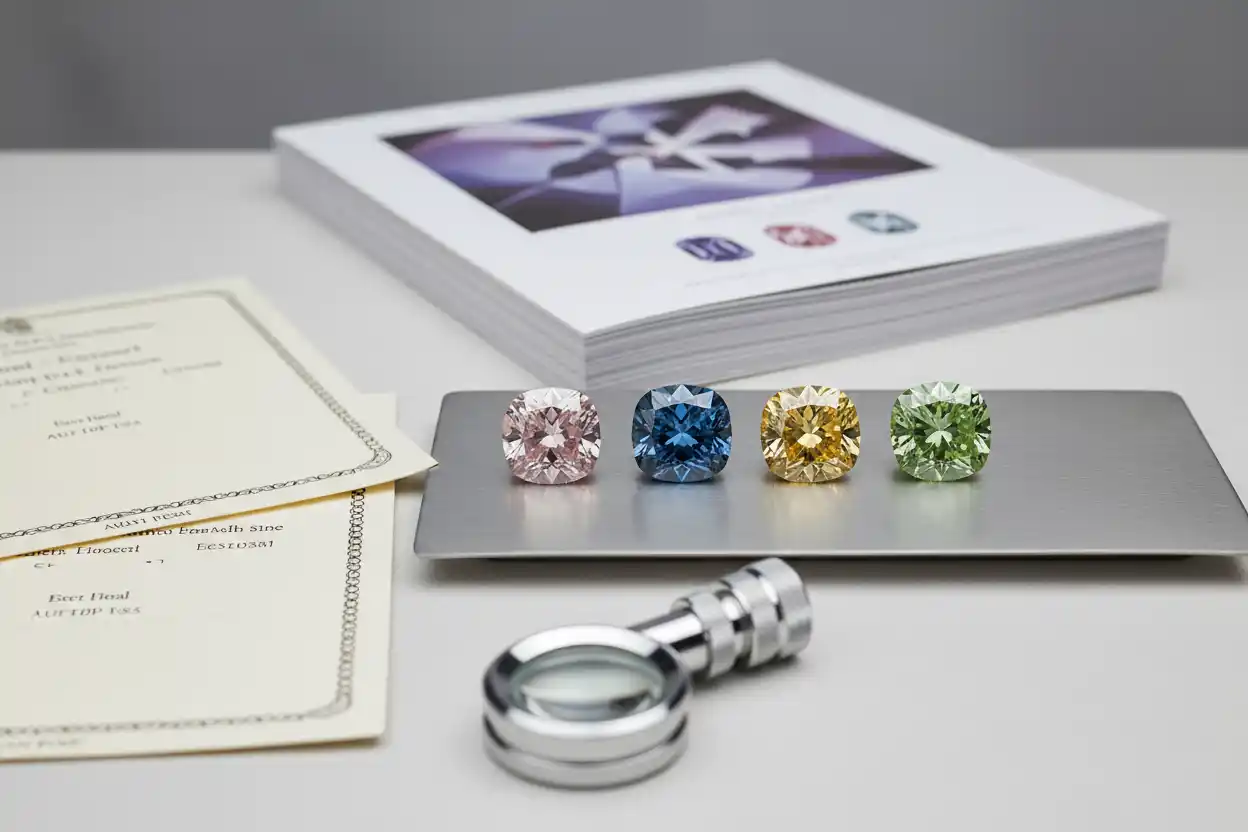
Colored Diamond Investment: Value & Buying Guide
Colored diamond investment attracts buyers because exceptional natural fancy-color diamonds combine beauty, geological rarity, portability, collectibility, and a market in which very small differences in color can create large differences in desirability. Pink, blue, green, red, orange, yellow, brown, violet, and other colored diamonds can all be collectible, but they do not have one predictable investment profile. A vivid natural blue diamond with strong laboratory documentation occupies a completely different market from a treated blue diamond, a commercial fancy yellow stone, or a laboratory-grown pink diamond.
That distinction is fundamental. Colored diamond investment should be approached as the purchase of a specialized collectible asset rather than as a guaranteed wealth-building strategy. Diamonds do not pay interest or dividends, transaction costs can be substantial, buyers and sellers may disagree widely on value, and resale can take time. The strongest approach is therefore to understand gemology first, buy only with appropriate documentation, compare genuine market equivalents, maintain provenance, and never commit money that depends on a guaranteed resale outcome.
Colored Diamond Investment at a Glance
| Factor | Why It Matters |
|---|---|
| Natural color origin | Natural fancy color usually occupies a different value tier from treated color |
| Hue | Some natural colors are much rarer than others |
| Tone and saturation | Strength and attractiveness of color can materially change desirability |
| Color modifiers | Secondary colors can raise or reduce appeal depending on the combination |
| Color grade | Small grade differences may significantly affect market perception |
| Carat weight | Larger fine natural-color stones become progressively scarcer |
| Cut | Colored diamonds are often cut to maximize face-up color rather than standard brilliance |
| Clarity | Important, but attractive color can outweigh moderate inclusions |
| Treatment | Must be disclosed; treated-color diamonds should not be valued like natural-color equivalents |
| Natural vs lab-grown | Both can be diamond, but rarity and market behavior differ substantially |
| Laboratory report | Critical for color origin, grading, identification, and buyer confidence |
| Provenance | Documented ownership or notable history can add collectibility |
| Liquidity | Resale is not guaranteed and may require specialist buyers |
| Transaction costs | Dealer spreads, commissions, insurance, shipping, and taxes can reduce returns |
A sensible colored diamond investment begins with the recognition that no single factor establishes value. Rarity matters only when it is combined with attractive quality, reliable identification, documentation, and actual buyer demand.
What Is a Fancy-Color Diamond?
Diamonds in the normal colorless-to-light-yellow or light-brown range are generally valued partly for the absence of noticeable color. Fancy-color diamonds are evaluated differently because visible color becomes a positive quality factor once the stone falls outside the normal grading range.
For fancy colors, hue refers to the actual color family, tone describes how light or dark it appears, and saturation describes color strength. Laboratories may assign descriptions such as Fancy Light, Fancy, Fancy Intense, Fancy Vivid, Fancy Deep, or Fancy Dark depending on the stone’s color characteristics.
This matters enormously for colored diamond investment because two diamonds that a casual buyer might simply call “pink” can occupy very different market positions. Differences in saturation, modifying colors, size, cut, natural color origin, and clarity can produce very different values.
For basic diamond properties before approaching the investment question, see the diamond meaning guide.
Why Color Is the Main Value Driver
Color is normally the dominant quality factor in natural fancy-color diamonds. Strong, attractive face-up color can make a colored diamond desirable even when its clarity would be considered less impressive in a colorless diamond.
This reverses a common beginner assumption. Someone entering colored diamond investment after learning the conventional 4Cs may focus too heavily on clarity and conventional cut proportions. In fancy-color diamonds, the cutter may deliberately choose a shape or facet arrangement that strengthens visible color rather than maximizing the light-return pattern preferred for a colorless round brilliant.
The question is therefore not simply, “How clean is the diamond?” It is whether the stone displays an attractive, stable, appropriately graded natural color when viewed face-up.
Which Colored Diamonds Are Rarest?
Natural red, pink, blue, green, violet, purple, and certain orange diamonds can be extraordinarily scarce, while natural fancy yellow and brown diamonds are generally more available. Rarity alone does not establish a profitable colored diamond investment, but it can strongly affect supply.
Within a color family, modifiers also matter. A diamond described as bluish green, grayish blue, purplish pink, brownish yellow, or orangy pink should not automatically be valued like a stone with a more commercially desirable primary hue.
This is why generic statements such as “pink diamonds always increase in value” are misleading. Every colored diamond investment depends on the characteristics of the specific stone, its documentation, purchase price, transaction channel, and future buyer demand.
Fancy Intense vs Fancy Vivid vs Other Grades
Color-grade terminology can materially affect colored diamond investment comparisons. A Fancy Vivid stone usually displays stronger saturation than a Fancy or Fancy Light example of similar hue, while Fancy Deep and Fancy Dark stones involve different combinations of tone and saturation.
Higher intensity does not automatically make every stone more beautiful or more valuable. A well-balanced Fancy Intense stone may appeal more strongly than an excessively dark example, and color modifiers can alter desirability even when two stones share the same intensity label.
When comparing possible purchases, read the complete laboratory color description rather than stopping at one word such as “Vivid.” The primary hue, modifying hues, intensity, size, shape, and color origin all need to be considered together.
Natural Color vs Treated Color
Natural color origin is one of the most important issues in colored diamond investment. Diamonds can be treated through processes that alter or intensify color, including irradiation, annealing, high-pressure/high-temperature processes, and surface-related treatments.
A treated diamond is still capable of being genuine diamond, but it should not be represented or valued as though its rare color developed naturally. The price difference between natural-color and treated-color material can be substantial, particularly for rare hues.
A credible laboratory report should therefore identify whether the observed color is natural or treated whenever that determination is part of the report. The treated diamond guide explains common treatment questions and why visual inspection alone cannot reliably establish color origin.
For colored diamond investment, never accept verbal assurances such as “completely natural color” as a substitute for appropriate independent testing on a significant purchase.
Natural Colored Diamonds vs Lab-Grown Colored Diamonds
Laboratory-grown diamonds have essentially the defining optical, physical, and chemical characteristics of diamond, but they are manufactured rather than geologically mined. They can also be produced in attractive colors.
That does not make them equivalent to rare natural fancy-color diamonds as collectible assets. The supply constraints, manufacturing economics, resale markets, rarity narratives, and buyer expectations are fundamentally different.
A colored diamond investment thesis based on geological scarcity should therefore distinguish natural diamonds clearly from laboratory-grown diamonds. Buyers comparing the two categories can use lab-grown vs natural gemstones for the broader origin distinction and buy lab diamond for laboratory-grown purchasing considerations.
Neither category should be misrepresented. The problem is not that a laboratory-grown diamond is “fake”; the problem is paying a natural-rarity premium for a product whose origin has not been disclosed accurately.
Laboratory Reports Are Essential
For a meaningful colored diamond investment, independent gemological documentation is not an optional decorative extra. The report should establish the stone’s identity and provide information relevant to natural or treated color, color grade, carat weight, measurements, and other quality characteristics appropriate to the report type.
Always verify the report number through the issuing laboratory’s report-check system when possible. Compare the report’s measurements, inscriptions, shape, weight, and description with the actual stone.
A laboratory report is not a valuation guarantee. It describes gemological characteristics; it does not promise that the diamond will appreciate or that another buyer will pay a particular amount.
The buy diamond guide provides a broader checklist for evaluating reports, sellers, and disclosure.
Color Origin Is Different From Geographic Origin
A frequent source of confusion in colored diamond investment is the word “origin.” Color origin asks whether the diamond’s color is natural or produced through treatment. Geographic origin refers to where the diamond was mined.
These are different questions.
For most potential investment-grade colored diamonds, determining natural color origin is crucial because treatment can fundamentally change the value proposition. Geographic mine origin may add provenance or historical interest in certain cases, but unsupported locality claims should never replace reliable color-origin testing.
Do not pay a significant mine-specific premium based only on a dealer story. Provenance needs documentation.
How Carat Weight Changes Rarity
Size can have a strong effect on colored diamond investment because large natural diamonds with attractive fancy color are considerably harder to find than smaller examples of similar quality.
However, carat weight must never be evaluated alone. A larger stone with weak color, undesirable modifiers, problematic treatment status, or poor face-up appearance can be less compelling than a smaller stone with superior natural color.
Compare both carat weight and actual dimensions. Certain cuts retain substantial weight beneath the face-up surface, so two diamonds of the same carat weight can appear noticeably different in visible size.
The underlying principles of diamond valuation are discussed more broadly in the diamond price guide.
Why Cut Works Differently in Fancy Colors
For colorless diamonds, buyers often focus heavily on brilliance, symmetry, and light return. Colored diamond investment requires a slightly different understanding because cutters frequently select shapes and proportions that maximize visible color.
Radiant, cushion, pear, oval, and other fancy shapes may help concentrate color. A cutter may accept proportions that would be unusual for a conventional colorless diamond if those proportions improve the face-up appearance of a rare natural hue.
This does not mean cut quality becomes irrelevant. Poor polish, weak symmetry, excessive depth, vulnerable corners, or unattractive color distribution can still hurt value.
The key is to judge whether the cut supports the feature that makes the diamond collectible: its color.
How Much Does Clarity Matter?
Clarity matters in colored diamond investment, but its importance can be lower than color when the stone displays rare and desirable natural coloration.
A fancy-color diamond with visible inclusions may remain highly collectible if its hue, saturation, size, rarity, and overall appearance are exceptional. However, inclusions that affect transparency, distract strongly from appearance, or threaten structural durability deserve more attention.
This is another reason not to compare fancy-color diamonds mechanically with colorless diamonds. Paying a large premium for extremely high clarity may not always produce the strongest colored diamond investment if the color itself is less desirable.
Provenance and Collectibility
Provenance can add another dimension to colored diamond investment. A documented connection to a notable collection, respected jeweler, historically important ownership chain, or well-recorded auction can make an already exceptional diamond more interesting to collectors.
The critical word is documented. Stories without records do not provide the same confidence.
Keep purchase invoices, laboratory reports, photographs, condition records, appraisals, auction documentation, correspondence, and repair or setting records together. If the stone is removed from or placed into jewelry, maintain records that connect the documented diamond to the finished piece.
Good provenance improves confidence and can make future due diligence easier.
Auction Results: Useful but Easy to Misread
High-profile auction results often attract people to colored diamond investment, but record-breaking sales are poor benchmarks for ordinary stones.
Exceptional auction diamonds may combine extreme rarity, important provenance, prestigious sale placement, international publicity, competitive bidding, unusual size, and top-tier color. A smaller commercial colored diamond with a superficially similar hue is not automatically comparable.
Auction results also need to be interpreted correctly. The headline number may include buyer-related charges or may reflect conditions unique to the sale. One transaction does not establish a universal market price.
Use auction data to understand buyer demand for genuinely comparable stones, not to calculate automatic appreciation.
Retail Price Is Not Resale Value
One of the most important rules in colored diamond investment is that retail asking price is not the same as realizable resale value.
A retailer’s price can include inventory costs, financing, insurance, security, marketing, staff, warranty service, brand premium, and profit margin. A private seller attempting to resell the same diamond may receive substantially less, particularly if there is no immediate specialist buyer.
Dealer offers can also vary because each dealer has different inventory needs and customer demand. This creates a bid-ask spread: the price at which you can buy and the price at which you can quickly sell are not necessarily close.
A successful colored diamond investment therefore needs enough potential appreciation to overcome transaction friction before any real profit exists.
Appraisal Value Is Not Guaranteed Market Value
Insurance appraisals are commonly misunderstood. An appraisal may estimate replacement cost through a particular retail channel, which is useful for insurance purposes but does not mean the diamond could be sold immediately for that figure.
Likewise, a seller-generated “valuation certificate” does not establish an independent market price.
For colored diamond investment decisions, give more weight to independent gemological identity, comparable transactions, dealer bids, auction evidence, and specialist market knowledge than to a high replacement appraisal.
A high number printed on paper is not liquidity.
Colored Diamond Investment Is an Illiquid Asset
Liquidity means how easily an asset can be sold at a reasonable market price. Colored diamonds are not as liquid as cash or heavily traded public-market assets.
Each natural fancy-color diamond is highly individual. Finding a buyer who wants the exact hue, intensity, size, shape, clarity, price level, and provenance of your stone may require a specialist network and patience.
That makes colored diamond investment unsuitable for money that may need to be accessed quickly. A forced sale can place the seller at a major negotiating disadvantage.
Scarcity and liquidity are not the same thing. Something can be extremely rare and still take considerable effort to sell.
Transaction Costs Can Be Significant
A colored diamond investment can incur costs at several points, including dealer margins, auction commissions, laboratory services, appraisals, insurance, secure transport, storage, setting or unsetting, and potential selling fees.
These expenses reduce net return. If a diamond appreciates modestly but the round-trip transaction costs are larger than the increase, the owner has not made an economic profit.
Calculate the entire acquisition cost rather than only the stone price. Then estimate realistic selling expenses before deciding whether the expected risk is reasonable.
Insurance and Secure Storage
Investment-oriented diamonds need appropriate physical protection. Their small size and high value make them portable, but that portability also creates theft and loss risk.
Insurance coverage should reflect the actual object, ownership documentation, laboratory report, photographs, setting information, and appropriate valuation basis. Review exclusions carefully rather than assuming every form of loss is covered.
Loose diamonds need secure storage, while mounted stones require protection from impacts and damaged settings. For cleaning and maintenance principles, see how to clean diamond jewelry.
Mounted vs Loose Colored Diamonds
Loose stones are generally easier to evaluate gemologically because the entire diamond can be examined and measured without a mounting obscuring portions of the girdle or pavilion.
Jewelry can add artistic, brand, provenance, and precious-metal value, but it also makes valuation more complex. A signed or exceptional piece may be worth more as a complete jewel than the stone alone, while an ordinary mounting may add little to the collectible thesis.
If the purpose is colored diamond investment rather than primarily jewelry enjoyment, understand whether you are buying the diamond, the jewelry design, the brand, or all three.
Readers choosing diamonds specifically for rings can compare those construction considerations in the diamond ring guide and diamond engagement ring guide.
Natural Rarity Does Not Guarantee Appreciation
A rare object does not automatically become a successful colored diamond investment. Price requires both constrained supply and sufficient future demand.
Buyer preferences can shift. Economic conditions can affect luxury spending. Certain hues or sizes may become more or less fashionable. New treatment techniques can create identification challenges, while laboratory-grown supply can influence broader consumer expectations even when it does not reproduce the rarity of natural material.
The strongest defense is disciplined acquisition: buy quality that is understandable, documented, genuinely scarce, and desirable without assuming that scarcity alone guarantees a future buyer.
Avoid “Guaranteed Return” Claims
Be cautious whenever a dealer describes colored diamond investment using guaranteed appreciation, guaranteed buyback profits, risk-free language, or predetermined return percentages.
No seller can know exactly what an individual diamond will command in a future private, dealer, or auction transaction. A legitimate buyback policy may provide contractual terms, but that is different from an open-market investment guarantee.
Read any repurchase agreement carefully. Pay attention to conditions, fees, grading requirements, eligible stones, payment calculation, and whether the seller is obligated to purchase rather than merely offering to help resell.
Watch for Treated and Misrepresented Diamonds
Color treatment creates one of the largest due-diligence risks in colored diamond investment because modern treatment can produce visually attractive colors that require expert testing to distinguish from naturally colored material.
Do not rely on a handheld diamond tester to answer this question. Basic testers may help determine whether a stone has diamond-like thermal properties, but they do not reliably establish natural color origin, geological versus laboratory growth, or sophisticated treatment history.
The real vs fake diamond guide explains why identification requires more than one simple consumer test.
Verify the Seller as Carefully as the Diamond
A laboratory report evaluates the stone, not the business practices of the seller.
For any substantial colored diamond investment, investigate the seller’s history, physical or verifiable business presence, return conditions, invoice detail, disclosure practices, payment protections, and willingness to allow independent examination.
The invoice should describe the diamond clearly enough to connect it with the laboratory documentation. Important representations about natural origin, treatment, color grade, carat weight, and report number should be written rather than dependent on verbal assurances.
Avoid pressure tactics built around supposedly immediate scarcity. Rare diamonds are scarce, but that does not eliminate the need for due diligence.
A Practical Colored Diamond Investment Framework
Rather than beginning with “Which color will rise the most?”, evaluate a prospective purchase in stages.
First, confirm identity. Establish that the stone is diamond and determine whether it is natural or laboratory-grown.
Second, confirm color origin. For a natural fancy-color thesis, establish that the color itself is natural rather than treatment-induced.
Third, evaluate the complete color description, including hue, modifiers, tone, saturation, and grade.
Fourth, assess size, clarity, cut, condition, and face-up appearance.
Fifth, compare the asking price with genuinely similar stones rather than unrelated record-setting examples.
Sixth, estimate all acquisition and potential selling costs.
Seventh, ask who would realistically buy the stone from you if you wanted to exit.
If that final question has no plausible answer beyond “someone will want it because it is rare,” the colored diamond investment case is incomplete.
Example: Comparing Two Hypothetical Stones
Imagine two natural fancy-color diamonds with independent reports.
Stone A has a stronger, cleaner primary hue, attractive saturation, moderate clarity, good face-up color, and a purchase price supported by several comparable specialist listings or transactions.
Stone B has a weaker hue with an undesirable modifier, extremely high clarity, and a much larger asking price because the seller emphasizes clarity and uses a generic “investment grade” label.
A beginner may choose Stone B because its clarity sounds superior. A more disciplined colored diamond investment analysis may favor Stone A because color is the dominant value factor and the purchase price has stronger comparable support.
The point is not that Stone A must appreciate. The example shows why the correct quality hierarchy matters.
Should You Diversify Across Colors?
Buying several different diamonds may reduce dependence on one individual stone, but small-scale diversification does not remove the fundamental risks of colored diamond investment.
Every purchase still involves specialist valuation, transaction costs, documentation, storage, and liquidity. Spreading a limited budget across multiple lower-quality stones can also be less attractive than purchasing one stronger example.
Diversification should never become an excuse to buy mediocre diamonds simply to own several colors.
For a broader perspective on collectible stones beyond diamonds, see best gemstones for investment.
Colored Diamonds vs Traditional Diamond Alternatives
Moissanite, white sapphire, cubic zirconia, and other diamond alternatives can be excellent jewelry choices, but they belong to fundamentally different markets from natural fancy-color diamonds.
Their purpose is often visual beauty, durability, affordability, or design flexibility rather than geological rarity. Evaluating them using a colored diamond investment thesis would therefore be inappropriate.
If jewelry value and appearance matter more than collectibility, the best diamond alternatives guide provides a more relevant comparison.
Common Colored Diamond Investment Mistakes
The first mistake is buying the color name instead of the exact color grade. “Pink diamond” is not enough information.
The second is failing to establish natural versus treated color.
The third is confusing laboratory-grown colored diamond with a geologically scarce natural colored diamond.
The fourth is assuming retail appraisal equals resale value.
The fifth is using a record auction result as the comparison for an ordinary stone.
The sixth is paying too much for clarity while ignoring color quality.
The seventh is accepting undocumented provenance.
The eighth is forgetting dealer spreads, commissions, insurance, storage, and other costs.
The ninth is assuming rarity guarantees liquidity.
The tenth is treating a salesperson’s return projection as evidence.
Avoiding these errors will not guarantee a profitable colored diamond investment, but it can substantially improve the quality of the decision.
Colored Diamond Investment Buying Checklist
Before committing funds, verify:
- The stone is genuinely diamond.
- Natural or laboratory-grown origin is documented.
- Natural versus treated color is independently evaluated.
- The complete color grade is understood.
- Secondary color modifiers are considered.
- The stone’s face-up appearance matches the report and photographs.
- Carat weight and measurements are recorded.
- Clarity issues do not threaten durability.
- Cut supports attractive color presentation.
- The laboratory report can be independently verified.
- Provenance claims have documentation.
- Seller representations appear on the invoice.
- Comparable market evidence involves genuinely similar stones.
- Retail asking prices are not being confused with realized value.
- Potential dealer or auction selling costs have been considered.
- Insurance and secure storage are practical.
- There is a plausible future resale channel.
- No guaranteed return is assumed.
- The purchase remains acceptable even if resale takes longer than expected.
This checklist is more useful than trying to predict one future price number.
Is Colored Diamond Investment Right for You?
Colored diamond investment may suit a knowledgeable collector who understands gemological grading, can tolerate an illiquid market, has access to reputable specialists, values the enjoyment of owning an exceptional gem, and does not depend on guaranteed appreciation.
It is less suitable for someone seeking predictable income, transparent real-time pricing, low transaction costs, rapid liquidity, or capital that must remain readily accessible.
The strongest reason to buy an exceptional natural fancy-color diamond is usually a combination of collectibility and personal appreciation. Potential financial performance should be treated as uncertain rather than promised.
Final Thoughts on Colored Diamond Investment
Colored diamond investment can involve some of the rarest and most visually distinctive materials in the gem market, but rarity alone is not an investment strategy. Natural color origin, hue, saturation, tone, modifiers, size, cut, clarity, laboratory documentation, provenance, purchase price, transaction costs, and liquidity all determine whether a specific stone deserves consideration.
The most important rule is to buy the documented diamond rather than the story around it. Confirm natural versus laboratory-grown origin, establish whether the color is natural or treated, understand the complete grading description, compare truly similar stones, keep comprehensive records, and plan the potential exit before completing the purchase.
A disciplined colored diamond investment should remain financially acceptable even if appreciation is slow, resale proves difficult, or buyer preferences change. There are no guaranteed returns, and exceptional auction headlines should never replace careful due diligence. When approached as a specialized collectible with genuine gemological knowledge and realistic expectations, a natural fancy-color diamond can be an extraordinary object to own without pretending that beauty and rarity eliminate investment risk.
FAQs
Are colored diamonds a good investment?
Colored diamond investment can appeal to specialist collectors because exceptional natural fancy-color diamonds are rare and portable, but returns are not guaranteed. Liquidity, purchase price, quality, documentation, transaction costs, and future buyer demand all affect the outcome.
Which colored diamonds are most valuable?
Natural red, pink, blue, green, violet, purple, and certain orange diamonds can be particularly scarce, while fancy yellow and brown material is generally more available. Exact value depends on hue, modifiers, saturation, tone, size, cut, clarity, natural color origin, and market demand.
Is Fancy Vivid always the best investment grade?
No. Fancy Vivid indicates strong color characteristics, but colored diamond investment should consider the complete hue description, modifiers, tone, size, cut, clarity, rarity, documentation, and purchase price. One grading term should not determine the decision alone.
Do colored diamonds always increase in value?
No. Natural scarcity does not guarantee appreciation. Colored diamond investment is exposed to changing demand, transaction costs, dealer spreads, economic conditions, and limited liquidity.
Are treated colored diamonds investment quality?
Treated diamonds can be attractive jewelry, but they should not be valued like equivalent natural-color diamonds. Treatment must be disclosed, and a colored diamond investment based on natural rarity requires reliable confirmation that the color is natural.
Are lab-grown colored diamonds the same as natural colored diamonds?
Both can be genuine diamond, but their origins and scarcity dynamics are different. Laboratory-grown supply is manufactured, so a geological-rarity colored diamond investment thesis should not treat lab-grown and natural colored diamonds as equivalent assets.
Do I need a laboratory report?
For a substantial colored diamond investment, independent laboratory documentation is highly important. It can confirm diamond identity, natural or laboratory-grown origin, color grade, natural or treated color, and other gemological characteristics depending on the report.
Is an appraisal the same as resale value?
No. An insurance or replacement appraisal can differ substantially from what a dealer, collector, or auction buyer would actually pay. A high appraisal should not be treated as guaranteed liquidity.
Can auction records predict what my diamond will sell for?
Not reliably. Exceptional auction diamonds may have unusual rarity, provenance, publicity, size, and competitive bidding. Only genuinely comparable transactions provide useful evidence for a specific colored diamond investment.
What matters more, color or clarity?
For fancy-color diamonds, color is often the dominant value factor. High clarity is desirable, but an exceptional natural color can be more important than obtaining the highest possible clarity grade.
How do I protect a valuable colored diamond?
Maintain the laboratory report, invoices, photographs, provenance records, insurance documentation, and secure storage. Mounted diamonds should also have their settings inspected and cleaned appropriately to reduce loss or damage risk.
What is the biggest risk when buying colored diamonds?
One major risk is overpaying because natural color, treatment, rarity, comparables, or resale liquidity were misunderstood. Independent gemological verification and disciplined price comparison are essential before treating any purchase as a colored diamond investment.