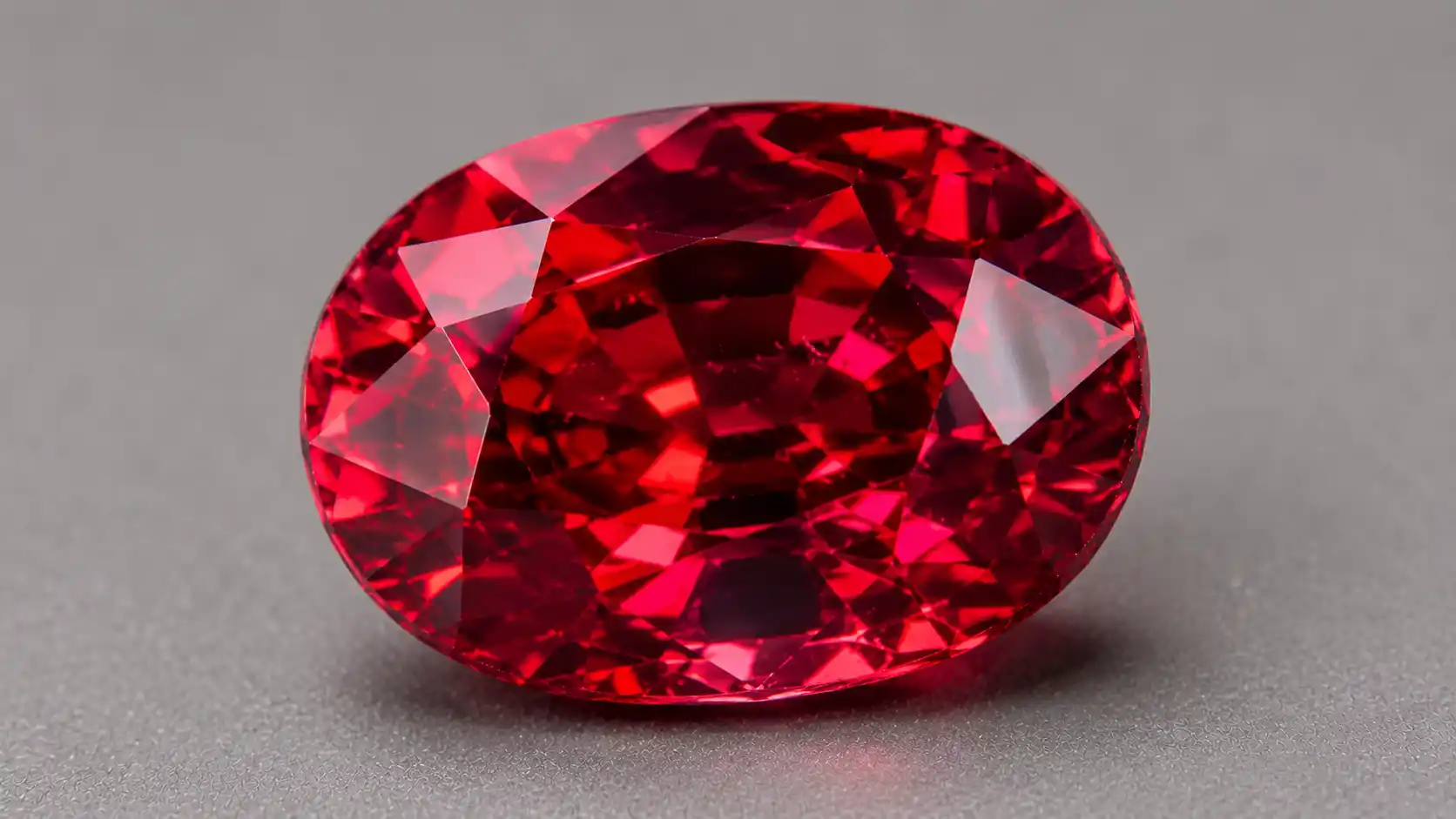
Spinel: Meaning, Healing Properties & Uses
Spinel is a durable magnesium-aluminum oxide gemstone found in vivid red, pink, orange, violet, blue, gray and black. Its transparent varieties can show excellent brilliance, while well-formed natural crystals often develop sharp octahedral shapes.
For centuries, red Spinel was confused with Ruby because early gem classification relied heavily on color. Modern gemology recognizes Spinel as a separate mineral species with its own chemistry, structure, optical properties and increasingly important place in fine jewelry.
Spinel at a Glance
| Property | Spinel |
|---|---|
| Mineral species | Spinel |
| Mineral group | Spinel group |
| Ideal composition | Magnesium aluminum oxide, MgAl₂O₄ |
| Mineral class | Oxide |
| Crystal system | Cubic |
| Common crystal habit | Octahedral crystals, twins and rounded alluvial pebbles |
| Colors | Red, pink, orange, violet, blue, gray, black and near-colorless |
| Luster | Vitreous |
| Transparency | Transparent to opaque |
| Mohs hardness | 8 |
| Cleavage | None or indistinct |
| Fracture | Conchoidal to uneven |
| Specific gravity | Approximately 3.5–3.7 |
| Optical character | Singly refractive |
| Common uses | Faceted gems, cabochons, beads, carvings and specimens |
| Main care concerns | Hard impacts, fractures, high heat and undisclosed treatment |
What Is Spinel?
Spinel is the magnesium-aluminum member of a wider mineral group whose members share a similar structural arrangement but contain different chemical elements.
Its ideal formula is MgAl₂O₄. Natural gem material may contain chromium, iron, cobalt, vanadium, zinc and other trace elements that influence color and physical properties.
The cubic crystal structure makes Spinel singly refractive. Light behaves similarly in every crystallographic direction, distinguishing it from doubly refractive Ruby, Sapphire, Zircon and many other gems.
Transparent Spinel can show strong brilliance when cut well. Opaque material, particularly black Spinel, is valued for polish and graphic contrast rather than internal light return.
The Spinel Mineral Group
“Spinel” can refer specifically to MgAl₂O₄ or more broadly to a group of structurally related minerals.
Other group members include Gahnite, Hercynite, Galaxite, Magnetite and Chromite. Their chemistry, color, magnetism and gem potential differ substantially.
Gem-quality transparent material is normally dominated by the Spinel species itself. Zinc-rich compositions may approach Gahnite, while iron-rich material can become darker.
A commercial seller should identify gem Spinel accurately rather than using the group name for any vaguely similar synthetic or industrial material.
How Spinel Forms
Gem Spinel commonly forms in metamorphosed limestone and marble where magnesium- and aluminum-bearing materials react under heat and pressure.
These marble-hosted deposits can also produce Ruby, Sapphire, Corundum, Calcite, Dolomite and other minerals. The geological association partly explains why red Spinel and Ruby were historically recovered together and confused.
Spinel also occurs in igneous rocks and metamorphic environments outside marble. Weathering can release durable crystals from host rock, allowing them to accumulate in river gravels and alluvial deposits.
Alluvial stones may become rounded while retaining strong color and transparency. Miners then recover them alongside Corundum, Garnet, Zircon and other dense gem minerals.
Crystal Habit
Spinel commonly forms octahedra with eight triangular faces. Sharp natural octahedral crystals are immediately recognizable when undamaged.
Twinned crystals can create flattened or triangular forms. The “spinel law” twin is a classic crystal relationship named after the mineral.
Some crystals show modified faces, growth patterns or etched surfaces. Alluvial material may lose obvious crystal form through transport.
Collectors value sharp, lustrous crystals separately from facetable rough. A specimen can be important because of its shape, locality or mineral association even when it is too included to cut.
Spinel Colors
Pure Spinel would be colorless, but trace elements create a broad natural palette.
Chromium contributes to vivid red and pink. Cobalt can produce valuable blue, while iron influences many blue, violet, greenish, brown and dark shades.
Fine red, cobalt blue, hot pink and vivid orange attract the strongest market attention. Lavender, violet, gray and black stones provide more accessible or stylistically unusual alternatives.
The dedicated Spinel color meaning guide explains each color’s symbolism and practical character. Mineral varieties and optical effects appear in the guide to types of Spinel.
Red Spinel and Ruby
Red Spinel and Ruby can appear remarkably similar because chromium may color both gems.
Ruby is red Corundum with a Mohs hardness of 9 and double refraction. Spinel has a hardness of 8 and is singly refractive.
Before modern instruments, red transparent stones recovered from the same regions were frequently classified together. Several famous royal “Rubies” were eventually recognized as Spinels.
The large red stone known as the Black Prince’s Ruby in Britain’s Imperial State Crown is a celebrated Spinel rather than a Ruby. Its historic name remains part of the object’s identity even though its mineral classification has changed.
The complete Ruby versus Spinel comparison examines history, structure and identification. Ruby versus Garnet versus Spinel compares three commonly confused red materials.
Historical Importance
Ancient and medieval gem names often described color rather than mineral species. Red transparent stones could be grouped under terms that later became associated more narrowly with Ruby.
Spinel from historic Asian mining regions entered royal collections across Europe and Asia. Its color, transparency and crystal size made it worthy of ceremonial jewelry regardless of the name used at the time.
The eventual separation of Spinel from Ruby demonstrates how gemology changed from visual classification to scientific testing based on optical, chemical and physical properties.
Today, collectors value historic Spinel for its own identity rather than as a Ruby substitute.
Major Sources
Myanmar’s Mogok region is famous for vivid red and pink Spinel as well as historic Ruby. Stones occur in marble-related deposits and alluvial gravels.
Sri Lanka produces Spinel in many colors, including pink, violet, blue, gray and black. Its alluvial gem fields have supplied diverse materials for centuries.
Tajikistan is associated with fine pink and red Spinel from mountainous deposits, including stones with strong saturation and attractive clarity.
Vietnam has produced vivid red and pink material from marble-hosted deposits. Tanzania, particularly Mahenge, is known for bright pinkish-red Spinel with exceptional brilliance.
Afghanistan, Pakistan, Madagascar and several other regions also produce gem and specimen material. A locality name should be supported by reliable documentation rather than inferred from color.
Physical Properties and Durability
Spinel ranks 8 on the Mohs scale. This makes it harder than Quartz, Garnet, Tourmaline and many other commonly worn colored stones.
It has no easy cleavage, which contributes to good jewelry toughness. Nevertheless, Spinel remains capable of chipping after a sharp impact.
Facet edges can abrade during long wear, particularly in exposed rings or bracelets. A secure setting and ordinary precautions preserve the polish.
Spinel is generally stable in normal light and common household conditions. High heat can affect some colors, while fractures and treatments may create additional vulnerabilities.
Optical Properties
Spinel is singly refractive because it crystallizes in the cubic system. A polished gem therefore does not show the pronounced facet doubling associated with Zircon or Sphene.
Its refractive index supports good brilliance, particularly when the pavilion and crown are proportioned well.
Spinel’s dispersion is moderate rather than extreme. The gem’s principal appeal usually comes from body color, transparency and bright reflections rather than intense rainbow fire.
Some included Spinels display asterism when cut as cabochons. Oriented inclusions can create four- or six-rayed stars under a concentrated light source.
Rare stones may also show a noticeable color change under different illumination.
Spinel Meaning and Symbolism
Modern crystal traditions associate Spinel with renewal, resilience, vitality and the restoration of purposeful energy.
Its historical misidentification with Ruby encourages symbolism based on recognizing one’s true identity. A Spinel may represent value that remains real even when other people misunderstand or mislabel it.
Red and orange stones are linked with courage and action, pink with affection and emotional renewal, blue with communication, and black with protection and boundaries.
These meanings are cultural interpretations rather than properties measured through mineralogical testing.
Spinel Healing Properties in Crystal Traditions
Practitioners sometimes use Spinel as a symbolic support during periods of exhaustion, discouragement or major change.
The stone may serve as a reminder that recovery does not require returning to an earlier version of oneself. Renewal can involve adapting goals, expectations and methods.
Red Spinel is commonly chosen for motivation and physical vitality symbolism. Pink material may be used during emotional reflection, while blue Spinel supports themes of calm communication.
Black Spinel is often associated with grounding and personal boundaries. None of these stones has been scientifically shown to treat fatigue, emotional disorders or physical illness.
Meditation and Reflective Uses
A tumbled stone or faceted gem can serve as a visual focus during meditation.
One reflective practice involves identifying an outdated label a person has accepted, then writing a more accurate description based on current evidence and values. Spinel’s history provides a natural metaphor for this exercise.
Another approach uses the gem as a reminder to distinguish urgency from importance. The practitioner names one necessary action and one pressure that can be released.
The stone functions as a physical prompt rather than the source of insight.
Chakra Associations
Modern chakra systems assign Spinel according to color.
Red and black stones are frequently linked with the root chakra, orange with the sacral or solar plexus region, pink with the heart, blue with the throat and violet with the upper centers.
These assignments are not uniform across historical spiritual traditions. They largely reflect modern color-based chakra teaching.
A person can use the associations respectfully without treating chakras as measurable anatomical organs.
Jewelry Uses
Spinel is suitable for nearly every jewelry format.
Spinel earrings take advantage of its color while minimizing impact. A Spinel bracelet can use repeated matched stones, although clasp and link security require attention.
The forthcoming Spinel necklace guide covers pendants, stations and graduated suites. The forthcoming Spinel ring guide addresses protective settings and daily wear.
Fine natural matched sets can be difficult to assemble because valuable rough is often cut in nonstandard dimensions to preserve weight.
Cutting and Clarity
Spinel is commonly cut as ovals, cushions, rounds and mixed shapes.
Well-proportioned stones show strong brightness. A shallow cut can create a transparent window, while excessive depth reduces visible size and may produce darkness.
Many fine Spinels are eye-clean. Natural inclusions may include crystals, needles, fingerprints, healed fractures and octahedral growth-related features.
A small internal inclusion may have little effect on beauty. Surface-reaching fractures require more attention because they can affect durability and may contain filling.
Identification
Spinel cannot be identified reliably by color alone.
A gemologist may use refractive index, single refraction, specific gravity, spectroscopy, fluorescence and microscopic inclusions.
Red Spinel and Ruby can both fluoresce because chromium is present, so fluorescence alone does not separate them.
Garnet is also singly refractive, but it has different refractive properties, density and chemistry. Synthetic Spinel may show curved growth, gas bubbles or other manufacturing features depending on the production method.
Professional testing is preferable to scratch tests or visual guesses.
Natural and Synthetic Spinel
Laboratory-grown Spinel has existed for many decades. Flame-fusion synthetic material is common and can be produced in numerous colors.
Synthetic Spinel has a manufactured origin but may share many chemical, optical and physical characteristics with natural material.
Some laboratory-grown products are sold directly as Spinel. Others have historically been used as imitations of Sapphire, Aquamarine, Peridot and additional gems.
A synthetic stone is not inherently poor quality. The problem arises when its origin is concealed or it is sold as a natural gem.
For a significant purchase, request a laboratory report confirming natural or laboratory-grown origin.
Treatments
Spinel has traditionally received less routine treatment than Ruby or Sapphire, yet the assumption that all Spinel is untreated is no longer safe.
Heat treatment has been documented. Fracture filling can improve the apparent clarity of surface-reaching breaks.
Cobalt diffusion can create vivid blue rims in natural or synthetic starting material. Nickel diffusion has also produced blue-green and greenish colors.
These treatments may require advanced laboratory testing. A strongly saturated blue or green gem should not command a natural-rarity premium without documentation.
Buying Spinel
Color is the principal value factor. Fine red generally attracts the greatest demand, followed by exceptional cobalt blue, hot pink and vivid orange.
Clarity, cutting and size modify the value. A clean stone with weak color may be less desirable than a vivid gem containing a minor harmless inclusion.
Fine-color Spinel becomes much less available in larger sizes. Nonstandard cuts are common because cutters preserve as much valuable rough as possible.
The Spinel buying guide provides a complete purchasing process. Current value factors belong in the Spinel price guide.
Spinel as an August Birthstone
Spinel is one of August’s modern birthstones, together with Peridot and Sardonyx.
Its range of colors gives August-born wearers substantial choice. Red, pink, blue, gray, purple and black stones can all represent the month.
The August birthstone guide explains the history and alternatives. The August birthstone jewelry guide focuses on practical gifts.
Care and Cleaning
Warm water, mild soap and a soft brush provide the safest general cleaning method.
Ultrasonic and steam cleaners may be appropriate for untreated, unfractured Spinel in durable settings. They should be avoided when a stone contains fractures, filling or uncertain treatment.
High heat may affect some colors and should be avoided during careless jewelry repair. A jeweler must know the stone’s identity and treatment history before applying a torch.
The dedicated guide to cleaning Spinel jewelry covers specific procedures.
Store Spinel away from Diamond and Sapphire, which can scratch it. Separate compartments also prevent the gem from abrading softer jewelry.
Directory Placement
Spinel appears among the crystals beginning with S and gemstones beginning with S.
Its classification as an oxide mineral distinguishes it from red Corundum, silicate Garnets and glass imitations, even when their colors overlap.
Final Perspective
Spinel’s history is often told as a story of mistaken identity, but the gem no longer needs Ruby’s reputation to justify its place in jewelry. Its cubic structure, durable physical properties, broad color range and sharp natural crystals give it a distinct mineral identity.
A well-chosen stone should be valued for what it is: natural or accurately disclosed laboratory-grown Spinel with appealing color, balanced cutting and documentation appropriate to its price. Understanding that identity makes its symbolism of renewal and self-recognition especially fitting.
Frequently Asked Questions
1. What is Spinel made of?
Gem Spinel is ideally magnesium aluminum oxide with the formula MgAl₂O₄.
2. Is Spinel the same as Ruby?
No. Spinel is a cubic oxide mineral, while Ruby is red Corundum. They differ in chemistry, hardness and optical properties.
3. Why was Spinel confused with Ruby?
Both can show vivid chromium-related red color and occur in some of the same mining regions. Scientific instruments were not available to early gem traders.
4. What colors can Spinel be?
Natural Spinel occurs in red, pink, orange, violet, purple, blue, gray, black, brown and near-colorless shades.
5. Is Spinel durable enough for everyday jewelry?
Yes. Its Mohs hardness of 8, good toughness and lack of easy cleavage make it suitable for most jewelry formats.
6. What does Spinel symbolize?
Modern traditions associate it with renewal, resilience, vitality, self-recognition and recovering purposeful energy.
7. Is Spinel an August birthstone?
Yes. Spinel is recognized alongside Peridot and Sardonyx as an August birthstone.
8. Is natural blue Spinel rare?
Fine strongly saturated natural cobalt-blue Spinel is rare. Grayish and violet-blue stones are more common.
9. Is synthetic Spinel real Spinel?
Laboratory-grown Spinel is manufactured material with related chemical and physical properties. It must be disclosed as synthetic rather than natural.
10. Is Spinel normally treated?
Many stones are untreated, but heat, fracture filling and cobalt or nickel diffusion treatments have been documented.
11. Where is Spinel found?
Important sources include Myanmar, Sri Lanka, Tajikistan, Vietnam, Tanzania, Afghanistan, Pakistan and Madagascar.
12. How should Spinel be cleaned?
Use warm water, mild soap and a soft brush. Avoid aggressive cleaning when fractures, filling or treatment history are uncertain.
Spinel’s healing, chakra and emotional associations belong to cultural and spiritual traditions and are not scientifically established medical effects. Do not use crystals instead of professional healthcare, and obtain independent gemological documentation when natural origin or treatment materially affects value.