Types of Spinel: Colors and Varieties Explained
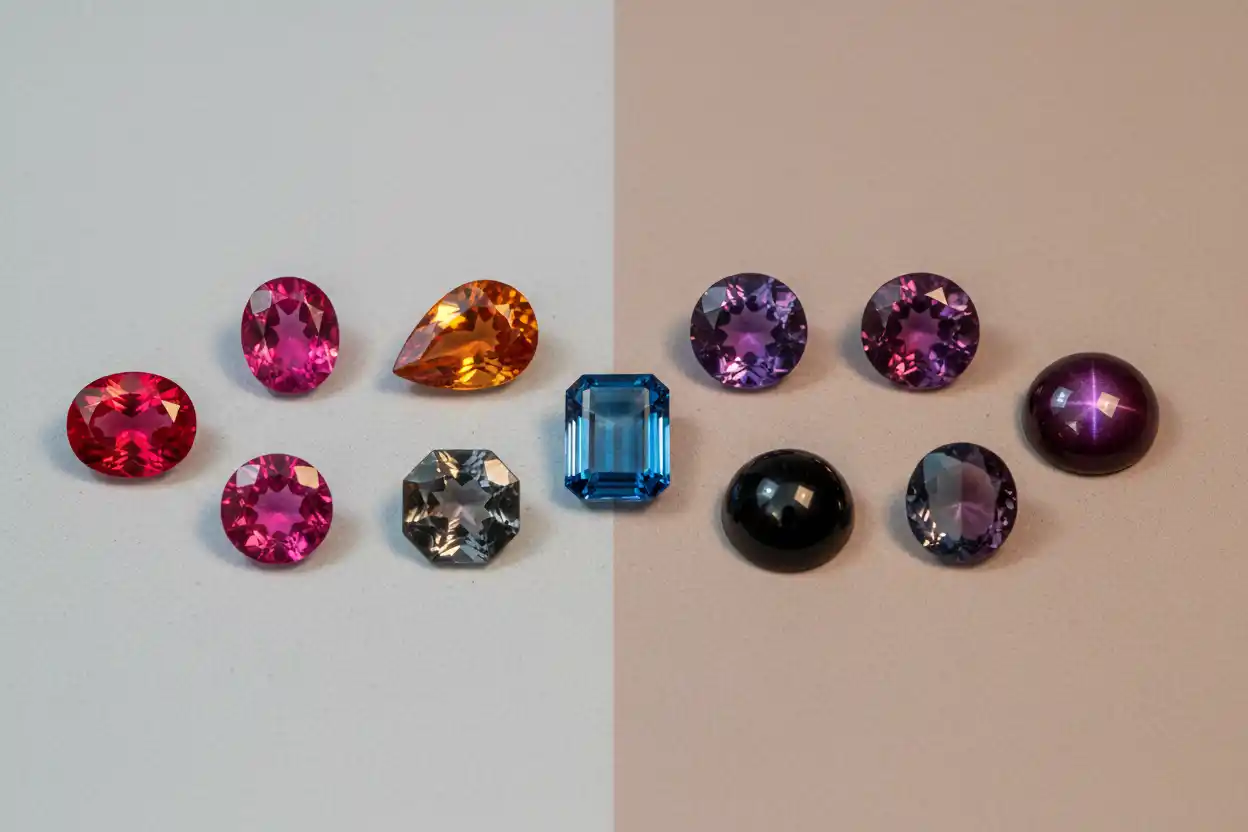
Spinel occurs in a wider range of colors than its historic reputation as a Ruby substitute suggests. Natural stones can be vivid red, hot pink, orange, purple, violet, blue, gray, black and occasionally nearly colorless, greenish or brown.
Color provides the most familiar way to describe Spinel, but several additional categories matter. Cobalt Spinel is distinguished by vivid blue associated with cobalt. Color-change and star Spinel display optical phenomena, while synthetic Spinel may be produced through flame-fusion, flux or other laboratory methods.
Treatments are less routine than they are for Ruby, Sapphire or Emerald, although heating, fracture filling and diffusion-treated blue or green material have been documented. Consequently, a precise description should identify natural or laboratory-grown origin, color, phenomenon and any detectable treatment separately.
Spinel Types at a Glance
| Spinel type | Typical appearance | Important buying consideration |
|---|---|---|
| Red Spinel | Pure red to orangish or purplish red | Saturation, tone and separation from Ruby |
| Pink Spinel | Pale pink to vivid neon or hot pink | Color intensity and clarity |
| Orange Spinel | Yellowish orange to reddish orange | Brown modifier and saturation |
| Flame Spinel | Vivid red-orange or orange-red trade color | No standardized grading boundary |
| Purple Spinel | Reddish purple to bluish purple | Grayness and darkness |
| Violet Spinel | Cool violet to blue-violet | Tone and color shift |
| Blue Spinel | Grayish blue, greenish blue or dark blue | Iron- versus cobalt-related color |
| Cobalt Spinel | Vivid saturated blue | Natural origin and treatment testing |
| Gray Spinel | Silver gray to charcoal | Brightness and undertone |
| Black Spinel | Opaque black | Polish and separation from imitations |
| Colorless Spinel | Near-colorless transparent material | Rare natural occurrence and synthetic confusion |
| Green Spinel | Greenish blue to green | Rare and often iron-rich or treated |
| Color-change Spinel | Different colors under different lighting | Strength and attractiveness of change |
| Star Spinel | Four- or six-rayed star | Centering, sharpness and natural inclusions |
| Cat’s-eye Spinel | Single moving chatoyant band | Eye orientation and host identity |
| Synthetic Spinel | Laboratory-grown in many colors | Clear origin disclosure |
What Is Spinel?
Gem Spinel is typically magnesium-aluminum oxide with the formula MgAl₂O₄.
It crystallizes in the cubic system and is normally singly refractive. Its hardness is approximately 8, while its toughness and lack of cleavage support frequent jewelry use.
Spinel belongs to a broader mineral group containing related species with different dominant elements. However, most transparent jewelry Spinel is close to magnesium-aluminum Spinel rather than a different group species.
The Spinel meaning guide covers its mineral identity, formation, history and symbolism. This page focuses on colors, optical varieties, laboratory-grown material and treatment categories.
Spinel Versus the Spinel Mineral Group
The word Spinel can refer both to a specific gem mineral and to a structural mineral group.
The broader group includes minerals such as gahnite, hercynite, galaxite, magnetite and chromite, among others.
These related minerals can be dark, opaque or unsuitable for ordinary faceted jewelry.
A gem advertised simply as Spinel generally refers to magnesium-aluminum Spinel unless a laboratory report identifies another species or intermediate composition.
Terms such as gahnospinel describe material containing substantial zinc-related gahnite components.
The exact group chemistry can matter in unusual blue, green and dark specimens.
Red Spinel
Red is the historically most famous Spinel color.
Fine stones can show vivid pure red, slightly orangish red or purplish red. Chromium commonly contributes to red and pink coloration.
The most desirable material combines strong saturation with medium tone and high transparency. Excessive darkness can reduce brilliance, while obvious brown or gray modifiers generally lower demand.
Large fine red Spinel is rare.
Historic red Spinels were repeatedly identified as Rubies before modern mineralogy separated the species. Several famous royal “Rubies” were eventually recognized as Spinel.
The Ruby versus Spinel guide explains their history and gemological differences.
Stoplight-Red Spinel
“Stoplight red” is an informal description for exceptionally vivid saturated red Spinel.
It is not a laboratory grade or separate mineral variety.
The term should describe the actual face-up color rather than function as automatic evidence of Burmese origin or top quality.
Fluorescence, chromium content, cutting and low iron can contribute to a bright appearance.
A stone can be strongly red but still suffer from windowing, extinction, fractures or poor polish.
Color language should remain secondary to direct examination under realistic lighting.
Pink Spinel
Pink Spinel ranges from pale pastel pink to vivid magenta and neon-like hot pink.
Chromium contributes to many attractive pink colors.
Fine vivid material from Tanzania, Vietnam, Myanmar and other sources has become particularly important in modern jewelry.
Pastel stones can show a delicate open appearance, while highly saturated gems may resemble pink Sapphire or Rubellite Tourmaline.
The pink gemstones guide provides wider color comparisons.
A seller should not assume that every bright pink Spinel has one geographic origin.
Hot-Pink Spinel
Hot-pink Spinel shows intense, highly saturated pink that may contain red, purple or orange modifiers.
The description is a trade color category rather than a formal variety.
Fine stones remain vivid in ordinary indoor light instead of appearing bright only under concentrated illumination.
Color zoning, darkness and visible inclusions can reduce the effect.
Small stones can display remarkably strong saturation, while matching pairs and suites require careful sorting.
The Spinel color-meaning guide handles symbolism by shade rather than gemological classification.
Orange Spinel
Orange Spinel ranges from yellowish orange and peach to reddish orange.
Pure vivid orange is less common than pinkish or red-orange material.
Iron, chromium and other trace elements can contribute to the color.
Brown modifiers may make the stone look earthy or subdued. Such material can still be attractive but occupies a different market from vivid bright orange.
Orange Spinel can resemble Spessartine Garnet, Fire Opal, orange Sapphire and Zircon.
The orange gemstones guide provides the broader comparison.
Flame Spinel
Flame Spinel is a trade description for vivid orange-red or red-orange material.
The term does not identify one chemical composition, origin or standardized color range.
A seller should show the actual stone in neutral light rather than relying on the dramatic name.
Fine examples can combine red intensity with bright orange flashes.
The label should not be confused with flame-fusion synthetic Spinel. “Flame” describes color in one context and a laboratory growth process in another.
An invoice should state natural or laboratory-grown origin clearly.
Purple Spinel
Purple Spinel can range from reddish purple and plum to balanced purple or bluish purple.
Many stones contain some gray, which may create an elegant muted appearance or reduce saturation depending on intensity.
Strongly reddish-purple material can resemble Rhodolite Garnet, while cool violet Spinel may overlap with Sapphire, Amethyst or Iolite.
Medium tone usually permits more brilliance than extremely dark material.
The purple gemstones guide provides additional visual alternatives.
Violet and Lavender Spinel
Violet Spinel contains a stronger blue component than typical purple material.
Lavender describes pale violet, lilac or grayish purple appearances.
These are color descriptions rather than separate mineral varieties.
Fine pastel stones can look open and bright, although low saturation may reduce rarity.
Some gray Spinels reveal lavender or violet modifiers only under particular lighting.
Color should be checked under daylight-equivalent and warm incandescent illumination because the balance can shift.
Blue Spinel
Blue Spinel ranges from grayish blue and greenish blue to dark navy and vivid saturated blue.
Iron produces many common blue, gray-blue and greenish-blue stones.
Iron-rich blue Spinel may appear dark or subdued. Excessive depth can make the center nearly black.
Fine blue material should retain recognizable color in normal indoor light.
Blue Spinel can resemble Sapphire, Aquamarine, Zircon, Tanzanite and synthetic blue material.
The blue gemstones guide provides the wider color context.
Cobalt Spinel
Cobalt Spinel is vivid blue material whose coloration includes a meaningful cobalt contribution.
The best stones can show intense electric or saturated blue that differs strongly from ordinary iron-dominated gray-blue Spinel.
Vietnam has become particularly important for bright cobalt-bearing material, although cobalt Spinel occurs elsewhere.
Cobalt content alone does not determine value. The visible color, tone, saturation, clarity, cut and size matter most.
Some synthetic Spinel is cobalt colored, and diffusion treatment can introduce blue-producing elements near the surface. Consequently, valuable cobalt-blue stones deserve laboratory testing.
Gray Spinel
Gray Spinel ranges from pale silver and blue-gray to charcoal.
Undertones may be blue, violet, green or brown.
Once overlooked, fine gray Spinel has gained popularity in contemporary jewelry because of its neutral appearance and strong durability.
A well-cut stone should remain lively rather than dull or completely black.
Gray can arise from iron-related absorption and the interaction of several trace elements.
The gray gemstones guide compares Spinel with gray Sapphire, Moonstone, Hematite and other options.
Black Spinel
Black Spinel is opaque to nearly opaque and usually owes its darkness to iron-rich composition.
It can take a high glassy polish and is commonly fashioned into faceted stones, cabochons and beads.
Black Spinel may be confused with Onyx, Obsidian, Black Tourmaline, Hematite and glass.
Fine faceting can create bright surface reflections even though little light passes through the stone.
The term should not be applied automatically to every black faceted gem.
The black gemstones guide provides broader comparisons.
Colorless Spinel
Natural colorless Spinel exists but is uncommon.
Most stones contain enough trace elements to produce gray, blue, pink, red or another color.
Colorless synthetic Spinel is much more widely available and has historically been used to imitate Diamond and other transparent gems.
A colorless stone’s identity should be confirmed through refractive index, optical character, density and inclusions.
Spinel has lower dispersion and hardness than Diamond, although it can still appear bright when well cut.
The white gemstones guide compares colorless and white alternatives.
Green Spinel
Natural green Spinel is uncommon and often appears dark, grayish or blue-green.
Iron and other compositional factors commonly influence the color.
Bright pure green comparable with fine Emerald or Tsavorite is rare.
Some blue-to-green Spinel in the market has been diffusion treated with cobalt or nickel-related processes. Therefore, unusual vivid green or blue-green color deserves professional analysis.
The green gemstones guide helps compare Spinel with Emerald, Tsavorite and Tourmaline.
Yellow and Brown Spinel
Yellow and brown Spinel occurs but is less commercially prominent.
Colors may include pale yellow, golden brown, reddish brown and olive-brown.
Iron and other trace elements contribute to these appearances.
Fine transparent material can show attractive brilliance, while dark brown stones may be cut as collectors’ gems rather than mainstream jewelry.
A yellow or brown Spinel should not be confused with Topaz, Zircon, Garnet or Chrysoberyl solely from color.
Color-Change Spinel
Color-change Spinel shows a different appearance under daylight-equivalent and incandescent light.
Some stones shift between blue, violet, gray-blue, purple and reddish-purple.
The phenomenon results from selective absorption caused by trace elements, including interactions involving cobalt, iron or chromium.
A strong change should remain observable under standardized lighting rather than merely showing a slight shift caused by photography or surrounding colors.
Color-change Spinel is uncommon and can carry collector interest.
The quality depends on both colors and the degree of separation between them.
Star Spinel
Star Spinel displays asterism from oriented internal features.
The gemstone is cut as a cabochon so reflected rays appear across its surface.
Four- and six-rayed stars can occur. The star should move when the light or stone changes position.
Body colors may include gray, blue-gray, violet, red and dark tones.
A well-centered sharp star is generally more desirable than broad, incomplete or off-center rays.
Synthetic star material and other imitations exist, so a rare natural example benefits from laboratory documentation.
Cat’s-Eye Spinel
Cat’s-eye Spinel shows a single moving band called chatoyancy.
Oriented inclusions or structural features reflect light across a cabochon.
The eye may appear in gray, blue, dark or other body colors.
A strong stone should show a centered band from the normal face-up position.
The effect is less common than ordinary transparent faceted Spinel.
Fiber-optic glass can imitate a sharp cat’s-eye line, making mineral identification important.
Gahnospinel
Gahnospinel is a Spinel containing a substantial gahnite or zinc-related component.
It can appear blue, greenish blue, dark green or other colors.
The term belongs to a compositional range within the Spinel group rather than one conventional color variety.
Some cobalt-bearing gahnospinel has shown unusually vivid blue color.
Laboratory chemical analysis may be required to determine the zinc content and appropriate name.
The visual appearance alone cannot separate every gahnospinel from ordinary magnesium-rich Spinel.
Natural Spinel by Locality
Spinel occurs in marble, metamorphic rocks and gem gravels.
Myanmar has a long association with fine red and pink material. Vietnam is particularly important for vivid pink and cobalt-blue Spinel.
Tajikistan has produced large pink and red crystals, while Tanzania, Sri Lanka and several other regions supply a broad color range.
Origin names should describe locality rather than function as quality grades.
A Myanmar stone can be pale or included, while a gem from another source may show exceptional color.
Geographic-origin conclusions require advanced laboratory comparison for valuable stones.
Natural Versus Synthetic Spinel
Natural Spinel formed geologically.
Synthetic Spinel was grown by people with a corresponding Spinel structure and related properties.
Synthetic material is not an imitation, but it must be disclosed clearly.
Laboratory-grown Spinel is common and has been produced in red, blue, green, colorless and many other appearances.
The lab-grown versus natural gemstones guide explains the general terminology.
A clean appearance alone does not prove synthetic origin because fine natural Spinel can be eye-clean.
Flame-Fusion Synthetic Spinel
Flame fusion is the most common method used to produce synthetic Spinel.
Powdered ingredients melt in a flame and solidify into a curved boule.
The material can contain curved growth lines, gas bubbles and strain-related optical effects.
Manufacturers can create many colors, including convincing blue, red and colorless stones.
Flame-fusion synthetic Spinel has also been used to imitate Sapphire, Aquamarine, Peridot and other gems through color rather than correct identity.
The product should be sold as synthetic Spinel even when it visually imitates another stone.
Flux-Grown Synthetic Spinel
Flux growth dissolves ingredients in a molten chemical solution and allows crystals to develop slowly.
Flux-grown Spinel is less ubiquitous than flame-fusion material.
Internal flux residue, metallic particles, growth features and seed-related structures may help with identification.
Some flux-grown stones can look more natural under magnification than ordinary flame-fusion products.
A laboratory combines microscopy, spectroscopy and chemical analysis when the origin is uncertain.
Spinel Treatments
Natural Spinel is less routinely treated than Corundum, Emerald or Topaz.
Some material has been heated to alter color or clarity. Fracture filling may reduce the visibility of cracks.
High-temperature cobalt diffusion has created blue color in natural Spinel. More recent nickel diffusion has produced blue-to-green appearances in pale starting material.
These diffusion processes can leave color concentrations and chemical gradients near the surface.
The gemstone treatments guide explains heat, diffusion and filling more broadly.
Cobalt and Nickel Diffusion
Diffusion treatment introduces color-producing elements into the near-surface region of a gemstone at high temperature.
Cobalt diffusion can create deep blue Spinel, while nickel diffusion has produced green-to-blue colors.
Color may be concentrated near facet surfaces rather than distributed naturally through the complete crystal.
Recutting or repolishing can alter the appearance if enough treated surface is removed.
Visual inspection is not always sufficient. Laboratories use spectroscopy and chemical profiling to identify the treatment.
Vivid blue-green Spinel with unusual characteristics deserves particular scrutiny.
Fracture-Filled Spinel
A filler may be introduced into surface-reaching fractures to improve apparent clarity.
The treatment does not heal the stone or restore its original strength.
Possible clues include flash effects, bubbles or differences in luster where the filler reaches the surface.
Fracture-filled Spinel requires warm soapy water rather than steam or ultrasonic cleaning.
The presence and extent of filling should be disclosed because it affects value, care and repair.
Spinel Versus Ruby
Red Spinel and Ruby can look extremely similar.
Ruby is red Corundum with Mohs hardness 9 and measurable birefringence. Spinel ranks approximately 8 and is normally singly refractive.
Their refractive indices, spectra, density and inclusions differ.
Spinel commonly occurs in the same deposits as Ruby, explaining historical confusion.
The Ruby versus Spinel guide owns the direct comparison and crown-jewel history.
Spinel Versus Garnet
Red, pink, purple and orange Spinel can overlap Garnet colors.
Both are normally singly refractive, so additional testing is required.
Refractive index, density, spectra and inclusions help separate them. Different Garnet species also have wide property ranges.
Fine red Spinel may show strong fluorescence, while iron-rich Garnet commonly absorbs more light.
The Ruby versus Garnet versus Spinel guide covers the three-way distinction.
Spinel Versus Sapphire
Blue, pink, purple and colorless Spinel can resemble Sapphire.
Sapphire is Corundum, ranks 9 on the Mohs scale and is doubly refractive.
Spinel ranks about 8 and is normally singly refractive.
Synthetic blue Spinel has historically been used as a Sapphire imitation.
A polariscope, refractometer, spectroscope and microscope can separate most examples without destructive testing.
Evaluating Spinel Color
Color is generally the most important visible quality factor.
Vivid red, bright pink and saturated cobalt blue occupy premium categories.
Orange, purple, gray and pastel material can also be valuable when attractive, bright and well cut.
Excessive darkness, brownness or grayness can reduce demand, although muted colors remain popular in particular designs.
Examine Spinel in daylight-equivalent and ordinary indoor light. Strong display lamps can conceal extinction.
The Spinel buying guide provides the detailed quality process.
Evaluating Clarity
Fine transparent Spinel is often expected to appear eye-clean.
Natural stones may contain crystals, octahedral negative crystals, needles, fingerprints, healed fractures and mineral inclusions.
An internal inclusion can confirm natural formation without affecting durability significantly.
Surface-reaching fractures near corners and prongs require more caution.
Synthetic material may contain gas bubbles, curved growth or flux residues, depending on growth method.
A visibly clean stone should not be assumed synthetic or untreated without testing.
Evaluating Cut
Spinel takes a bright polish and can show excellent brilliance.
Rounds, ovals and cushions are common. Pears, emerald cuts and custom shapes also occur.
Spinel rough frequently forms octahedra and twinned crystals. Preserving weight may lead to shallow or asymmetrical cuts.
A shallow gem can show windowing, while excessive depth creates darkness and reduced face-up size.
The best cut balances brightness, color, symmetry and rough conservation.
Spinel Value by Type
Fine vivid red and cobalt-blue Spinel commonly occupy the highest market levels.
Hot-pink and neon-like material can also be highly valuable, particularly in larger clean sizes.
Orange, purple and gray Spinel vary widely according to saturation, tone and demand.
Star, color-change and unusual compositional varieties appeal to collectors when the phenomenon remains strong.
The Spinel price guide owns detailed value factors and avoids turning every color name into a fixed price category.
Spinel Jewelry
Spinel’s hardness, toughness and lack of cleavage make it suitable for many jewelry formats.
The Spinel bracelet guide explains line construction and clasp security.
The Spinel earrings guide focuses on pair matching, while the Spinel necklace guide covers pendants and chains.
The Spinel ring guide addresses settings, engagement use and daily wear.
Individual fractures and treatment still need consideration.
August Birthstone
Spinel is recognized as an August birthstone alongside Peridot and Sardonyx.
The August birthstone guide explains the calendar tradition.
Its broad color range gives August jewelry options beyond Peridot green.
A birthstone label does not establish natural origin or treatment status.
Synthetic Spinel should remain disclosed even when used correctly as an August-themed stone.
Spinel Care
Spinel ranks about 8 on the Mohs scale and is durable enough for frequently worn jewelry.
Hardness does not eliminate the possibility of chips or fracture damage.
Warm water, mild soap and a soft brush are the safest routine cleaning method.
Steam and ultrasonic cleaning should be avoided when fractures or filling are present.
The Spinel jewelry-cleaning guide provides the full procedure.
The gemstone hardness chart and toughness-versus-hardness guide provide wider durability context.
Final Perspective
Spinel types are most clearly organized by color, optical phenomenon, composition and growth origin.
Red, pink, orange, purple, cobalt blue, gray and black are color categories. Star, cat’s-eye and color-change Spinel are phenomenal types, while gahnospinel describes composition.
Natural, flame-fusion and flux-grown describe origin. Heat, filling and diffusion describe treatment rather than separate varieties.
A precise label should identify each of these dimensions instead of relying on one dramatic trade color.
Frequently Asked Questions
1. What colors does natural Spinel occur in?
Natural Spinel can be red, pink, orange, purple, violet, blue, gray, black, brown, greenish and rarely near-colorless.
2. Which Spinel color is most valuable?
Vivid red and saturated cobalt blue are generally among the most valuable, with fine hot-pink material also highly prized.
3. What is cobalt Spinel?
It is vivid blue Spinel whose color includes a meaningful cobalt contribution.
4. Is every vivid blue Spinel natural cobalt Spinel?
No. Synthetic Spinel and diffusion-treated natural stones can also show strong blue, so valuable examples need laboratory testing.
5. What is flame Spinel?
It is a trade description for vivid orange-red or red-orange natural Spinel, not a standardized mineral variety.
6. Does black Spinel occur naturally?
Yes. Natural iron-rich Spinel can be opaque black, although other black materials may imitate it.
7. Does Spinel show color change?
Yes. Rare stones can shift between blue, violet, gray, purple and reddish colors under different lighting.
8. Does star Spinel exist?
Yes. Oriented inclusions can create four- or six-rayed asterism in cabochon-cut Spinel.
9. Is synthetic Spinel common?
Yes. Flame-fusion synthetic Spinel is widely available in many colors.
10. Is natural Spinel usually treated?
Most is untreated, but heating, fracture filling and cobalt or nickel diffusion have been documented.
11. How is Spinel distinguished from Ruby?
Spinel is normally singly refractive and ranks about 8 in hardness, while Ruby is doubly refractive Corundum with hardness 9. Instrumental testing confirms the difference.
12. Is Spinel suitable for everyday jewelry?
Yes. Its hardness, toughness and lack of cleavage make sound untreated stones suitable for regular wear in protective settings.