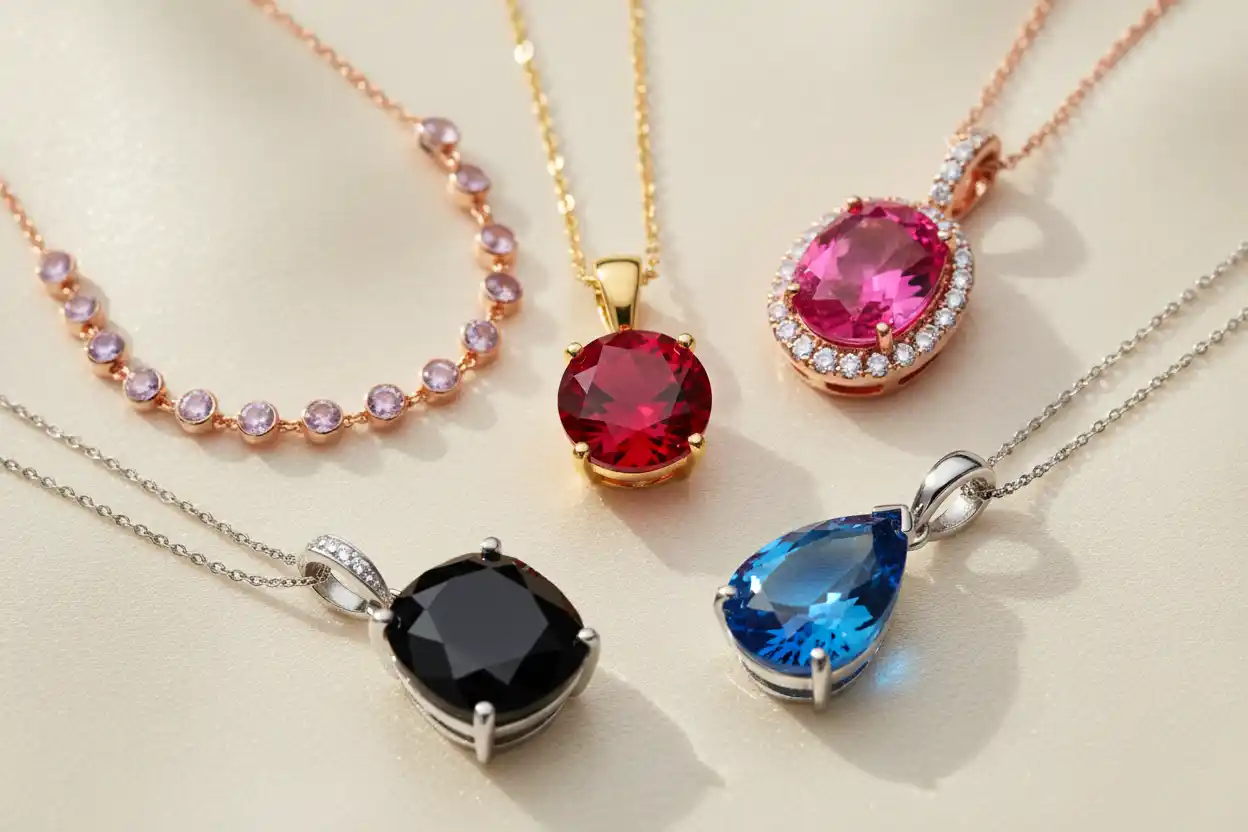
Spinel Necklaces and Pendants Guide
A Spinel necklace combines strong jewelry durability with a color range extending from vivid red and hot pink to cobalt blue, violet, gray and opaque black. The necklace format also protects the gemstone from much of the abrasion and impact that rings and bracelets experience.
The quality of the gem remains important, but a necklace must also function as a complete piece of jewelry. Chain strength, bail construction, pendant balance, clasp security, setting height and length all determine whether the Spinel sits correctly and remains comfortable.
Spinel Necklaces at a Glance
| Feature | What to Consider |
|---|---|
| Gemstone | Natural or laboratory-grown Spinel |
| Common colors | Red, pink, orange, violet, blue, gray and black |
| Mohs hardness | 8 |
| Toughness | Good |
| Cleavage | No easy cleavage |
| Most versatile design | Solitaire pendant on an adjustable chain |
| Most protective setting | Full or partial bezel |
| Popular cuts | Round, oval, cushion, pear and emerald-style cuts |
| Common necklace formats | Pendant, station, halo, lariat, strand and graduated line |
| Treatment concerns | Heat, fracture filling and diffusion in some material |
| Safest routine cleaning | Warm water, mild soap and a soft brush |
| Birthstone connection | Spinel is an August birthstone |
Why Spinel Works Well in Necklaces
Spinel has enough hardness for frequent wear and does not possess the pronounced cleavage found in some colored gemstones. A sound stone can therefore tolerate normal contact with clothing and careful handling.
Necklaces also keep the gem away from many hard surfaces. A pendant may still strike a desk, sink or seat belt, especially when worn on a long chain, but it generally encounters less danger than a ring mounted on the hand.
The broad Spinel meaning guide explains the gem’s mineral identity, historical confusion with Ruby and modern symbolism. This page concentrates on necklace formats, construction and selection.
Solitaire Spinel Pendants
A solitaire pendant places one Spinel at the center of the design. It is the most adaptable option because the pendant can remain understated or become a statement according to gemstone size and chain length.
Round and cushion cuts produce a balanced outline, while ovals create greater visible length. Pear shapes work naturally in vertical pendants because their pointed end directs the eye downward.
A four-prong basket exposes more of the gemstone and permits easy cleaning. However, the prongs should remain substantial enough to protect the girdle without covering excessive color.
A six-prong arrangement can provide greater security for round or oval stones. The additional metal may suit an expensive natural red or cobalt-blue Spinel where retention matters more than a completely open view.
Bezel-Set Spinel Pendants
A bezel surrounds most or all of the Spinel’s edge with metal. This reduces snagging and offers excellent protection against accidental side impacts.
Full bezels create a clean modern outline. Partial bezels leave portions of the girdle exposed and may allow the gemstone to look slightly larger.
The setting must fit the stone precisely. A loose bezel permits movement, while excessive pressure during setting can damage a stone containing a significant surface-reaching fracture.
Bezel pendants are particularly useful for active wearers and people who layer several necklaces. Their smooth profile is less likely to catch adjacent chains or clothing.
Halo Pendants
A halo places smaller accent stones around a central Spinel. Colorless Diamonds, white Sapphires and Zircon are common choices because they provide contrast and increase the apparent size of the center.
Red and hot-pink Spinel can look especially vivid inside a white halo. Blue and violet stones may also gain brightness when the surround prevents them from appearing too dark.
Every accent introduces additional setting points. Small prongs can loosen, and lotion may collect between the halo and the center gem.
A well-designed halo should preserve the Spinel’s visible outline. An oversized double halo may create greater scale, but it can also make the center stone appear secondary.
Spinel Station Necklaces
A station necklace places several Spinels at intervals along a chain. It creates repeated color without the expense or weight of a continuous gem-set line.
Bezel stations generally stay smooth against the skin and offer good girdle protection. Prong-set stations look lighter but can flip if their weight distribution is poor.
Each station should face forward when the necklace is worn. Check the reverse side for exposed culets, sharp galleries or metal edges that may irritate the skin.
Multicolor Spinel works especially well in a station layout. Pink, lavender, gray and blue gems can form a deliberate sequence without requiring identical matching.
Graduated Spinel Necklaces
A graduated necklace uses larger stones near the center and progressively smaller gems toward the clasp. Fine examples demand careful matching across color, saturation, clarity and cutting.
The progression should appear smooth. One unusually dark, pale or heavily windowed gem can interrupt the complete composition.
Large matched suites of natural Spinel can be difficult to assemble because fine rough is often cut to nonstandard dimensions. A jeweler may need to sort or recut many stones before the necklace looks coherent.
Ask whether replacement gems or spare matched stones are available. Replacing one lost stone years later may be difficult, particularly in rare red, vivid pink or cobalt-blue material.
Spinel Line Necklaces
A line necklace places Spinels close together in a continuous flexible row. It delivers greater color coverage than a station necklace and may resemble a tennis bracelet adapted to the neckline.
Each setting needs enough articulation to follow the neck without forming rigid corners. The links should move smoothly while preventing the stones from turning inward.
Shared-prong construction reduces visible metal but gives one prong responsibility for neighboring gemstones. Individual four-prong or bezel units provide greater separation.
A substantial clasp and secondary safety mechanism are appropriate for a high-value natural Spinel suite.
Spinel Lariat Necklaces
A lariat creates a vertical line through an adjustable or open-ended design. Spinel drops may appear at one or both ends.
Pear and elongated oval stones suit this format. The moving ends should not strike each other repeatedly because gemstone-to-gemstone contact can chip edges or abrade settings.
The adjustment mechanism should hold its position securely. A weak slider can allow the necklace to loosen during wear.
Long lariats work well over high necklines but receive more impact than short pendants because the gems swing farther from the body.
Spinel Bead Necklaces
Black Spinel beads are common, while transparent red, pink and blue bead strands are less widely available and generally more expensive.
Faceted black beads produce sharp reflections and can resemble black Diamond, Onyx, coated glass or other dark materials. Accurate identification remains important.
Transparent Spinel beads may contain more inclusions than fine faceted center stones because drilling reduces usable material and creates additional breakage risk.
Inspect each drill hole for fractures. A crack extending outward from the hole may enlarge as beads move against one another.
Heavier strands require appropriately strong stringing material. Individually knotted construction can reduce direct impact and limit loss if the strand breaks.
Choosing Spinel Color
Color normally has the greatest influence on Spinel’s appeal. Fine red is the classic premium choice, followed by exceptional cobalt blue, hot pink and vivid orange.
Red Spinel ranges from orangy red to slightly purplish red. The best stones remain bright rather than appearing black in ordinary indoor light.
Pink material can vary from pale blush to saturated neon-like color. Rose gold emphasizes warmth, while platinum and white gold produce stronger contrast.
Blue Spinel ranges from gray-blue and violet-blue to rare vivid cobalt hues. Significant bright-blue purchases deserve independent documentation because synthetic and diffusion-treated material exists.
Lavender, violet and gray Spinel provide more restrained alternatives. Black Spinel offers an opaque, graphic appearance rather than transparent brilliance.
The dedicated Spinel color meaning guide examines the symbolism and visual character of each shade. Mineral varieties appear separately in the guide to types of Spinel.
Red Spinel Necklaces
A red Spinel pendant can resemble Ruby, although the materials are distinct. Spinel is singly refractive and has a Mohs hardness of 8, while Ruby belongs to Corundum and reaches 9.
Historical red Spinels were frequently classified as Rubies before modern gemological testing. The dedicated Ruby versus Spinel comparison explains the Crown Jewels mix-up and practical identification.
A broader Ruby, Garnet and Spinel comparison separates three common red-gem possibilities.
Red Spinel works effectively in both yellow and white metals. Yellow gold gives the pendant a warmer historical character, while platinum creates a brighter contemporary frame.
Pink Spinel Necklaces
Pink Spinel makes an adaptable pendant because its color can feel delicate or dramatic according to saturation.
Pale pink stones suit compact bezels and minimal chains. Hot-pink material can carry a larger solitaire or halo without appearing visually weak.
A pink gem should be examined for orange or purple modifiers. Neither is inherently undesirable, but the color should match the recipient’s expectations.
Related color options appear in the pink gemstones guide, including Sapphire, Tourmaline, Morganite and other materials.
Blue Spinel Necklaces
Natural vivid-blue Spinel is much rarer than grayish or violet-blue material. Cobalt can contribute to strong blue coloration, although the presence and role of cobalt require laboratory analysis.
Diffusion treatments have been used to modify Spinel toward blue and blue-green. Consequently, a substantial natural cobalt-blue pendant should have a report from a respected gemological laboratory.
A laboratory report should address whether the material is natural or synthetic and identify detectable treatment. Exceptional color should not rely solely on a seller’s verbal description.
The blue gemstones guide compares Spinel with Sapphire, Aquamarine, Zircon and Tourmaline.
Black Spinel Necklaces
Black Spinel is opaque and depends on polish and reflected surface light rather than transparency.
It appears in bead necklaces, small pavé pendants, geometric designs and contrasting accents. White metal produces a sharp monochrome look, while yellow gold adds warmth.
Black Spinel can be confused with Onyx, Obsidian, black glass and treated Diamond. These materials have different structures, values and durability.
The black gemstones guide provides a broader comparison of dark jewelry stones.
Evaluating Cut
A well-cut Spinel should return light across most of its face. A shallow stone may show a central window through which the setting or skin becomes visible.
Excessive depth creates the opposite problem. The gemstone may retain carat weight but appear smaller and darker than its stated size suggests.
Ovals and cushions are common because they preserve valuable rough efficiently. Round brilliants produce balanced sparkle but may require greater weight loss during cutting.
Emerald-style cuts show broad flashes and reveal clarity readily. Pear and marquise shapes work well in pendants but need protection around their points.
Facet junctions should remain crisp. Abraded edges may indicate prior wear, careless storage or low-quality finishing.
Evaluating Clarity
Many Spinels are eye-clean, although natural stones can contain crystals, needles, fingerprints, healed fractures and other inclusions.
A small internal inclusion may have little effect on a pendant because the gem is normally viewed from conversational distance.
Surface-reaching fractures deserve greater attention. They may weaken the stone, collect residue or contain filling.
Compare clarity under magnification, but judge overall appearance at normal viewing distance. A technically clean stone with weak color may be less satisfying than a vivid gem containing a harmless inclusion.
Natural and Laboratory-Grown Spinel
Natural Spinel forms through geological processes. Laboratory-grown Spinel is manufactured under controlled conditions.
Synthetic material can be clean, evenly colored and affordable. It remains a valid jewelry choice when disclosed accurately.
Laboratory-grown Spinel has also been used historically to imitate Sapphire, Aquamarine and other gemstones. A blue synthetic Spinel may therefore be sold under confusing descriptions unless the seller is precise.
For an important natural necklace, an independent report helps confirm origin and detectable treatment.
Spinel Treatments
Many natural Spinels receive no treatment, but enhancement cannot be ruled out from reputation alone.
Heat treatment has been documented. Fracture filling may reduce the apparent visibility of surface-reaching breaks.
Cobalt and nickel diffusion treatments can modify blue, greenish-blue and green colors. These processes may require advanced laboratory testing.
Written disclosure should identify known treatment directly. A vague term such as “enhanced” does not provide enough information for a significant purchase.
Chain Length
A short necklace places the Spinel near the collarbone. Longer lengths allow layering and work well with higher necklines.
An adjustable chain offers flexibility when the recipient’s preferred length is uncertain. The extension should remain strong enough for the pendant’s weight.
A heavy pendant can pull the clasp forward if the chain is too fine or the necklace is poorly balanced.
Measure a necklace the recipient already wears instead of relying only on labels such as princess, matinee or choker.
Chain Construction
Cable chains provide a clean, adaptable foundation. Box, wheat and rope chains offer greater visual substance for heavier pendants.
Snake chains create a smooth surface but may kink if stored carelessly. Very fine chains can look elegant yet become the weakest component in the piece.
The chain should pass through the bail freely without excessive movement. A bail that is too narrow restricts the pendant, while one that is too large can look disconnected.
Confirm whether the chain is included in the listed price. Some fine Spinel pendants are sold separately.
Bail Design
The bail carries the full weight of the pendant and should be inspected as carefully as the gemstone setting.
A fixed bail controls the pendant’s direction but limits chain compatibility. A hinged bail allows movement and can help the pendant lie flat.
Hidden bails create a seamless appearance. Enhancer bails open so a pendant can attach to pearls or thicker necklaces, but their locking mechanisms need to remain secure.
Check that solder joints are complete and that the bail does not contain thin areas likely to wear through.
Clasp Security
A lobster clasp is suitable for many lightweight and moderate necklaces. Spring-ring clasps are smaller but may be harder to operate.
Box clasps with safety catches are appropriate for line necklaces and valuable multi-stone pieces.
Magnetic clasps offer convenience but generally provide less security for an expensive natural Spinel necklace.
Open and close the clasp several times. It should engage positively without sharp edges, excessive resistance or visible gaps.
Metal Choices
White gold and platinum emphasize red, pink, blue, violet and black Spinel through cool contrast.
Yellow gold complements red, orange, black and warmer purple stones. It can also make historic-style red Spinel designs feel more traditional.
Rose gold pairs naturally with pink and lavender material, although pale gems may blend into the mounting.
Sterling silver provides a lower-cost option for black, gray and commercial-quality multicolor Spinel. The setting and chain should still remain strong enough for the gemstone’s value and weight.
August Birthstone Necklaces
Spinel is one of the modern birthstones for August, alongside Peridot and Sardonyx.
Its broad color range allows the gift to reflect the recipient rather than requiring one traditional shade. Red, pink, blue, gray, violet and black are all valid Spinel birthstone options.
The August birthstone guide explains the calendar tradition. The August birthstone jewelry guide compares necklace gifts with rings, earrings and bracelets.
An adjustable pendant is particularly practical because it avoids ring and wrist sizing.
Comparing Other Spinel Jewelry
Spinel earrings provide color near the face and avoid necklace-length decisions.
A Spinel bracelet remains visible to the wearer but experiences more contact with surfaces. The dedicated Spinel ring guide addresses settings and daily hand wear.
A necklace offers one of the safest opportunities to use a larger Spinel because the gem receives less impact than it would in hand jewelry.
Price and Documentation
Spinel value depends strongly on color, followed by clarity, cutting, size, origin and treatment.
Fine natural red, hot-pink and cobalt-blue stones can command substantial prices. Large gems become increasingly scarce when vivid color and eye-clean clarity remain intact.
A multi-stone necklace also includes the difficulty of matching. Closely coordinated suites may be worth more than an equivalent collection of unrelated stones.
The Spinel price guide covers current value factors. The Spinel buying guide provides seller questions, report guidance and quality checks.
Cleaning and Maintenance
Clean Spinel with warm water, mild soap and a soft brush. Support the pendant and chain over a bowl or closed drain.
Brush beneath the setting, around the bail and between links where cosmetics and skin oils collect. Rinse briefly and dry thoroughly.
Steam and ultrasonic equipment may be suitable for untreated, unfractured Spinel in strong settings. Warm soapy water remains the safer choice when treatment, filling or structural condition is uncertain.
The dedicated guide to cleaning Spinel jewelry provides a complete treatment-aware process.
Apply perfume, hairspray and cosmetics before putting on the necklace. Remove it before exercise, bathing and sleeping.
Storage
Fasten the clasp before storage to reduce tangling. Lay long necklaces flat or hang them from a suitable organizer.
Keep the Spinel away from Diamond and Sapphire, which can scratch it. Separate compartments also prevent the pendant from striking metal components.
A travel case should hold the gem still rather than allowing it to swing inside a box.
Spinel is listed in both the crystals beginning with S and gemstones beginning with S directories.
Frequently Asked Questions
1. Is Spinel suitable for necklaces?
Yes. Its Mohs hardness of 8, good toughness and lack of easy cleavage make it highly suitable for pendants and necklaces.
2. What is the safest Spinel pendant setting?
A full or partial bezel provides excellent edge protection and reduces snagging. Secure prongs also work when inspected regularly.
3. Which Spinel color is best for a necklace?
Fine red, cobalt blue, hot pink and orange are highly valued, but lavender, gray and black may better suit the wearer’s personal style.
4. What chain length is most versatile?
An adjustable chain that covers the common collarbone range works for many recipients, although an existing favorite necklace provides the best measurement.
5. Does a natural Spinel necklace need a laboratory report?
A modest commercial pendant may not need one. Reports become more useful for large, expensive, vivid-blue, fine-red or exceptionally represented stones.
6. Is synthetic Spinel suitable for necklaces?
Yes, when its manufactured origin is disclosed. It can provide clean, evenly matched color at a lower cost.
7. Can Spinel be treated?
Yes. Heat, fracture filling and cobalt or nickel diffusion have been documented. Known treatment should appear in writing.
8. Is a blue Spinel necklace always natural?
No. Natural, synthetic and diffusion-treated blue Spinel all exist. Valuable vivid-blue stones deserve independent verification.
9. Which metal works best with red Spinel?
White metal provides bright contrast, while yellow gold gives red Spinel a warmer and more traditional appearance.
10. Can Spinel necklaces be layered?
Yes. Leave enough distance between chains to prevent tangling and contact with harder gemstones or rough metal edges.
11. Is Spinel an August birthstone?
Yes. Spinel is recognized alongside Peridot and Sardonyx as a modern August birthstone.
12. How should a Spinel necklace be cleaned?
Use warm water, mild soap and a soft brush. Avoid aggressive steam or ultrasonic cleaning when fractures, filling or treatment history are uncertain.