
August Birthstone: Peridot’s Meaning, Color & History

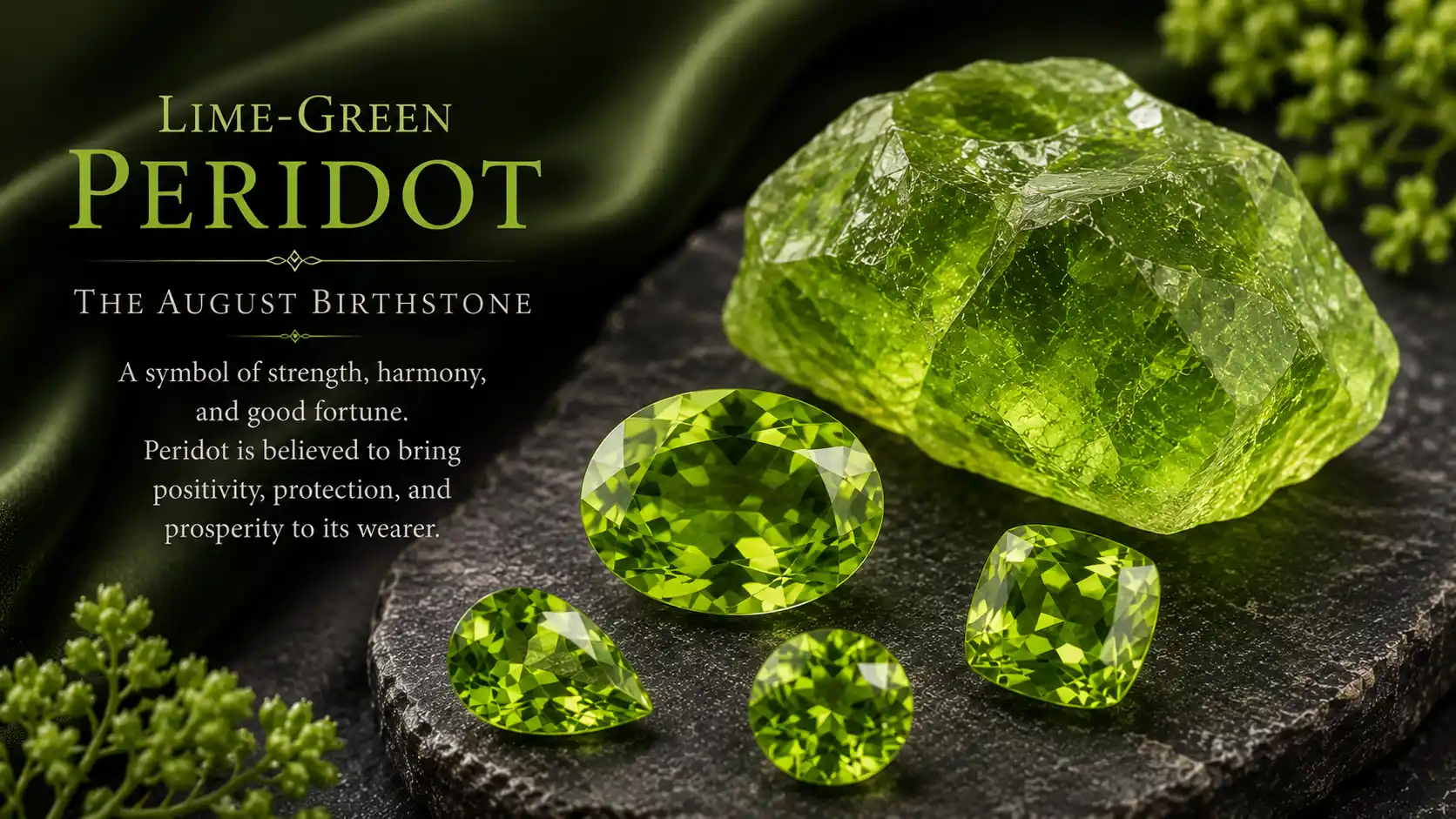
Peridot is the best-known modern August birthstone, recognized for its yellowish-green to green color and its unusual formation deep within Earth’s mantle. August also has two additional birthstones: spinel, which occurs in many colors, and sardonyx, the historic banded chalcedony choice.
These three materials provide very different options. Peridot offers a distinctive natural green, spinel supplies red, pink, blue and other colors with strong durability, while sardonyx creates an opaque layered appearance suited to carvings, cameos and signet jewelry.
August Birthstones at a Glance
| Birthstone | Material identity | Typical colors | Mohs hardness | Main appeal |
|---|---|---|---|---|
| Peridot | Gem-quality olivine | Yellowish green to greenish yellow | 6.5–7 | Distinctive natural green |
| Spinel | Magnesium aluminum oxide | Red, pink, purple, blue, orange and others | 8 | Color variety and durability |
| Sardonyx | Banded chalcedony | Red-brown, orange, white and black bands | 6.5–7 | Layering, carving and history |
What Is the Main August Birthstone?
Peridot is the principal stone most people associate with August. It appears prominently on modern birthstone charts and has a color that is difficult to confuse with most monthly stones.
However, the complete modern August tradition includes peridot, spinel and sardonyx.
Sardonyx is the oldest of the three assignments, with a history stretching back thousands of years. Spinel joined modern August lists more recently, providing a durable and colorful alternative.
The birthstones-by-month guide places all three within the annual sequence.
A person born in August can choose any of the recognized stones. The best option depends on color preference, jewelry use, budget and interest in history.
What Is Peridot?
Peridot is the gem variety of olivine, a group of magnesium-iron silicate minerals.
Gem-quality peridot usually lies toward the magnesium-rich end of the olivine series. Iron produces its green color, making peridot an idiochromatic gemstone whose coloring element forms an essential part of its chemistry.
Unlike sapphire, quartz and several other gems, peridot occurs in a relatively narrow color range. It remains green, although the balance can shift from yellowish green to brownish or more nearly pure green.
The dedicated peridot meaning guide owns the full mineral profile, symbolism and material-specific uses.
Why Peridot Is Always Green
Peridot’s iron content creates its body color.
Lower or better-balanced iron concentrations can produce attractive yellowish-green to grass-green material, while excessive iron may contribute brownish or darker tones.
Lighting affects perception. Warm artificial light may emphasize yellow, whereas neutral daylight can reveal a cleaner green.
Peridot does not occur naturally as red, blue or purple. Products using names such as blue peridot or pink peridot are therefore misidentified, coated or made from another material.
The strongest commercial preference commonly favors an even, vivid green with limited brown and enough saturation to remain visible indoors.
Peridot Formation
Most gem peridot formed within Earth’s upper mantle.
Volcanic processes can carry olivine-bearing rock toward the surface. The crystals may occur in basalt, mantle-derived nodules or weathered deposits created after the host rock breaks down.
This origin distinguishes peridot from many gemstones that form in crustal pegmatites, hydrothermal veins or sedimentary environments.
Olivine also occurs in some pallasite meteorites. Rare transparent extraterrestrial crystals can be cut as peridot, although most jewelry material comes from terrestrial deposits.
The presence of olivine in meteorites does not make ordinary commercial peridot extraterrestrial. Provenance must support such a claim.
Peridot History
Peridot has been mined and traded for thousands of years.
One of its most famous historic sources is Zabargad, an island in the Red Sea off Egypt. Ancient mining conditions were difficult, and material from the island entered royal, religious and trade networks.
Historical texts sometimes confused peridot with topaz because the island was associated with names related to Topazios. Green peridot was also mistaken for emerald in older collections.
Some historians have proposed that part of Cleopatra’s celebrated emerald collection may have included peridot. This remains a historical possibility rather than a proven description of every stone she owned.
Peridot later appeared in church treasures and ceremonial jewelry. Its vivid color remained desirable even when mineral identification was less precise than it is today.
Historic Peridot Confusion
Peridot has been confused with emerald, green glass, chrysoberyl and other green gems.
A well-known example involves green stones in historic religious objects that were long described as emerald but later identified as peridot.
The confusion is understandable because ancient and medieval gem names often emphasized color or origin rather than modern mineral species.
Today, refractive index, birefringence, inclusions, density and spectroscopy provide more reliable identification.
The dedicated peridot-versus-emerald guide owns the complete side-by-side comparison.
Major Peridot Sources
Historic Zabargad material remains important to collectors, but modern peridot comes from several regions.
Myanmar has produced transparent crystals with strong color, particularly from the Mogok region. Pakistani deposits have yielded large, attractive crystals from mountainous areas.
Arizona is an important United States source. Peridot has been mined on the San Carlos Apache Reservation, where production has supported local families and trade networks.
Additional material comes from China, Vietnam, Tanzania and other locations.
One source does not guarantee quality. Color, clarity, cutting, condition and treatment must still be evaluated in the individual stone.
Peridot From Pakistan
Pakistan is known for peridot from high mountain regions, including areas within Khyber Pakhtunkhwa and neighboring northern geological zones.
Some crystals show strong color and useful transparency, allowing cutters to produce substantial gems.
Mining in mountainous terrain can involve difficult access and seasonal conditions. Therefore, supply may vary, and origin stories should be supported rather than assumed from appearance.
A Pakistani origin can add collector interest, but the stone’s face-up beauty and documentation remain more important than a seller’s unsupported locality label.
Peridot From Arizona
Arizona peridot commonly occurs in basaltic environments associated with mantle-derived olivine.
Commercial production from the San Carlos Apache Reservation has made Arizona one of the best-known modern sources.
Much of the material appears in smaller calibrated sizes, beads and commercial jewelry. Fine stones can still show attractive color and transparency.
Responsible purchasing should recognize the difference between generic “Arizona peridot” marketing and material sold with meaningful information about its community and supply chain.
Peridot in Meteorites
Olivine crystals occur within pallasite meteorites, which contain nickel-iron metal and silicate material.
Exceptionally transparent olivine from a suitable meteorite may be faceted into rare extraterrestrial gems.
These stones can be fragile, small and difficult to cut. They may also require documentation linking the material to a recognized meteorite.
A green gemstone is not meteoritic simply because a seller uses phrases such as cosmic, celestial or space peridot.
For expensive extraterrestrial claims, provenance and specialist verification are essential.
Peridot Meaning and Symbolism
Peridot traditionally symbolizes renewal, optimism, protection and the release of resentment.
Its bright green color has encouraged associations with growth, summer, prosperity and fresh beginnings. Historical talisman traditions also connected it with protection from fear or troubling dreams.
Modern spiritual practices often use peridot as a reminder to approach change without carrying every previous grievance forward.
These meanings are cultural and personal rather than scientifically established properties.
The dedicated peridot healing properties guide owns the fuller wellness discussion and medical boundaries.
Peridot as a Summer Birthstone
Peridot’s yellow-green color fits the late-summer landscape associated with August in the Northern Hemisphere.
The stone can symbolize growth reaching maturity rather than the earliest green of spring. Consequently, it may represent gratitude, harvest and deciding what should continue into the next season.
Seasonal symbolism changes across regions because August does not represent late summer everywhere.
Birthstone meaning should therefore remain flexible enough to include the wearer’s own climate, culture and experience.
Peridot Color Quality
Color usually has the greatest visible effect on peridot quality.
Fine material shows lively green with minimal brown. A slight yellow component is common and does not automatically reduce beauty.
Small stones can appear lighter, while larger gems may show stronger color because light travels through more material.
An overly dark peridot can lose brightness, especially under weak indoor lighting. Brownish stones may remain attractive but generally receive less commercial interest than cleaner green material.
The setting metal also affects perception. Yellow gold reinforces warm yellow-green tones, while white metals can create stronger contrast.
Peridot Clarity
Faceted peridot is commonly expected to appear eye-clean, particularly in smaller sizes.
Typical inclusions can include mineral crystals, fractures and rounded reflective features sometimes described as lily-pad inclusions.
A small internal feature may not affect beauty or durability. Surface-reaching fractures near the girdle or corners deserve more caution.
Larger stones may show more visible inclusions simply because the viewer can see further into the gem.
Clarity should be balanced with color. A slightly included stone with vivid green can be more appealing than a flawless but weakly colored gem.
Peridot Cut
Peridot is available in oval, round, cushion, pear, emerald and other faceted shapes.
A good cut distributes color evenly and returns light across the face. Large windows reduce brilliance, while excessive depth hides weight below the setting.
Peridot has strong double refraction. When viewed through some facets, rear facet junctions may appear doubled.
This optical feature can help identification, but a poorly designed cut may make the interior appear visually busy.
Cutters must also manage brittle behavior and cleavage-related concerns. Thin corners and exposed points need particular care.
The peridot buying guide owns the full quality-selection workflow.
Peridot Treatments and Imitations
Peridot is not routinely enhanced on the scale associated with sapphire, ruby or emerald.
However, surface coatings, fracture filling or assembled products may occasionally appear. Sellers may also misidentify green glass, synthetic materials or other natural gems as peridot.
The relative lack of common treatment does not eliminate the need for verification.
An intensely saturated large stone at an implausibly low price deserves closer examination. Color, inclusions and a seller’s statement alone may not prove identity.
A laboratory report can be useful for an important stone or unusual locality claim.
Peridot Value Boundaries
Peridot value depends on color, size, clarity, cut, origin claims and condition.
Fine, strongly colored larger stones generally command more than pale commercial melee. Historic or documented meteorite material can occupy specialist markets.
However, detailed current prices belong to the dedicated peridot price guide.
Birthstone jewelry should be selected for appearance and construction rather than the expectation of automatic appreciation.
A well-cut modest stone in a secure setting often provides more lasting value than a larger gem with weak color or visible damage.
Spinel: The Colorful August Alternative
Spinel is August’s most colorful birthstone option.
It occurs in red, pink, purple, blue, violet, orange and other colors. Red spinel was confused with ruby for centuries, including in historic royal collections.
Spinel ranks 8 on the Mohs scale and generally provides strong durability for rings, earrings, necklaces and bracelets.
Fine natural red, cobalt-blue and vivid pink spinels can be rare and expensive. Other colors may provide more accessible alternatives.
The spinel color meaning guide owns detailed symbolism, while the types of spinel guide explains color and variety classifications.
Why Spinel Was Mistaken for Ruby
Red spinel and ruby can occur in similar geological settings and share a vivid red appearance.
Before modern mineralogical testing, both might be described using broad color-based gem names.
Spinel is magnesium aluminum oxide, whereas ruby is chromium-bearing corundum. Their hardness, optical properties and crystal structures differ.
Several famous historic “rubies” were later identified as spinel. This history no longer makes spinel a substitute; fine spinel has become a desirable gemstone in its own right.
Sardonyx: The Historic August Birthstone
Sardonyx is the oldest traditional August birthstone.
It consists of contrasting layers of sard and onyx, usually creating red-brown, orange, white or dark bands within chalcedony.
The layered structure made sardonyx especially suitable for engraved seals, cameos and intaglios. A carver could use one layer for the raised image and another for the background.
Traditional symbolism includes courage, communication, protection and marital stability.
Sardonyx is generally more affordable than fine peridot or spinel, making it a historically meaningful option without requiring transparent gem material.
Choosing Between the Three August Birthstones
| Preference | Best starting choice |
|---|---|
| Bright natural green | Peridot |
| Red, pink, blue or purple | Spinel |
| Historic carved or banded material | Sardonyx |
| Strong ring durability | Spinel |
| Traditional August identity | Peridot |
| Oldest historical assignment | Sardonyx |
| Transparent faceted jewelry | Peridot or spinel |
| Signet, cameo or opaque cabochon | Sardonyx |
| Lower-cost symbolic gift | Sardonyx or modest peridot |
| Broadest color selection | Spinel |
A person does not need to choose the stone with the highest market value. Color preference and intended jewelry format should lead.
Someone who dislikes green may enjoy spinel, while a recipient drawn to historic objects may prefer sardonyx.
August Birthstone Jewelry
Peridot works well in earrings, pendants and bracelets. Rings require more protection because the stone is softer and more brittle than spinel.
The guides to peridot bracelets, peridot earrings, peridot necklaces and peridot rings cover format-specific choices.
Spinel’s stronger durability makes it especially suitable for frequently worn rings. Dedicated guides cover spinel bracelets, spinel earrings, spinel necklaces and spinel rings.
Sardonyx works naturally in signet rings, cameos, cuff links, pendants and bead jewelry.
The August birthstone jewelry guide owns complete gift-format decisions.
August Anniversary Connections
Peridot is traditionally associated with the sixteenth wedding anniversary, while spinel is assigned to the twenty-second year in widely used modern lists.
Sardonyx has historical associations with marriage, loyalty and communication but is less consistently tied to one modern anniversary year.
The anniversary gemstone guide provides the complete sequence.
An anniversary gift does not need to follow the chart rigidly. The wearer’s style and the relationship’s own history may justify another August stone.
Durability Comparison
Peridot and sardonyx both fall around 6.5–7 on the Mohs scale, although their structures and cutting styles differ.
Spinel ranks 8 and generally offers better resistance to surface wear.
The gemstone hardness chart explains scratch resistance. Nevertheless, all three can chip, break or suffer setting damage.
Peridot is vulnerable to heat, acids and thermal shock. Sardonyx may be dyed, which can affect chemical and light stability.
Spinel usually tolerates routine wear well, although heavily fractured or treated material may require additional care.
Cleaning the August Birthstones
Peridot should be cleaned with lukewarm water, mild soap and a soft brush. Avoid ultrasonic and steam cleaning because heat and vibration can create unnecessary risks.
Spinel can often tolerate ultrasonic or steam cleaning when untreated and free from significant fractures. Warm soapy water remains the safest universal method.
Sardonyx can usually be cleaned gently with mild soap and water, but dyed, filled or assembled pieces should not be soaked or exposed to strong chemicals.
Mixed birthstone jewelry must follow the needs of its most vulnerable component.
Frequently Asked Questions
1. What is the main August birthstone?
Peridot is the birthstone most strongly associated with August, although spinel and sardonyx are also recognized.
2. How many August birthstones are there?
Modern lists recognize three: peridot, spinel and sardonyx.
3. What color is the August birthstone?
Peridot is yellowish green to green. Spinel occurs in many colors, while sardonyx commonly shows red-brown, white, orange or dark bands.
4. Why is peridot always green?
Iron is an essential color-producing part of peridot’s olivine chemistry, so the gemstone remains within a green color range.
5. Where is peridot found?
Important sources include Myanmar, Pakistan, Arizona, China, Vietnam and Tanzania, along with the historic Red Sea source of Zabargad.
6. Can peridot come from meteorites?
Olivine occurs in some pallasite meteorites, and rare transparent crystals can be faceted. Most commercial peridot is terrestrial.
7. Is spinel a real August birthstone?
Yes. Spinel is recognized as a modern August birthstone alongside peridot and sardonyx.
8. Why was spinel confused with ruby?
Red spinel and ruby can look similar and occur in comparable deposits. Modern testing shows that they have different chemistry and crystal structures.
9. Is sardonyx the original August birthstone?
Sardonyx is the oldest traditional August birthstone of the three, with a history spanning thousands of years.
10. Which August birthstone is best for an everyday ring?
Spinel generally provides the strongest durability. Peridot and sardonyx can work in protective settings with more careful wear.
11. Is peridot treated?
Peridot is not commonly treated, although coatings, filling or misidentification can occur. Important stones may warrant professional verification.
12. Does the August birthstone have proven healing powers?
No reliable scientific evidence shows that peridot, spinel or sardonyx treats medical or mental health conditions.
Three Birthstones, Three Different Traditions
Peridot remains August’s signature gemstone because its natural green color and mantle origin give it a distinct identity. Spinel adds durability and a broad palette, while sardonyx preserves the month’s oldest carved-stone tradition.
The strongest choice does not need to follow popularity. A well-cut green peridot, vivid spinel or carefully patterned sardonyx can all represent an August birthday when the material, treatment and setting are understood accurately.
Disclaimer: Birthstone meanings and metaphysical properties reflect cultural, historical and spiritual traditions rather than established medical effects. Gemstones should not replace professional healthcare or be purchased on the basis of guaranteed outcomes.