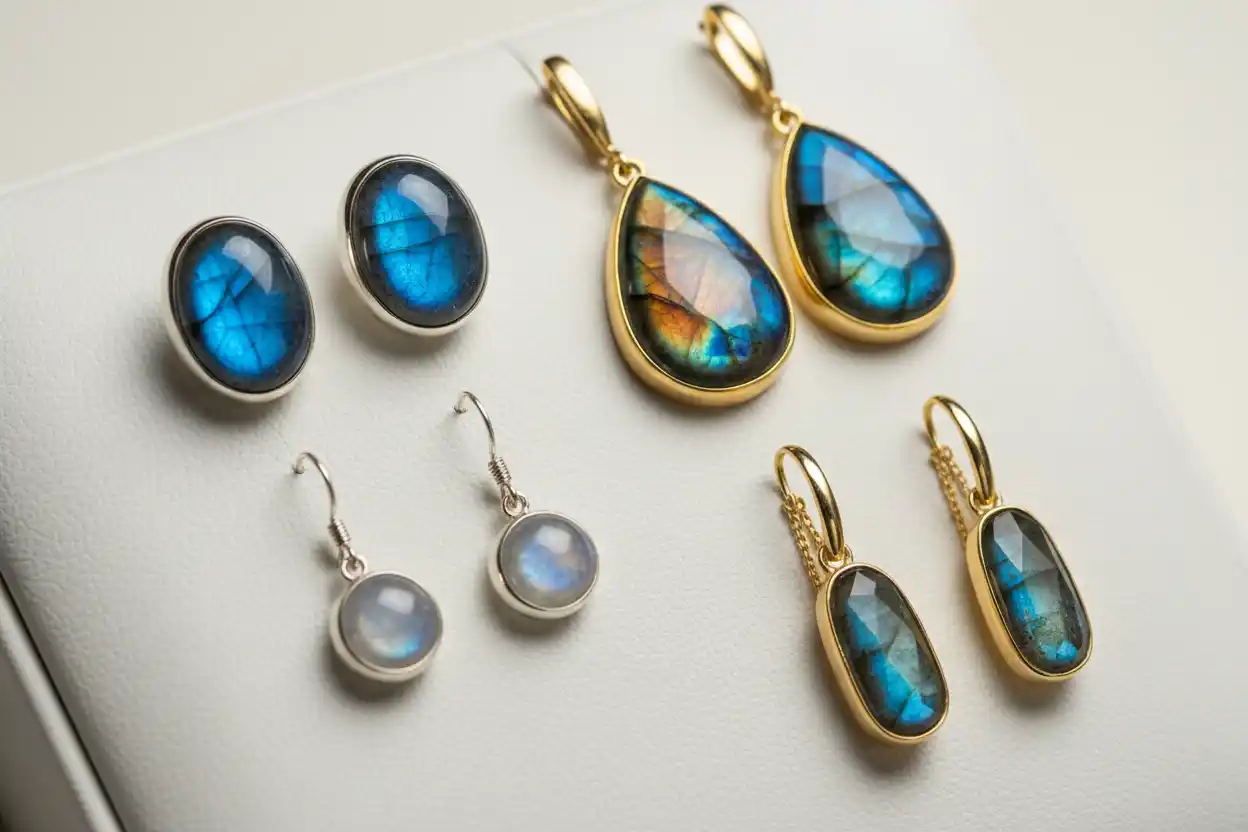
Labradorite Earrings: Styles, Flash and Buying Guide
Labradorite earrings reveal their strongest colors through movement. As the wearer turns their head, a gray cabochon may flash blue, green, gold, orange, violet or several colors in succession. That moving optical display gives each pair a character that cannot be judged from one still photograph.
Earrings also provide one of the safest jewelry environments for labradorite. The stone has moderate hardness and pronounced cleavage, but earrings encounter fewer desks, tools and hard surfaces than rings or bracelets.
The buying challenge is matching. Two labradorite cabochons may have similar shapes and bodycolors yet flash in different directions. One can appear vivid from the front while the other remains gray unless it is tilted sharply.
The broad labradorite guide explains the mineral’s geology, symbolism and uses. This page focuses specifically on earring styles, orientation, pair matching, construction, comfort, buying and care.
Why Labradorite Is Well Suited to Earrings
Labradorite is a plagioclase feldspar with Mohs hardness around 6–6.5 and two strong cleavage directions.
It resists some routine surface wear but can scratch, chip or split from impact. Earrings reduce those risks because they hang away from most hard surfaces.
Studs offer the greatest protection. Short drops also perform well. Long dangles remain suitable when the components do not strike one another or catch in clothing.
The gemstone hardness chart provides scratch-resistance context. The guide to gemstone toughness versus hardness explains why cleavage matters even when a gem is not unusually soft.
Main Labradorite Earring Styles
| Earring style | Visual advantage | Main concern |
|---|---|---|
| Cabochon studs | Compact face-up flash | Orientation and post security |
| Bezel studs | Strong edge protection | Bezel pressure and hidden backing |
| Prong-set studs | More visible stone | Exposed girdle |
| Drop earrings | Movement activates flash | Bail and connector strength |
| Dangle earrings | Dramatic shifting color | Snagging, weight and collision |
| Hoop charms | Contemporary movement | Charm impact and hinge wear |
| Spectrolite earrings | Strong multicolor effects | Matching and locality claims |
| Rainbow-moonstone earrings | Pale body with colorful sheen | Trade-name confusion |
| Carved earrings | Large artistic surfaces | Thin areas and cleavage |
| Mixed-gem earrings | Color contrast | Harder stones can scratch labradorite |
Labradorite Stud Earrings
Studs sit close to the ear and minimize movement. They suit everyday styling better than large drops and reduce the chance of snagging.
Because studs remain nearly face-forward, their flash orientation is especially important. A good pair should show color with small head movements rather than requiring the stones to be tilted almost sideways.
Bezel Studs
A bezel surrounds the cabochon’s edge and provides excellent protection. It also creates a smooth profile that catches less easily in hair or clothing.
Inspect the metal around the complete stone. Gaps, ripples, glue seepage and rough pressure points suggest poor construction.
A closed back can support the cabochon but may conceal cracks, backing, foil or glue. Ask for photographs of the reverse.
Prong-Set Studs
Prongs expose more of the stone and may allow a broader view of the flash.
However, labradorite’s girdle remains more vulnerable. The cabochon should sit low in a supportive basket rather than projecting far beyond the metal.
Four prongs can secure a moderate oval or round cabochon. Larger stones may benefit from more support or a partial bezel.
Labradorite Drop Earrings
Drop earrings allow the stones to move enough for the labradorescence to appear and disappear naturally.
Oval, pear, marquise, round, shield and freeform cabochons are common. The strongest designs allow movement without letting the stone flip permanently backward.
An articulated connector should hang from the cabochon’s center of balance. When the bail or jump ring sits off-center, the stone may turn toward its weakest flash angle.
Check that the connector does not grind directly against an exposed feldspar edge.
Long Dangle Earrings
Dangles may include several cabochons, beads, chains or metal components.
The stones should not strike one another repeatedly. Harder accent stones should remain separated from the labradorite.
Weight becomes important. Request the weight per earring rather than only the pair’s total weight.
Long earrings should use dependable hooks, leverbacks or posts. Open fishhook wires benefit from silicone stoppers.
The design should also work with the wearer’s hair, scarves, headphones and clothing.
Matching Labradorite Earrings
Matching labradorite is more complex than matching a pair of uniformly colored stones.
The two cabochons should be compared for:
| Matching factor | What to examine |
|---|---|
| Bodycolor | Gray, dark gray, brown, pale or black-looking |
| Flash color | Blue, green, gold, orange, violet or multicolor |
| Flash brightness | Relative intensity |
| Coverage | Full-face, partial or narrow flash |
| Orientation | Angle at which each stone flashes |
| Shape | Outline and symmetry |
| Dimensions | Length, width and dome height |
| Surface | Polish, pits and scratches |
| Transparency | Opaque, translucent or transparent areas |
| Condition | Cleavage lines, chips and cracks |
The best pair does not need identical internal patterns. Natural variation is expected. However, the earrings should respond to normal movement in a coordinated way.
How to Evaluate Flash in a Pair
Ask for a single continuous video rather than separate clips.
The seller should hold both earrings in the same position, under the same light, and move them together.
Watch whether:
- Both stones flash from near-front angles.
- One remains gray while the other is bright.
- The colors complement one another.
- The flash disappears completely when worn upright.
- Reflections from a lamp are being mistaken for labradorescence.
- Editing has increased saturation.
- One stone has been rotated differently from the other.
A still image captures only one moment. Earrings must be evaluated through movement.
Full-Face and Partial Flash
Full-face flash covers most of the cabochon at the correct angle. It creates a bold appearance in studs and simple drops.
Partial flash may appear as a band, patch, edge or diagonal sweep. It can create an attractive asymmetrical pattern when the pair is coordinated.
A narrow, brilliant blue line may look more dramatic than a broad weak area. Coverage should therefore be judged with intensity and orientation.
Choosing Flash Color
Blue is common and versatile. Green and gold provide warmer variation, while orange, red and violet may be less common.
Multicolor labradorite can reveal several hues as the earring turns. A pair with identical full-spectrum patterns may be difficult to find.
The types of labradorite guide explains colors, optical varieties, transparent material and trade names.
Color preference should not override structural quality. A vivid cabochon with a large open fracture is a weaker purchase than a slightly less dramatic but sound stone.
Spectrolite Earrings
Spectrolite is a trade name associated with strongly colored Finnish labradorite.
It often has a dark bodycolor and vivid blue, green, yellow, orange, red and violet flashes.
A pair can be difficult to match because each stone may show a different internal pattern. Designers sometimes choose complementary rather than identical cabochons.
Ask whether the spectrolite name reflects documented Finnish origin or simply strong multicolor appearance. The term should not function as an unsupported universal quality grade.
Rainbow Moonstone Earrings
Rainbow moonstone is generally transparent or translucent white labradorite rather than traditional orthoclase moonstone.
It may display blue, green, yellow, orange and multicolor sheen against a pale body.
The rainbow moonstone guide explains the trade identity. The direct Labradorite vs Moonstone guide owns the mineralogical comparison.
Rainbow-moonstone earrings often use prongs because the material is transparent. A low bezel or supportive halo may provide better edge protection.
Cut and Orientation
Labradorite is commonly cut as cabochons because a broad curved surface can display the internal flash effectively.
The base should be oriented approximately parallel to the internal structures responsible for the phenomenon. Incorrect orientation can shift the flash to an edge or remove it from the face-up view.
Some transparent labradorite is faceted. Faceting emphasizes transparency and brilliance, although it may display less broad labradorescence than a well-oriented cabochon.
Carved leaves, wings, moons and geometric shapes can show large flash areas, but thin sections are vulnerable to cleavage and impact.
Surface Quality
Labradorite may contain visible internal planes, dark inclusions, veins and colorless areas.
Inspect the polished face for:
- Scratches
- Pits
- Flat spots
- Orange-peel texture
- Undercutting
- Open cracks
- Edge chips
- Coating wear
- Residue around the setting
A highly reflective photograph can hide surface damage. Diffused side lighting reveals polish more clearly.
Treatments and Imitations
Labradorite is not normally subjected to one dominant routine treatment, but coating, resin filling, backing, dye and assembly can occur.
A dark backing may increase contrast. A coating may add color or gloss. Resin can stabilize fractures or fill cavities.
Glass can imitate shifting color through foil, coatings or layered construction. The movement usually differs from internal labradorescence, but high-quality imitations may require professional inspection.
The Labradorite Buying Guide owns the full authenticity and quality process.
Earring Metal
Sterling silver is widely used because its cool tone complements blue and green flash.
Yellow gold emphasizes gold, orange and green. Rose gold can strengthen violet and copper-colored effects.
The metal must be substantial enough to support the cabochons. Lightweight hooks, thin bezels and open jump rings can fail even though the stones remain intact.
The guide to gemstones and metals for sensitive skin explains why posts, backs, solder, nickel and plating matter independently from the labradorite.
Posts, Hooks and Backs
Studs may use friction, screw or locking backs.
Large cabochons benefit from supportive disk backs that keep the earrings upright. Small standard backs may allow the pair to tilt downward.
Drops may use leverbacks, posts, hinged hoops or hooks. Leverbacks provide strong loss protection, while hooks should include stoppers.
Check that the post is attached to a metal setting rather than glued directly onto the stone without adequate support.
Weight and Comfort
Labradorite has moderate density, but large cabochons and substantial silver settings can produce heavy earrings.
Request the weight per earring and compare it with a comfortable pair already owned.
A wide stud can distribute weight more effectively than a narrow drop. Long earrings create leverage even when their total weight seems modest.
The bottom of a dangle should not strike the shoulder continuously, because repeated impact can chip the stone or bend the connector.
Price and Value
The labradorite price guide owns valuation.
Earring price depends on:
- Flash strength
- Flash coverage
- Color rarity
- Pair matching
- Cabochon size
- Surface condition
- Spectrolite claims
- Metal
- Setting labor
- Accent stones
- Designer work
- Findings and backs
A matched pair can cost more than two unrelated cabochons because orientation, dimensions and color must coordinate.
Buying Online
Follow How to Buy Gemstones Online Without Getting Scammed.
Request:
| Buying detail | What to confirm |
|---|---|
| Material | Natural labradorite or accurately disclosed alternative |
| Trade name | Spectrolite, rainbow moonstone or ordinary labradorite |
| Pair matching | Bodycolor, flash, coverage and orientation |
| Dimensions | Length, width and depth of each stone |
| Earring weight | Grams per earring |
| Metal | Alloy, hallmark, posts, backs and plating |
| Setting | Bezel, prongs, glue, drilled or capped construction |
| Condition | Cracks, chips, coating and repairs |
| Video | Both earrings moving together under neutral light |
| Returns | Inspection and comfort-testing period |
An independent report is rarely necessary for ordinary commercial earrings. It may be useful for expensive spectrolite, a disputed identity or a high-value designer piece.
The gemstone certification guide explains the limits of laboratory documentation.
Styling Labradorite Earrings
Blue-flash studs work easily with neutral, denim, black, gray and cool-colored clothing.
Multicolor drops can become the main visual feature of an outfit. They do not need a matching necklace or bracelet, because an exact flash match may look forced.
A future labradorite necklace can repeat one color or metal. A labradorite bracelet creates more movement but receives greater impact.
A future labradorite ring should be chosen independently because ring settings require stronger protection.
Symbolic Meaning
Modern crystal traditions associate labradorite with transformation, intuition, creativity and energetic protection.
The labradorite healing-properties guide owns those claims and their evidence limits.
An earring can carry personal symbolism, but its flash results from optical interference within feldspar—not from a scientifically measured energy field.
Cleaning and Storage
Follow How to Clean Labradorite Jewelry Safely.
Use lukewarm water, mild soap and a soft cloth or brush. Avoid steam, ultrasonic vibration and sudden temperature change.
Hold the earrings over a padded bowl rather than a hard sink. Small studs and backs can be lost easily, while drops can strike the basin.
Store each earring separately. Posts, hooks and harder accent stones can scratch the opposite cabochon.
The Crystals That Start With L and Gemstones That Start With L directories provide the wider alphabetical context.
Repair and Maintenance
Inspect bezels, prongs, posts, hooks, jump rings, hinges and backs regularly.
Stop wearing an earring if the cabochon moves or a connector begins opening.
Tell the jeweler that the stone is labradorite. Heat, pressure and ultrasonic cleaning can exploit cleavage and existing fractures.
Replacing one cabochon can be difficult because the new stone must match the original in shape, bodycolor, flash direction and brightness. In some cases, replacing both stones produces a more balanced pair.
Frequently Asked Questions
1. Are labradorite earrings durable?
They are suitable for careful regular wear because earrings receive limited impact. The stone can still scratch, chip or split along cleavage.
2. Why does one earring flash more than the other?
The cabochons may have different internal orientations, cutting angles or flash coverage.
3. What is the best labradorite earring style?
Low bezel studs and short bezel-set drops provide a strong balance of flash, comfort and protection.
4. Is full-face flash necessary?
No. Partial flash can be attractive, but both earrings should respond to movement in a balanced way.
5. Are blue-flash earrings more valuable?
Blue is popular, but brightness, coverage, matching, surface quality and condition matter more than color alone.
6. What are spectrolite earrings?
They contain labradorite represented as Finnish spectrolite, usually with a dark body and strong multicolor flash.
7. Is rainbow moonstone a type of labradorite?
Most rainbow moonstone is transparent white labradorite rather than traditional orthoclase moonstone.
8. Can labradorite earrings contain coatings?
Yes. Coatings, backing, resin and assembly can occur and should be disclosed.
9. Are heavy labradorite drops comfortable?
They may not be. Request the weight per earring and choose supportive findings.
10. Can earrings be cleaned ultrasonically?
No. Vibration can worsen fractures and cleavage-related weakness.
11. Can I sleep in labradorite earrings?
Removal is safer. Posts can bend, drops can snag and the stones may strike hard surfaces.
12. What should I do if one stone chips?
Stop wearing the pair and have both earrings inspected. Recutting or replacement may change the match.
Labradorite earrings should be chosen as a moving pair rather than two attractive stones photographed separately. Coordinated flash orientation, sound cabochons, protective settings, suitable weight and dependable findings allow the color to appear naturally as the wearer moves without sacrificing comfort or structural security.