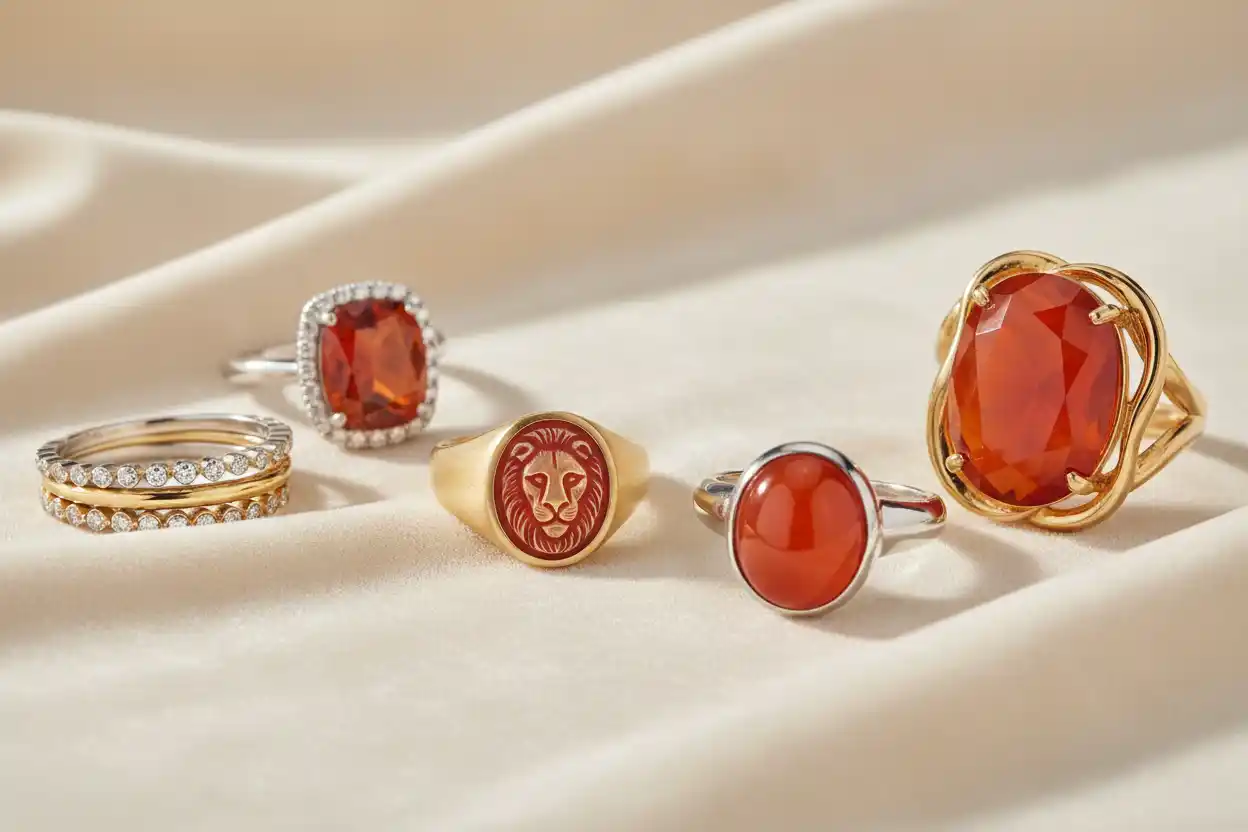
Carnelian Ring: Styles, Settings & Buying Guide
A carnelian ring combines the warm orange-to-red color of chalcedony with one of the most demanding jewelry formats for any gemstone, because rings repeatedly contact desks, countertops, doors, tools, other jewelry and everyday objects. Carnelian has useful quartz-family durability, but choosing a good carnelian ring requires more than finding a beautiful stone: setting height, edge protection, shank width, ring size, stone thickness, translucency, treatment, metal quality and the way the ring balances on the finger can determine whether the piece remains practical after regular wear.
Carnelian is an orange, red-orange to reddish-brown variety of chalcedony composed primarily of silicon dioxide, SiO₂. It generally has Mohs hardness around 6.5–7, no true cleavage in the conventional gemological sense and good practical toughness, which gives a carnelian ring a stronger durability profile than jewelry made from softer minerals such as calcite, fluorite or pearl. However, carnelian remains brittle enough to chip under concentrated impact, particularly where a thin edge, pointed carving or poorly supported cabochon projects above the setting.
This makes ring design especially important. A low bezel-set carnelian ring can perform well as everyday jewelry because metal protects much of the stone perimeter and keeps leverage low, while an oversized high-profile cocktail ring with exposed edges requires more deliberate wear. The gemstone may be identical in both pieces, yet their practical durability can be dramatically different.
Treatment deserves equal attention. Carnelian can be heated to develop or intensify orange-to-red color, while dyeing also occurs in chalcedony and agate. A treated carnelian ring can still contain genuine natural stone, but sellers should explain whether the color is untreated, heat enhanced or dyed rather than relying on vague descriptions such as “100% natural crystal.”
The best carnelian ring therefore balances gemstone quality with engineering. Color attracts attention first, but setting protection, comfortable sizing, stable construction and accurate disclosure determine whether the ring is actually a good purchase.
Carnelian Ring at a Glance
| Feature | What Buyers Should Know |
|---|---|
| Gem material | Carnelian, an orange-to-red chalcedony |
| Composition | Primarily SiO₂ |
| Typical color | Honey orange, orange, red-orange, reddish brown |
| Transparency | Usually translucent to nearly opaque |
| Mohs hardness | About 6.5–7 |
| Cleavage | None in the conventional gemological sense |
| Toughness | Generally good |
| Common cuts | Cabochon, tablet, carving, intaglio, rose-cut or faceted-style top |
| Strong everyday setting | Low full or protective partial bezel |
| Common ring styles | Signet, solitaire, bezel, cocktail, halo, cluster, stackable, carved |
| Main wear concern | Surface abrasion, edge chipping and high-profile impact |
| Main fit concern | Wide shanks and heavy tops can feel tighter or spin |
| Common treatments | Heating and dyeing |
| Main authenticity concerns | Dyed chalcedony, glass, resin and misidentified red jasper |
| Safest cleaning | Lukewarm water, mild soap and soft cleaning when construction allows |
| Symbolic themes | Motivation, creativity, courage, confidence and purposeful action |
The broader carnelian meaning guide covers the gemstone itself in more depth, while this carnelian ring guide concentrates on hand-level wear, settings, sizing, treatment, construction and buying decisions.
Why Carnelian Works Well in Rings
Carnelian has several characteristics that make ring use realistic.
Its fine microcrystalline chalcedony structure takes a smooth polish and offers useful resistance to ordinary scratching. Unlike gemstones with prominent cleavage planes, carnelian does not tend to split cleanly along one crystallographic direction after a moderate knock.
However, hardness is only one part of durability. The distinction between scratch resistance and resistance to breaking is explained in gemstone toughness vs hardness, and it matters particularly for a carnelian ring because the hand receives more mechanical contact than the neck or ears.
Carnelian can chip.
Edges can abrade.
Drilled or carved sections can fracture.
A ring should therefore protect the stone rather than relying on Mohs hardness alone.
Carnelian Ring Styles
Different ring constructions change both appearance and risk.
| Carnelian ring style | Main advantage | Main concern |
|---|---|---|
| Signet ring | Broad stone surface and historic carving connection | Large top may spin if sizing is poor |
| Full bezel | Strong perimeter protection | Metal can cover more of the stone |
| Partial bezel | More stone remains visible | Exposed edges still need care |
| Solitaire cabochon | Simple stone-focused design | Height and support matter |
| Cocktail ring | Large visual presence | Greater impact exposure |
| Halo ring | Makes center appear larger | Accent stones and tiny settings add maintenance |
| Cluster ring | Strong decorative effect | More settings and edges collect residue |
| Three-stone ring | Balanced design and optional symbolism | Stones should not strike one another |
| Stackable ring | Easy to combine with bands | Neighboring jewelry can scratch carnelian |
| Carved/intaglio ring | Highlights carnelian’s engraving tradition | Fine details and thin sections can chip |
The best carnelian ring style depends on how often it will be worn and how much protection the stone needs.
Carnelian Signet Ring
The signet is one of the most natural formats for carnelian.
Carnelian has a long history as an engraving material because its fine texture can hold carved detail while taking a strong polish. The stone can remain plain, display a monogram, carry an intaglio or form part of a larger symbolic design.
The best gemstones for carving context helps explain why chalcedony materials perform so well in seals and engraved jewelry.
A good carnelian ring in signet form usually places the stone relatively low within a substantial metal surround.
That provides useful protection.
Signet Ring Balance
Large signet tops can rotate on the finger when:
- The shank is too narrow.
- The ring is too loose.
- The stone is unusually heavy.
- The shoulders offer limited support.
A wide top needs enough metal beneath it to remain stable.
If a carnelian ring continually spins, the problem is not necessarily incorrect gemstone weight. It can be a mismatch between top weight, shank width and finger size.
Sizing beads or a broader lower shank can sometimes improve stability.
Carnelian Bezel Ring
A full bezel is generally one of the strongest settings for a carnelian ring.
The metal surrounds the stone’s edge, reducing direct impact and snagging.
Benefits include:
- Strong perimeter protection.
- Low profile.
- Smooth edges.
- Secure support.
- Excellent compatibility with cabochons.
- Good suitability for carved tablets.
The bezel should be even and firmly pressed against the carnelian without obvious gaps.
A loose bezel can allow the stone to move.
Open-Back Bezel
An open-backed carnelian ring allows some light to reach the rear of translucent material.
This can make pale orange or medium-tone stones appear brighter.
However, skin oils, lotion and soap can accumulate on the rear surface.
If the carnelian ring gradually appears darker, the gemstone may simply need careful cleaning rather than having changed color.
Closed-Back Bezel
A closed back can make a carnelian ring appear deeper and more saturated because less light passes through the stone.
This design can also support thin carvings or provide an engraving surface.
The disadvantage is reduced cleaning access.
Residue can accumulate around small gaps if construction is poor.
A closed back should still be finished neatly rather than hiding rough adhesive or unfinished metal.
Partial Bezel
A partial bezel protects selected parts of the stone while leaving other edges exposed.
This can create a lighter design than a full bezel.
It works particularly well when the vulnerable ends of an oval, rectangular or pointed carnelian receive metal support.
However, exposed edges remain exposed.
For a daily carnelian ring, the protective advantage should be real rather than purely decorative.
Carnelian Solitaire Ring
A solitaire places one carnelian at the center of the ring.
Common stone shapes include:
- Oval.
- Round.
- Cushion.
- Rectangular tablet.
- Octagon.
- Pear.
- Freeform.
A solitaire carnelian ring should keep the stone as low as practical while maintaining the intended visual effect.
Tall basket settings increase leverage.
When a high ring strikes a hard object, force acts through the projecting setting and can loosen metal or chip the stone.
Low-Profile Carnelian Ring
For everyday wear, low-profile construction is usually the strongest choice.
A low carnelian ring:
- Catches clothing less often.
- Strikes hard surfaces less frequently.
- Places less leverage on the setting.
- Feels less top-heavy.
- Works more comfortably with gloves.
A recessed signet or low bezel is particularly practical.
The stone does not need to sit high to display carnelian’s color because carnelian is valued primarily for body color and translucency rather than diamond-like brilliance.
High-Profile Carnelian Ring
A high setting can create drama but deserves more cautious wear.
Potential problems include:
- Snagging.
- Stone rotation.
- Greater leverage.
- Bent prongs.
- Chipped edges.
- Contact with adjacent fingers.
If you want an oversized carnelian ring for occasional wear, a higher profile can be perfectly reasonable.
Just do not evaluate it as though it were a low everyday bezel.
Carnelian Cocktail Ring
Cocktail rings use large gemstones, carvings or elaborate settings to create strong visual impact.
Carnelian is particularly suitable because large pieces can be obtained without reaching the extreme cost of many transparent precious gemstones.
A cocktail carnelian ring may feature:
- Large oval cabochon.
- Carved floral top.
- Intaglio.
- Sculptural gold or silver frame.
- Halo.
- Multi-gemstone composition.
Before buying, ask for the complete ring dimensions.
A photograph does not tell you whether a 30 mm ring top will interfere with adjacent fingers.
Large Carnelian Ring Comfort
Large carnelian rings can become uncomfortable for several reasons.
The stone may press against neighboring fingers.
A broad base may restrict bending.
A heavy top can spin.
A wide shank may feel tighter than expected.
Ask for:
- Top length.
- Top width.
- Height above finger.
- Shank width.
- Complete weight.
These measurements reveal much more about comfort than the stone’s carat weight.
Carnelian Halo Ring
A halo surrounds the center carnelian with smaller stones or decorative metal.
Possible accents include:
- Diamond.
- White sapphire.
- Cubic zirconia.
- Black spinel.
- Onyx.
- Other colored gemstones.
A halo can make a modest center look substantially larger.
However, accent stones add additional prongs or bead settings that require maintenance.
The carnelian ring becomes mechanically more complex.
Hard Accent Stones Can Scratch Carnelian
Diamond, sapphire and other harder stones can scratch carnelian if their exposed surfaces rub against it.
In a properly constructed halo, the stones should remain separated by the setting.
Inspect the design carefully.
The halo should protect or frame the center rather than allowing sharp accent edges to contact the carnelian.
Three-Stone Carnelian Ring
A three-stone design can use three carnelians or combine carnelian with contrasting gemstones.
The arrangement may be purely decorative or carry personal symbolism.
Whatever the interpretation, spacing matters physically.
Stones should not strike one another during movement.
If a carnelian ring includes softer materials such as pearl, opal or turquoise, cleaning and wear should follow the needs of the most vulnerable component.
Cluster Carnelian Ring
Cluster rings use several small stones rather than one large center.
This format can create substantial visual coverage without requiring one large piece of carnelian.
However, more stones mean more:
- Settings.
- Junctions.
- Crevices.
- Cleaning areas.
- Potential loose components.
Inspect a cluster carnelian ring regularly for movement.
One loose stone can eventually fall out even while the rest of the ring appears secure.
Stackable Carnelian Ring
A small bezel-set carnelian ring can work well in a stack.
The main concern is contact with neighboring bands.
A diamond pavé band or hard textured edge can abrade carnelian through repeated rubbing.
Choose smooth adjacent rings whenever possible.
A curved or contoured band can also create clearance around a larger center.
Stacked rings often fit tighter than a single narrow band, so size should be checked with similar total width.
Carnelian Intaglio Ring
Intaglio carving is especially appropriate for carnelian because the stone has a long history in engraved seals.
An intaglio cuts the design below the surrounding surface.
Quality depends on:
- Engraving sharpness.
- Proportion.
- Surface polish.
- Stone thickness.
- Wear.
- Setting condition.
- Provenance when antique.
A vintage or antique carnelian ring can derive substantial value from workmanship and history rather than the raw carnelian alone.
Plain Carnelian Cabochon Ring
A plain cabochon is one of the simplest and strongest designs.
The smooth domed surface distributes contact better than sharp facets and displays color across a broad area.
For a daily carnelian ring, an oval or round cabochon in a low bezel is difficult to beat for practical simplicity.
Check the dome for:
- Surface scratches.
- Pits.
- Flat polishing areas.
- Chips.
- Surface-reaching cracks.
The polish should appear smooth rather than wavy.
Cabochon vs Faceted-Style Carnelian Ring
Carnelian is typically translucent rather than highly transparent, so it does not rely on conventional brilliant faceting to produce its beauty.
Cabochons emphasize:
- Color.
- Translucency.
- Internal clouds.
- Bands.
- Surface polish.
Faceted-style or rose-cut tops can add surface flashes, but they should not be judged against diamond brilliance.
A carnelian ring works best when cutting enhances the material’s actual strengths.
Choosing Carnelian Ring Shape
Shape changes both aesthetics and vulnerability.
Oval
The classic choice.
Ovals offer good visible area without sharp corners.
Round
Compact and symmetrical.
Excellent for low bezels.
Cushion
Provides broad face-up presence with softened corners.
Rectangle or Octagon
Works particularly well in signet designs.
Corners should remain protected.
Pear
Elegant but needs protection at the tip.
Marquise
Provides substantial visible length but exposes two narrow points.
Freeform
Can preserve unique natural color patterns but needs custom metalwork.
A setting should follow the stone rather than forcing an irregular carnelian into poor support.
Pointed Shapes Need Protection
A pear or marquise carnelian ring deserves stronger protection at the tips.
A bezel or V-shaped support can reduce direct impact.
A tiny exposed point is a natural chip risk.
The fact that carnelian has no cleavage does not mean sharp geometry becomes harmless.
Carnelian Ring Color
Carnelian commonly ranges through:
- Honey orange.
- Golden orange.
- Bright orange.
- Red-orange.
- Rust red.
- Reddish brown.
- Deep red-brown.
The broader orange gemstones context shows why carnelian occupies a distinctive place among warm-colored gems.
Darker does not automatically mean better.
Color should be evaluated according to beauty, translucency and personal preference.
Lighter Carnelian Rings
Light orange material can appear especially luminous in open-backed settings.
A thin cabochon may glow vividly when daylight reaches the rear of the gemstone.
For buyers who like bright warm color, lighter carnelian can be more visually interesting than very dark material.
Dark Carnelian Rings
Deep red-orange or reddish-brown carnelian creates a more restrained appearance.
In thick cabochons or closed settings, very dark material may look nearly opaque.
Ask to see the stone in ordinary room lighting.
A highly backlit photograph can exaggerate translucency dramatically.
Natural Color Variation
Color zoning, clouds, subtle bands and iron-rich patches can occur naturally.
These are not automatically defects.
Large carnelian ring stones often reveal more internal variation simply because there is more visible surface.
A perfectly uniform stone may be attractive, but uniformity should not be confused automatically with natural quality.
Heat-Treated Carnelian Ring
Heating is one of the main treatments associated with carnelian.
Heat can encourage or intensify warm iron-related coloration in suitable chalcedony.
A heat-treated carnelian ring can still contain natural gemstone material.
The stone formed naturally.
Its color was later modified.
The broader gemstone treatments framework is useful because treatment, synthetic origin and imitation are different categories.
Dyed Carnelian Ring
Dyeing can create or intensify orange-red color in chalcedony and agate.
Possible clues include concentrated pigment:
- Along fractures.
- Inside cavities.
- Around drilled areas.
- Near damaged edges.
- In unusually porous-looking sections.
These signs are suggestive rather than definitive.
Natural iron-related coloration can also be uneven.
Do not use destructive chemical tests on a finished carnelian ring.
Does Treatment Mean a Carnelian Ring Is Fake?
No.
A more accurate classification is:
| Material | What It Means |
|---|---|
| Natural untreated carnelian | Natural chalcedony with no known intentional color enhancement |
| Heated carnelian | Natural chalcedony whose color has been modified through heat |
| Dyed chalcedony | Natural silica material with introduced color |
| Glass imitation | Manufactured glass resembling carnelian |
| Resin imitation | Polymer material resembling carnelian |
| Composite | Multiple materials assembled into one stone-like component |
These products can all look orange-red.
Their material identity and value are different.
Carnelian vs Red Jasper Ring
Carnelian and red jasper overlap significantly in color and basic silica chemistry.
The most useful practical difference is transparency.
Carnelian is characteristically translucent.
Red jasper is characteristically opaque.
The detailed carnelian vs red jasper comparison explains why hardness and color alone are poor separators.
For a carnelian ring, examine the stone under strong backlighting where the setting allows.
Edges can be especially informative.
Carnelian vs Sard
Sard is another reddish-brown chalcedony term that can overlap commercially with darker carnelian.
The boundary between the names is not perfectly standardized.
Carnelian is generally associated with more orange-to-red color, while sard tends toward deeper brown-red shades.
Do not pay a large premium simply because a seller insists that one borderline shade belongs to a rarer-sounding trade category.
Material quality and disclosure matter more.
Glass Imitation Carnelian Rings
Orange-red glass can imitate carnelian effectively.
Possible clues include:
- Round gas bubbles.
- Flow lines.
- Very uniform transparency.
- Mold seams.
- Artificially perfect repeated designs.
However, natural inclusions can sometimes appear round.
One suspected bubble should not determine the entire identification.
Resin Imitations
Resin can reproduce warm translucent colors and carved designs easily.
Potential clues include:
- Very low weight.
- Surface softness.
- Mold seams.
- Repeated identical carvings.
- Numerous rounded bubbles.
Touch-temperature tests are weak.
A small natural stone and a resin piece both warm rapidly when worn.
Professional identification is preferable when the ring’s value depends strongly on authenticity.
How to Evaluate Carnelian Ring Authenticity
Use several observations together.
Look for:
- Appropriate orange-to-red chalcedony color.
- Translucency in thin areas.
- Fine internal cloudiness.
- Natural variation.
- Good polish.
- No obvious molding.
- No abundant spherical gas bubbles.
- Plausible seller disclosure.
The where to buy carnelian guidance is useful because seller behavior is often as important as visual examination when purchasing online.
Avoid destructive scratch, heat or chemical tests.
Carnelian Ring Sizing
Ring sizing is one of the most important form-specific considerations.
A carnelian ring should pass over the knuckle without excessive force and sit securely at the base of the finger without spinning continually.
Finger size changes temporarily with:
- Temperature.
- Activity.
- Salt intake.
- Normal swelling.
- Time spent using the hands.
Measure when the hands are at a comfortable normal temperature.
Wide Rings Fit Differently
A broad signet or wide shank often feels tighter than a narrow band with the same nominal size.
This is because more metal contacts more of the finger.
When buying a wide carnelian ring, test size using a sizing band with approximately similar width.
Do not rely only on a measurement taken from a thin sample ring.
Knuckle Size Matters
Some people have knuckles significantly wider than the base of the finger.
The carnelian ring must pass over the knuckle while remaining stable afterward.
Possible solutions include:
- Sizing beads.
- Hinged shank systems in specialized jewelry.
- Wider lower band.
- Careful size adjustment.
Do not choose a ring so tight that removing it becomes difficult.
Top-Heavy Rings Can Spin
A large carnelian ring may rotate even when the nominal size is correct.
Causes include:
- Heavy stone.
- Narrow shank.
- Small finger base.
- Large top.
- High setting.
A broader lower shank or low-profile design often improves stability more effectively than simply making the ring smaller.
Can a Carnelian Ring Be Resized?
Many metal rings can be resized within limits, but feasibility depends on construction.
Resizing may be difficult when the ring has:
- Continuous engraving.
- Stones around the entire band.
- Plating.
- Complex inlay.
- Very wide shank.
- Unusual alloy.
- Antique construction.
Ask about resizing before buying.
Do not assume every carnelian ring can be adjusted later.
Choosing the Metal
Metal affects both appearance and mechanical performance.
Yellow Gold
Yellow gold reinforces warm orange and red carnelian tones.
It works particularly well with:
- Signets.
- Intaglios.
- Deep red cabochons.
- Vintage-inspired rings.
Rose Gold
Rose gold creates a softer tonal relationship with carnelian.
The gemstone may blend more subtly into the setting.
White Gold
White gold provides stronger contrast and can make orange carnelian appear brighter.
Some white gold is rhodium plated, so finish maintenance may eventually be required.
Sterling Silver
Sterling silver is a popular choice because its cool color contrasts effectively with carnelian.
Tarnish is normal surface chemistry.
It does not mean the gemstone is deteriorating.
Oxidized Silver
Darkened silver creates particularly strong contrast around orange or red carnelian and works well in signet or antique-inspired designs.
Platinum
Platinum provides durable premium construction but adds substantial density and weight.
Large platinum carnelian rings can feel heavier than similar silver or gold designs.
Brass and Copper
Warm base metals can complement carnelian visually.
However, they can tarnish and may discolor skin.
The metal quality should be represented clearly.
Metal Sensitivity
The carnelian can be perfectly safe against the skin while the metal causes irritation.
If sensitivity is known, verify:
- Base alloy.
- Nickel content where relevant.
- Plating.
- Solder.
- Underlying metal.
The gemstones and metals for sensitive skin context helps separate gemstone compatibility from metal-allergy considerations.
“Hypoallergenic” is less useful than a specific alloy description.
Shank Width
Shank width influences:
- Comfort.
- Stability.
- Resistance to bending.
- Ring size.
- Visual proportion.
A substantial carnelian signet usually benefits from stronger shoulders and a shank proportionate to the top.
A very thin band beneath a large stone can twist or deform.
Ring Weight
Complete ring weight matters in large designs.
A heavy carnelian ring can become tiring even when it fits correctly.
Ask for total weight when:
- The stone is oversized.
- The metal is substantial.
- The ring is platinum.
- The signet top is very broad.
Photographs make large jewelry appear easier to wear than it sometimes is.
Setting Height
Ask for a side photograph.
This is one of the most useful buying images for a carnelian ring.
It reveals:
- Height above finger.
- Stone thickness.
- Bezel depth.
- Prong length.
- Under-gallery construction.
- Potential snagging.
Front-facing photographs can hide excessive height completely.
Buying a Carnelian Ring Online
A strong listing should provide:
- Ring size.
- Stone dimensions.
- Top dimensions.
- Setting height.
- Shank width.
- Complete ring weight when substantial.
- Gemstone treatment.
- Metal composition.
- Plating details.
- Resizing information.
- Actual-item photographs.
- Return terms.
The broader buying gemstones online process is particularly useful when authenticity or treatment affects the transaction.
For a ring, sizing and construction require additional scrutiny.
Ask for Front, Side and Underside Photos
Each angle answers a different question.
Front
Shows:
- Color.
- Shape.
- polish.
- Setting symmetry.
Side
Shows:
- Height.
- Stone depth.
- Prongs.
- Bezel profile.
Underside
Shows:
- Shank construction.
- Open or closed back.
- Hollow areas.
- Glue.
- Setting access.
- Wear.
An expensive carnelian ring should not be purchased from one flattering frontal image alone.
Carnelian Ring Buying Red Flags
Be cautious when:
- Ring size is missing.
- Shank width is omitted on a wide design.
- No side photograph is available.
- Setting height is concealed.
- The stone visibly moves.
- Prongs do not touch the gem.
- Bezel edges contain obvious gaps.
- Glue is visible around a supposedly fine-jewelry setting.
- Treatment questions receive vague answers.
- Every intense red stone is described as untreated.
- Metal is identified only as “gold tone.”
- Plating is not disclosed.
- A large carnelian sits on an extremely thin shank.
- Glass or resin is represented as chalcedony.
- “AAAAA” grades have no defined criteria.
- The seller guarantees wealth, fertility, romance or medical benefits.
- Return terms are unclear.
A good carnelian ring should withstand ordinary scrutiny without relying on metaphysical promises.
What Makes a Carnelian Ring Valuable?
Carnelian itself is generally accessible, so ring value frequently comes from more than the raw gemstone.
Important factors include:
- Attractive color.
- Strong translucency.
- Large fine material.
- Carving or intaglio quality.
- Treatment status.
- Precious metal content.
- Handmade workmanship.
- Designer origin.
- Antique provenance.
- Setting quality.
- Condition.
A common cabochon in a simple base-metal setting belongs to a very different value category from a finely carved historical intaglio in substantial gold.
Price should reflect actual materials and craftsmanship.
Does a Carnelian Ring Need a Lab Report?
Most ordinary carnelian rings do not justify individual gemological reports.
Testing becomes more useful when:
- The ring is unusually expensive.
- Untreated status carries a major premium.
- The stone may be glass.
- Antique provenance adds significant value.
- The jewelry contains substantial precious metal.
- The seller makes an unusual origin or treatment claim.
For ordinary jewelry, strong disclosure, actual-item photographs and a useful return policy are often more valuable than a generic certificate.
Carnelian Ring for Everyday Wear
Carnelian can be suitable for regular ring wear when the design is practical.
The strongest everyday combination is usually:
- Sound cabochon.
- Low profile.
- Protective bezel.
- Adequate shank.
- Comfortable size.
- Secure setting.
Remove the carnelian ring before activities involving strong impact or abrasion.
Examples include:
- Weight training.
- Construction work.
- Gardening.
- Mechanical repairs.
- Contact sports.
- Rock climbing.
- Aggressive household cleaning.
Everyday wear does not need to mean continuous wear.
Carnelian Ring at Work
Desk work can gradually abrade a ring because the hand repeatedly contacts hard surfaces.
Pay attention to:
- Desk edges.
- Keyboard frames.
- Metal tools.
- Countertops.
A low carnelian ring generally performs better than a high cocktail design in these environments.
If the ring continually strikes the desk, removing it during prolonged typing is reasonable.
Stacking Carnelian Rings
A carnelian ring can be stacked, but neighboring rings matter.
Avoid continuous contact with:
- Diamond pavé edges.
- Sapphire.
- Ruby.
- Topaz.
- Rough-textured hard metal.
These materials can scratch carnelian during repeated movement.
Smooth metal bands are safer companions.
Can You Wear a Carnelian Ring Every Day?
Yes, if the ring is well made and activities are appropriate.
Carnelian has enough durability for regular jewelry use.
However, scratches and small chips become more likely when any ring is worn continuously through manual work.
Preventive removal protects both the gemstone and metal.
Can You Shower With a Carnelian Ring?
Removing a carnelian ring before showering is preferable.
The gemstone itself generally tolerates brief clean-water exposure, but showering adds:
- Soap.
- Shampoo.
- Conditioner.
- Warm water.
- Hard-water deposits.
- Metal exposure.
- Possible glue or treatment concerns.
The dedicated crystals in water guidance explains why mineral water resistance and finished-jewelry care are not identical questions.
Can You Wash Your Hands Wearing a Carnelian Ring?
Occasional hand washing is less demanding than prolonged soaking, but removing the ring when practical reduces soap buildup beneath the setting.
If you wash while wearing it:
- Rinse away soap.
- Dry the ring.
- Dry beneath broad settings.
- Avoid harsh cleaners.
Repeated moisture can also accumulate under closed-back designs.
Can You Swim Wearing a Carnelian Ring?
Removing it is better.
Pool chemicals, saltwater and the possibility of losing the ring create unnecessary risk.
Cold water can also temporarily change finger size, increasing the chance that a loose ring slips off.
Can You Sleep Wearing a Carnelian Ring?
Many people can physically sleep with low rings, but removal usually reduces:
- Pressure.
- Snagging.
- Metal wear.
- Contact with other jewelry.
A tall or oversized carnelian ring is particularly unnecessary during sleep.
How to Clean a Carnelian Ring
For sound carnelian in a stable conventional setting:
- Prepare lukewarm water with a small amount of mild soap.
- Use a soft cloth or very soft brush.
- Clean the carnelian surface gently.
- Clean carefully beneath an open setting.
- Rinse away residue.
- Pat dry.
- Allow hidden areas to dry fully.
Manual cleaning is sufficient for most carnelian rings.
Avoid Aggressive Chemicals
Do not routinely use:
- Bleach.
- Strong acids.
- Abrasive powder.
- Harsh alkaline cleaners.
- Unknown solvents.
Even if carnelian tolerates a substance reasonably well, the metal, dye, adhesive or accent stones may not.
Ultrasonic Cleaning
Ultrasonic cleaning is generally unnecessary.
A sound untreated carnelian may tolerate more vibration than several delicate gems, but a finished carnelian ring can contain:
- Fractures.
- Dye.
- Glue.
- Loose metal.
- Mixed gemstones.
Gentle manual cleaning creates less uncertainty.
Steam Cleaning
Steam adds heat and pressure without providing a meaningful advantage for ordinary carnelian jewelry.
Avoid it, particularly when treatment, glue or mixed materials are present.
How to Store a Carnelian Ring
Store the ring separately from harder gemstones.
Diamond, sapphire, ruby and topaz can scratch chalcedony.
A padded compartment or individual pouch works well.
Avoid dropping several rings into one container where stones and metal edges rub together.
Inspect the Setting Periodically
Check:
- Bezel.
- Prongs.
- Shank.
- Accent stones.
- Stone movement.
- Surface chips.
Gently touch the carnelian.
It should not click or move.
If a prong catches fabric or the stone begins to shift, repair the ring before continued wear.
Carnelian Ring Symbolism
Modern and historical carnelian symbolism commonly includes:
- Motivation.
- Courage.
- Creativity.
- Confidence.
- Initiative.
- Eloquence.
- Purposeful action.
A carnelian ring makes a particularly effective symbolic reminder because the stone is visible whenever the hands are used.
At Gems Lore, these associations are treated as cultural and personal meanings rather than scientifically established effects of chalcedony.
Carnelian Ring for Motivation
A practical symbolic use connects the ring with one specific action.
Instead of assuming a carnelian ring creates motivation, use it as a prompt:
What needs to begin now?
What is the smallest useful next step?
What can be completed before switching tasks?
The gemstone becomes a cue.
The action creates progress.
Carnelian Ring for Confidence
Confidence is another common carnelian association.
A grounded interpretation links confidence to preparation.
Before a presentation or difficult task, the carnelian ring might symbolize:
- Practice completed.
- Skills developed.
- Evidence gathered.
- Willingness to act despite uncertainty.
The ring cannot guarantee success.
Carnelian Ring for Creativity
Carnelian’s history as an engraved and carved gemstone makes creativity an especially natural symbolic theme.
An intaglio or carved carnelian ring can represent the transition from idea to execution.
That symbolism might support:
- Writing.
- Design.
- Performance.
- Art.
- Craft.
- Problem solving.
The useful part is beginning the work.
Carnelian Ring and Communication
Carnelian has also been associated historically with eloquence and confidence in expression.
A practical interpretation is to use the ring as a reminder to communicate clearly.
Before speaking:
Clarify the main point.
Check the facts.
Decide what needs to be said.
Listen to the response.
No gemstone alters speech or persuasion biologically.
Which Finger Should Wear a Carnelian Ring?
There is no gemological requirement to wear carnelian on a specific finger.
Astrological and spiritual traditions may assign different symbolic meanings to fingers, but those systems vary.
Choose the finger based on:
- Comfort.
- Ring proportions.
- Hand activity.
- Existing jewelry.
- Personal symbolism.
For a large signet, the index or middle finger may physically balance the design well.
For a smaller carnelian ring, almost any comfortable finger can work.
Which Hand Should Wear a Carnelian Ring?
There is likewise no scientifically established left-versus-right rule.
Some spiritual traditions describe one hand as receptive and the other as active, but these interpretations are symbolic.
From a practical perspective, wearing a carnelian ring on the less dominant hand may expose it to fewer impacts.
That can improve durability more reliably than any symbolic rule.
Carnelian Ring and Chakra Traditions
Modern crystal systems commonly associate carnelian with the sacral chakra and sometimes root-chakra symbolism.
These are spiritual concepts rather than anatomical structures.
Wearing a carnelian ring on the hand does not scientifically affect reproductive organs, hormones, metabolism or circulation.
If chakra symbolism is meaningful personally, the ring can represent creativity, initiative or grounded action without making medical claims.
Does a Carnelian Ring Have Healing Properties?
There is no established clinical evidence that wearing carnelian treats illness.
Claims involving:
- Fertility.
- Hormones.
- Circulation.
- Sexual function.
- Pain.
- Depression.
- Anxiety.
- Metabolism.
- Immunity.
should not be presented as scientifically demonstrated effects of a carnelian ring.
The jewelry can carry personal symbolism while remaining distinct from healthcare.
Carnelian Ring as a Gift
A carnelian ring can make a distinctive gift, but unlike earrings or necklaces, sizing must be accurate.
Before buying, confirm:
- Exact ring size.
- Preferred finger.
- Metal preference.
- Ring width tolerance.
- Lifestyle.
- Whether resizing is possible.
- Preference for signet, cabochon or statement designs.
If exact size is uncertain, a carnelian necklace or carnelian earrings may be easier gift formats.
Carnelian Ring vs Carnelian Bracelet
A carnelian bracelet experiences significant desk, clothing and wrist-level contact, but individual beads distribute that exposure across many stones.
A carnelian ring concentrates impact on one or a few gemstones at the hand’s leading edge.
That makes setting protection especially important for rings.
Carnelian Ring vs Carnelian Necklace
A carnelian necklace is generally the lower-impact format.
Large carvings, thin tablets and open-backed cabochons can therefore be more practical around the neck.
A carnelian ring demands stronger protection, lower profile and more attention to fit.
Frequently Asked Questions
What is a carnelian ring?
A carnelian ring is finger jewelry containing carnelian, an orange-to-red translucent variety of chalcedony.
Is carnelian good for rings?
Yes. Carnelian has hardness around 6.5–7, no easy cleavage and generally good toughness, making it suitable for rings when the setting protects the stone appropriately.
Is a carnelian ring good for everyday wear?
Yes, particularly in a low bezel or recessed setting. Remove it during rough physical activity.
Does carnelian scratch easily?
It resists ordinary scratches reasonably well but can be scratched by harder materials such as diamond, sapphire, ruby and topaz.
Can a carnelian ring chip?
Yes. Carnelian is relatively durable but still brittle enough to chip after hard impact, especially along exposed edges.
What is the best setting for a carnelian ring?
A low full bezel provides one of the strongest combinations of edge protection, security and everyday practicality.
Is a signet ring good for carnelian?
Yes. Carnelian’s carving history, broad color and ability to take a smooth polish make it particularly suitable for signet rings.
Is carnelian good for an intaglio ring?
Yes. Carnelian is historically and technically well suited to engraved intaglio work.
Is a high-set carnelian ring safe for daily wear?
It can be worn, but a high setting has greater snagging and impact exposure than a low bezel or signet.
Are carnelian cocktail rings practical?
They are best for controlled or occasional wear because larger stones and higher settings receive greater impact.
Can carnelian be used in a halo ring?
Yes. Ensure the accent stones do not rub against the carnelian and inspect their small settings regularly.
Can carnelian rings be stacked?
Yes, but avoid adjacent hard or abrasive bands that can scratch the carnelian.
What carnelian ring shape is most durable?
Round and oval cabochons are particularly practical because they lack sharp exposed points. Protective setting design still matters.
Are pear-shaped carnelian rings fragile?
The pointed tip is more vulnerable than a rounded edge, so a bezel or V-shaped support is useful.
What color should a real carnelian ring be?
Natural carnelian can range from honey orange through orange-red to reddish brown.
Is dark red carnelian better?
Not automatically. Lighter translucent stones can show stronger glow, while darker stones provide deeper saturation.
Should carnelian be translucent?
Carnelian is usually translucent to nearly opaque. Thinner areas often transmit warm orange-red light.
Why does my carnelian ring look brown indoors?
Thick or deeply colored carnelian may appear brown-red in reflected light and brighter orange under transmitted light.
Can carnelian be heat treated?
Yes. Heating can modify or strengthen warm iron-related color.
Is heated carnelian fake?
No. Heated carnelian can still be natural chalcedony whose color was altered after geological formation.
Can carnelian rings be dyed?
Yes. Dyed chalcedony and agate occur commercially.
Does dyed carnelian mean the ring is fake?
No. The substrate can still be natural chalcedony, although its color has been introduced and should be disclosed.
How can I tell dyed carnelian?
Concentrated color in fractures or porous areas may suggest dye, but visual examination cannot always establish treatment conclusively.
Can glass imitate a carnelian ring?
Yes. Orange-red glass can resemble carnelian and may contain round bubbles or flow structures.
Is red jasper the same as carnelian?
No. Carnelian is generally translucent chalcedony, while red jasper is characteristically opaque.
What metal is best for a carnelian ring?
Gold, silver, platinum and suitable steel can all work. Choose according to style, durability, budget and metal sensitivity.
Does yellow gold look good with carnelian?
Yes. Yellow gold reinforces carnelian’s warm orange and red tones.
Does silver look good with carnelian?
Yes. Silver creates strong cool-warm contrast and is one of the most common combinations.
Are brass carnelian rings good?
They can be attractive and affordable, but brass can tarnish and may discolor skin.
How should a carnelian ring fit?
It should pass over the knuckle securely and sit comfortably without constant spinning or painful tightness.
Do wide carnelian rings fit tighter?
Yes. Wide shanks generally feel tighter than narrow bands at the same nominal ring size.
Why does my carnelian ring spin?
A heavy or wide top, narrow shank or slightly loose fit can cause rotation.
Can a carnelian ring be resized?
Many can, but resizing depends on metal, shank design, engraving, plating and whether additional stones extend around the band.
Can I wear a carnelian ring every day?
Yes, with sensible care and removal during rough work or activities likely to cause impact.
Can I wash my hands with a carnelian ring?
Occasional water exposure may be tolerated, but removing the ring reduces soap and moisture buildup beneath the setting.
Can I shower with a carnelian ring?
Removing it is better because showering exposes the complete ring to soap, shampoo, heat and repeated moisture.
Can I swim wearing a carnelian ring?
It is safer to remove it because chemicals, saltwater and temporary finger-size changes increase both care and loss risks.
Can I exercise with a carnelian ring?
Remove it for gym and strenuous activity because weights and equipment can damage the gemstone or metal.
Can I sleep with a carnelian ring?
You may be able to, but removing it reduces unnecessary pressure and snagging.
How do I clean a carnelian ring?
Use lukewarm water, mild soap and a soft cloth or brush when the stone, treatment and setting allow.
Can a carnelian ring go in an ultrasonic cleaner?
Manual cleaning is usually safer because fractures, treatments, glue or other stones may be present.
Can a carnelian ring be steam cleaned?
Steam is unnecessary and introduces avoidable heat-related risk.
How should I store a carnelian ring?
Keep it separate from harder gemstones in a padded compartment or soft pouch.
Does a carnelian ring need certification?
Most ordinary carnelian rings do not require laboratory reports. Testing becomes more useful when unusual value depends on authenticity or untreated status.
What should I ask before buying a carnelian ring online?
Ask for ring size, shank width, stone dimensions, setting height, complete weight, treatment, metal composition, resizing information, actual-item photographs and return terms.
What does a carnelian ring symbolize?
Carnelian symbolism commonly includes motivation, confidence, creativity, courage, eloquence and purposeful action.
Which finger should I wear a carnelian ring on?
There is no gemological requirement. Choose the finger according to comfort, ring size, lifestyle and personal symbolism.
Which hand should I wear carnelian on?
There is no scientifically established right- or left-hand requirement. The less active hand may expose the ring to fewer impacts.
Does a carnelian ring increase confidence?
There is no established evidence that the gemstone changes confidence biologically. It can serve as a personal reminder linked with preparation and action.
Does a carnelian ring attract money?
No evidence shows that wearing carnelian changes financial probability or guarantees prosperity.
Does a carnelian ring have healing properties?
No medical treatment effect from ordinary carnelian contact has been scientifically established.
Carnelian Ring Buying Checklist
Before buying a carnelian ring, confirm that the stone is represented accurately as carnelian or carnelian-bearing chalcedony rather than simply “red crystal.”
Check the exact ring size.
If the band is wide, make sure sizing accounts for the additional width.
Ask for the stone’s length, width and thickness.
Request the complete top dimensions when the ring is large.
Check the setting height from the side.
Inspect bezel edges or every prong.
Look for chips and surface-reaching fractures.
Make sure pointed shapes receive adequate protection.
Examine the shank width relative to the top weight.
Ask for total ring weight when the design is substantial.
Confirm whether the carnelian is untreated, heated, dyed, filled or otherwise altered.
Check the exact metal and plating.
Ask whether resizing is possible.
Review front, side and underside photographs.
For high-value pieces, request images of the exact ring rather than only a stock example.
Verify return terms before buying.
Most importantly, choose the setting according to actual wear. A low bezel carnelian ring is generally more practical for daily use than a tall exposed cocktail ring, even when the larger design looks more impressive in photographs.
Final Thoughts on Choosing a Carnelian Ring
A carnelian ring can be excellent everyday gemstone jewelry when its design respects the realities of hand-level wear. Carnelian’s hardness around 6.5–7, absence of easy cleavage and useful toughness provide a solid foundation, but the gemstone still needs protection from repeated impact, harder jewelry and abrasive surfaces.
Setting design therefore matters more in a carnelian ring than in most necklace or earring formats. A low full bezel or recessed signet protects the perimeter, reduces snagging and keeps leverage under control, while a high cocktail setting exposes the stone to more mechanical stress. Neither is inherently wrong, but they belong to different wear categories.
Sizing also deserves more attention than generic ring charts suggest. Wide shanks feel tighter than narrow bands, large tops can spin and prominent knuckles can complicate fit. A carnelian ring should be measured with the intended band width in mind rather than selected solely from the size of an unrelated thin ring.
Color is more flexible than marketing sometimes implies. Carnelian may be honey orange, bright orange, red-orange, rust red or reddish brown. Lighter stones can glow beautifully in open settings, while deep material creates richer color but may appear nearly opaque. The best carnelian ring is not automatically the darkest one.
Treatment should be disclosed clearly. Heating can enhance warm color while preserving natural chalcedony identity, dye can introduce color into natural silica material, and glass or resin belongs to an imitation category. Those distinctions matter for price and buyer expectations without requiring the simplistic idea that every treated gemstone is fake.
Construction and metal quality matter just as much as the stone. A fine carnelian cabochon cannot compensate for weak prongs, a thin unstable shank, poor solder or a loose bezel. Conversely, a modest commercial carnelian in a well-made protective setting can become an excellent practical ring.
Care should remain straightforward: use mild manual cleaning, remove the ring during rough activity, avoid unnecessary chemical exposure, store it away from harder gemstones and inspect the setting periodically.
Symbolically, a carnelian ring can represent motivation, confidence, creativity, courage and decisive action. Those meanings can add personal value when used as reminders attached to real choices, while remaining separate from unsupported promises involving health, money, fertility, attraction or guaranteed success.
The strongest carnelian ring is therefore the one where gemstone identity, treatment disclosure, protective setting, comfortable sizing, balanced proportions, sound metalwork and the wearer’s actual lifestyle all support one another.