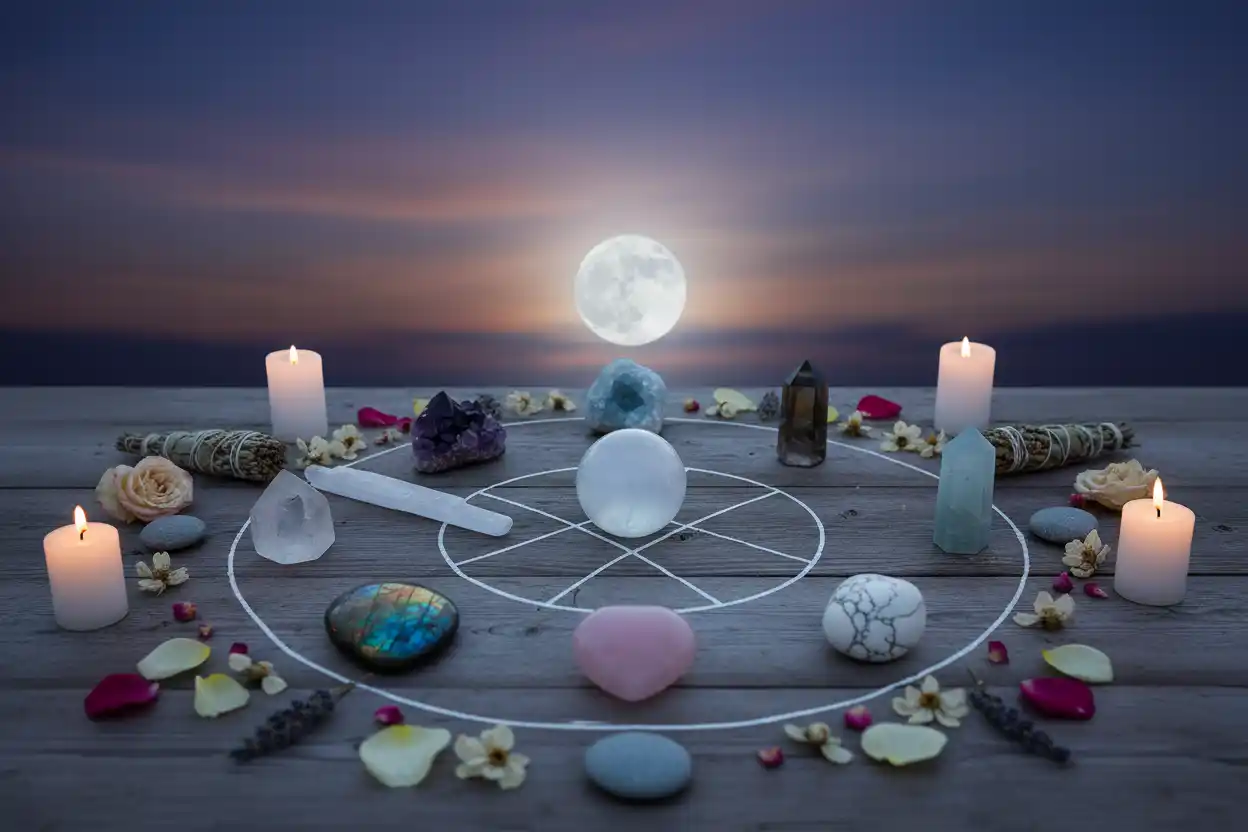
Best Crystals for the Full Moon: Top 10 Ritual Stones
Full-moon crystal practices commonly focus on reflection, completion, gratitude and symbolic release. The moon does not scientifically charge minerals with measurable energy, yet its visible monthly cycle can provide a meaningful schedule for reviewing intentions and resetting a personal ritual.
Moonstone, selenite and clear quartz are popular full-moon choices, while smoky quartz and black obsidian suit reflective release. The right stone depends on the purpose of the ritual rather than its color or reputation alone.
Top 10 Full-Moon Crystals at a Glance
| Rank | Crystal | Traditional full-moon theme | Suggested ritual role |
|---|---|---|---|
| 1 | Moonstone | Cycles, intuition and reflection | Review emotional patterns |
| 2 | Selenite | Clarity and symbolic purification | Mark a calm ritual space |
| 3 | Clear quartz | Intention and amplification | Review one central intention |
| 4 | Labradorite | Reflection and transformation | Examine changing perspectives |
| 5 | Amethyst | Composure and contemplation | Create a quiet review period |
| 6 | Smoky quartz | Grounding and release | Identify what no longer needs attention |
| 7 | Black obsidian | Truth and pattern recognition | Examine an avoided issue |
| 8 | Rose quartz | Compassion and gratitude | Recognize support and progress |
| 9 | Carnelian | Motivation and purposeful action | Decide what happens after reflection |
| 10 | Lapis lazuli | Truth and understanding | Put an insight into clear language |
What the Full Moon Represents in Crystal Traditions
Many spiritual and cultural traditions treat the full moon as a symbol of visibility, culmination and heightened awareness. Modern crystal rituals often use it as a monthly point for reviewing progress rather than beginning entirely new intentions.
The astronomical full moon occurs when Earth lies approximately between the Sun and Moon, allowing the Moon’s near side to appear fully illuminated. That physical event does not establish a therapeutic or energetic effect on crystals.
Nevertheless, a recurring lunar date can support consistency. A person who reviews goals once each full moon gains a memorable schedule for reflection, much like a weekly or monthly planning session.
1. Moonstone for Cycles and Reflection
Moonstone is the most direct symbolic match for a full-moon ritual. It is traditionally associated with cycles, intuition and changing emotional states.
Use moonstone while reviewing the period since the previous full moon. Consider what changed, which responses repeated and what now feels clearer.
Avoid interpreting every feeling as a prediction or supernatural message. Instead, compare the impression with observable circumstances and record it as one source of personal insight.
Moonstone belongs to the feldspar group and can chip along cleavage planes. Place it on a stable cloth or tray rather than leaving it on a narrow outdoor ledge.
2. Selenite for a Clear Ritual Space
Selenite is traditionally associated with clarity, purification and peaceful environments. Its pale, translucent appearance makes it a popular full-moon altar stone.
Place selenite beside a journal or at the edge of a safe indoor ritual area. It can mark the transition from ordinary activity to deliberate reflection.
Despite its moonlike appearance, selenite is soft and water-sensitive. It should not be left in dew, rain or damp soil.
The material-specific guide explaining whether selenite is safe in water and sunlight covers these limitations in greater detail.
3. Clear Quartz for Reviewing an Intention
Clear quartz is commonly described as an intention-setting and amplifying stone. During a full-moon practice, it can represent the principal goal being reviewed.
Write the original intention beside the stone. Then assess what was completed, what changed and whether the goal still deserves the same priority.
Do not preserve an outdated objective merely because it was once meaningful. A full-moon review can conclude with continuation, revision or deliberate closure.
Clear quartz is durable compared with many crystals, although fractured points and heavy clusters still require secure handling.
4. Labradorite for Transformation and Perspective
Labradorite is associated in modern crystal traditions with transformation, intuition and seeing beyond surface appearances. Its optical flashes emerge only at particular angles, which makes it a natural symbol for changing perspective.
Use labradorite when an experience needs to be viewed from more than one position. Ask what you believed at the beginning of the lunar period, what evidence appeared and what interpretation now seems more accurate.
Transformation does not always require dramatic change. Sometimes the most useful outcome is a clearer explanation of why an existing approach should continue.
5. Amethyst for Quiet Contemplation
Amethyst is traditionally associated with reflection, moderation and composure. It suits a full-moon ritual focused on slowing down rather than creating an elaborate ceremony.
Reduce avoidable stimulation, set a limited reflection period and write without attempting to solve every issue in one sitting.
Amethyst may fade after extended exposure to strong sunlight, but brief indirect moonlight does not create the same concern. However, outdoor placement still introduces moisture, temperature changes, falls and theft.
When the stone needs symbolic refreshing, use the safe methods described in the guide to cleansing and charging amethyst.
6. Smoky Quartz for Symbolic Release
Smoky quartz is traditionally connected with grounding, release and practical perspective. It fits a full-moon ritual centered on deciding what no longer requires continued attention.
Write one thought, commitment or expectation that has become unproductive. Then identify whether it needs action, delegation, a boundary or acceptance.
Release should remain specific. “I release all negativity” provides little guidance, whereas “I will stop checking for an answer that the person has chosen not to provide” describes an observable change.
Avoid burning paper indoors or outdoors as part of the ritual. Shredding, recycling or safely storing the page creates the same symbolic endpoint without fire risk.
7. Black Obsidian for Honest Pattern Recognition
Black obsidian is volcanic glass traditionally associated with truth, protection and direct self-examination. It may suit a full-moon review that addresses an issue repeatedly avoided.
Ask one focused question rather than attempting a complete emotional excavation. For example:
“Which commitment repeatedly receives time without producing value?”
“What boundary have I avoided communicating?”
“What evidence contradicts the story I prefer?”
Use observable information and avoid treating discomfort as proof of hidden danger. Moreover, stop the practice when it produces overwhelming distress.
Broken obsidian can form sharp edges, so inspect specimens and handle damaged pieces carefully.
8. Rose Quartz for Gratitude and Self-Compassion
Rose quartz introduces gentleness into full-moon practices that might otherwise become harsh performance reviews.
Record three forms of support, progress or care that occurred during the month. They may involve personal effort, another person’s help or an ordinary circumstance that made life easier.
Gratitude should not be used to deny disappointment or injustice. Both appreciation and difficulty can be acknowledged in the same review.
Rose quartz also supports a compassionate assessment of incomplete goals. A missed target may require better planning, reduced scope or more support rather than self-punishment.
9. Carnelian for the Next Concrete Action
Carnelian is traditionally linked with initiative, courage and purposeful action. Although the full moon often emphasizes completion, reflection becomes more useful when it informs what happens next.
Choose one action based on the review. It might involve sending a message, closing an unfinished task, changing a schedule or removing an unnecessary commitment.
Keep the step proportional. A full-moon ritual does not need to produce a major life decision each month.
Carnelian therefore provides a bridge between reflection and ordinary behavior.
10. Lapis Lazuli for Expressing the Insight
Lapis lazuli carries traditional associations with truth, wisdom and articulate expression. It suits the final stage of a ritual in which an insight needs to be stated clearly.
Complete one sentence:
“The most important thing I understand now is…”
Then identify which evidence supports that conclusion and what action follows from it.
Lapis lazuli should not be soaked or exposed to acidic cleaners. Its variable composition may include calcite and pyrite, so gentle dry care is preferable.
Choosing a Full-Moon Crystal by Intention
| Full-moon intention | Recommended crystals | Reflective question |
|---|---|---|
| Review progress | Clear quartz and moonstone | What changed since the last review? |
| Create a calm space | Selenite and amethyst | What input can be reduced for the next hour? |
| Release an old expectation | Smoky quartz | What no longer requires my attention? |
| Recognize a pattern | Black obsidian and labradorite | What evidence have I avoided? |
| Practice gratitude | Rose quartz | What support or progress deserves recognition? |
| Take the next step | Carnelian | What is the smallest useful action? |
| Express an insight | Lapis lazuli | How can I state this clearly? |
One or two stones are sufficient for most rituals. Too many pieces can turn the arrangement itself into the main task.
A Simple Full-Moon Crystal Ritual
Begin by choosing one purpose: review, gratitude, release or decision-making. Place one compatible crystal on a stable indoor surface beside a journal.
Write the date and the original intention being reviewed. Next, record what happened, what remains unfinished and what changed in importance.
If the ritual involves release, define the behavior that will stop or the boundary that will begin. For gratitude, identify specific people, actions or circumstances rather than relying on general statements.
Finally, record one next step and put the materials away. A defined ending prevents the ritual from expanding into prolonged rumination.
Charging Crystals in Full-Moon Light
“Charging” is a spiritual term rather than a measurable mineral process. Moonlight does not scientifically add energy to a crystal, change its chemistry or improve its therapeutic properties.
People may still place stones in indirect moonlight as a symbolic practice. The safest approach uses an indoor windowsill or another secure, dry area.
Avoid rooftops, balcony edges and outdoor surfaces exposed to rain, dew, animals or theft. Even durable stones can fall, while soft or porous materials may absorb moisture or become damaged.
The general guide to cleansing crystals explains several symbolic methods that do not require outdoor exposure.
Does a Crystal Need Direct Moonlight?
No. Spiritual traditions do not follow one universal rule, and direct exposure is unnecessary for a symbolic ritual.
A crystal can remain on a table, inside a pouch or beside a written intention. The full-moon date and the person’s practice provide the symbolism.
Clouds, walls and windows do not make a reflective ritual invalid. Likewise, missing the exact astronomical moment does not require waiting another month.
Consistency and safety matter more than perfect placement.
Full-Moon Crystal Grids
A crystal grid can provide a structured visual layout for a full-moon intention. Clear quartz often serves as a central stone, while supporting crystals represent review, gratitude or release.
Keep the arrangement physically stable and avoid creating interpretations based solely on accidental movements. Pets, vibrations and uneven surfaces can shift stones.
The completed crystal grid guide explains basic layouts and intention-setting without assigning scientifically proven effects to the geometry.
After the ritual, dismantle the grid deliberately and store the stones according to their hardness and fragility.
Full-Moon Journaling Prompts
A full-moon journal can use a small set of recurring questions:
- What reached completion?
- What changed direction?
- Which effort produced a meaningful result?
- What no longer deserves the same attention?
- Where did I receive support?
- What is the next concrete action?
Answer only the questions relevant to the current month. Reflection should clarify priorities rather than create pressure to produce a profound revelation.
Full-Moon Water Safety
Some rituals involve placing water under moonlight. Water that will be consumed should remain in a clean, sealed food-safe container and should never contain crystals.
Many minerals can release unwanted substances, react with water or carry residues from mining, cutting, polishing, dyeing and handling. Even stones considered chemically stable may introduce dirt or contamination.
Therefore, keep crystals outside the container. A stone can sit safely beside the sealed jar if that arrangement holds symbolic value.
Do not drink water left outdoors in an open vessel.
Candles and Fire Safety
Candles are optional and unnecessary for a full-moon ritual. Battery-operated lights provide atmosphere without an open flame.
When a real candle is used, place it on a heat-resistant surface away from paper, fabric, dried plants, crystal coatings and unstable stones. Never leave it unattended.
Some crystals can fracture under rapid temperature change, while decorative materials may contain unknown treatments. Keep all specimens away from direct heat.
Full Moon Versus New Moon Practices
Full-moon rituals commonly emphasize culmination, review and release. New-moon practices often focus on beginnings, planning and intention-setting.
These distinctions come from spiritual convention rather than a scientific rule. A person may use either phase in a way that supports a consistent reflective routine.
This article remains focused on full-moon review. It does not reproduce the separate new-moon selection and ritual intent assigned elsewhere in the tracker.
Cleansing Moonstone After a Ritual
Moonstone requires protection from impacts and harsh treatment. It does not need to be soaked after every ritual.
A soft cloth, sound, visualization or another low-contact symbolic method may be sufficient. The material-specific guide to cleansing and charging moonstone explains suitable options and durability concerns.
Store moonstone separately from harder gems that may scratch or chip it.
Conclusion
The best full-moon crystals support reflection rather than promise supernatural results. Moonstone represents cycles, selenite marks a clear ritual space and clear quartz provides a focal intention. Labradorite, amethyst and black obsidian suit thoughtful review, while smoky quartz represents release. Rose quartz adds gratitude, carnelian identifies the next action and lapis lazuli helps express the resulting insight.
A safe full-moon practice can remain simple: one stone, one purpose, a short written review and one realistic next step. Direct moonlight, outdoor exposure, fire and crystal-infused drinking water are not required.
Frequently Asked Questions
1. What is the best overall crystal for the full moon?
Moonstone is the most direct symbolic choice because it is traditionally associated with lunar cycles and reflection. Clear quartz is more versatile when the ritual centers on a specific intention.
2. Which crystals should I put out during a full moon?
Moonstone, clear quartz, labradorite, rose quartz and smoky quartz are popular choices. However, stones do not need outdoor exposure, and water-sensitive or fragile materials should remain indoors.
3. Does the full moon scientifically charge crystals?
No measurable evidence shows that moonlight adds therapeutic or spiritual energy to minerals. Charging is a symbolic practice rather than an established physical process.
4. Do crystals need direct moonlight?
No. A stone may remain indoors, inside a pouch or beside a journal. Direct exposure is unnecessary for a meaningful personal ritual.
5. Can crystals stay outside overnight?
Outdoor placement introduces moisture, falls, animals, temperature changes and theft. An indoor windowsill or stable table offers a safer alternative.
6. Can selenite be placed in moonlight?
Selenite can sit in a dry indoor location, but it should not be exposed to rain or dew because it is soft and water-sensitive.
7. Which full-moon crystal is best for release?
Smoky quartz is traditionally associated with grounding and release. Black obsidian may suit deeper pattern recognition, although it can feel more emotionally intense.
8. Which crystal is best for a full-moon manifestation ritual?
Clear quartz is commonly used for intention-setting. However, no crystal can guarantee that a desired event or material outcome will occur.
9. Can I make moon water with crystals inside it?
Crystals should not be placed in drinking water. Keep the water in a sealed food-safe container and position the stone outside it.
10. How many crystals should I use during a full moon?
One to three stones are enough for most rituals. Give each crystal a distinct role rather than building an unnecessarily large arrangement.
11. What time should I perform a full-moon ritual?
No exact hour is required for a personal spiritual practice. Choose a safe, practical time near the full-moon date when reflection will not be rushed.
12. What should I do with the crystals after the ritual?
Record the next action, dismantle any arrangement and store each stone safely. A crystal connected with an ongoing intention may remain in a relevant indoor location.
Disclaimer: Full-moon and crystal correspondences are spiritual traditions, not scientifically established methods for changing health, relationships or external events. Keep stones dry and secure, never ingest crystals or place them in drinking water, and use candles or outdoor spaces only with appropriate physical safety precautions.