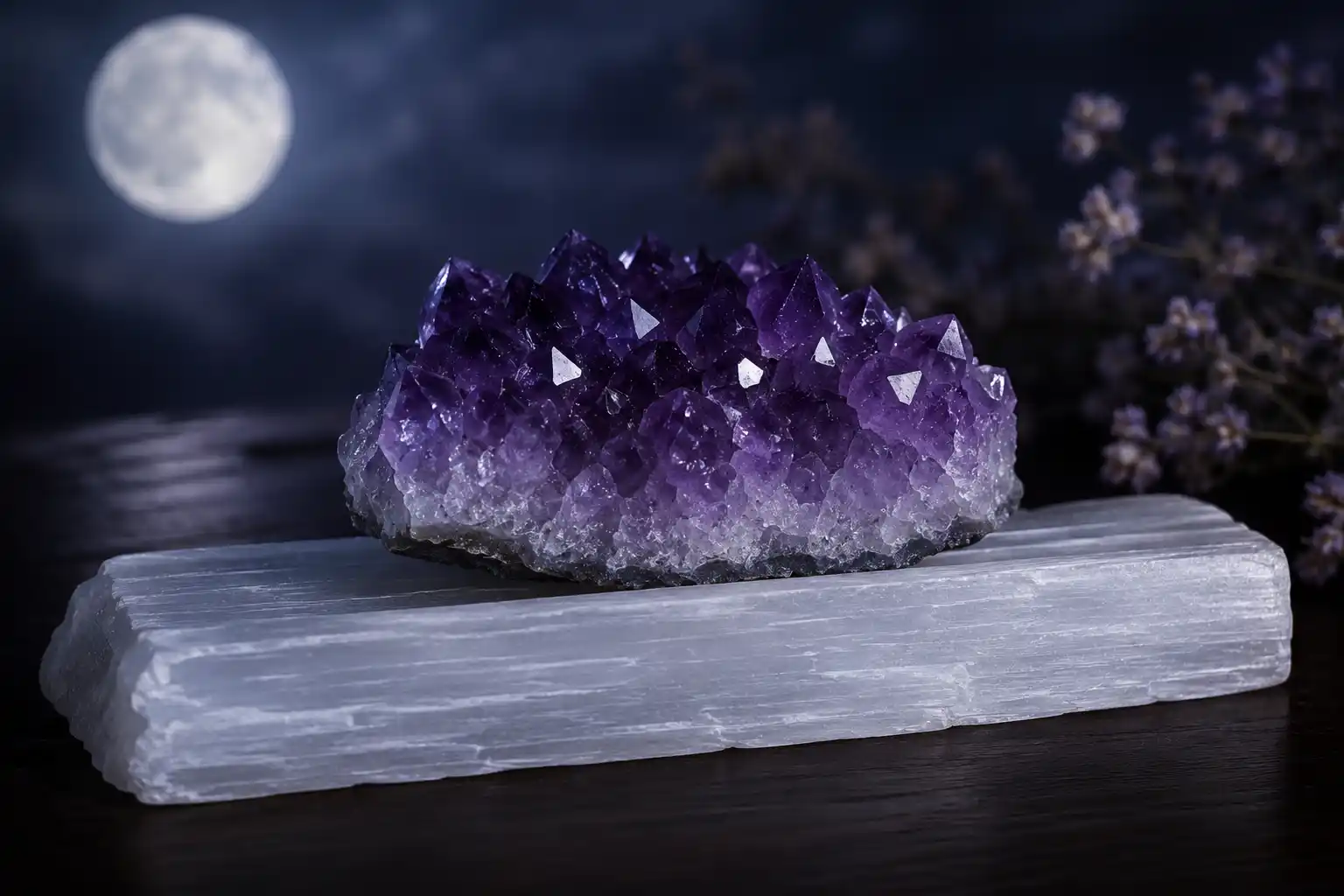
How to Cleanse and Charge Amethyst (Safely)
The safest ways to cleanse and charge Amethyst are sound, intention, visualization, breath, indirect moonlight, and gentle physical cleaning when the stone is dirty. These approaches respect Amethyst’s quartz durability while avoiding prolonged intense sunlight, steam, abrupt temperature changes, chemicals, salt buildup, and damage to fragile crystal points.
Amethyst does not require cleansing for gemological reasons. Cleansing and charging are spiritual or personal rituals used to mark intention, transition, meditation, or symbolic renewal.
What Cleansing and Charging Mean
In modern crystal practice, cleansing usually refers to symbolically releasing unwanted associations or preparing a stone for use.
Charging refers to dedicating it toward a purpose, such as reflection, calm, focus, creativity, remembrance, or meditation.
These practices come from individual belief, contemporary spirituality, and selected cultural traditions. They are not established scientific processes that change the chemical structure or measurable energy of quartz.
The mineralogy, colors, sources, and symbolism of the gemstone belong to the broader Amethyst guide. Traditional wellness claims appear separately in Amethyst Healing Properties.
Why Amethyst Still Needs Safe Handling
Amethyst is purple quartz and ranks 7 on the Mohs scale. It has good toughness and no pronounced cleavage, making it more durable than Amber, Selenite, Fluorite, Moonstone, or Calcite.
Its position within the larger mineral family appears in the Quartz guide.
Nevertheless, crystal points, druzy surfaces, geode edges, filled fractures, dyed material, glue, and metal settings can be damaged by careless rituals.
The broader durability context appears in the gemstone hardness chart, Gemstone Toughness vs Hardness, and Gemstone Cleavage Explained.
Amethyst can fracture after abrupt temperature changes. Some color may fade after prolonged intense light, while high heat can alter purple quartz or convert suitable material toward yellow or greenish colors.
Inspect the Amethyst First
Look at the stone under bright, indirect light.
Check for loose crystal points, unstable matrix, open fractures, chipped edges, peeling coatings, color concentrated in cracks, cloudy glue, and damaged settings.
A cluster or geode requires more care than a smooth tumble because individual points can break when pressed or dropped.
Chevron Amethyst contains white quartz banding and purple zones. Its material background belongs to the Chevron Amethyst guide.
Natural zoning and inclusions are not dirt. Do not scrape them or force salt, soil, or brush bristles into an opening.
Physically Clean the Stone When Necessary
A symbolic ritual does not remove oil, dust, makeup, or setting residue.
The dedicated physical-care instructions belong to How to Clean Amethyst Jewelry Safely.
Sound, unfilled Amethyst can usually be cleaned with warm water, mild soap, and a soft brush.
Dyed, fracture-filled, glued, coated, antique, or matrix-supported pieces require more conservative treatment.
The wider treatment boundaries appear in How to Spot Treated or Synthetic Amethyst and Gemstone Treatments Explained.
Dry the stone completely before beginning a spiritual ritual or returning it to storage.
Method 1: Cleanse Amethyst with Sound
Sound is suitable for loose stones, jewelry, clusters, geodes, and fragile points because it requires no liquid or direct contact.
Place the Amethyst on a folded cloth. Ring a singing bowl, bell, tuning fork, or chime nearby.
You can also hum, chant, clap gently, or play calm music.
Do not place a crystal cluster inside a metal singing bowl or strike the bowl while the Amethyst touches it. Direct vibration and hard contact can chip crystal points.
A few slow sound cycles are sufficient.
Method 2: Use Indirect Moonlight
Place the Amethyst indoors near a window where the night sky is visible.
Use a soft cloth, lined tray, or padded jewelry box. An hour, an evening, or an overnight indoor placement may be used according to personal preference.
The moon phase does not affect the gemstone’s physical properties. Some practitioners select a full moon for symbolism, while others use any clear night.
Indoor placement prevents dew, rain, theft, falling debris, animals, and temperature changes.
Moonlight also avoids the prolonged intense exposure discussed in Which Crystals Can and Can’t Go in the Sun.
Method 3: Use Breath and Intention
Hold a smooth Amethyst loosely over a soft surface or leave the stone resting in front of you.
Take several slow breaths and choose a single intention.
Exhale gently toward the stone once or twice, avoiding moisture buildup. Then state the intention silently or aloud.
For jewelry, the intention may be connected with wearing the object mindfully. Relevant formats include an Amethyst ring, Amethyst necklace, Amethyst bracelet, or Amethyst earrings.
This method is physically safe and does not depend on weather, tools, or contact with another material.
Method 4: Use Visualization
Place the Amethyst on a padded surface.
Imagine the stone becoming clear of unwanted associations and connected with a chosen purpose.
Some practitioners visualize white, violet, or neutral light. The specific color is symbolic rather than physically meaningful.
Continue for a few breaths or several minutes.
Visualization is particularly suitable for geodes, clusters, fragile points, treated stones, and valuable jewelry because no contact is required.
Method 5: Use a Brief Water Ritual
A sound, untreated, unfilled loose Amethyst may be rinsed briefly in clean lukewarm water.
Hold it securely over a bowl rather than an open drain. Dry it immediately with a soft cloth.
Do not leave Amethyst soaking overnight. Water can enter fractures, loosen matrix, stretch stringing, affect glue, or damage metal components.
Avoid water rituals for druzy clusters with unstable bases, dyed stones, fracture-filled material, glued jewelry, elastic bracelets, or unidentified specimens.
The broader water-safety framework belongs to Which Crystals Can and Can’t Go in Water.
Physical dirt should be handled through the cleaning page rather than repeated spiritual soaking.
Method 6: Place Amethyst Near Clear Quartz
Some practitioners use Clear Quartz as a symbolic companion for charging other stones.
The material profile belongs to the Clear Quartz guide.
Place the stones near each other on a lined tray rather than stacking points directly together.
Amethyst and Clear Quartz have the same Mohs hardness, so their edges can abrade one another when grit is trapped between them.
A cloth barrier protects polished surfaces and crystal points.
No specific length of time is required; a few minutes or an evening can carry the intended symbolism.
Method 7: Use a Selenite Plate with a Barrier
Selenite is often used in modern cleansing rituals, although it is far softer than Amethyst and can itself be scratched.
Place a clean soft cloth over the Selenite before adding the Amethyst.
Do not slide the quartz across the plate or place a heavy geode on a thin Selenite slab.
The ritual’s symbolic meaning does not require direct mineral-to-mineral contact.
This barrier also prevents powdery Selenite residue from entering jewelry settings.
Method 8: Use Smoke Cautiously
Smoke from incense or herbs is part of some spiritual traditions, but it can leave soot, resin, oil, and odor on a crystal.
Keep Amethyst away from flame, hot ash, incense coal, and heated containers.
Move the stone briefly through cool, dispersed smoke in a ventilated area, or let the smoke pass nearby without direct contact.
Avoid smoke cleansing for respiratory-sensitive households, children’s spaces, pets, or jewelry that will need immediate rewashing.
Sound, breath, and visualization offer cleaner alternatives.
Avoid Prolonged Direct Sunlight
Some Amethyst color can fade after prolonged exposure to intense light.
A sunny windowsill may also become hot enough to create unnecessary thermal stress.
Brief daylight during normal wear is different from leaving a cluster outside or in direct sun for hours.
Use indirect moonlight, sound, or intention when a light-based ritual is important.
Do not attempt to restore faded Amethyst by heating, chilling, or exposing it to ultraviolet lamps.
Avoid Fire, Steam, and High Heat
Heat can lighten or alter Amethyst color. Under controlled treatment conditions, some Amethyst becomes Citrine or Prasiolite-like material.
The related quartz profiles appear in the Citrine guide and Prasiolite guide.
These transformations are not household charging methods.
Keep the stone away from candles, fireplaces, incense flames, stovetops, hot water, steam, saunas, radiators, and heated ritual bowls.
The machine-specific boundary appears in Which Gemstones Can Go in an Ultrasonic Cleaner?, although symbolic cleansing does not require ultrasound at all.
Avoid Direct Salt Contact
Dry salt can lodge between crystal points, inside druzy surfaces, in fractures, and around jewelry settings.
Saltwater may corrode metal, affect glue, stretch stringing, and leave deposits after drying.
Burying a cluster in salt also creates pressure against delicate points.
When salt has symbolic importance, place it in a separate bowl and set the Amethyst in a lined dish above or beside it without direct contact.
Avoid Soil Burial
Soil contains Quartz grains, moisture, microorganisms, fertilizers, organic acids, and debris.
These materials can scratch polished Amethyst, lodge in clusters, discolor matrix, and affect metal settings.
Outdoor burial also creates a risk of loss, weather exposure, and accidental impact.
A safer nature-based practice is to place the Amethyst near a plant while keeping it on a separate cloth or dish.
Charging Amethyst with a Clear Intention
After cleansing, identify one purpose for the stone.
The intention might involve maintaining a meditation routine, creating a visual reminder to pause, marking a new project, or supporting reflective journaling.
Place one or both hands near the Amethyst and repeat the chosen statement.
Some people pair the ritual with written Amethyst affirmations or a personal meditation practice.
Symbolic chakra associations belong to Amethyst Chakra, while practical non-medical uses belong to How to Use Amethyst.
The process is complete when the intention feels clearly associated with the object.
How Often Should Amethyst Be Cleansed?
There is no scientifically required schedule.
A practitioner might cleanse the stone before first use, after lending it, at the beginning of a month, after a difficult event, or before meditation.
Others perform the ritual only when the stone is physically cleaned.
Frequent outdoor exposure, soaking, or contact with salt is not more effective than a brief protected ritual.
Choose a routine that respects the stone’s condition and the role it plays in your personal practice.
Buying, Authenticity, and Birthstone Context
The Amethyst buying guide covers purple hue, tone, saturation, zoning, clarity, cut, treatment, and setting quality.
Market factors belong to the Amethyst price guide.
Glass, synthetic quartz, dyed quartz, Fluorite, and other purple materials may imitate Amethyst. The complete identification workflow belongs to Real vs Fake Amethyst.
Amethyst is February’s traditional birthstone, covered in the February birthstone guide.
Whether natural, laboratory grown, treated, or imitation, an object can still hold personal symbolic meaning. Its physical care should be based on its actual material identity.
Frequently Asked Questions
1. What is the safest way to cleanse Amethyst?
Sound, intention, visualization, breath, and indirect indoor moonlight are the lowest-risk methods.
2. Can Amethyst be cleansed in water?
A sound untreated stone can be rinsed briefly in lukewarm water. Avoid soaking filled, dyed, glued, fractured, or matrix-supported pieces.
3. Can Amethyst be charged in sunlight?
Prolonged intense sunlight is not recommended because some purple color can fade.
4. Can Amethyst be left in moonlight overnight?
Yes, when placed indoors on a padded surface. Outdoor exposure creates unnecessary weather, impact, and loss risks.
5. Can Amethyst be cleansed with salt?
Direct salt contact is best avoided because grains can lodge in clusters, fractures, and settings.
6. Can Amethyst be cleansed with smoke?
A brief cool-smoke ritual is possible, but sound or intention avoids soot, fragrance, heat, and fire risk.
7. Can Amethyst be placed on Selenite?
Yes, with a soft cloth barrier to protect the softer Selenite and avoid abrasive contact.
8. Can Clear Quartz charge Amethyst?
Some practitioners use it symbolically. Keep the stones separated by cloth so equal-hardness quartz surfaces do not rub.
9. Can heat charge Amethyst?
No. Heat can alter its color and cause fractures after abrupt temperature changes.
10. How long should Amethyst charge?
A few minutes, an evening, or overnight indoors can serve the ritual. There is no objective minimum duration.
11. How often should Amethyst be cleansed?
Use a schedule that fits your practice. Frequent handling or exposure is not physically necessary.
12. Does cleansing change Amethyst scientifically?
No established scientific evidence shows that cleansing changes Amethyst’s chemical structure, health effects, or measurable physical energy.
Conclusion
Amethyst does not need harsh exposure to serve as a meaningful ritual object. Sound, intention, visualization, and protected moonlight preserve its purple color while avoiding salt deposits, direct sun, heat, and damage to crystal points. A safe ritual leaves the quartz physically unchanged and gives the chosen intention—not the cleaning method—the central role.
Crystal cleansing and charging are spiritual or personal practices, not scientifically established methods for changing health, energy, or the physical properties of Amethyst.