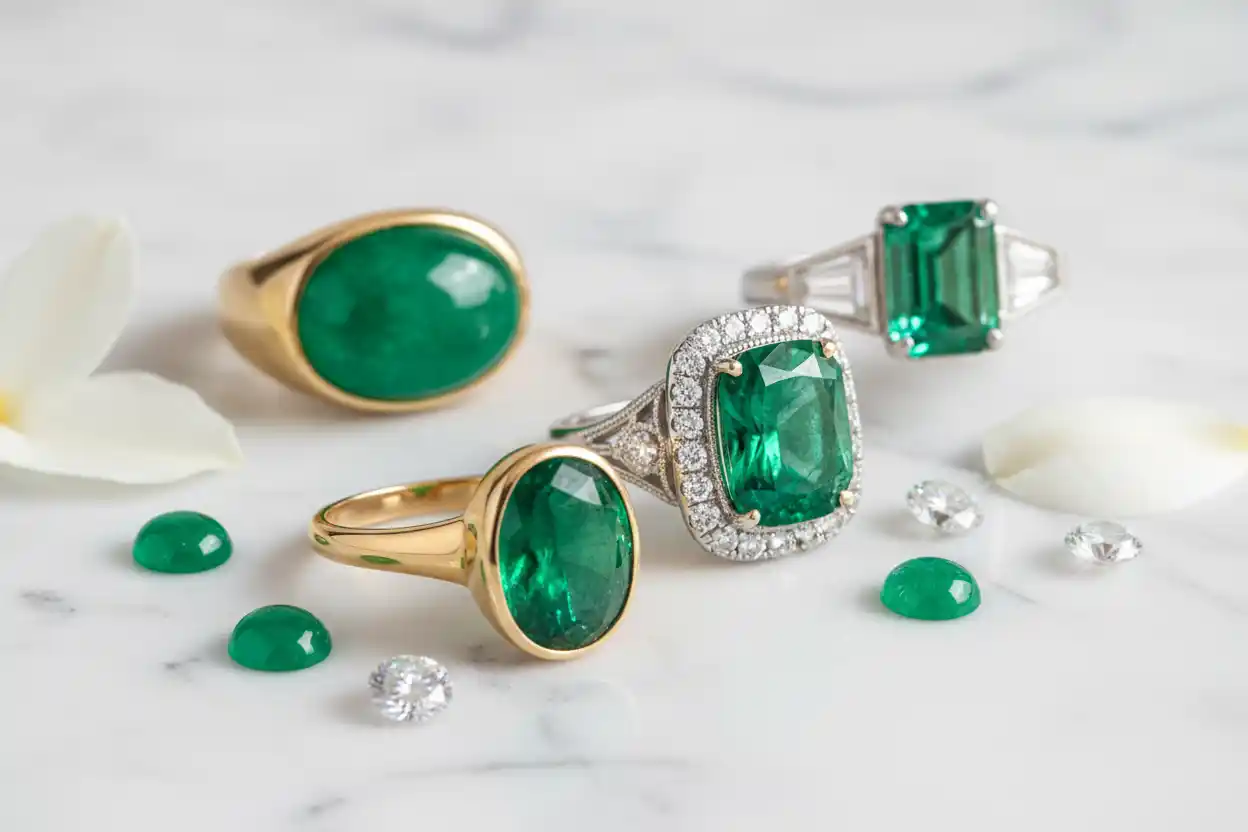
Emerald Rings: Styles, Settings and Buying Tips
Emerald rings offer intense green color in designs ranging from minimal bezels to antique-inspired clusters and diamond halos. Although emerald is reasonably hard, rings expose the gemstone to more impacts than earrings and necklaces, making setting protection and realistic wear especially important.
Natural inclusions are normal, and many emeralds receive clarity enhancement with oil, resin or another filler. Therefore, a strong purchase depends on transparent treatment disclosure, attractive color and construction suited to the way the ring will actually be worn.
Emerald Rings at a Glance
| Factor | What to look for |
|---|---|
| Gem identity | Natural or clearly disclosed laboratory-grown emerald |
| Color | Attractive green to bluish green |
| Transparency | Appropriate to faceted or cabochon style |
| Inclusions | Expected; assess stability rather than demanding perfection |
| Treatment | Written disclosure of fracture filling or dye |
| Best protective setting | Bezel, partial bezel or low halo |
| Best careful-wear setting | Strong prongs with protected corners |
| Metal | Gold or platinum with adequate thickness |
| Ring fit | Secure enough to reduce spinning |
| Main care issue | Impact, heat, chemicals and fillers |
| Resizing | Depends on band and stone-setting design |
| Cleaning | Warm mild soapy water; avoid steam and ultrasonic systems |
Emerald Rings vs Emerald Engagement Rings
An emerald ring may be purchased for fashion, an anniversary, a birthstone, collecting or personal symbolism.
An emerald engagement ring carries additional considerations around partnership, wedding-band compatibility and long-term proposal jewelry.
The general ring buyer can consider a wider range of styles, including cocktail rings, cabochons, signets and pieces intended only for occasional wear.
This distinction matters because an elaborate high-profile ring may be perfectly reasonable for special occasions even though it would be a poor choice for constant engagement-ring use.
Is Emerald Durable Enough for Rings?
Emerald has a Mohs hardness of about 7.5 to 8.
That means it resists many ordinary scratches, but hardness alone does not determine whether a stone will survive impacts.
Natural emerald commonly contains fissures. Some reach the surface and are filled to improve apparent clarity.
A hard blow can extend an existing fracture or chip an exposed edge.
Therefore, emerald is suitable for rings when the owner removes the piece during rough activities and chooses an appropriate setting.
The completed gemstone toughness versus hardness guide explains why scratch resistance and breakage resistance are different properties.
Solitaire Emerald Rings
A solitaire centers one emerald without significant side stones.
This gives color and cut complete visual attention.
Emerald-cut rectangles create an architectural appearance, while oval and cushion stones feel softer. Round emeralds can provide more scintillation, and pear shapes create strong vertical movement.
For frequent wear, lower settings are preferable.
A substantial bezel or sturdy prong basket protects the stone better than a tall setting with exposed edges.
Bezel-Set Emerald Rings
Bezels provide one of the best protection options for emerald.
Metal surrounds the gemstone’s girdle, reducing direct impact to the edge and creating a smooth profile.
Full bezels suit round, oval and cabochon emerald. Partial bezels preserve more openness while protecting selected areas.
The craftsmanship should remain even around the complete gemstone.
A lopsided bezel can make the stone appear crooked and may apply uneven pressure.
Bezel rings are particularly useful for wearers who dislike prongs catching on clothing.
Prong-Set Emerald Rings
Prongs expose more of the emerald and create a traditional fine-jewelry appearance.
However, the stone’s vulnerable corners and any major fissures must be considered during setting.
Emerald cuts usually need secure support at all four clipped corners.
The emerald should not move or rotate.
Inspect prongs periodically and stop wearing the ring when one catches fabric.
A very thin prong design may look delicate but can become less secure over years of frequent wear.
Halo Emerald Rings
A diamond halo surrounds the green center with small white stones.
The contrast can make the emerald appear more saturated and visually larger.
A low halo also provides some protection around the edge.
However, the additional small diamond settings increase maintenance requirements.
Check that the halo remains symmetrical and does not rub directly against the emerald.
Cleaning should follow emerald limitations even when diamonds make up most of the visible ring.
Three-Stone Emerald Rings
Three-stone designs may use one central emerald with diamond sides or three emeralds.
Diamond side stones create strong color contrast. Tapered baguettes work well beside rectangular emerald cuts, while rounds and pears can soften an oval or cushion center.
A three-emerald ring requires good color matching.
The side stones should not extend so far between neighboring fingers that the ring becomes uncomfortable.
Inspect the profile as carefully as the face-up design.
Emerald Cocktail Rings
Cocktail rings emphasize size and design rather than minimal daily practicality.
Large cabochons, clusters, diamond surrounds and sculptural metalwork are common.
Because these rings often sit high above the finger, they are more likely to strike surfaces.
Treat them as deliberate event jewelry rather than pieces for gardening, exercise or manual work.
A wide or substantial shank can help prevent a top-heavy ring from rotating.
Comfort should be assessed before purchase because large designs may contact neighboring fingers.
Emerald Birthstone Rings
Emerald is the principal modern May birthstone.
A birthstone ring may use a natural emerald, laboratory-grown emerald or a small green accent within a more accessible design.
The completed May birthstone guide covers its calendar history and symbolism.
Birthstone jewelry does not need to use the largest or most expensive emerald available.
A small protected stone can carry the same personal meaning while being easier to wear.
Cabochon Emerald Rings
Cabochons provide a smooth domed appearance.
They work especially well with translucent or heavily included emerald whose strength lies in color rather than transparency.
A bezel-set cabochon can offer a relatively protected surface and vintage character.
Some emerald cabochons may display unusual optical phenomena, although such stones require appropriate gemological confirmation.
The absence of facets does not eliminate treatment or fracture considerations.
A cabochon should still receive gentle wear.
Vintage and Antique Emerald Rings
Antique emerald rings may combine the gemstone with old-cut diamonds, engraved metal, enamel or period-specific settings.
Condition evaluation is essential.
Check:
- Prong wear
- Thin shanks
- Previous resizing
- Replacement stones
- Solder seams
- Abraded emerald surfaces
- Loose accent gems
Historic value may depend on provenance and original craftsmanship in addition to gemstone quality.
Do not automatically repolish an antique emerald because surface wear can form part of the piece’s history and restoration decisions may affect value.
Choosing Emerald Color
Fine emerald usually falls between green and bluish green with strong saturation.
Very dark stones can appear nearly opaque, while very pale material may lack the classic emerald intensity.
The ideal color depends partly on personal preference.
Evaluate the ring under ordinary lighting rather than only concentrated jewelry-store illumination.
Yellow gold adds warmth, while platinum and white gold create cooler contrast.
The completed emerald buying guide provides a full color and quality checklist.
Emerald Clarity
Visible inclusions are expected.
The internal pattern often described as jardin can provide natural character.
However, buyers should distinguish attractive inclusions from durability concerns.
A fracture extending to a corner or girdle may deserve closer assessment than an isolated internal crystal.
Emerald should not be evaluated with diamond-like expectations for complete eye-cleanliness.
A transparent stone with beautiful color and moderate inclusions may be far more desirable than a cleaner but weakly colored emerald.
Treatment Disclosure
Many emeralds receive clarity enhancement.
Oil, resin or other fillers reduce the visibility of surface-reaching fractures.
Treatment level affects value and cleaning.
The completed treated emerald guide explains treatment terminology and synthetic-material boundaries.
For an expensive ring, laboratory documentation may describe detectable clarity enhancement.
Never assume natural means untreated.
Likewise, a treated stone is not automatically undesirable when the treatment is disclosed and the price reflects it.
Lab-Grown Emerald Rings
Laboratory-grown emerald can create attractive rings at a different price point.
The material is synthetic emerald, not glass or cubic zirconia.
It may provide stronger apparent clarity and larger size than a comparable natural emerald within the same budget.
The completed lab emerald meaning guide covers its material properties.
Origin should remain clearly disclosed through sales descriptions and documentation.
A synthetic emerald does not become natural because it contains inclusions.
Emerald Ring Cuts
| Cut | Visual effect | Ring consideration |
|---|---|---|
| Emerald cut | Geometric, elegant | Protect clipped corners |
| Oval | Soft and elongated | Check windowing and symmetry |
| Cushion | Rounded-square | Facet patterns vary |
| Round | Bright and classic | Good setting versatility |
| Pear | Tapered and dramatic | Protect the point |
| Cabochon | Smooth and organic | Strong option for included material |
Cutters often preserve emerald weight because valuable rough is expensive.
Therefore, some stones may be deep or irregular.
Buy according to face-up beauty rather than assuming a heavier carat weight produces a better ring.
Choosing the Metal
Yellow gold remains a classic emerald metal because it creates warm contrast.
White gold and platinum emphasize cooler greens and coordinate well with diamond accents.
Rose gold creates a more unusual warm appearance.
The metal must also provide adequate structural support.
Extremely thin shanks or prongs may reduce long-term durability.
Ask about exact fineness and alloy composition, particularly when skin sensitivity matters.
Emerald and Diamond Rings
Diamonds often surround or flank emerald.
The combination is beautiful but needs thoughtful engineering because diamond is considerably harder.
Diamond girdles should not rub directly against emerald surfaces.
Likewise, a diamond wedding band may need a small gap or spacer to prevent repeated contact.
During cleaning, follow the emerald’s limitations rather than using a method selected because the accents are diamond.
The harder material does not make the complete ring tougher.
Emerald vs Tsavorite Rings
Tsavorite is green grossular garnet.
It often provides stronger brilliance and may offer greater practical toughness because it usually lacks emerald’s characteristic extensive fissuring.
Emerald offers a different color character and a much longer prestige tradition in fine jewelry.
The completed tsavorite versus emerald guide compares them directly.
Someone prioritizing easier maintenance may prefer tsavorite, while another buyer may specifically want emerald’s appearance and history.
Emerald vs Sapphire Rings
Green sapphire is generally harder and more resistant to abrasion than emerald.
However, it has a different color range, brilliance and treatment landscape.
The completed sapphire vs emerald vs ruby guide compares these major colored gems.
An emerald ring should not be selected because it is expected to perform physically like sapphire.
The materials require different care even when both are suitable for fine jewelry.
Choosing Ring Fit
A correctly fitted ring should pass the knuckle without excessive force and remain secure during ordinary movement.
Loose emerald rings spin, increasing impact risk.
Wide bands can feel tighter than narrow designs.
Measure under normal temperature conditions because fingers can swell or contract.
Complex pavé, eternity and antique rings may have resizing limitations.
Ask what range of future adjustment is realistic before purchase.
Ring Profile
A low-profile emerald ring is generally safer for frequent wear.
Tall settings place the gemstone farther from the finger and increase leverage during impact.
High settings may allow another band to sit flush, but that convenience should be balanced against snagging risk.
Look at the ring from the side.
If the emerald appears perched unnecessarily high above the band, consider whether the visual effect justifies the exposure.
Emerald Ring Pricing
Price depends on color, transparency, treatment, size, cut, source documentation, metal and workmanship.
A larger emerald with significant filling may cost less than a smaller stone with fine color and minimal enhancement.
The completed emerald price guide explores these variables directly.
Commercial grades such as AAA are not universal gemological standards.
Ask the seller to explain the actual characteristics behind any quality label.
Buying an Emerald Ring Online
Request:
- Exact gemstone dimensions
- Carat weight
- Treatment disclosure
- Natural or laboratory-grown origin
- Laboratory report where appropriate
- Metal fineness
- Setting height
- Ring size
- Resizing policy
- Return rights
Video under ordinary lighting can reveal color and windowing better than one heavily edited photograph.
Do not remove tags or resize the ring until the return decision is complete.
For major purchases, an independent inspection during the return period can provide additional confidence.
How to Wear an Emerald Ring
Remove the ring before:
- Weight training
- Gardening
- Housework
- Swimming
- Showering
- Cooking involving heavy equipment
- Mechanical work
- Contact sports
Apply lotion and cosmetics before wearing the ring.
Avoid stacking it tightly against diamond bands that repeatedly strike the emerald.
The goal is not to keep the ring unused. It is to remove it during situations where the risk provides no corresponding benefit.
Cleaning Emerald Rings
Use warm water, mild soap and a soft brush for routine cleaning.
Avoid steam and ultrasonic systems.
Strong solvents and aggressive jewelry dips may also affect fillers.
The completed guide to cleaning emerald jewelry safely provides detailed instructions.
Clean over a bowl rather than an open drain and inspect the setting while the ring is wet enough for residue to be removed easily.
Dry it completely before storage.
Professional Inspection
Seek professional service when a prong catches, the emerald moves, the shank bends or the filler appearance changes.
Tell the jeweler that the stone is emerald before any repair involving heat.
Older rings and heavily included emeralds may need specialist handling.
Do not attempt to tighten prongs or restore clarity enhancement at home.
Periodic inspection can identify worn metal before the gemstone is lost.
Storage
Store emerald rings separately in padded compartments.
Diamonds, sapphires and other harder stones may scratch them.
Avoid stacking loose rings inside one jewelry dish.
Keep the ring away from strong heat and household chemicals.
Travel with the ring in a structured jewelry case rather than a handbag pocket.
Store laboratory documentation and receipts in a separate secure location.
Conclusion
Emerald rings range from practical low bezels to elaborate cocktail designs. The best style depends on how frequently the ring will be worn and how much maintenance the wearer accepts.
Color remains the main visual priority, while natural inclusions and treatment require realistic evaluation rather than automatic rejection. Setting protection, ring fit and metal strength matter just as much as gemstone carat weight.
Choose a ring whose design respects emerald’s physical limitations, and it can remain beautiful for many years of careful use.
Frequently Asked Questions
1. Is emerald good for rings?
Yes. Emerald can be used successfully in rings when the setting provides protection and the wearer avoids rough activities.
2. What is the best setting for an emerald ring?
A full or partial bezel provides excellent protection, while a low halo and sturdy prongs can also work well.
3. Can emerald rings be worn every day?
Careful regular wear is possible, but emerald rings should be removed for exercise, cleaning, gardening and high-impact activities.
4. What color emerald is best for a ring?
Attractive saturated green to bluish green with enough lightness to remain lively generally receives the strongest market interest.
5. Are inclusions normal in emerald rings?
Yes. Natural emerald commonly contains visible inclusions and fissures.
6. Are most emerald rings treated?
Many natural emeralds are clarity-enhanced with oil, resin or similar fillers. Treatment should be disclosed.
7. Is lab emerald suitable for a ring?
Yes. Laboratory-grown emerald can be used in fine jewelry, but its synthetic origin must be clearly represented.
8. Is emerald durable enough for an engagement-style ring?
Yes, with a protective setting and careful wear. Diamond or sapphire may be easier for someone who wants truly rough daily use.
9. Can emerald and diamond rings be stacked?
Yes, but prevent direct rubbing between exposed diamond edges and the emerald or its setting.
10. Can emerald rings be resized?
Many can, but extensive pavé, eternity construction and complex vintage designs may limit resizing.
11. Can an emerald ring be cleaned ultrasonically?
No. Ultrasonic and steam cleaning should generally be avoided because emerald frequently contains fractures and fillers.
12. How should an emerald ring be stored?
Keep it in a separate padded compartment away from diamonds, sapphires and other harder gemstones.