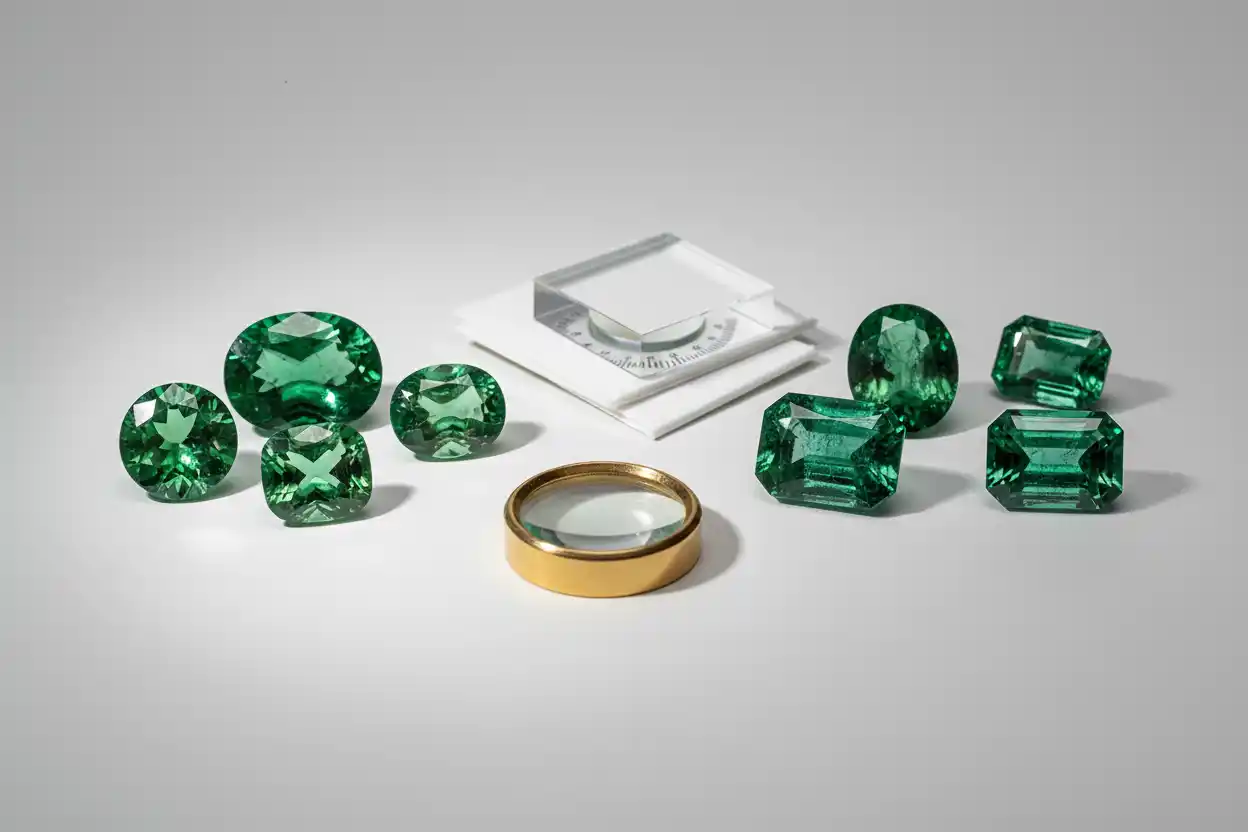
Tsavorite vs Emerald: How to Tell Them Apart
Tsavorite and Emerald can occupy a similar vivid-green color range, yet they belong to completely different mineral families. Tsavorite is green Grossular Garnet, whereas Emerald is chromium- or vanadium-bearing Beryl.
The two gems also differ in brilliance, density, refractive behavior, inclusions, treatment expectations, toughness and price structure. Tsavorite commonly appears brighter and cleaner, while Emerald often displays a deeper green with visible internal features traditionally described as its jardin.
Color alone cannot identify either gem reliably. A dark Tsavorite can resemble Emerald, and an unusually clean Emerald may look similar to fine green Garnet. When identity materially affects value, controlled gemological testing provides a more reliable answer than visual comparison or destructive home tests.
Tsavorite vs Emerald at a Glance
| Property | Tsavorite | Emerald |
|---|---|---|
| Mineral family | Garnet | Beryl |
| Variety or species | Green Grossular Garnet | Green Beryl variety |
| Approximate composition | Calcium aluminum silicate | Beryllium aluminum silicate |
| Main color agents | Primarily vanadium, sometimes chromium | Chromium, vanadium or both |
| Typical color | Yellowish green to slightly bluish green | Yellowish green to bluish green |
| Mohs hardness | About 7–7.5 | About 7.5–8 |
| Toughness | Fair to good | Often reduced by fractures |
| Cleavage | None | Indistinct |
| Refractive character | Singly refractive | Doubly refractive |
| Typical refractive index | Approximately 1.74 | Approximately 1.57–1.59 |
| Specific gravity | Approximately 3.6 | Approximately 2.7 |
| Common inclusions | Crystals, needles, feathers and fluid features | Three-phase inclusions, crystals, fractures and growth tubes |
| Common treatment | Usually untreated | Oil, resin, wax or polymer filling is common |
| Typical visual effect | Bright brilliance and crisp green flashes | Richer, softer green with visible internal garden |
| Major sources | Kenya, Tanzania and Madagascar | Colombia, Zambia, Brazil, Afghanistan and other localities |
What Is Tsavorite?
Tsavorite is a transparent green variety of Grossular Garnet.
Grossular has the approximate formula Ca₃Al₂(SiO₄)₃. Trace vanadium produces much of Tsavorite’s green color, while chromium can contribute in some material.
The name is associated with East Africa, particularly Kenya and Tanzania. Fine material can show vivid medium-tone green, strong brilliance and relatively high clarity.
Tsavorite belongs to the broader Garnet family but differs from familiar red Almandine, Pyrope and Rhodolite. It also differs from Demantoid, which is green Andradite Garnet rather than Grossular.
The completed Tsavorite meaning guide owns the gemstone’s formation, localities and symbolism. Its parent mineral is covered separately in the Grossular Garnet guide.
What Is Emerald?
Emerald is the green gem variety of Beryl.
Its approximate formula is Be₃Al₂Si₆O₁₈. Chromium, vanadium or a combination of both produces qualifying green color, depending on the deposit and laboratory terminology.
Emerald belongs to the same mineral family as Aquamarine, Morganite, Heliodor and Goshenite. However, its green color, inclusion patterns, history and market position give it a distinct identity.
Many Emeralds contain surface-reaching fractures. Oils, waxes and artificial resins are commonly introduced into those fractures to make them less visible.
The planned Emerald meaning guide owns the complete mineral profile, while the completed treated Emerald guide explains clarity enhancement and synthetic material.
The Fastest Visual Difference
Tsavorite usually appears more brilliant than Emerald.
Its higher refractive index produces stronger internal reflections, especially when the stone has been cut well. Small Tsavorites can look exceptionally lively beneath ordinary light.
Emerald often has a softer visual character. Internal fractures, growth tubes and crystals scatter light and create the textured appearance known as jardin, meaning garden.
This difference is helpful but not conclusive. A heavily included Tsavorite may look subdued, while a fine clean Emerald can be surprisingly brilliant.
Cutting also affects the result. A windowed Tsavorite can appear less lively than a well-proportioned Emerald.
Comparing Green Color
Both gemstones can range from yellowish green to bluish green.
Fine Tsavorite often displays vivid green with medium tone and strong saturation. Slightly bluish-green material can be especially attractive, although yellow-green stones may remain bright and beautiful.
Emerald is valued for sufficiently deep green color rather than pale green Beryl. Fine stones can show intense bluish green or balanced green without becoming black or gray.
Color preferences differ. Tsavorite often looks crisp and energetic, while Emerald can appear deeper, softer and more velvety.
Neither stone should be judged under one concentrated jewelry lamp. Compare the gems under daylight-equivalent lighting, ordinary indoor illumination and warmer evening light.
Brilliance and Refractive Index
Tsavorite’s refractive index is approximately 1.74, considerably higher than Emerald’s range near 1.57–1.59.
That difference helps Tsavorite return stronger flashes of light.
Emerald’s brilliance is often reduced further by inclusions and fractures. Nevertheless, its color may remain visually compelling even when it does not sparkle as strongly.
Refractive-index testing provides an effective laboratory distinction. A polished loose gemstone can usually be measured with a refractometer.
Mounted stones, poor polish and limited facet access can complicate the reading.
Single Versus Double Refraction
Tsavorite belongs to the cubic crystal system and is normally singly refractive.
Emerald belongs to the hexagonal crystal system and is doubly refractive.
A polariscope can help separate the two. Tsavorite generally remains dark through a complete rotation under crossed polarizers, although strain can produce anomalous reactions.
Emerald typically shows changing light and dark positions because it is anisotropic.
This test requires experience. Aggregate material, internal strain and mounting restrictions can create confusing results.
Specific Gravity
Tsavorite is noticeably denser than Emerald.
A loose Tsavorite commonly has a specific gravity around 3.6, while Emerald is closer to 2.7.
Two similarly sized loose stones can therefore have substantially different weights. The Tsavorite will generally weigh more.
Hydrostatic weighing can support identification, but the result must be interpreted carefully. Settings, trapped air, fractures, fillers and assembled construction can affect measurements.
Density identifies the material more reliably than it reveals treatment.
Hardness
Emerald is slightly harder on the Mohs scale, ranking approximately 7.5–8 compared with Tsavorite’s roughly 7–7.5.
That difference does not mean Emerald is automatically more durable.
Hardness measures resistance to scratching. It does not measure resistance to breaking, chipping or impact.
The completed gemstone hardness chart explains the scale, while the gemstone toughness-versus-hardness guide separates scratch resistance from structural durability.
Destructive scratch testing should never be used to distinguish finished jewelry.
Toughness and Breakage
Tsavorite generally offers the practical durability advantage.
It has no cleavage and fair-to-good toughness. A sound stone can withstand normal jewelry wear when protected from hard blows.
Emerald has indistinct cleavage, but fractures are the more important concern. Most commercial stones contain fissures, and many have been clarity enhanced.
A blow can extend an existing fracture even when the surface remains resistant to scratching.
Consequently, Tsavorite is often the more forgiving choice for frequently worn rings and bracelets. Emerald remains suitable for jewelry, but it benefits from more protective designs and conservative wear.
Inclusion Differences
Tsavorite can contain needles, crystals, feathers, growth features and fluid-related inclusions.
Fine stones are often relatively clean, particularly in smaller sizes. A visible inclusion does not automatically reduce durability unless it reaches the surface or interrupts a vulnerable edge.
Emerald commonly contains crystals, liquid films, fractures, growth tubes and three-phase inclusions consisting of liquid, gas and a crystal.
Colombian Emeralds are especially associated with classic three-phase inclusions, although inclusion type alone does not prove geographic origin.
The presence of a visible internal garden supports natural formation but does not prove that an Emerald is untreated.
The Emerald Jardin
The French word jardin describes the garden-like network of inclusions commonly visible inside Emerald.
A pleasing jardin may contribute character and provide evidence of natural geological growth. However, romantic terminology should not hide structural concerns.
A fracture reaching the girdle, corner or prong position may weaken the gemstone.
Heavily included Emeralds can also appear cloudy or lose transparency.
Clarity should therefore be judged by beauty and structural condition rather than by whether the seller calls every fracture desirable jardin.
Treatment Differences
Routine treatment expectations provide one of the strongest market distinctions.
Tsavorite is usually sold without heat treatment, dye or routine clarity enhancement. Rare fracture filling may occur, but it is not a defining market practice.
Emerald is frequently filled with oil, wax, resin or polymer. The filler enters surface-reaching fractures and makes them less visible.
Emerald reports may describe the degree of clarity enhancement as minor, moderate or significant, depending on the laboratory.
Treatment does not make an Emerald fake. It affects value, stability, cleaning and repair.
The completed real-versus-fake Emerald guide owns the wider authentication workflow.
Synthetic Emerald
Laboratory-grown Emerald is commercially available.
Hydrothermal and flux-growth methods can produce crystals with Emerald’s composition and structure. These gems are genuine synthetic Emerald rather than glass imitations.
Synthetic stones may contain characteristic growth features, flux remnants, nail-head spicules or chevron patterns, depending on the method and producer.
Some laboratory-grown Emerald is cleaner than typical natural material, although synthetic stones can also contain deliberate-looking inclusions.
The completed Lab Emerald guide explains the material, while the lab Emerald buying guide owns purchasing and disclosure.
Gem-quality synthetic Tsavorite is not a routine mainstream jewelry product.
Cut Differences
Tsavorite is commonly cut in rounds, ovals, cushions and mixed brilliant styles that emphasize sparkle.
Emerald is often fashioned in the rectangular step cut that carries its name. The clipped corners reduce vulnerability while broad facets emphasize color.
Either gem can appear in many other shapes.
A window through the center indicates excessive shallowness or poor proportions. Dark extinction can result from excessive depth or unfavorable orientation.
Compare face-up dimensions rather than carat weight alone because Tsavorite’s greater density affects how large it appears for a given weight.
Tsavorite Versus Emerald Under Magnification
A loupe may reveal useful differences.
A clean, lively green gem with small crystals or needles may suggest Tsavorite. A stone with a network of fractures, growth tubes and three-phase inclusions may suggest Emerald.
However, these are tendencies rather than universal rules.
A clean Emerald can resemble Tsavorite. Likewise, included Tsavorite can resemble Emerald’s internal texture.
Magnification is most useful when combined with refractive index, optical character, specific gravity and spectroscopy.
Chelsea Filter and Color Filters
A Chelsea filter may cause chromium-bearing Emerald to appear red or pinkish.
Some Tsavorites containing chromium may also show a reddish response. Vanadium-rich stones may react differently.
Consequently, a red filter reaction does not prove Emerald identity.
Modern laboratory testing gives the Chelsea filter only a supporting role. It should not override refractive-index and optical-character results.
Ultraviolet Fluorescence
Ultraviolet response varies in both gems.
Some Emeralds fluoresce weakly red, while iron-rich stones may remain inert. Oils and resins can create additional reactions.
Tsavorite may be inert or show weak responses depending on composition and inclusions.
UV fluorescence cannot reliably separate every Tsavorite from Emerald.
It is more useful for detecting certain fillers, synthetic features or unusual responses when combined with other observations.
Spectroscopy
A handheld spectroscope can reveal chromium and vanadium absorption patterns.
Emerald and Tsavorite can both contain these color-producing elements, so their spectra can overlap.
Advanced ultraviolet-visible, infrared and Raman spectroscopy can provide stronger separation by identifying the mineral structure and treatment-related substances.
Raman spectroscopy distinguishes Grossular Garnet from Beryl directly.
Infrared analysis can also help detect oils, polymers and resins inside Emerald fractures.
Geographic Origin
Tsavorite is strongly associated with Kenya and Tanzania, with additional material from Madagascar and nearby regions.
Important Emerald sources include Colombia, Zambia, Brazil, Afghanistan, Pakistan and other localities.
Color and inclusion appearance can suggest a geological environment, but they cannot prove origin reliably.
Geographic-origin determination requires comparison with known reference samples and advanced chemical and spectroscopic analysis.
A locality claim should not be accepted solely because a seller mentions a particular shade of green.
Price Differences
Fine Emerald generally commands higher prices than comparable Tsavorite, particularly in large sizes with strong color, desirable origin and limited clarity enhancement.
Tsavorite can still become expensive because fine stones above a few carats are scarce.
The completed Tsavorite price guide and Emerald price guide own detailed market information.
The comparison should focus on what the buyer receives: color, durability, treatment status, documentation and craftsmanship.
A lower price does not make Tsavorite inferior. It reflects a different market history, supply structure and consumer recognition.
Which Is Better for an Engagement Ring?
Tsavorite is generally the more practical choice for frequent hand wear.
Its lack of cleavage, fair-to-good toughness and limited routine treatment provide useful advantages.
Emerald can still be used in an engagement ring when the stone has manageable fractures, an appropriate setting and a wearer who accepts careful habits.
A bezel or protective halo helps both gems.
The completed Tsavorite ring guide and planned Emerald ring guide provide jewelry-specific decisions without duplicating them here.
Earrings, Necklaces and Bracelets
Earrings and necklaces protect either gem better than hand jewelry.
The completed Tsavorite earrings guide and planned Emerald earrings guide address pair matching.
The completed Tsavorite necklace guide and planned Emerald necklace guide cover chain and pendant construction.
Bracelets create greater impact exposure. The completed Tsavorite bracelet guide and planned Emerald bracelet guide explain setting and clasp requirements.
Birthstone Differences
Emerald is the modern birthstone for May.
The completed May birthstone guide covers its calendar tradition and history.
Tsavorite belongs to the Garnet family, which represents January. The completed January birthstone guide explains why Garnet includes green, orange and other colors beyond red.
A green birthstone gift should still be chosen according to durability and personal preference rather than month alone.
Cleaning Differences
Tsavorite can be cleaned with warm water, mild soap and a soft brush.
The completed Tsavorite jewelry-cleaning guide provides the full method.
Emerald requires greater caution because fillers and fractures may react to heat, solvents and vibration. Warm soapy water and gentle hand cleaning are safest.
The completed Emerald jewelry-cleaning guide explains why steam and ultrasonic equipment should be avoided.
Which Gem Should You Choose?
Choose Tsavorite when you prioritize brilliance, natural untreated appearance, practical durability and a less conventional green gemstone.
Choose Emerald when you value its distinctive color character, long cultural history, May birthstone identity and established fine-jewelry status.
Neither stone is universally superior.
A fine Tsavorite will outperform a weak, heavily treated Emerald in some contexts. A beautiful Emerald with controlled fractures may hold greater personal or collector value than an ordinary Tsavorite.
The completed green gemstones guide provides wider alternatives.
Frequently Asked Questions
1. Is Tsavorite a type of Emerald?
No. Tsavorite is green Grossular Garnet, while Emerald is green Beryl.
2. Which stone is harder?
Emerald is slightly harder on the Mohs scale, but Tsavorite is commonly tougher and less vulnerable to fracture-related damage.
3. Which stone sparkles more?
Tsavorite usually shows stronger brilliance because it has a higher refractive index and is often cleaner.
4. Is Tsavorite always lighter green than Emerald?
No. Both can range from yellowish green to bluish green and from light to dark tones.
5. Which gem is normally treated?
Emerald is commonly filled with oil or resin. Tsavorite is generally untreated, although rare fracture filling can occur.
6. Can a loupe distinguish Tsavorite from Emerald?
A loupe may reveal useful inclusion differences, but reliable separation usually requires refractive-index and optical testing.
7. Is Tsavorite rarer than Emerald?
Fine large Tsavorite is rare, but rarity depends on size and quality. Emerald has a much larger and more established market.
8. Which gem is better for everyday rings?
Tsavorite is generally more forgiving because it has no cleavage, fair-to-good toughness and fewer treatment concerns.
9. Does Tsavorite have a jardin?
Tsavorite can contain inclusions, but the term jardin is most closely associated with Emerald’s internal fracture and crystal patterns.
10. Can synthetic Emerald resemble Tsavorite?
Yes. Laboratory-grown Emerald can be clean and brilliant, making instrumental testing important.
11. Which is heavier at the same size?
Tsavorite is denser and generally weighs more than a similarly sized Emerald.
12. Which gem costs more?
Fine Emerald commonly costs more, although large vivid Tsavorite can also command substantial prices.