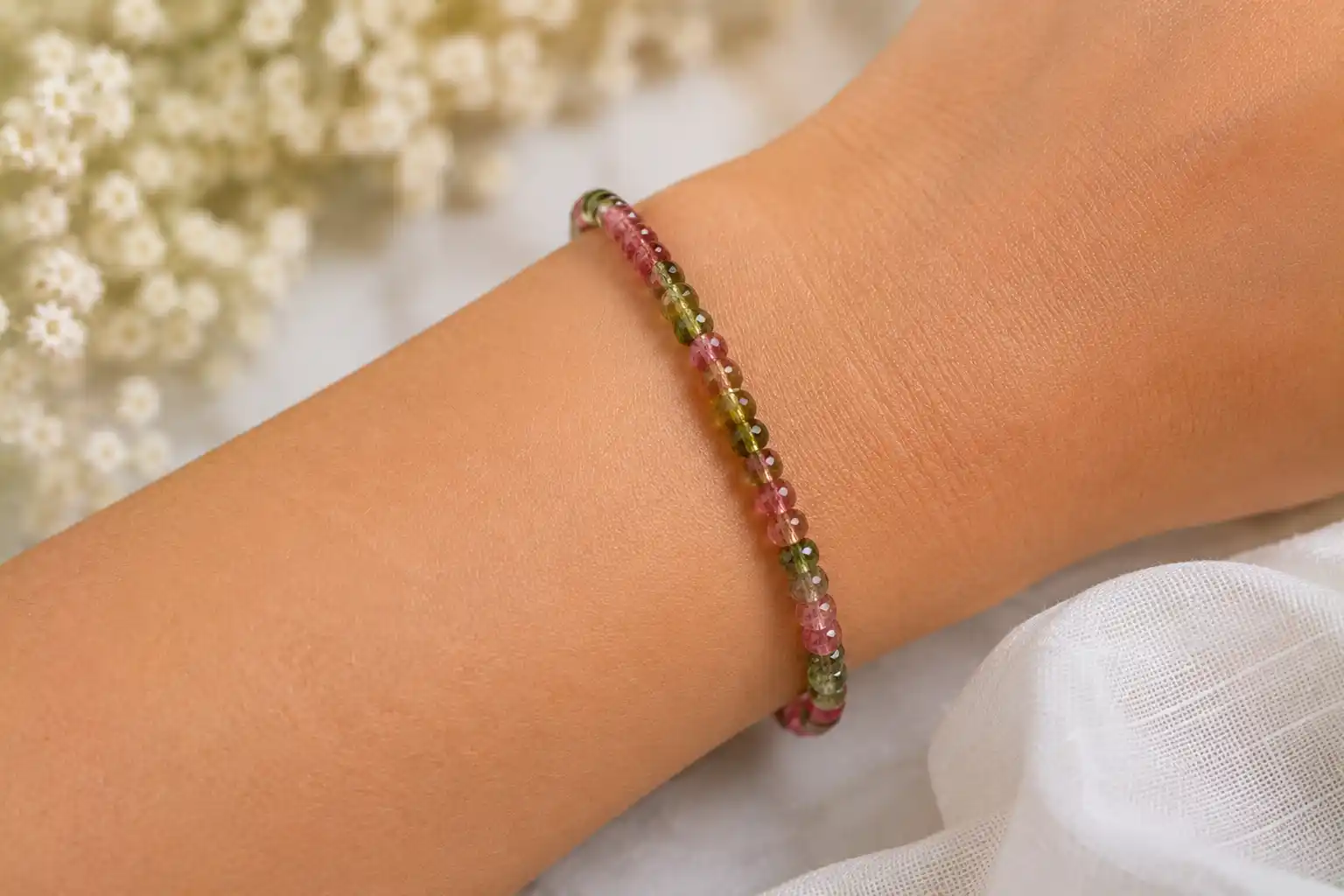
Watermelon Tourmaline Bracelets: How to Choose and Wear
Watermelon Tourmaline bracelets showcase one of the gem world’s most recognizable natural color patterns: pink or red interiors surrounded by green outer zones, sometimes separated by a pale or colorless band. Cutters may slice the crystal across its growth direction to show a rind-like pattern or cut it lengthwise to reveal parallel sections of pink and green.
A bracelet can use thin polished slices, rounded beads, faceted bicolor gems, cabochons or one central station. Each format presents different concerns involving thickness, fractures, drill holes, edge protection, matching, flexibility and clasp security.
Tourmaline offers useful jewelry hardness, but Watermelon Tourmaline is often included and color-zoned. Thin slices and fractured beads need more protection than a compact faceted gem with sound edges.
Watermelon Tourmaline Bracelets at a Glance
| Feature | What to Consider |
|---|---|
| Gem family | Tourmaline |
| Typical gem species | Usually Elbaite or related Tourmaline composition |
| Defining appearance | Pink center with green exterior or pink-green zoning |
| Mohs hardness | Approximately 7–7.5 |
| Toughness | Fair |
| Common forms | Cross-section slices, longitudinal slices, beads, cabochons and faceted stones |
| Popular bracelet styles | Elastic strand, knotted strand, station, tennis, charm, cuff and bangle |
| Main slice risk | Thin edges and internal fractures |
| Main bead risk | Chipped drill holes and weak stringing |
| Common treatment concerns | Heating, irradiation, filling, dye and imitation |
| Safest setting | Low bezel or protected frame |
| Safest cleaning | Warm water, mild soap and a soft brush |
What Is a Watermelon Tourmaline Bracelet?
A Watermelon Tourmaline bracelet contains natural or represented Tourmaline whose color zoning resembles a watermelon.
The classic cross-section shows a pink interior, a pale transitional zone and a green outer rim. Some crystals display only two clear colors, while others include white, colorless, yellow or darker intermediate bands.
Not every pink-and-green Tourmaline is a perfect concentric “watermelon.” Longitudinal cuts may show the colors side by side or from one end to the other.
The Watermelon Tourmaline meaning guide explains the variety’s formation and symbolism. This article focuses on bracelet construction and selection.
How the Color Zoning Forms
Tourmaline crystals grow from chemically changing fluids.
As the supply of trace elements changes, successive growth zones develop different colors. Manganese-related conditions may contribute to pink and red sections, while iron, vanadium, chromium or other compositional influences can create green.
The result records stages of crystal growth rather than an artificial assembly of two stones.
Color zoning can be concentric, parallel, irregular or sharply divided.
A convincing Watermelon Tourmaline should show a naturally integrated transition rather than paint, dye or two unrelated materials glued together.
Cross-Section Slice Bracelets
Cross-section slices are cut perpendicular to the crystal’s length.
This orientation reveals the pink center and green perimeter most clearly. The outline may be round, triangular, rounded triangular or irregular because Tourmaline crystals often develop three-sided prismatic forms.
Slices can be drilled, wire wrapped or framed in metal.
Thickness is critical. A very thin slice may display attractive translucency but can crack around its perimeter or drill hole.
The polished faces should remain reasonably parallel so the slice does not taper to a fragile knife-like edge.
Longitudinal Slice Bracelets
A longitudinal slice follows the crystal’s length.
Instead of a central pink core surrounded by green, the finished piece may show parallel bands or a transition from pink at one end to green at the other.
This format works well in elongated stations, tablets and bar-shaped bracelet centers.
The design should orient the colors intentionally. A setting that hides most of one section defeats the purpose of the zoning.
Long slices may contain natural growth fractures running with the crystal. These need inspection from the edge and back.
Watermelon Tourmaline Bead Bracelets
Beads may be round, faceted, barrel-shaped, disk-shaped or irregular.
Some display clear pink and green divisions, while others appear mottled or translucent with several colors.
Inspect every drill hole. Pale stress marks, chips and fractures radiating from the opening can weaken the bead.
The strand should not depend on one or two exceptional beads while the rest contain muddy color or poor polish.
A naturally varied strand can be attractive, but the sequence should still look intentional.
Elastic Bracelets
Elastic Watermelon Tourmaline bracelets are convenient and widely available.
The elastic must remain proportionate to the bead weight. Large or irregular Tourmaline beads can be heavy, placing substantial stress on thin cord.
Roll the bracelet over the hand instead of stretching it outward sharply.
Replace the elastic when it becomes loose, flattened, cloudy or frayed.
Avoid showering, swimming and sleeping in the bracelet. Moisture, heat, skincare products and repeated stretching shorten the cord’s life even when the stones remain intact.
Knotted Bead Bracelets
Knots between beads reduce direct impact and limit loss if the cord breaks.
This method is useful for valuable, large or heavily zoned beads.
The knots should sit closely against the drill holes without cutting into weak edges.
Silk creates a flexible drape but absorbs moisture. High-quality synthetic cord may provide stronger resistance in daily wear.
Professional restringing becomes appropriate when the knots stretch or the strand begins to gap.
Wire-Strung Bracelets
Flexible jewelry wire provides structure and supports a clasp.
The wire should curve smoothly without kinks. A permanent bend can become a future failure point.
Crimps must remain secure and neatly finished. Sharp metal edges can damage the wearer or abrade nearby Tourmaline.
A heavy strand needs a clasp and connecting rings capable of holding the total weight.
Metal spacers should remain smooth and should not press directly against thin slice edges.
Watermelon Tourmaline Station Bracelets
Station bracelets place one or several protected gems along a chain.
This design uses fewer stones and gives each color pattern more visual space.
A bezel-set slice station offers strong edge protection. Faceted bicolor stones can also be mounted in individual low settings.
The station should face outward instead of constantly flipping against the wrist.
An adjustable chain is useful for fit, but excessive looseness causes greater desk impact and repeated movement.
Tennis and Line Bracelets
A line bracelet may use small faceted pink-green Tourmalines arranged continuously.
Matching is demanding because each stone must coordinate in color distribution, dimensions, tone and brilliance.
The bracelet should not be sold as Watermelon Tourmaline merely because separate pink and green stones alternate. Genuine Watermelon Tourmaline displays multiple colors within individual crystals or gems.
Every link must articulate smoothly.
Shared-prong construction uses less visible metal but increases the consequences of one damaged prong. Individual settings provide greater separation and security.
Watermelon Tourmaline Charm Bracelets
One slice or bicolor cabochon can be used as a charm.
A compact metal frame protects the edge better than a thin drilled slice hanging from an open jump ring.
The attachment loop should be soldered or mechanically secure.
Do not allow the charm to strike hard metal objects or harder gemstones repeatedly.
A single high-quality charm may offer better color, transparency and construction than a crowded bracelet assembled from low-grade fragments.
Cuff and Bangle Designs
A Watermelon Tourmaline cuff may feature one central slice, several cabochons or a geometric inlay.
A rigid structure controls orientation and can protect the stone from bead-to-bead contact.
The gem should sit low enough that the bracelet’s metal absorbs some impact.
Open cuffs should not be bent repeatedly during wear. Continual reshaping weakens the metal and can transfer pressure to the stone.
Hinged bangles need a properly aligned hinge and secure closure.
Matching Color Zones
Matching does not require every gem to have an identical pattern.
The stones should coordinate in overall balance: the proportion of pink to green, saturation, transparency, outline and visible size.
A bracelet can use graduated zoning deliberately, moving from green-dominant pieces to pink-dominant ones.
One slice with bright clean zoning may look misplaced among heavily included, pale stones.
Judge the gems dry and under ordinary light. Water and concentrated display lighting can temporarily make color appear stronger.
Evaluating the Pink Center
The pink area may range from pale blush to vivid red-pink or magenta.
Strong color can be desirable, but the center should remain naturally integrated with the surrounding zones.
A very dark interior may lose transparency. Extremely pale pink may become difficult to see in a small slice.
Irradiation can create or intensify pink in some Tourmaline. Treatment should be disclosed when known.
The Pink Tourmaline meaning guide provides the wider context for pink Tourmaline without replacing Watermelon-specific zoning.
Evaluating the Green Rind
The green zone may be yellow-green, forest green, blue-green or nearly black.
A medium green rim usually provides stronger contrast than one so dark that it looks opaque.
The exterior does not need to form a perfectly uniform circle. Natural crystals commonly show uneven growth and triangular outlines.
Green Tourmaline is often called Verdelite in the trade. The Verdelite meaning guide explains that broader variety name.
The green area should not appear as a surface paint layer or removable coating.
Pale and Colorless Transitional Zones
Many Watermelon Tourmalines contain a pale or colorless band between the pink and green sections.
This zone can make the pattern more legible and create a crisp layered effect.
Its width may vary around the slice. Unevenness is not automatically a defect.
A milky transitional area can reduce transparency, while a clear band can increase visual separation.
The best pattern depends on the design rather than a rigid requirement that every slice reproduce a commercial illustration.
Clarity and Inclusions
Pink Tourmaline commonly contains more visible inclusions than many green and blue varieties.
Thread-like cavities, feathers, crystals and partially healed fractures may appear.
An internal inclusion can contribute character without threatening durability. A surface-reaching fracture at a thin edge or drill hole is more concerning.
Inspect slices from the side. A crack may be difficult to see face-up yet run through much of the thickness.
Filled fractures should be disclosed because fillers change care and repair requirements.
Slice Thickness
Thickness affects translucency, weight and strength.
Thin slices transmit more light and may show vivid color against the skin. They also chip and crack more easily.
Thicker slices provide greater structural support but can appear darker and become heavy.
Compare the thickness around the complete perimeter. One extremely thin corner is a likely vulnerability.
A protective frame can allow a moderately thin slice to be worn more safely than an unframed drilled piece.
Polishing Quality
Both main faces should be polished evenly unless the design intentionally preserves a natural crystal surface.
Scratches, cloudy areas and coarse grinding marks reduce visual quality.
Edge finishing matters because sharp or rough areas catch fabric and concentrate impact.
Oil or wax can temporarily make a weak polish look brighter. Examine the bracelet dry.
Natural pits and inclusions may remain, but workmanship defects should not be excused as proof of authenticity.
Treatments and Imitations
Heating may alter some Tourmaline colors, while irradiation can strengthen pink, red or yellow components.
Fracture filling with oil or resin can reduce the appearance of cracks.
Dyed Quartz, glass, resin and assembled pink-green materials can imitate Watermelon Tourmaline.
The Watermelon Tourmaline buying guide owns the full authenticity and seller-evaluation process.
The types-of-Tourmaline guide explains the family’s broader colors and variety names.
Price and Value
Value depends on color contrast, zoning, transparency, structural condition, cutting, thickness, matching and craftsmanship.
A slice with a clear pink center, distinct green rim and sound edges generally attracts more interest than muddy or weakly divided material.
Large slices are not automatically valuable when heavily fractured or poorly polished.
Matched suites can cost more because assembling several pieces with compatible patterns is difficult.
The Watermelon Tourmaline price guide provides the dedicated market discussion.
Bracelet Fit
Measure the wrist where the bracelet will rest.
A close but comfortable fit limits impact. Excessive looseness allows slices and beads to strike desks repeatedly.
A tight bracelet strains elastic, wire, links and drill holes.
Large beads reduce the internal circumference, so an outside length measurement may not predict fit accurately.
Try normal movements such as typing and bending the wrist. The bracelet should not pinch or rotate continuously.
Clasp Security
Lobster clasps work well for station and wire-strung bracelets.
Box clasps with secondary safety mechanisms suit valuable line designs.
Toggle clasps may open when a bracelet becomes slack.
Magnetic clasps are convenient but can release unexpectedly.
Connecting rings should be soldered or sufficiently substantial.
The closure should support the complete gemstone and metal weight rather than merely matching the bracelet visually.
Choosing the Metal
Yellow and rose gold complement the pink center and warm some green zones.
White gold, platinum and silver create a cooler frame and emphasize color contrast.
A full bezel in any metal can protect thin slices.
The metal’s strength matters more than its color. Thin frames, open jump rings and weak solder joints place the gemstone at risk.
Metal spacers should remain smooth and should not rub against polished Tourmaline faces.
Comparing Other Watermelon Tourmaline Jewelry
Watermelon Tourmaline earrings provide lower-impact wear and require close pair matching.
The Watermelon Tourmaline necklace guide can accommodate larger slices with less desk contact.
The Watermelon Tourmaline ring guide will require maximum edge protection.
The broader Tourmaline bracelet guide covers single-color, rainbow and mixed-variety construction without duplicating the slice-specific concerns here.
Cleaning the Bracelet
Use warm water, mild soap and a soft brush.
Support the bracelet over a bowl or closed drain. Work gently around drill holes, bezels, links and the clasp.
Do not use steam or ultrasonic equipment. Included slices, filled fractures, glue and stringing materials may react poorly to heat or vibration.
Avoid prolonged soaking, particularly with elastic, silk, leather or uncertain treatments.
The Watermelon Tourmaline jewelry-cleaning guide provides the detailed process.
Storage
Fasten the clasp before storage and lay the bracelet in its natural curve.
Keep Tourmaline away from Topaz, Sapphire and Diamond, which can scratch it.
Do not allow thin slices to strike one another inside a pouch.
Elastic bracelets should rest without being stretched around a permanent display form.
Watermelon Tourmaline appears in the crystals beginning with W and gemstones beginning with W directories.
Final Perspective
A Watermelon Tourmaline bracelet should preserve the natural color pattern without sacrificing physical stability. The most vivid slice is not a good bracelet stone when its perimeter is dangerously thin or a drill hole crosses a major fracture.
Begin with sound material and intentional zoning. Then inspect stringing, articulation, fit and clasp security. A smaller bracelet with protected, well-matched pieces will usually outlast a larger strand assembled from thin, chipped or unstable slices.
Frequently Asked Questions
1. What makes Tourmaline “watermelon”?
The name describes pink or red central zoning surrounded by a green exterior, often with a pale transitional band.
2. Are Watermelon Tourmaline bracelets natural?
Natural color-zoned Tourmaline exists, but treated stones, glass, dyed material and assembled imitations also occur.
3. Are cross-section slices fragile?
They can be, especially when thin, fractured or drilled close to the edge. Protective frames improve durability.
4. What is the safest bracelet style?
A station bracelet using individually bezel-set slices or sound faceted stones offers strong protection.
5. Can Watermelon Tourmaline be worn every day?
Careful regular wear is possible, although thin slices and highly included beads are better treated more cautiously.
6. How should a Watermelon Tourmaline bracelet fit?
It should sit comfortably without stretching the stringing or swinging excessively against hard surfaces.
7. Are perfectly circular color zones more valuable?
Balanced, attractive zoning can increase appeal, but natural triangular and irregular patterns can also be valuable.
8. Can Watermelon Tourmaline be treated?
Heating, irradiation and fracture filling can occur in Tourmaline. Known treatments should be disclosed.
9. How can an imitation be recognized?
Painted surfaces, bubbles, mold seams, glued layers and unnatural repeated patterns can provide clues, but laboratory testing may be needed.
10. Why do some slices have a clear band?
A pale or colorless growth zone can form naturally between the pink center and green exterior.
11. Can the bracelet be cleaned ultrasonically?
No. Warm soapy water is safer, particularly when slices contain fractures or the bracelet uses glue or stringing.
12. How should the bracelet be stored?
Lay it in a padded compartment away from harder gemstones and prevent thin slices from striking one another.